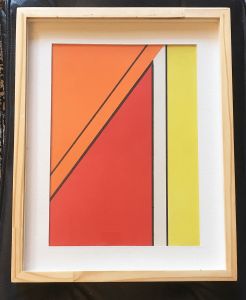
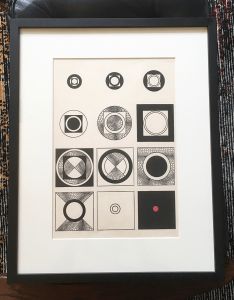
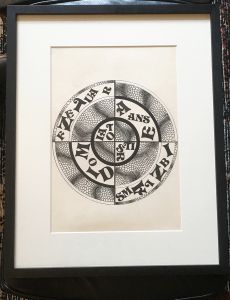
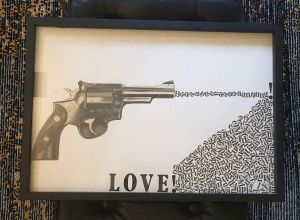
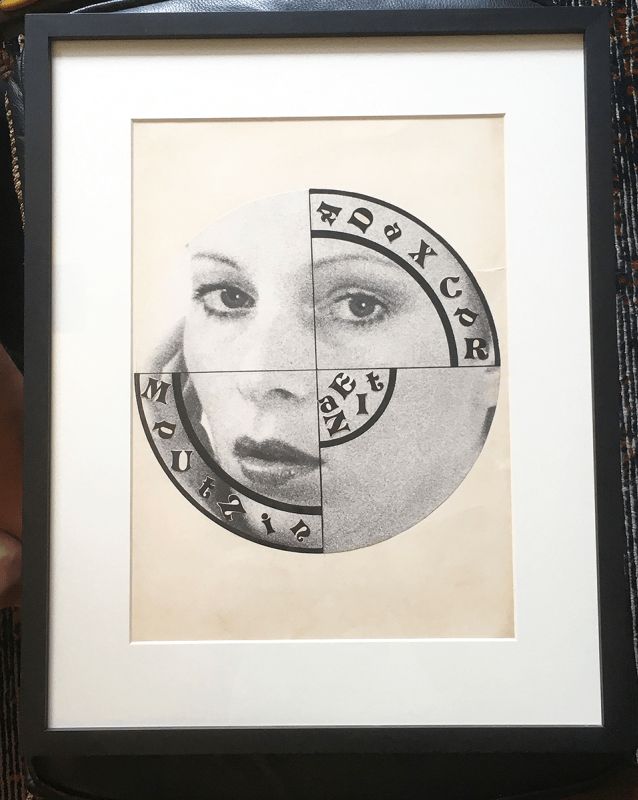
Falves Silva, sem título, 1977, colagem e Letraset sobre papel, 32 x 23 cm.
Falves Silva
Categoria: Poema Processo
Acervo: 00348
Data: 1977
Dimensões: 32 x 23
Falves Silva, sem título, 1977, colagem e Letraset sobre papel, 32 x 23 cm. Obra de poesia visual e arte experimental brasileira que combina apropriação fotográfica, estrutura circular, divisão geométrica e caracteres tipográficos. A composição utiliza o fragmento fotográfico de um rosto feminino como núcleo visual, reorganizado por círculos concêntricos, quadrantes e segmentos que interrompem a continuidade da imagem.
O rosto é inserido em uma estrutura circular cortada por eixos vertical e horizontal. A divisão transforma olhos, boca e demais partes da face em unidades independentes e produz uma imagem simultaneamente reconhecível e fragmentada. Sobre os anéis circulares aparecem letras de diferentes formas e orientações, aplicadas por Letraset e organizadas como componentes visuais da composição. Algumas sequências permanecem de leitura ambígua devido à tipografia ornamental, à rotação dos caracteres e à fragmentação estrutural.
A obra articula fotografia e linguagem gráfica em um sistema no qual palavra, letra, imagem e geometria possuem funções equivalentes. O percurso de leitura deixa de ser linear e passa a acompanhar as curvas, divisões e mudanças de direção determinadas pela estrutura circular. A fragmentação do rosto reforça questões relacionadas a identidade, percepção, representação, comunicação e decomposição da imagem.
Realizada em 1977, a obra se insere nas pesquisas de Falves Silva relacionadas ao Poema Processo, à poesia visual brasileira, à colagem, à experimentação tipográfica e à semiótica visual. A utilização de Letraset permite transformar a escrita em elemento plástico, enquanto a fotografia apropriada é submetida a uma reorganização geométrica que modifica seu significado original.
O trabalho constitui um importante documento da arte experimental brasileira da década de 1970 e evidencia procedimentos associados à integração entre poesia visual, fotografia, colagem, comunicação gráfica, arte conceitual, linguagem não linear e investigação das relações entre palavra e imagem.
SALSA TEXT ENGLISH
Falves Silva, untitled, 1977, collage and Letraset on paper, 32 x 23 cm. A work of Brazilian visual poetry and experimental art combining appropriated photography, circular structure, geometric division and typographic characters. The composition uses a photographic fragment of a female face as its visual nucleus, reorganized through concentric circles, quadrants and segments that interrupt the continuity of the image.
The face is inserted into a circular structure intersected by vertical and horizontal axes. This division transforms the eyes, mouth and other facial features into independent units, producing an image that is simultaneously recognizable and fragmented. Different letterforms appear along the circular rings, applied with Letraset and organized as visual components of the composition. Some sequences remain difficult to read because of the ornamental typography, rotation of characters and structural fragmentation.
The work combines photography and graphic language within a system in which word, letter, image and geometry perform equivalent functions. Reading no longer follows a linear path and instead moves through curves, divisions and changes of direction established by the circular structure. The fragmentation of the face reinforces questions related to identity, perception, representation, communication and the decomposition of the image.
Produced in 1977, the work belongs to Falves Silva's investigations related to Poema Processo, Brazilian visual poetry, collage, typographic experimentation and visual semiotics. The use of Letraset transforms writing into a plastic element, while the appropriated photograph is subjected to a geometric reorganization that alters its original meaning.
The work is an important document of Brazilian experimental art of the 1970s and demonstrates procedures associated with the integration of visual poetry, photography, collage, graphic communication, conceptual art, nonlinear language and investigations into the relationship between word and image.
TEXTO DE OBSERVAÇÃO PORTUGUÊS
Obra original de Falves Silva realizada em 1977, em colagem e Letraset sobre papel, medindo 32 x 23 cm. A imagem analisada não apresenta título visível. A composição tem como elemento central uma fotografia em preto e branco de rosto feminino, recortada e reorganizada dentro de uma estrutura circular.
O círculo principal é dividido por linhas vertical e horizontal, formando quatro setores. Outros segmentos circulares criam anéis internos e externos, produzindo uma composição semelhante a um sistema de coordenadas ou mecanismo gráfico de leitura. A fotografia ultrapassa parcialmente essas divisões, mas também é interrompida por elas, provocando deslocamentos entre as diferentes partes do rosto.
Os olhos ocupam a parte superior da estrutura e permanecem relativamente alinhados, enquanto a boca aparece no setor inferior esquerdo. O setor inferior direito apresenta principalmente textura fotográfica sem um elemento facial claramente definido. Essa distribuição fragmenta a unidade do retrato e transforma a fotografia em matéria estrutural.
Caracteres tipográficos ornamentais são aplicados ao longo dos anéis circulares. Algumas letras são claramente identificáveis isoladamente, mas a leitura integral das sequências não pode ser confirmada com segurança a partir da reprodução disponível. As rotações, a tipografia decorativa e a divisão da composição dificultam uma transcrição literal. Por esse motivo, esses caracteres devem ser compreendidos prioritariamente como componentes visuais da obra até que uma fotografia de maior resolução ou documentação do artista permita confirmar as palavras.
A utilização de Letraset é essencial para a construção visual do trabalho. O sistema de letras transferíveis possibilita ao artista variar orientação, posição, escala e sequência dos caracteres, integrando tipografia e imagem fotográfica em uma mesma estrutura.
A composição trabalha intensamente com relações entre círculo, corpo, rosto, fragmento e signo. A divisão geométrica interfere diretamente na identidade visual do retrato, sugerindo possíveis reflexões sobre percepção, decomposição, reconstrução, identidade e comunicação. Essas interpretações devem ser consideradas leituras formais e não significados documentais atribuídos pelo artista.
O procedimento de fragmentar uma imagem figurativa e transformá la em sistema gráfico se relaciona de maneira significativa às experiências do Poema Processo. Em vez de separar texto e imagem, Falves Silva constrói uma organização em que ambos integram uma única estrutura informacional. A obra pode ser compreendida dentro das pesquisas brasileiras sobre poesia visual, linguagem não verbal, semiótica, colagem, fotografia experimental e comunicação visual.
Documento relevante para pesquisa e indexação sobre Falves Silva, 1977, colagem, Letraset, Poema Processo, poesia visual brasileira, arte experimental brasileira, fotografia e poesia visual, colagem fotográfica, tipografia experimental, semiótica visual, comunicação gráfica, rosto feminino, fragmentação da imagem, palavra e imagem, linguagem não linear, arte conceitual e produção artística brasileira da década de 1970.
OBSERVATION TEXT ENGLISH
Original work by Falves Silva produced in 1977 in collage and Letraset on paper, measuring 32 x 23 cm. The analyzed image does not display a visible title. The composition is centered on a black and white photograph of a female face, cut and reorganized within a circular structure.
The principal circle is divided by vertical and horizontal lines into four sectors. Additional circular segments create inner and outer rings, producing a composition that resembles a coordinate system or graphic reading mechanism. The photograph partially crosses these divisions but is also interrupted by them, creating displacements between different parts of the face.
The eyes occupy the upper portion of the structure and remain relatively aligned, while the mouth appears in the lower left sector. The lower right sector mainly contains photographic texture without a clearly defined facial feature. This arrangement breaks the unity of the portrait and transforms photography into structural material.
Ornamental typographic characters are applied along the circular rings. Several individual letters can be recognized, but the complete sequences cannot be transcribed with certainty from the available reproduction. Rotations, decorative letterforms and the structural divisions make literal reading difficult. For this reason, the characters should primarily be understood as visual components until a higher resolution image or documentary information from the artist makes it possible to confirm the words.
The use of Letraset is essential to the visual construction of the work. Transferable lettering allows the artist to vary orientation, position, scale and sequence, integrating typography and photographic imagery within a single structure.
The composition develops relationships between circle, body, face, fragment and sign. The geometric divisions directly interfere with the visual identity of the portrait, suggesting possible reflections on perception, decomposition, reconstruction, identity and communication. These interpretations should be understood as formal readings rather than documented meanings assigned by the artist.
The procedure of fragmenting a figurative image and transforming it into a graphic system is significantly related to the experiments of Poema Processo. Rather than separating text and image, Falves Silva creates an organization in which both become part of a single informational structure. The work can be understood within Brazilian investigations into visual poetry, nonverbal language, semiotics, collage, experimental photography and visual communication.
An important document for research and indexing related to Falves Silva, 1977, collage, Letraset, Poema Processo, Brazilian visual poetry, Brazilian experimental art, photography and visual poetry, photographic collage, experimental typography, visual semiotics, graphic communication, female face, image fragmentation, word and image relationships, nonlinear language, conceptual art and Brazilian artistic production of the 1970s.