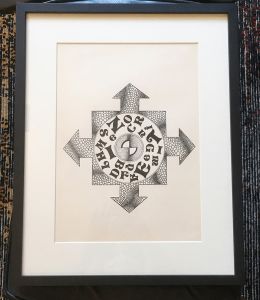
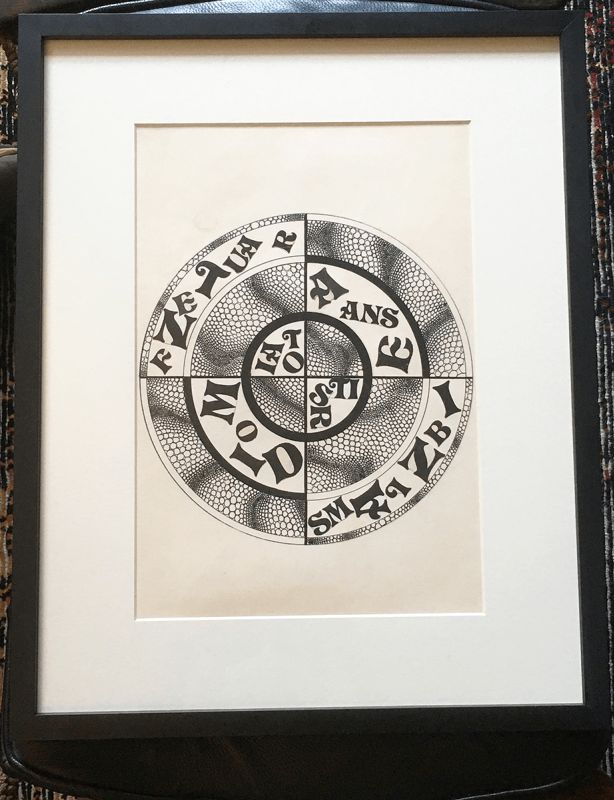
Falves Silva, sem título, 1977, colagem e Letraset sobre papel, 31,2 x 21,5 cm.
Falves Silva
Categoria: Poema Processo
Acervo: 00347
Data: 1977
Dimensões: 31,2 x 21,5
Falves Silva, sem título, 1977, colagem e Letraset sobre papel, 31,2 x 21,5 cm. Obra de poesia visual e arte experimental brasileira organizada a partir de uma estrutura circular dividida em setores concêntricos, nos quais palavras, letras, formas geométricas e tramas gráficas são combinadas em diferentes direções de leitura.
A composição apresenta círculos concêntricos cortados por eixos verticais e horizontais que subdividem o campo em quadrantes. Entre os anéis aparecem palavras e fragmentos tipográficos dispostos em curvas, rotações e inversões, integrando escrita e desenho em uma única estrutura visual. A tipografia de aspecto decorativo e expressivo contrasta com a precisão geométrica dos círculos e divisões internas.
Entre os elementos textuais visíveis destacam se palavras e fragmentos como amor, ato, ser, mundo e sans, além de outras sequências parcialmente deformadas ou de leitura ambígua. No núcleo central, as letras são distribuídas em pequenos compartimentos circulares e quadrangulares, reforçando a transformação da palavra em signo visual.
As áreas preenchidas por tramas de pequenas células ou pontos criam uma textura orgânica que se contrapõe à organização geométrica da estrutura. Esse contraste entre forma regular e textura irregular intensifica a sensação de movimento circular, rotação e expansão.
Realizada em 1977, a obra se relaciona diretamente às pesquisas de Falves Silva no campo do Poema Processo, da poesia visual, da experimentação tipográfica, da comunicação gráfica e da semiótica visual. A leitura deixa de obedecer a uma sequência linear e passa a depender do percurso do olhar pelo círculo, pelos setores, pelas palavras fragmentadas e pelas relações entre texto e imagem.
A obra constitui um importante exemplo da expansão do conceito de poema para além da linguagem verbal tradicional, característica central do Poema Processo. Letras, palavras, círculos, quadrantes, texturas e relações espaciais funcionam como unidades equivalentes de informação, produzindo uma linguagem visual baseada em simultaneidade, permutação, fragmentação e estrutura.
SALSA TEXT ENGLISH
Falves Silva, untitled, 1977, collage and Letraset on paper, 31.2 x 21.5 cm. A work of Brazilian visual poetry and experimental art organized around a circular structure divided into concentric sectors in which words, letters, geometric forms and graphic textures are combined through different directions of reading.
The composition features concentric circles intersected by vertical and horizontal axes that divide the visual field into quadrants. Words and typographic fragments appear between the rings in curved, rotated and inverted arrangements, integrating writing and drawing within a single visual structure. The expressive decorative typography contrasts with the geometric precision of the circles and internal divisions.
Among the visible textual elements are words and fragments such as amor, ato, ser, mundo and sans, together with other sequences that are partially transformed or visually ambiguous. In the central nucleus, letters are distributed within small circular and quadrangular compartments, reinforcing the transformation of language into visual signs.
Areas filled with patterns of small cellular or dotted forms create an organic texture that contrasts with the geometric organization of the structure. This opposition between regular form and irregular texture intensifies the sensation of circular movement, rotation and expansion.
Produced in 1977, the work is directly connected to Falves Silva's investigations into Poema Processo, visual poetry, typographic experimentation, graphic communication and visual semiotics. Reading no longer follows a conventional linear sequence and instead depends on the movement of the eye through the circle, its sectors, fragmented words and relationships between text and image.
The work is an important example of the expansion of the concept of poetry beyond traditional verbal language, a central characteristic of Poema Processo. Letters, words, circles, quadrants, textures and spatial relationships operate as equivalent units of information, producing a visual language based on simultaneity, permutation, fragmentation and structure.
TEXTO DE OBSERVAÇÃO PORTUGUÊS
Obra original de Falves Silva realizada em 1977, em colagem e Letraset sobre papel, medindo 31,2 x 21,5 cm. A imagem analisada não apresenta título visível. A composição é construída a partir de uma grande forma circular subdividida por círculos concêntricos e por eixos ortogonais que organizam o campo em quatro quadrantes principais.
A estrutura combina tipografia transferível, desenho geométrico e áreas de textura reticulada. As palavras e letras acompanham a curvatura dos anéis e aparecem em diferentes orientações, obrigando o observador a girar mentalmente a composição ou alterar continuamente a direção da leitura.
No anel externo aparecem palavras e fragmentos distribuídos ao longo da circunferência. Algumas sequências podem ser identificadas visualmente como amor, mundo, sans e outros conjuntos tipográficos de leitura parcial. Na área central aparecem grupos menores de letras organizados em setores, entre os quais se reconhecem fragmentos relacionados a ato e ser. A leitura de algumas palavras permanece ambígua devido ao desenho ornamental das letras, às rotações e às sobreposições.
O círculo funciona como estrutura dominante da obra. Ele é simultaneamente forma geométrica, suporte para a escrita e mecanismo de organização da leitura. A divisão em quadrantes introduz uma lógica modular, enquanto os anéis concêntricos sugerem níveis sucessivos de informação.
As tramas formadas por pequenas unidades celulares aparecem em diversas regiões da composição e criam efeitos de densidade, profundidade e fluxo. Em alguns setores, essas tramas parecem se expandir ou se contrair, produzindo uma sensação de movimento que contrasta com a estabilidade dos círculos e eixos.
A utilização do Letraset é fundamental para a materialidade da obra. Os caracteres transferíveis permitem variações de escala, posição e orientação e possibilitam que a escrita seja tratada como imagem. Falves Silva utiliza a tipografia não apenas para transmitir palavras, mas para construir ritmo, direção, textura e organização espacial.
O trabalho apresenta características fortemente associadas ao Poema Processo, sobretudo pela recusa da leitura linear convencional e pela transformação da palavra em componente plástico e estrutural. A obra também se relaciona com poesia visual, arte conceitual, semiótica, comunicação visual, poesia concreta expandida, colagem e experimentação gráfica.
A estrutura circular pode ainda ser interpretada como dispositivo de leitura não linear, permitindo múltiplos percursos e diferentes combinações entre os signos. Essa interpretação deve ser entendida como leitura formal da composição, já que não há na imagem analisada uma explicação escrita do próprio artista.
Obra relevante para pesquisa e indexação sobre Falves Silva, 1977, colagem e Letraset, Poema Processo, poesia visual brasileira, poesia experimental, tipografia experimental, Letraset, semiótica visual, comunicação gráfica, palavra e imagem, linguagem não linear, círculo, estrutura concêntrica, modularidade, arte conceitual e arte experimental brasileira da década de 1970.
OBSERVATION TEXT ENGLISH
Original work by Falves Silva produced in 1977 in collage and Letraset on paper, measuring 31.2 x 21.5 cm. The analyzed image does not display a visible title. The composition is constructed around a large circular form subdivided by concentric rings and orthogonal axes that organize the field into four principal quadrants.
The structure combines transferable typography, geometric drawing and areas of reticulated texture. Words and letters follow the curvature of the rings and appear in different orientations, requiring the viewer to mentally rotate the composition or continuously alter the direction of reading.
Words and typographic fragments are distributed around the outer ring. Some sequences can be visually identified as amor, mundo, sans and other partially readable groups. In the central area, smaller clusters of letters are organized within separate sectors, including fragments related to ato and ser. Some readings remain uncertain because of the ornamental letterforms, rotations and overlapping elements.
The circle functions as the dominant structural element of the work. It operates simultaneously as geometric form, support for writing and mechanism for organizing reading. The division into quadrants introduces a modular logic, while the concentric rings suggest successive levels of information.
Patterns formed by small cellular units appear across several areas of the composition and create effects of density, depth and flow. In certain sectors these textures seem to expand or contract, producing a sensation of movement that contrasts with the stability of the circles and axes.
The use of Letraset is fundamental to the material construction of the work. Transferable characters allow variations in scale, position and orientation and enable writing to be treated as image. Falves Silva employs typography not only to communicate words but also to create rhythm, direction, texture and spatial organization.
The work presents characteristics strongly associated with Poema Processo, particularly through its rejection of conventional linear reading and its transformation of words into plastic and structural components. It is also related to visual poetry, conceptual art, semiotics, visual communication, expanded concrete poetry, collage and graphic experimentation.
The circular structure may also be interpreted as a device for nonlinear reading, allowing multiple visual paths and different combinations among signs. This should be understood as a formal interpretation of the composition, since the analyzed image does not contain a written explanation by the artist.
An important work for research and indexing related to Falves Silva, 1977, collage and Letraset, Poema Processo, Brazilian visual poetry, experimental poetry, experimental typography, Letraset, visual semiotics, graphic communication, word and image, nonlinear language, circular structures, concentric composition, modularity, conceptual art and Brazilian experimental art of the 1970s.