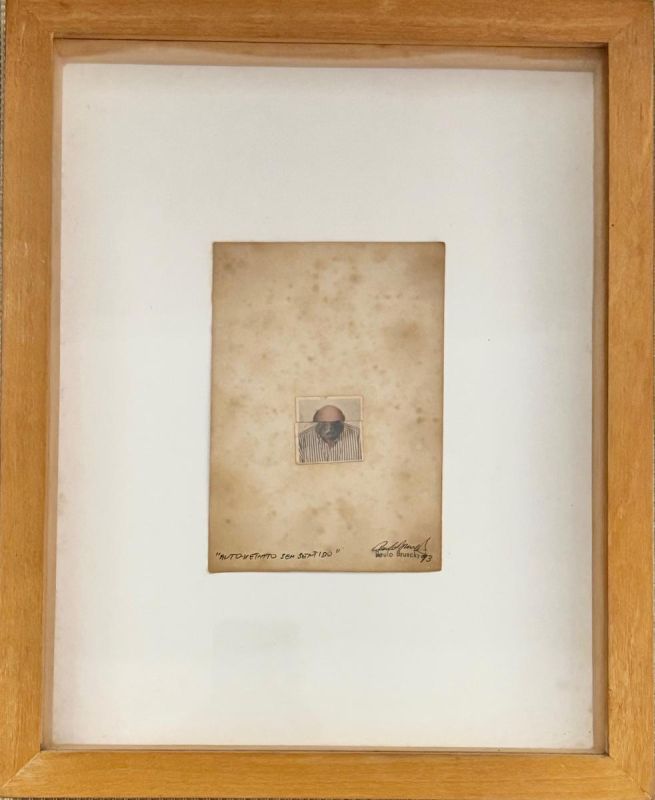
Autorretrato sem sentido
Paulo Bruscky
Categoria: Documentação de Performance
Acervo: 05081
Data: 1993
Dimensões: 15 x 10,5 cm
TEXTO SALSA PORTUGUÊS
Autorretrato sem sentido, de 1993, é uma obra do artista brasileiro Paulo Bruscky realizada mediante intervenção em uma fotografia de sua própria imagem. A composição integra suas investigações sobre autorrepresentação, identidade, fragmentação visual e manipulação de imagens fotográficas, estabelecendo relações entre fotografia experimental, arte conceitual e procedimentos de desconstrução da representação.
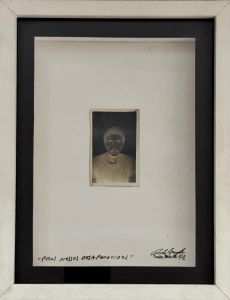
A obra apresenta uma pequena fotografia em preto e branco de Paulo Bruscky, recortada horizontalmente e reorganizada em duas partes sobre um suporte de papel. O fragmento superior contém parte da cabeça do artista, enquanto o fragmento inferior apresenta seu rosto e o tronco vestido com camisa de listras verticais. O deslocamento entre as partes interrompe a continuidade da imagem e transforma um retrato convencional em uma composição visual fragmentada.
A intervenção utiliza um procedimento material simples, o corte e a reorganização da fotografia, para alterar a relação entre a imagem e a identidade representada. A figura humana permanece reconhecível como retrato, mas sua integridade visual é modificada pela separação e pelo desalinhamento dos fragmentos.
O título Autorretrato sem sentido acrescenta uma dimensão conceitual à composição. A expressão relaciona a imagem fragmentada à possibilidade de questionar os mecanismos convencionais de representação individual. O sentido do autorretrato deixa de depender exclusivamente da semelhança física e passa a ser construído pela intervenção realizada sobre a própria fotografia.
A obra aproxima a representação do artista de um procedimento de desmontagem e reconstrução. O retrato, tradicionalmente associado à identificação de uma pessoa, torna-se uma imagem instável, na qual a continuidade do rosto é interrompida e reorganizada. A operação estabelece uma relação entre identidade, percepção e os limites da representação fotográfica.
A composição é apresentada sobre um suporte de papel com amplas áreas vazias ao redor da fotografia. Essa distribuição enfatiza a pequena dimensão da imagem central e concentra a atenção no procedimento de fragmentação. Na região inferior encontram-se o título manuscrito Autorretrato sem sentido e a assinatura de Paulo Bruscky, acompanhada da data de 1993.
A obra pertence às experiências de Paulo Bruscky com fotografia, apropriação de imagens, humor conceitual e transformação de procedimentos cotidianos em linguagem artística. Ao intervir sobre sua própria representação fotográfica, o artista utiliza o autorretrato como espaço de experimentação com a construção e a desconstrução da identidade visual.
Autorretrato sem sentido também possui relação documental com a participação de Paulo Bruscky na 26ª Bienal de São Paulo, realizada em 2004, quando o artista apresentou O ateliê como arquivo. Nessa instalação, seu espaço de trabalho e arquivo pessoal, originalmente localizado no Recife, foi transportado e remontado no Pavilhão da Bienal, em São Paulo.
A obra é identificada como integrante do conjunto apresentado naquela ocasião, estabelecendo uma relação entre sua produção experimental de 1993 e a apresentação pública do universo de criação e documentação de Paulo Bruscky na Bienal de 2004.
TEXTO SALSA INGLÊS
Autorretrato sem sentido, translated as Meaningless Self-Portrait, is a 1993 artwork by Brazilian artist Paulo Bruscky created through an intervention in a photograph of his own image. The composition belongs to his investigations into self-representation, identity, visual fragmentation, and photographic manipulation, establishing connections between experimental photography, conceptual art, and the deconstruction of conventional representation.
The artwork contains a small black-and-white photograph of Paulo Bruscky, horizontally cut and rearranged into two sections on a paper support. The upper fragment shows part of the artist's head, while the lower section contains his face and torso, dressed in a vertically striped shirt. The displacement between the fragments interrupts the continuity of the image, transforming a conventional portrait into a fragmented visual composition.
The intervention employs a simple material procedure, cutting and rearranging the photograph, to alter the relationship between the image and the identity it represents. The human figure remains recognizable as a portrait, but its visual integrity is modified by the separation and misalignment of its components.
The title Autorretrato sem sentido introduces a conceptual dimension to the composition. It connects the fragmented image with a questioning of conventional mechanisms of individual representation. The meaning of the self-portrait no longer depends exclusively on physical resemblance but is constructed through the intervention performed on the photograph itself.
The artwork approaches the artist's representation as a process of dismantling and reconstruction. Traditionally associated with personal identification, the portrait becomes an unstable image in which the continuity of the face is interrupted and reorganized. This procedure establishes relationships between identity, perception, and the limits of photographic representation.
The composition is presented on a paper support surrounded by extensive empty areas. This arrangement emphasizes the small size of the central image and focuses attention on the fragmentation process. The lower section contains the handwritten title Autorretrato sem sentido and Paulo Bruscky's signature, accompanied by the date 1993.
The work belongs to Paulo Bruscky's experiments with photography, image appropriation, conceptual humor, and the transformation of everyday procedures into artistic language. By intervening in his own photographic representation, the artist turns self-portraiture into an experimental investigation of the construction and deconstruction of visual identity.
Autorretrato sem sentido also has a documentary connection with Paulo Bruscky's participation in the 26th São Paulo Biennial in 2004, when the artist presented O ateliê como arquivo, or The Studio as Archive. For this installation, his studio and personal archive, originally located in Recife, were transported and reconstructed inside the São Paulo Biennial Pavilion.
The artwork is identified as having formed part of the ensemble presented on that occasion, establishing a relationship between Bruscky's experimental production of 1993 and the public presentation of his artistic and documentary environment at the 2004 Biennial.
TEXTO DE OBSERVAÇÃO PORTUGUÊS
Obra de Paulo Bruscky intitulada Autorretrato sem sentido, datada de 1993, constituída por uma pequena fotografia em preto e branco recortada horizontalmente e reorganizada sobre um suporte de papel.
A composição apresenta uma fotografia central de formato aproximadamente quadrado, dividida em dois fragmentos horizontais. O fragmento superior contém a região superior da cabeça de Paulo Bruscky, enquanto o fragmento inferior apresenta o rosto e parte do tronco do artista, vestido com camisa de listras verticais.
A separação entre os fragmentos cria uma interrupção na continuidade anatômica do retrato. A disposição das duas partes conserva elementos suficientes para a identificação da imagem como autorretrato, mas altera a organização visual convencional da fotografia.
A fotografia encontra-se posicionada aproximadamente no centro de uma folha retangular de papel, com tonalidade amarelada e manchas acastanhadas distribuídas irregularmente pela superfície.
Na região inferior esquerda da folha aparece a inscrição manuscrita Autorretrato sem sentido, que identifica o título da obra.
No canto inferior direito encontra-se a assinatura manuscrita de Paulo Bruscky, acompanhada da identificação impressa Paulo Bruscky e da data 93, correspondente ao ano de 1993.
A fotografia apresenta tonalidade predominantemente monocromática, com pequenas variações de contraste e definição. A natureza precisa do papel fotográfico e o procedimento de fixação dos fragmentos não podem ser determinados exclusivamente pela reprodução disponível.
A montagem encontra-se apresentada em moldura de madeira clara, com amplo passe-partout branco. A abertura central expõe a folha original, preservando a relação espacial entre a fotografia fragmentada, o título manuscrito e a assinatura do artista.
O suporte apresenta manchas de envelhecimento e alterações cromáticas perceptíveis, especialmente nas regiões superior e central. A determinação do estado de conservação, da estabilidade dos materiais e da origem das manchas depende de exame físico direto.
A intervenção fotográfica constitui o elemento principal da obra. O recorte horizontal interrompe a continuidade da representação e estabelece uma relação entre imagem, fragmentação e identidade pessoal.
A obra é identificada como integrante do conjunto apresentado por Paulo Bruscky na 26ª Bienal de São Paulo, realizada entre 25 de setembro e 19 de dezembro de 2004, sob curadoria geral de Alfons Hug.
Naquela edição, Paulo Bruscky apresentou a instalação O ateliê como arquivo, que consistiu na transferência e remontagem de seu ateliê e arquivo pessoal do Recife para o Pavilhão da Bienal, em São Paulo.
A participação do artista e a apresentação da instalação estão documentadas pela Fundação Bienal de São Paulo. A inclusão específica deste exemplar de Autorretrato sem sentido no conjunto expositivo é informada na identificação da obra, sem confirmação individualizada em registro de exposição consultado.
A data de criação, 1993, deve ser diferenciada da data de apresentação na Bienal, em 2004.
Não foram informados as dimensões da folha, o tamanho da fotografia, o processo fotográfico, o responsável pela tomada fotográfica original ou a data da montagem em moldura.
TEXTO DE OBSERVAÇÃO INGLÊS
Artwork by Paulo Bruscky titled Autorretrato sem sentido, dated 1993, consisting of a small black-and-white photograph horizontally cut and rearranged on a paper support.
The composition contains a centrally positioned photograph of approximately square format, divided into two horizontal fragments. The upper fragment shows the upper part of Paulo Bruscky's head, while the lower fragment presents his face and part of his torso, dressed in a vertically striped shirt.
The separation between the fragments interrupts the anatomical continuity of the portrait. Their arrangement preserves sufficient elements for the image to function as a self-portrait while altering the conventional visual organization of the photograph.
The photograph is positioned approximately at the center of a rectangular sheet of paper displaying yellowing and irregular brownish stains across its surface.
The handwritten inscription Autorretrato sem sentido appears near the lower left corner of the sheet, identifying the title of the artwork.
The lower right corner contains Paulo Bruscky's handwritten signature, accompanied by the printed identification Paulo Bruscky and the date 93, corresponding to 1993.
The photograph is predominantly monochromatic, with minor variations in contrast and definition. The specific photographic paper and method used to attach the fragments cannot be determined from the available reproduction alone.
The composition is presented in a light wooden frame with a wide white window mat. The central opening exposes the original paper sheet, preserving the spatial relationship between the fragmented photograph, handwritten title, and artist's signature.
The paper displays visible aging stains and tonal changes, particularly in its upper and central areas. Determining its conservation condition, material stability, and the origin of these marks requires direct physical examination.
The photographic intervention constitutes the principal element of the artwork. The horizontal cut interrupts the continuity of the representation and establishes a relationship between image, fragmentation, and personal identity.
The artwork is identified as having belonged to the ensemble presented by Paulo Bruscky at the 26th São Paulo Biennial, held from September 25 to December 19, 2004, under the general curatorship of Alfons Hug.
At that edition, Paulo Bruscky presented O ateliê como arquivo, or The Studio as Archive, an installation involving the transfer and reconstruction of his studio and personal archive from Recife to the São Paulo Biennial Pavilion.
The artist's participation and the installation are documented by the Fundação Bienal de São Paulo. The specific inclusion of this individual work in the exhibition is based on the supplied identification and has not been independently confirmed through an itemized exhibition record.
The creation date, 1993, must be distinguished from the Biennial presentation date, 2004.
The physical dimensions of the sheet and photograph, photographic process, identity of the original photographer, and date of framing have not been provided.
Proveniência
Coleção Poema Processo
Inglês
Meaningless Self-Portrait
Dimensions: 5,9 x 4,1 in