Balaio Incomun, Folha Porreta, número 1080, Ano XII, Rio de Janeiro, setembro de 1998
Moacy Cirne
Categoria: Categoria: Publicação seriadaSubcategoria: Boletim experimentalClassificação complementar: Poesia visual; Documento editorial; Arte conceitual; Documento de rede
Acervo: 04391
Data: Setembro de 1998
Dimensões: 33 x 21,5 cm
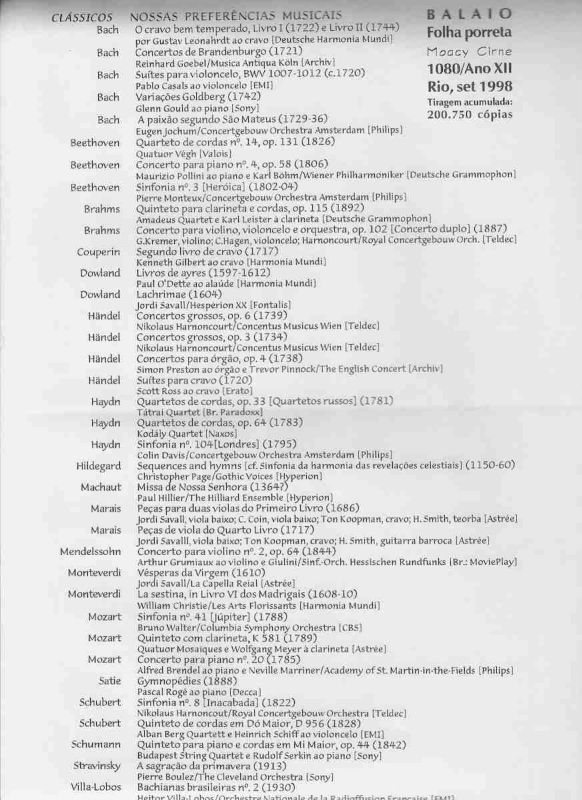
TEXTO SALSA EM PORTUGUÊSBalaio Incomun, Folha Porreta, número 1080, Ano XII, Rio de Janeiro, setembro de 1998, publicação de Moacy Cirne, com tiragem acumulada indicada de 200.750 cópias. O exemplar apresenta a seleção Clássicos, Nossas Preferências Musicais, um inventário de obras e interpretações de música erudita escolhidas por Cirne. A página funciona como discografia comentada e como documento de suas preferências musicais, reunindo repertório medieval, renascentista, barroco, clássico, romântico e moderno, além de compositores europeus e brasileiros. A seleção registra não apenas as composições, mas também intérpretes, maestros, conjuntos, orquestras e selos fonográficos, permitindo reconstruir o universo de escuta musical de Moacy Cirne no final da década de 1990.Johann Sebastian Bach ocupa posição central na seleção. Cirne indica O Cravo Bem Temperado, Livros I e II, interpretado por Gustav Leonhardt ao cravo, em gravação da Deutsche Harmonia Mundi. Também aparecem os Concertos de Brandemburgo com Reinhard Goebel e Musica Antiqua Köln, as Suítes para Violoncelo BWV 1007 a 1012 com Pablo Casals, as Variações Goldberg com Glenn Gould ao piano e A Paixão Segundo São Mateus com Eugen Jochum e a Concertgebouw Orchestra Amsterdam. As escolhas aproximam interpretações historicamente orientadas de leituras consagradas do repertório bachiano.Ludwig van Beethoven aparece com o Quarteto de Cordas número 14, opus 131, interpretado pelo Quarteto Végh, com o Concerto para Piano número 4, opus 58, com Maurizio Pollini, Karl Böhm e Wiener Philharmoniker, e com a Sinfonia número 3, Heroica, regida por Pierre Monteux com a Concertgebouw Orchestra Amsterdam. Johannes Brahms é representado pelo Quinteto para Clarineta e Cordas, opus 115, com Amadeus Quartet e Karl Leister, e pelo Concerto Duplo para violino, violoncelo e orquestra, opus 102, com Gidon Kremer, Clemens Hagen, Nikolaus Harnoncourt e Royal Concertgebouw Orchestra.François Couperin aparece com o Segundo Livro de Cravo, interpretado por Kenneth Gilbert. John Dowland está representado pelos Livros de Ayres com Paul O Dette ao alaúde e por Lachrimae com Jordi Savall e Hespèrion XX. Georg Friedrich Händel aparece com os Concertos Grossos opus 6 e opus 3, interpretados por Nikolaus Harnoncourt e Concentus Musicus Wien, os Concertos para Órgão opus 4 com Simon Preston, Trevor Pinnock e The English Concert, e as Suítes para Cravo com Scott Ross.Joseph Haydn é lembrado pelos Quartetos de Cordas opus 33, conhecidos como Quartetos Russos, pelos Quartetos de Cordas opus 64 e pela Sinfonia número 104, Londres, interpretada por Colin Davis e Concertgebouw Orchestra Amsterdam. A música medieval aparece com Hildegard von Bingen, por meio de Sequences and Hymns, associada à Sinfonia da Harmonia das Revelações Celestiais, com Christopher Page e Gothic Voices. Guillaume de Machaut está presente com a Missa de Nossa Senhora, interpretada por Paul Hillier e The Hilliard Ensemble.Marin Marais aparece com peças para violas dos seus livros, interpretadas por Jordi Savall, Christophe Coin, Ton Koopman e Hopkinson Smith. Felix Mendelssohn é representado pelo Concerto para Violino número 2, opus 64, com Arthur Grumiaux. Claudio Monteverdi aparece com Vésperas da Virgem, de 1610, com Jordi Savall e La Capella Reial, e com La Sestina, do Livro VI dos Madrigais, interpretada por William Christie e Les Arts Florissants.Wolfgang Amadeus Mozart está representado pela Sinfonia número 41, Júpiter, com Bruno Walter e Columbia Symphony Orchestra, pelo Quinteto com Clarineta K 581, interpretado pelo Quatuor Mosaïques e Wolfgang Meyer, e pelo Concerto para Piano número 20, com Alfred Brendel e Neville Marriner à frente da Academy of St Martin in the Fields. Erik Satie aparece com Gymnopédies, interpretadas por Pascal Rogé.Franz Schubert é representado pela Sinfonia número 8, Inacabada, com Nikolaus Harnoncourt e Royal Concertgebouw Orchestra, e pelo Quinteto de Cordas em Dó Maior D 956, com Alban Berg Quartett e Heinrich Schiff. Robert Schumann aparece com o Quinteto para Piano e Cordas em Mi Maior, opus 44, com Budapest String Quartet e Rudolf Serkin. Igor Stravinsky é lembrado por A Sagração da Primavera, interpretada por Pierre Boulez e The Cleveland Orchestra.A presença brasileira ocorre por meio de Heitor Villa Lobos e das Bachianas Brasileiras número 2, obra de 1930. A inclusão de Villa Lobos ao lado de Bach, Beethoven, Brahms, Monteverdi, Mozart, Schubert e Stravinsky situa a produção musical brasileira dentro do panorama internacional escolhido por Moacy Cirne.Os selos fonográficos registrados incluem Deutsche Harmonia Mundi, Archiv, EMI, Sony, Philips, Deutsche Grammophon, Teldec, Harmonia Mundi, Fontalis, Erato, Naxos, Hyperion, Astrée, CBS e Decca. A atenção aos selos e às interpretações específicas demonstra que Cirne não apresenta apenas um cânone de compositores, mas uma discografia de referência baseada na qualidade das execuções e das gravações.Balaio Incomun número 1080 constitui importante documento para pesquisas sobre Moacy Cirne, Folha Porreta, música clássica, música erudita, história da gravação sonora, discografia, crítica musical, Johann Sebastian Bach, Beethoven, Brahms, Couperin, Dowland, Händel, Haydn, Hildegard von Bingen, Machaut, Marin Marais, Mendelssohn, Monteverdi, Mozart, Satie, Schubert, Schumann, Stravinsky, Villa Lobos, Gustav Leonhardt, Glenn Gould, Pablo Casals, Jordi Savall, Nikolaus Harnoncourt, Maurizio Pollini, Pierre Monteux, Alfred Brendel, Pierre Boulez e cultura musical brasileira dos anos 1990.TEXTO SALSA EM INGLÊSBalaio Incomun, Folha Porreta, issue 1080, Year XII, Rio de Janeiro, September 1998, published by Moacy Cirne, with an accumulated circulation indicated as 200,750 copies. The issue presents Clássicos, Nossas Preferências Musicais, an extensive selection of classical works and recordings chosen by Cirne. The page functions as a discographic inventory and as a document of his musical preferences, bringing together Medieval, Renaissance, Baroque, Classical, Romantic and modern repertoire as well as European and Brazilian composers. The selection records not only compositions but also performers, conductors, ensembles, orchestras and recording labels, making it possible to reconstruct Moacy Cirne's listening universe at the end of the 1990s.Johann Sebastian Bach occupies a central position in the selection. Cirne includes The Well Tempered Clavier, Books I and II, performed by Gustav Leonhardt on harpsichord for Deutsche Harmonia Mundi. Also included are the Brandenburg Concertos with Reinhard Goebel and Musica Antiqua Köln, the Cello Suites BWV 1007 to 1012 with Pablo Casals, the Goldberg Variations with Glenn Gould on piano and the Saint Matthew Passion with Eugen Jochum and the Concertgebouw Orchestra Amsterdam. These choices bring together historically informed performance and major established interpretations of the Bach repertoire.Ludwig van Beethoven is represented by String Quartet number 14, opus 131, performed by the Végh Quartet, Piano Concerto number 4, opus 58, with Maurizio Pollini, Karl Böhm and Wiener Philharmoniker, and Symphony number 3, Eroica, conducted by Pierre Monteux with the Concertgebouw Orchestra Amsterdam. Johannes Brahms appears with the Clarinet Quintet, opus 115, performed by the Amadeus Quartet and Karl Leister, and the Double Concerto for violin, cello and orchestra, opus 102, with Gidon Kremer, Clemens Hagen, Nikolaus Harnoncourt and the Royal Concertgebouw Orchestra.François Couperin appears with the Second Book for Harpsichord performed by Kenneth Gilbert. John Dowland is represented by the Books of Ayres with Paul O Dette on lute and by Lachrimae with Jordi Savall and Hespèrion XX. Georg Friedrich Handel appears with the Concerti Grossi opus 6 and opus 3 performed by Nikolaus Harnoncourt and Concentus Musicus Wien, the Organ Concertos opus 4 with Simon Preston, Trevor Pinnock and The English Concert, and the Harpsichord Suites with Scott Ross.Joseph Haydn is represented by the String Quartets opus 33, known as the Russian Quartets, the String Quartets opus 64 and Symphony number 104, London, performed by Colin Davis and the Concertgebouw Orchestra Amsterdam. Medieval music is represented by Hildegard von Bingen through Sequences and Hymns, associated with the Symphony of the Harmony of Celestial Revelations, performed by Christopher Page and Gothic Voices. Guillaume de Machaut appears with the Mass of Our Lady performed by Paul Hillier and The Hilliard Ensemble.Marin Marais is represented by works for viols from his collections, performed by Jordi Savall, Christophe Coin, Ton Koopman and Hopkinson Smith. Felix Mendelssohn appears with Violin Concerto number 2, opus 64, featuring Arthur Grumiaux. Claudio Monteverdi is represented by the Vespers of the Virgin from 1610 with Jordi Savall and La Capella Reial and by La Sestina from the Sixth Book of Madrigals performed by William Christie and Les Arts Florissants.Wolfgang Amadeus Mozart appears with Symphony number 41, Jupiter, performed by Bruno Walter and the Columbia Symphony Orchestra, the Clarinet Quintet K 581 performed by Quatuor Mosaïques and Wolfgang Meyer and Piano Concerto number 20 with Alfred Brendel and Neville Marriner conducting the Academy of St Martin in the Fields. Erik Satie is represented by Gymnopédies performed by Pascal Rogé.Franz Schubert is represented by Symphony number 8, Unfinished, with Nikolaus Harnoncourt and the Royal Concertgebouw Orchestra and by the String Quintet in C Major D 956 with the Alban Berg Quartett and Heinrich Schiff. Robert Schumann appears with the Piano Quintet in E Flat Major, opus 44, performed by the Budapest String Quartet and Rudolf Serkin. Igor Stravinsky is represented by The Rite of Spring with Pierre Boulez and The Cleveland Orchestra.Brazilian music is represented by Heitor Villa Lobos and Bachianas Brasileiras number 2, composed in 1930. The inclusion of Villa Lobos alongside Bach, Beethoven, Brahms, Monteverdi, Mozart, Schubert and Stravinsky places Brazilian concert music within the international musical panorama selected by Moacy Cirne.Recording labels mentioned include Deutsche Harmonia Mundi, Archiv, EMI, Sony, Philips, Deutsche Grammophon, Teldec, Harmonia Mundi, Fontalis, Erato, Naxos, Hyperion, Astrée, CBS and Decca. Cirne's attention to particular labels and interpretations demonstrates that the page is not simply a canon of composers but a reference discography based on preferred performances and recordings.Balaio Incomun issue 1080 is an important document for research on Moacy Cirne, Folha Porreta, classical music, art music, recording history, discography, music criticism, Johann Sebastian Bach, Beethoven, Brahms, Couperin, Dowland, Handel, Haydn, Hildegard von Bingen, Machaut, Marin Marais, Mendelssohn, Monteverdi, Mozart, Satie, Schubert, Schumann, Stravinsky, Villa Lobos, Gustav Leonhardt, Glenn Gould, Pablo Casals, Jordi Savall, Nikolaus Harnoncourt, Maurizio Pollini, Pierre Monteux, Alfred Brendel, Pierre Boulez and Brazilian musical culture of the 1990s.
TEXTO DE OBSERVAÇÃO EM PORTUGUÊSDocumento original pertencente à série Balaio Incomun, Folha Porreta, de Moacy Cirne, número 1080, Ano XII, datado de setembro de 1998, Rio de Janeiro. A folha informa tiragem acumulada de 200.750 cópias e apresenta o título Clássicos, Nossas Preferências Musicais. Trata se de um inventário de repertório e interpretações musicais selecionadas por Moacy Cirne, permitindo identificar compositores, obras, datas, intérpretes, instrumentos, conjuntos, maestros, orquestras e gravadoras que integravam seu universo musical.A organização da página demonstra especial interesse por Johann Sebastian Bach, representado por O Cravo Bem Temperado, Concertos de Brandemburgo, Suítes para Violoncelo, Variações Goldberg e A Paixão Segundo São Mateus. Os intérpretes associados incluem Gustav Leonhardt, Reinhard Goebel, Musica Antiqua Köln, Pablo Casals, Glenn Gould e Eugen Jochum.Beethoven aparece com o Quarteto de Cordas número 14, o Concerto para Piano número 4 e a Sinfonia número 3 Heroica. São mencionados Quarteto Végh, Maurizio Pollini, Karl Böhm, Wiener Philharmoniker, Pierre Monteux e Concertgebouw Orchestra Amsterdam. Brahms está presente com o Quinteto para Clarineta e Cordas e o Concerto Duplo, com Amadeus Quartet, Karl Leister, Gidon Kremer, Clemens Hagen e Nikolaus Harnoncourt.O repertório antigo e barroco possui presença expressiva. Couperin aparece com Kenneth Gilbert. Dowland é interpretado por Paul O Dette e Jordi Savall. Händel é associado a Nikolaus Harnoncourt, Concentus Musicus Wien, Simon Preston, Trevor Pinnock, The English Concert e Scott Ross. Hildegard von Bingen aparece com Christopher Page e Gothic Voices. Machaut é representado por Paul Hillier e The Hilliard Ensemble. Marin Marais aparece em gravações de Jordi Savall, Christophe Coin, Ton Koopman e Hopkinson Smith. Monteverdi surge com Jordi Savall, La Capella Reial, William Christie e Les Arts Florissants.A seleção clássica e romântica inclui Haydn, Mozart, Mendelssohn, Schubert, Schumann e Brahms. Entre os intérpretes encontram se Colin Davis, Bruno Walter, Alfred Brendel, Neville Marriner, Arthur Grumiaux, Nikolaus Harnoncourt, Alban Berg Quartett, Heinrich Schiff, Budapest String Quartet e Rudolf Serkin. Na música moderna aparecem Erik Satie e Igor Stravinsky, este último representado por A Sagração da Primavera em interpretação de Pierre Boulez e The Cleveland Orchestra.A inclusão de Heitor Villa Lobos, por meio das Bachianas Brasileiras número 2, possui especial significado por inserir um compositor brasileiro no mesmo repertório de referência formado por grandes nomes da tradição musical europeia. O registro demonstra a atenção de Moacy Cirne à música brasileira dentro de uma perspectiva internacional e interdisciplinar da cultura.O documento também possui valor para a história da cultura fonográfica, pois registra selos como Deutsche Harmonia Mundi, Archiv, EMI, Sony, Philips, Deutsche Grammophon, Teldec, Harmonia Mundi, Hyperion, Astrée, Decca, Erato, CBS e Naxos. A escolha de gravações específicas mostra que a preferência de Cirne não se restringia às obras, envolvendo também diferentes concepções interpretativas.A diversidade cronológica vai de Hildegard von Bingen e Machaut à música do século vinte, passando por Dowland, Marais, Couperin, Bach, Händel, Haydn, Mozart, Beethoven, Schubert, Schumann, Brahms, Mendelssohn, Satie, Stravinsky e Villa Lobos. Essa amplitude transforma Balaio Incomun número 1080 em importante fonte para compreender a formação intelectual e musical de Moacy Cirne e seu entendimento da cultura como território de diálogo entre diferentes épocas, linguagens e tradições.O exemplar é relevante para indexação de Moacy Cirne, Balaio Incomun, Folha Porreta, Clássicos, Nossas Preferências Musicais, música clássica, música erudita, discografia, crítica musical, gravações clássicas, Johann Sebastian Bach, Ludwig van Beethoven, Johannes Brahms, François Couperin, John Dowland, Georg Friedrich Händel, Joseph Haydn, Hildegard von Bingen, Guillaume de Machaut, Marin Marais, Felix Mendelssohn, Claudio Monteverdi, Wolfgang Amadeus Mozart, Erik Satie, Franz Schubert, Robert Schumann, Igor Stravinsky, Heitor Villa Lobos, Gustav Leonhardt, Glenn Gould, Pablo Casals, Jordi Savall, Nikolaus Harnoncourt, Pierre Boulez e história cultural brasileira.TEXTO DE OBSERVAÇÃO EM INGLÊSOriginal document from the Balaio Incomun, Folha Porreta series by Moacy Cirne, issue 1080, Year XII, dated September 1998, Rio de Janeiro. The sheet indicates an accumulated circulation of 200,750 copies and carries the title Clássicos, Nossas Preferências Musicais. It is an inventory of musical repertoire and preferred interpretations selected by Moacy Cirne, making it possible to identify composers, works, dates, performers, instruments, ensembles, conductors, orchestras and recording labels that formed part of his musical universe.The organization of the page demonstrates a particular interest in Johann Sebastian Bach, represented by The Well Tempered Clavier, the Brandenburg Concertos, the Cello Suites, the Goldberg Variations and the Saint Matthew Passion. Performers associated with these works include Gustav Leonhardt, Reinhard Goebel, Musica Antiqua Köln, Pablo Casals, Glenn Gould and Eugen Jochum.Beethoven appears with String Quartet number 14, Piano Concerto number 4 and Symphony number 3, Eroica. The page names the Végh Quartet, Maurizio Pollini, Karl Böhm, Wiener Philharmoniker, Pierre Monteux and Concertgebouw Orchestra Amsterdam. Brahms is represented by the Clarinet Quintet and Double Concerto, with the Amadeus Quartet, Karl Leister, Gidon Kremer, Clemens Hagen and Nikolaus Harnoncourt.Early and Baroque music has a substantial presence. Couperin appears with Kenneth Gilbert. Dowland is interpreted by Paul O Dette and Jordi Savall. Handel is associated with Nikolaus Harnoncourt, Concentus Musicus Wien, Simon Preston, Trevor Pinnock, The English Concert and Scott Ross. Hildegard von Bingen appears with Christopher Page and Gothic Voices. Machaut is represented by Paul Hillier and The Hilliard Ensemble. Marin Marais appears in recordings by Jordi Savall, Christophe Coin, Ton Koopman and Hopkinson Smith. Monteverdi is represented by Jordi Savall, La Capella Reial, William Christie and Les Arts Florissants.The Classical and Romantic selection includes Haydn, Mozart, Mendelssohn, Schubert, Schumann and Brahms. Performers include Colin Davis, Bruno Walter, Alfred Brendel, Neville Marriner, Arthur Grumiaux, Nikolaus Harnoncourt, Alban Berg Quartett, Heinrich Schiff, Budapest String Quartet and Rudolf Serkin. Modern music is represented by Erik Satie and Igor Stravinsky, with The Rite of Spring performed by Pierre Boulez and The Cleveland Orchestra.The inclusion of Heitor Villa Lobos through Bachianas Brasileiras number 2 is particularly significant because it places a Brazilian composer within the same reference repertoire as major figures of the European musical tradition. This demonstrates Moacy Cirne's attention to Brazilian music within an international and interdisciplinary conception of culture.The document is also valuable for the history of recorded music because it names labels including Deutsche Harmonia Mundi, Archiv, EMI, Sony, Philips, Deutsche Grammophon, Teldec, Harmonia Mundi, Hyperion, Astrée, Decca, Erato, CBS and Naxos. Cirne's selection of specific recordings demonstrates that his preferences concerned not only musical works but also particular interpretive approaches.The chronological range extends from Hildegard von Bingen and Machaut to twentieth century music, passing through Dowland, Marais, Couperin, Bach, Handel, Haydn, Mozart, Beethoven, Schubert, Schumann, Brahms, Mendelssohn, Satie, Stravinsky and Villa Lobos. This breadth makes Balaio Incomun issue 1080 an important source for understanding Moacy Cirne's intellectual and musical formation and his conception of culture as a territory of dialogue among different periods, languages and traditions.The issue is especially relevant for indexing Moacy Cirne, Balaio Incomun, Folha Porreta, Clássicos, Nossas Preferências Musicais, classical music, art music, discography, music criticism, classical recordings, Johann Sebastian Bach, Ludwig van Beethoven, Johannes Brahms, François Couperin, John Dowland, Georg Friedrich Handel, Joseph Haydn, Hildegard von Bingen, Guillaume de Machaut, Marin Marais, Felix Mendelssohn, Claudio Monteverdi, Wolfgang Amadeus Mozart, Erik Satie, Franz Schubert, Robert Schumann, Igor Stravinsky, Heitor Villa Lobos, Gustav Leonhardt, Glenn Gould, Pablo Casals, Jordi Savall, Nikolaus Harnoncourt, Pierre Boulez and Brazilian cultural history.
Proveniência
Coleção Poema ProcessoInglês
Balaio Incomun, Folha Porreta, issue 1080, Year XII, Rio de Janeiro, September 1998
Dimensions: 13 x 8,5 in