Balaio Incomun, Folha Porreta, número 1067, Ano XII, Rio de Janeiro, 29 de junho de 1998
Moacy Cirne
Categoria: Categoria: Publicação seriadaSubcategoria: Boletim experimentalClassificação complementar: Poesia visual; Documento editorial; Arte conceitual; Documento de rede
Acervo: 04390
Data: 29 de junho de 1998
Dimensões: 33 x 21,5 cm
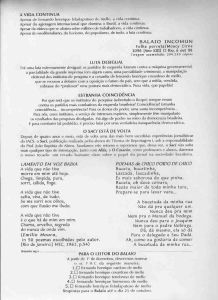
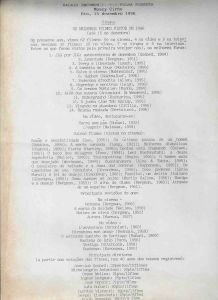
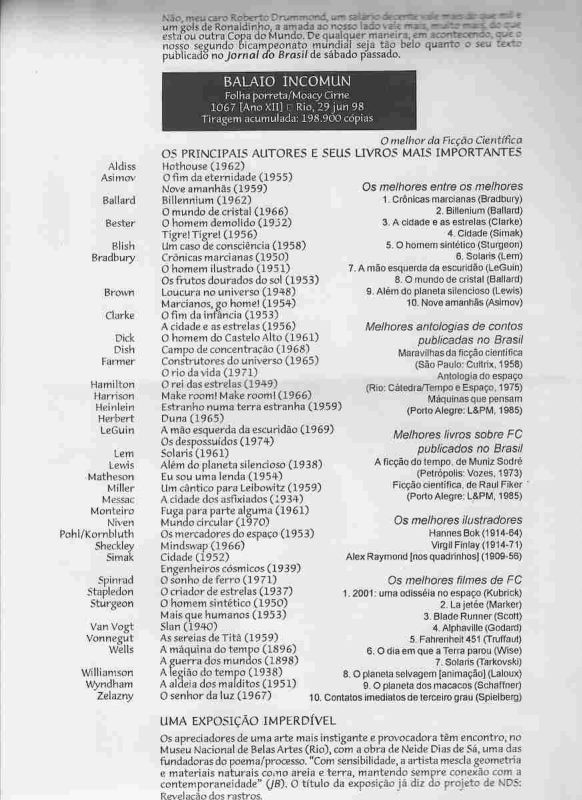
TEXTO SALSA EM PORTUGUÊSBalaio Incomun, Folha Porreta, número 1067, Ano XII, Rio de Janeiro, 29 de junho de 1998, publicação de Moacy Cirne, com tiragem acumulada indicada de 198.900 cópias. O exemplar tem como núcleo principal O melhor da Ficção Científica, reunindo a seção Os Principais Autores e Seus Livros Mais Importantes, uma seleção dos melhores livros do gênero, antologias e estudos publicados no Brasil, ilustradores fundamentais, filmes de ficção científica e, ao final, uma nota dedicada à exposição da artista Neide Dias de Sá no Museu Nacional de Belas Artes, no Rio de Janeiro. A página constitui um amplo mapa crítico da ficção científica elaborado por Moacy Cirne e simultaneamente registra a presença de uma das fundadoras do Poema Processo no circuito institucional brasileiro de arte contemporânea em 1998.A relação de autores e livros de ficção científica percorre diferentes períodos e vertentes do gênero. Brian Aldiss aparece com Hothouse. Isaac Asimov é representado por O Fim da Eternidade e Nove Amanhãs. J G Ballard aparece com Billenium e O Mundo de Cristal. Alfred Bester é lembrado por O Homem Demolido e Tigre Tigre. James Blish aparece com Um Caso de Consciência. Ray Bradbury é representado por Crônicas Marcianas, O Homem Ilustrado e Os Frutos Dourados do Sol. Fredric Brown aparece com Loucura no Universo e Marcianos, Go Home. Arthur C Clarke é associado a O Fim da Infância e A Cidade e as Estrelas.Philip K Dick aparece com O Homem do Castelo Alto. Thomas M Disch é lembrado por Campo de Concentração. Philip José Farmer surge com Construtores do Universo e O Rio da Vida. Edmond Hamilton aparece com O Rei das Estrelas. Harry Harrison é associado a Make Room Make Room. Robert Heinlein aparece com Estranho numa Terra Estranha. Frank Herbert é representado por Duna. Ursula K Le Guin surge com A Mão Esquerda da Escuridão e Os Despossuídos. Stanislaw Lem aparece com Solaris. C S Lewis é lembrado por Além do Planeta Silencioso. Richard Matheson aparece com Eu Sou uma Lenda. Walter M Miller Jr surge com Um Cântico para Leibowitz.A seleção também inclui Messac com A Cidade dos Asfixiados, Monteiro com Fuga para Parte Alguma, Larry Niven com Mundo Circular, Frederik Pohl e Cyril Kornbluth com Os Mercadores do Espaço, Robert Sheckley com Mindswap, Clifford D Simak com Cidade, E E Smith com Engenheiros Cósmicos, Norman Spinrad com O Sonho de Ferro, Olaf Stapledon com O Criador de Estrelas, Theodore Sturgeon com O Homem Sintético e Mais que Humanos, A E van Vogt com Slan, Kurt Vonnegut com As Sereias de Titã, H G Wells com A Máquina do Tempo e A Guerra dos Mundos, Jack Williamson com A Legião do Tempo, John Wyndham com A Aldeia dos Malditos e Roger Zelazny com O Senhor da Luz.Na seleção intitulada Os Melhores entre os Melhores, Moacy Cirne estabelece um cânone pessoal de dez obras fundamentais. A lista é liderada por Crônicas Marcianas, de Ray Bradbury, seguida por Billenium, de J G Ballard, A Cidade e as Estrelas, de Arthur C Clarke, Cidade, de Clifford D Simak, O Homem Sintético, de Theodore Sturgeon, Solaris, de Stanislaw Lem, A Mão Esquerda da Escuridão, de Ursula K Le Guin, O Mundo de Cristal, de J G Ballard, Além do Planeta Silencioso, de C S Lewis, e Nove Amanhãs, de Isaac Asimov. Essa escolha revela uma preferência por obras que combinam especulação científica, crítica social, invenção filosófica, imaginação literária e experimentação narrativa.A página registra ainda antologias de contos publicadas no Brasil. São mencionadas Maravilhas da Ficção Científica, publicada pela Cultrix em São Paulo em 1958, Antologia do Espaço, publicada por Caledra e Tempo e Espaço no Rio de Janeiro em 1975, e Máquinas que Pensam, publicada pela LPM em Porto Alegre em 1985. Entre os livros brasileiros sobre ficção científica aparecem A Ficção do Tempo, de Muniz Sodré, publicada pela Vozes em Petrópolis em 1973, e Ficção Científica, de Raul Fiker, publicada pela LPM em Porto Alegre em 1985. Essas referências possuem relevância para a história editorial e crítica da ficção científica no Brasil.No campo da ilustração, Moacy Cirne destaca Hannes Bok, Virgil Finlay e Alex Raymond. A presença de Alex Raymond, conhecido também pela história dos quadrinhos, estabelece uma ponte entre ficção científica, ilustração e narrativa gráfica, áreas centrais na trajetória crítica de Cirne.A seção Os Melhores Filmes de Ficção Científica reúne dez títulos essenciais segundo Moacy Cirne. São eles 2001 Uma Odisseia no Espaço, de Stanley Kubrick, La Jetée, de Chris Marker, Blade Runner, de Ridley Scott, Alphaville, de Jean Luc Godard, Fahrenheit 451, de François Truffaut, O Dia em que a Terra Parou, de Robert Wise, Solaris, de Andrei Tarkovski, O Planeta Selvagem, animação de René Laloux, O Planeta dos Macacos, de Franklin J Schaffner, e Contatos Imediatos de Terceiro Grau, de Steven Spielberg. A seleção aproxima cinema de autor, cinema experimental, animação, distopia, especulação tecnológica e produção de grande circulação.No alto da página, Moacy Cirne dirige um comentário ao escritor Roberto Drummond relacionado ao futebol e à Copa do Mundo de 1998. A nota menciona Ronaldinho e expressa o desejo de que a conquista brasileira de um novo bicampeonato mundial pudesse ser tão bela quanto um texto de Roberto Drummond publicado no Jornal do Brasil. A passagem demonstra a recorrente aproximação de Cirne entre literatura, futebol e comentário cotidiano.Na parte inferior encontra se Uma Exposição Imperdível, nota dedicada à obra de Neide Dias de Sá no Museu Nacional de Belas Artes, no Rio de Janeiro. Moacy Cirne identifica Neide Dias de Sá como uma das fundadoras do Poema Processo e caracteriza sua produção como arte instigante e provocadora. O texto destaca a combinação de geometria com materiais naturais, como areia e terra, mantendo conexão com questões da contemporaneidade. Cirne informa que o título da exposição integrava o projeto de Neide Dias de Sá denominado Revelação dos Rastros.A presença de Neide Dias de Sá neste número é especialmente significativa para a documentação do Poema Processo. O registro estabelece uma ligação entre a história da vanguarda brasileira iniciada na década de 1960 e a atuação institucional da artista nos anos 1990. Ao lado do extenso panorama da ficção científica, essa nota confirma o caráter interdisciplinar de Balaio Incomun, publicação em que Moacy Cirne articula literatura, cinema, quadrinhos, cultura popular, futebol, arte contemporânea e Poema Processo.Balaio Incomun número 1067 constitui fonte relevante para pesquisas sobre Moacy Cirne, Folha Porreta, ficção científica, literatura fantástica, história da ficção científica no Brasil, Isaac Asimov, Ray Bradbury, J G Ballard, Arthur C Clarke, Philip K Dick, Ursula K Le Guin, Stanislaw Lem, H G Wells, Theodore Sturgeon, Frank Herbert, Clifford D Simak, cinema de ficção científica, Stanley Kubrick, Chris Marker, Ridley Scott, Jean Luc Godard, François Truffaut, Andrei Tarkovski, René Laloux, Steven Spielberg, histórias em quadrinhos, ilustração, Alex Raymond, Roberto Drummond, Ronaldinho, Neide Dias de Sá, Museu Nacional de Belas Artes, Poema Processo, arte contemporânea brasileira e Revelação dos Rastros.TEXTO SALSA EM INGLÊSBalaio Incomun, Folha Porreta, issue 1067, Year XII, Rio de Janeiro, June 29, 1998, published by Moacy Cirne, with an accumulated circulation indicated as 198,900 copies. The central subject of the issue is O melhor da Ficção Científica, including the section Os Principais Autores e Seus Livros Mais Importantes, a selection of the finest books in the genre, anthologies and critical studies published in Brazil, major illustrators, science fiction films and, at the bottom of the page, a note devoted to an exhibition by artist Neide Dias de Sá at the Museu Nacional de Belas Artes in Rio de Janeiro. The page functions as an extensive critical map of science fiction assembled by Moacy Cirne while also documenting the presence of one of the founders of Poema Processo within the institutional Brazilian art circuit in 1998.The list of major science fiction authors and books covers different periods and tendencies of the genre. Brian Aldiss appears with Hothouse. Isaac Asimov is represented by The End of Eternity and Nine Tomorrows. J G Ballard appears with Billenium and The Crystal World. Alfred Bester is represented by The Demolished Man and The Stars My Destination. James Blish appears with A Case of Conscience. Ray Bradbury is represented by The Martian Chronicles, The Illustrated Man and The Golden Apples of the Sun. Fredric Brown appears with What Mad Universe and Martians Go Home. Arthur C Clarke is associated with Childhoods End and The City and the Stars.Philip K Dick appears with The Man in the High Castle. Thomas M Disch is represented by Camp Concentration. Philip José Farmer appears with works associated with his speculative universe and with To Your Scattered Bodies Go. Edmond Hamilton is represented by The Star Kings. Harry Harrison appears with Make Room Make Room. Robert Heinlein is associated with Stranger in a Strange Land. Frank Herbert appears with Dune. Ursula K Le Guin is represented by The Left Hand of Darkness and The Dispossessed. Stanislaw Lem appears with Solaris. C S Lewis is represented by Out of the Silent Planet. Richard Matheson appears with I Am Legend. Walter M Miller Jr is represented by A Canticle for Leibowitz.The selection also includes Messac with La Cité des asphyxiés, Monteiro with Fuga para Parte Alguma, Larry Niven with Ringworld, Frederik Pohl and Cyril Kornbluth with The Space Merchants, Robert Sheckley with Mindswap, Clifford D Simak with City, E E Smith with Cosmic Engineers, Norman Spinrad with The Iron Dream, Olaf Stapledon with Star Maker, Theodore Sturgeon with The Synthetic Man and More Than Human, A E van Vogt with Slan, Kurt Vonnegut with The Sirens of Titan, H G Wells with The Time Machine and The War of the Worlds, Jack Williamson with The Legion of Time, John Wyndham with The Midwich Cuckoos and Roger Zelazny with Lord of Light.In the section Os Melhores entre os Melhores, Moacy Cirne establishes a personal canon of ten essential books. The list begins with The Martian Chronicles by Ray Bradbury, followed by Billenium by J G Ballard, The City and the Stars by Arthur C Clarke, City by Clifford D Simak, The Synthetic Man by Theodore Sturgeon, Solaris by Stanislaw Lem, The Left Hand of Darkness by Ursula K Le Guin, The Crystal World by J G Ballard, Out of the Silent Planet by C S Lewis and Nine Tomorrows by Isaac Asimov. The selection reveals a preference for works combining scientific speculation, social criticism, philosophical invention, literary imagination and narrative experimentation.The page also records science fiction anthologies published in Brazil. These include Maravilhas da Ficção Científica, published by Cultrix in São Paulo in 1958, Antologia do Espaço, published in Rio de Janeiro in 1975, and Máquinas que Pensam, published by LPM in Porto Alegre in 1985. Brazilian books about science fiction include A Ficção do Tempo by Muniz Sodré, published by Vozes in Petrópolis in 1973, and Ficção Científica by Raul Fiker, published by LPM in Porto Alegre in 1985. These references are relevant to the publishing and critical history of science fiction in Brazil.In the field of illustration, Cirne highlights Hannes Bok, Virgil Finlay and Alex Raymond. The inclusion of Alex Raymond, also a major figure in comics, creates a connection between science fiction, illustration and graphic narrative, fields that were central to Moacy Cirne's critical work.The section Os Melhores Filmes de Ficção Científica presents ten essential films according to Moacy Cirne. They are 2001 A Space Odyssey by Stanley Kubrick, La Jetée by Chris Marker, Blade Runner by Ridley Scott, Alphaville by Jean Luc Godard, Fahrenheit 451 by François Truffaut, The Day the Earth Stood Still by Robert Wise, Solaris by Andrei Tarkovsky, Fantastic Planet by René Laloux, Planet of the Apes by Franklin J Schaffner and Close Encounters of the Third Kind by Steven Spielberg. The selection brings together auteur cinema, experimental film, animation, dystopia, technological speculation and internationally popular cinema.At the top of the page, Moacy Cirne addresses writer Roberto Drummond in a comment related to football and the 1998 World Cup. The note mentions Ronaldinho and expresses the hope that another Brazilian world championship victory might be as beautiful as a text by Roberto Drummond published in Jornal do Brasil. The passage illustrates Cirne's recurring practice of bringing literature, football and everyday commentary into the same cultural space.At the bottom of the page appears Uma Exposição Imperdível, a note devoted to the work of Neide Dias de Sá at the Museu Nacional de Belas Artes in Rio de Janeiro. Moacy Cirne identifies Neide Dias de Sá as one of the founders of Poema Processo and characterizes her work as stimulating and provocative. He emphasizes her combination of geometry with natural materials such as sand and earth while maintaining a connection with contemporary artistic concerns. Cirne states that the exhibition title was part of Neide Dias de Sá's project Revelação dos Rastros.The presence of Neide Dias de Sá in this issue is particularly significant for the documentation of Poema Processo. It establishes a direct link between the history of the Brazilian avant garde beginning in the 1960s and the artist's institutional activity during the 1990s. Together with the extensive science fiction survey, this note confirms the interdisciplinary character of Balaio Incomun, where Moacy Cirne brings together literature, cinema, comics, popular culture, football, contemporary art and Poema Processo.Balaio Incomun issue 1067 is an important source for research on Moacy Cirne, Folha Porreta, science fiction, speculative literature, the history of science fiction in Brazil, Isaac Asimov, Ray Bradbury, J G Ballard, Arthur C Clarke, Philip K Dick, Ursula K Le Guin, Stanislaw Lem, H G Wells, Theodore Sturgeon, Frank Herbert, Clifford D Simak, science fiction cinema, Stanley Kubrick, Chris Marker, Ridley Scott, Jean Luc Godard, François Truffaut, Andrei Tarkovsky, René Laloux, Steven Spielberg, comics, illustration, Alex Raymond, Roberto Drummond, Ronaldinho, Neide Dias de Sá, Museu Nacional de Belas Artes, Poema Processo, Brazilian contemporary art and Revelação dos Rastros.
TEXTO DE OBSERVAÇÃO EM PORTUGUÊSDocumento original pertencente à série Balaio Incomun, Folha Porreta, de Moacy Cirne, número 1067, Ano XII, datado de 29 de junho de 1998, Rio de Janeiro. A folha informa tiragem acumulada de 198.900 cópias. O exemplar apresenta dois conjuntos documentais de especial importância, um amplo levantamento crítico sobre ficção científica e uma nota sobre Neide Dias de Sá, artista fundadora do Poema Processo, em exposição no Museu Nacional de Belas Artes.O núcleo O Melhor da Ficção Científica é estruturado como uma seleção crítica e bibliográfica. A relação Os Principais Autores e Seus Livros Mais Importantes reúne dezenas de escritores e obras, entre eles Brian Aldiss, Isaac Asimov, J G Ballard, Alfred Bester, James Blish, Ray Bradbury, Fredric Brown, Arthur C Clarke, Philip K Dick, Thomas M Disch, Philip José Farmer, Edmond Hamilton, Harry Harrison, Robert Heinlein, Frank Herbert, Ursula K Le Guin, Stanislaw Lem, C S Lewis, Richard Matheson, Walter M Miller Jr, Larry Niven, Frederik Pohl, Cyril Kornbluth, Robert Sheckley, Clifford D Simak, Norman Spinrad, Olaf Stapledon, Theodore Sturgeon, A E van Vogt, Kurt Vonnegut, H G Wells, Jack Williamson, John Wyndham e Roger Zelazny.A lista Os Melhores entre os Melhores permite identificar de maneira particularmente clara o cânone pessoal de Moacy Cirne para a ficção científica. Crônicas Marcianas, de Ray Bradbury, ocupa a primeira posição. Em seguida aparecem Billenium, de J G Ballard, A Cidade e as Estrelas, de Arthur C Clarke, Cidade, de Clifford D Simak, O Homem Sintético, de Theodore Sturgeon, Solaris, de Stanislaw Lem, A Mão Esquerda da Escuridão, de Ursula K Le Guin, O Mundo de Cristal, de J G Ballard, Além do Planeta Silencioso, de C S Lewis, e Nove Amanhãs, de Isaac Asimov. O conjunto é relevante para estudos sobre gosto literário, formação intelectual e critérios críticos de Moacy Cirne.A seção dedicada às publicações brasileiras registra a circulação da ficção científica no país por meio de antologias e estudos críticos. São mencionadas Maravilhas da Ficção Científica, Cultrix, São Paulo, 1958, Antologia do Espaço, Rio de Janeiro, 1975, Máquinas que Pensam, LPM, Porto Alegre, 1985, A Ficção do Tempo, de Muniz Sodré, Vozes, Petrópolis, 1973, e Ficção Científica, de Raul Fiker, LPM, Porto Alegre, 1985. Esses dados contribuem para pesquisas bibliográficas sobre recepção, edição e crítica da ficção científica no Brasil.Os ilustradores Hannes Bok, Virgil Finlay e Alex Raymond são apresentados como referências fundamentais. Sua inclusão confirma a atenção de Moacy Cirne à dimensão visual da ficção científica e reforça a proximidade de seus interesses com ilustração, histórias em quadrinhos, cultura gráfica e comunicação visual.A seleção cinematográfica contém 2001 Uma Odisseia no Espaço, La Jetée, Blade Runner, Alphaville, Fahrenheit 451, O Dia em que a Terra Parou, Solaris, O Planeta Selvagem, O Planeta dos Macacos e Contatos Imediatos de Terceiro Grau. A presença conjunta de Stanley Kubrick, Chris Marker, Ridley Scott, Jean Luc Godard, François Truffaut, Robert Wise, Andrei Tarkovski, René Laloux, Franklin J Schaffner e Steven Spielberg demonstra que Cirne compreendia a ficção científica cinematográfica como campo capaz de reunir experimentação estética, reflexão filosófica, crítica política e cultura popular.A nota Uma Exposição Imperdível possui particular valor para o arquivo do Poema Processo. Moacy Cirne registra uma exposição de Neide Dias de Sá no Museu Nacional de Belas Artes, no Rio de Janeiro, e a apresenta explicitamente como uma das fundadoras do Poema Processo. O texto destaca uma produção que combina geometria e materiais naturais como areia e terra e estabelece conexão com questões da contemporaneidade. A exposição é associada ao projeto de Neide Dias de Sá intitulado Revelação dos Rastros.Esse registro demonstra a continuidade da produção de Neide Dias de Sá décadas depois do surgimento do Poema Processo e documenta sua presença em uma importante instituição museológica brasileira. A relação entre geometria, matéria natural, espaço e contemporaneidade também amplia a compreensão de sua trajetória para além dos poemas visuais históricos, mostrando o desenvolvimento de procedimentos experimentais em novas materialidades.O exemplar possui especial relevância para indexação de Moacy Cirne, Balaio Incomun, Folha Porreta, Ficção Científica, literatura de ficção científica, ficção científica brasileira, bibliografia de ficção científica, cinema de ficção científica, histórias em quadrinhos, ilustração fantástica, Isaac Asimov, Ray Bradbury, J G Ballard, Arthur C Clarke, Philip K Dick, Ursula K Le Guin, Stanislaw Lem, H G Wells, Stanley Kubrick, Chris Marker, Ridley Scott, Andrei Tarkovski, Alex Raymond, Muniz Sodré, Raul Fiker, Neide Dias de Sá, Museu Nacional de Belas Artes, Poema Processo, Revelação dos Rastros, poesia visual, arte experimental e arte contemporânea brasileira.TEXTO DE OBSERVAÇÃO EM INGLÊSOriginal document from the Balaio Incomun, Folha Porreta series by Moacy Cirne, issue 1067, Year XII, dated June 29, 1998, Rio de Janeiro. The sheet indicates an accumulated circulation of 198,900 copies. The issue contains two documentary groups of particular importance, an extensive critical survey of science fiction and a note concerning Neide Dias de Sá, a founding artist of Poema Processo, exhibiting at the Museu Nacional de Belas Artes.The section O Melhor da Ficção Científica is organized as a critical and bibliographic selection. Os Principais Autores e Seus Livros Mais Importantes brings together dozens of writers and works, including Brian Aldiss, Isaac Asimov, J G Ballard, Alfred Bester, James Blish, Ray Bradbury, Fredric Brown, Arthur C Clarke, Philip K Dick, Thomas M Disch, Philip José Farmer, Edmond Hamilton, Harry Harrison, Robert Heinlein, Frank Herbert, Ursula K Le Guin, Stanislaw Lem, C S Lewis, Richard Matheson, Walter M Miller Jr, Larry Niven, Frederik Pohl, Cyril Kornbluth, Robert Sheckley, Clifford D Simak, Norman Spinrad, Olaf Stapledon, Theodore Sturgeon, A E van Vogt, Kurt Vonnegut, H G Wells, Jack Williamson, John Wyndham and Roger Zelazny.The list Os Melhores entre os Melhores offers particularly direct evidence of Moacy Cirne's personal science fiction canon. The Martian Chronicles by Ray Bradbury occupies first place, followed by Billenium by J G Ballard, The City and the Stars by Arthur C Clarke, City by Clifford D Simak, The Synthetic Man by Theodore Sturgeon, Solaris by Stanislaw Lem, The Left Hand of Darkness by Ursula K Le Guin, The Crystal World by J G Ballard, Out of the Silent Planet by C S Lewis and Nine Tomorrows by Isaac Asimov. The selection is important for research into Moacy Cirne's literary taste, intellectual formation and critical criteria.The section devoted to Brazilian publications documents the circulation of science fiction in Brazil through anthologies and critical studies. It includes Maravilhas da Ficção Científica, published by Cultrix in São Paulo in 1958, Antologia do Espaço, published in Rio de Janeiro in 1975, Máquinas que Pensam, published by LPM in Porto Alegre in 1985, A Ficção do Tempo by Muniz Sodré, published by Vozes in Petrópolis in 1973, and Ficção Científica by Raul Fiker, published by LPM in Porto Alegre in 1985. These references contribute to bibliographical research on the reception, publishing and criticism of science fiction in Brazil.Illustrators Hannes Bok, Virgil Finlay and Alex Raymond are presented as major references. Their inclusion confirms Moacy Cirne's attention to the visual dimension of science fiction and reinforces the proximity of his interests to illustration, comics, graphic culture and visual communication.The cinema selection includes 2001 A Space Odyssey, La Jetée, Blade Runner, Alphaville, Fahrenheit 451, The Day the Earth Stood Still, Solaris, Fantastic Planet, Planet of the Apes and Close Encounters of the Third Kind. The combined presence of Stanley Kubrick, Chris Marker, Ridley Scott, Jean Luc Godard, François Truffaut, Robert Wise, Andrei Tarkovsky, René Laloux, Franklin J Schaffner and Steven Spielberg shows that Cirne understood science fiction cinema as a field capable of combining aesthetic experimentation, philosophical reflection, political criticism and popular culture.The note Uma Exposição Imperdível has particular importance for the Poema Processo archive. Moacy Cirne records an exhibition by Neide Dias de Sá at the Museu Nacional de Belas Artes in Rio de Janeiro and explicitly identifies her as one of the founders of Poema Processo. The text emphasizes work combining geometry with natural materials such as sand and earth while maintaining a connection with contemporary artistic concerns. The exhibition is associated with Neide Dias de Sá's project Revelação dos Rastros.This record demonstrates the continuity of Neide Dias de Sá's artistic production decades after the emergence of Poema Processo and documents her presence in an important Brazilian museum institution. The relationship among geometry, natural matter, space and contemporaneity also expands the understanding of her career beyond her historical visual poems, showing the development of experimental procedures through new materials.This issue is especially relevant for indexing Moacy Cirne, Balaio Incomun, Folha Porreta, science fiction, science fiction literature, Brazilian science fiction, science fiction bibliography, science fiction cinema, comics, fantastic illustration, Isaac Asimov, Ray Bradbury, J G Ballard, Arthur C Clarke, Philip K Dick, Ursula K Le Guin, Stanislaw Lem, H G Wells, Stanley Kubrick, Chris Marker, Ridley Scott, Andrei Tarkovsky, Alex Raymond, Muniz Sodré, Raul Fiker, Neide Dias de Sá, Museu Nacional de Belas Artes, Poema Processo, Revelação dos Rastros, visual poetry, experimental art and Brazilian contemporary art.
Proveniência
Coleção Poema ProcessoInglês
Balaio Incomun, Folha Porreta, issue 1067, Year XII, Rio de Janeiro, June 29, 1998
Dimensions: 13 x 8,5 in