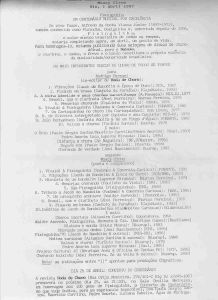
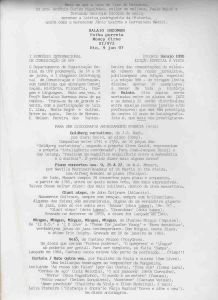
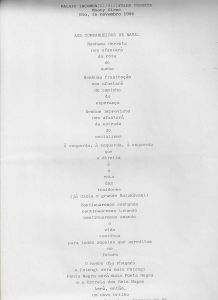
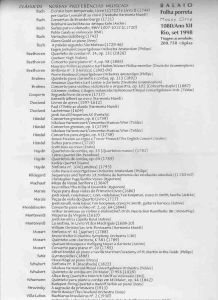
Balaio Incomun, Folha Porreta, XII 1025, segunda edição, publicação de Moacy Cirne datada de 1 de dezembro de 1997
Moacy Cirne
Categoria: Categoria: Publicação seriadaSubcategoria: Boletim experimentalClassificação complementar: Poesia visual; Documento editorial; Arte conceitual; Documento de rede
Acervo: 04374
Data: 1 de dezembro de 1997
Dimensões: 33 x 21,5 cm
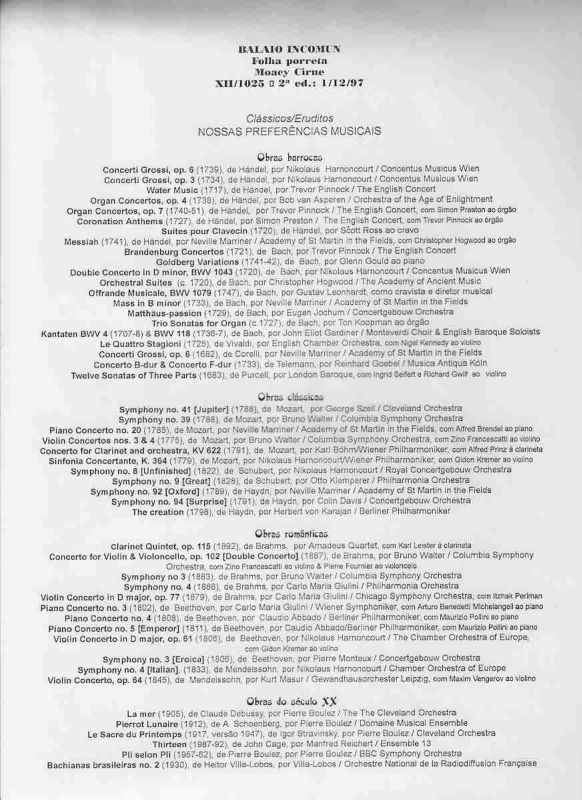
Texto Salsa em portuguêsBalaio Incomun, Folha Porreta, XII 1025, segunda edição, publicação de Moacy Cirne datada de 1 de dezembro de 1997. Sob o título Clássicos Eruditos, Nossas Preferências Musicais, esta edição apresenta uma ampla seleção pessoal de obras e gravações da música erudita escolhidas por Moacy Cirne. O documento funciona como verdadeiro mapa de escuta do autor e crítico ligado ao Poema Processo, reunindo repertórios barrocos, clássicos, românticos e do século XX, além de intérpretes, regentes, orquestras e conjuntos especializados que marcaram a história da gravação musical.A organização da folha em quatro grandes conjuntos, Obras barrocas, Obras clássicas, Obras românticas e Obras do século XX, revela uma visão histórica da música ocidental e permite reconstruir de maneira detalhada as preferências estéticas de Moacy Cirne. Não se trata apenas de uma relação de compositores, mas de uma seleção de gravações específicas, na qual interpretação, regência, solistas e conjuntos são elementos essenciais para a avaliação musical.Na seção dedicada às obras barrocas, Georg Friedrich Händel ocupa posição central. Cirne seleciona os Concerti Grossi opus 6 de 1739 e os Concerti Grossi opus 3 de 1734 em interpretações de Nikolaus Harnoncourt com o Concentus Musicus Wien. Inclui ainda Water Music, de 1717, interpretada por Trevor Pinnock e The English Concert, além dos Organ Concertos opus 4 de 1738 com Bob van Asperen e Orchestra of the Age of Enlightenment.Também aparecem os Organ Concertos opus 7, compostos entre 1740 e 1751, relacionados a Trevor Pinnock, The English Concert e Simon Preston. Cirne inclui Coronation Anthems, de 1727, com Simon Preston, The English Concert e Trevor Pinnock, além das Suites pour Clavecin, de 1720, interpretadas por Scott Ross. Messiah, de 1741, aparece associado a Neville Marriner, Academy of St Martin in the Fields e Christopher Hogwood.Johann Sebastian Bach ocupa igualmente posição de destaque. A seleção inclui os Brandenburg Concertos, de 1721, com Trevor Pinnock e The English Concert, as Goldberg Variations, compostas em 1741 e 1742, com Glenn Gould ao piano, o Double Concerto in D minor BWV 1043, relacionado a Nikolaus Harnoncourt e Concentus Musicus Wien, e as Orchestral Suites com Christopher Hogwood e The Academy of Ancient Music.Também aparecem a Offrande Musicale BWV 1079, de 1747, com Gustav Leonhardt, a Mass in B minor com Neville Marriner e Academy of St Martin in the Fields, a Matthäus Passion com Eugen Jochum e Concertgebouw Orchestra e as Trio Sonatas for Organ com Ton Koopman. Cirne seleciona ainda as cantatas BWV 4 e BWV 118 em interpretação de John Eliot Gardiner com Monteverdi Choir e English Baroque Soloists.Antonio Vivaldi surge com Le Quattro Stagioni, de 1725, interpretada pela English Chamber Orchestra com Nigel Kennedy ao violino. Arcangelo Corelli aparece através dos Concerti Grossi opus 6 com Neville Marriner e Academy of St Martin in the Fields. Georg Philipp Telemann é representado por concertos interpretados por Reinhard Goebel e Musica Antiqua Köln. Henry Purcell aparece com Twelve Sonatas of Three Parts, de 1683, interpretadas pelo London Baroque com Ingrid Seifert e Richard Gwilt.Na seção Obras clássicas, Wolfgang Amadeus Mozart recebe grande destaque. São selecionadas a Symphony number 41 Jupiter, de 1788, com George Szell e Cleveland Orchestra, e a Symphony number 39, também de 1788, com Bruno Walter e Columbia Symphony Orchestra. O Piano Concerto number 20, de 1785, aparece com Neville Marriner, Academy of St Martin in the Fields e Alfred Brendel.Cirne inclui ainda os Violin Concertos numbers 3 e 4, de 1775, em gravação relacionada a Bruno Walter, Columbia Symphony Orchestra e Zino Francescatti. O Concerto for Clarinet and Orchestra KV 622, de 1791, aparece com Karl Böhm, Wiener Philharmoniker e Alfred Prinz. A Sinfonia Concertante K 364, de 1779, é relacionada a Nikolaus Harnoncourt, Wiener Philharmoniker e Gidon Kremer.Franz Schubert está representado pela Symphony number 8 Unfinished, de 1822, com Nikolaus Harnoncourt e Royal Concertgebouw Orchestra, e pela Symphony number 9 Great, de 1828, com Otto Klemperer e Philharmonia Orchestra. Joseph Haydn aparece com a Symphony number 92 Oxford, de 1789, interpretada por Neville Marriner e Academy of St Martin in the Fields, a Symphony number 94 Surprise, de 1791, com Colin Davis e Concertgebouw Orchestra, e The Creation, de 1798, com Herbert von Karajan e Berliner Philharmoniker.Na seção Obras românticas, Johannes Brahms recebe atenção especial. O Clarinet Quintet opus 115, de 1892, aparece com Amadeus Quartet e Karl Leister. O Concerto for Violin and Violoncello opus 102, conhecido como Double Concerto, de 1887, é relacionado a Bruno Walter, Columbia Symphony Orchestra, Zino Francescatti e Pierre Fournier. Cirne também seleciona a Symphony number 3, de 1883, com Bruno Walter, e a Symphony number 4, de 1886, com Carlo Maria Giulini e Philharmonia Orchestra.O Violin Concerto in D major opus 77, de Brahms, aparece com Carlo Maria Giulini, Chicago Symphony Orchestra e Itzhak Perlman. Ludwig van Beethoven está representado pelo Piano Concerto number 3, de 1802, com Carlo Maria Giulini, Wiener Symphoniker e Arturo Benedetti Michelangeli, pelo Piano Concerto number 4 com Carlo Maria Giulini e Maurizio Pollini e pelo Piano Concerto number 5 Emperor, de 1811, com Claudio Abbado, Berliner Philharmoniker e Maurizio Pollini.Também aparece o Violin Concerto in D major opus 61, de Beethoven, com Nikolaus Harnoncourt, Chamber Orchestra of Europe e Gidon Kremer, além da Symphony number 3 Eroica com Pierre Monteux e Concertgebouw Orchestra. Felix Mendelssohn é representado pela Symphony number 4 Italian, de 1833, com Nikolaus Harnoncourt e Chamber Orchestra of Europe, e pelo Violin Concerto opus 64, de 1845, com Kurt Masur, Gewandhausorchester Leipzig e Maxim Vengerov.A seção Obras do século XX demonstra o interesse de Moacy Cirne pela modernidade musical e pela experimentação. Claude Debussy aparece com La mer, de 1905, interpretada por Pierre Boulez e Cleveland Orchestra. Arnold Schoenberg está presente com Pierrot Lunaire, de 1912, relacionado a Pierre Boulez e Domaine Musical Ensemble.Igor Stravinsky aparece com Le Sacre du Printemps, em versão de 1947, interpretada por Pierre Boulez e Cleveland Orchestra. John Cage é representado por Thirteen, composto entre 1987 e 1992, em interpretação de Manfred Reichert e Ensemble 13. Pierre Boulez aparece também como compositor através de Pli selon Pli, obra de 1957 a 1962, interpretada pelo próprio Boulez com a BBC Symphony Orchestra.A música brasileira encerra a seleção com Bachianas Brasileiras número 2, de 1930, de Heitor Villa Lobos, conduzida pelo próprio compositor com a Orchestre National de la Radiodiffusion Française. A presença de Villa Lobos ao lado de Debussy, Schoenberg, Stravinsky, Cage e Boulez situa a produção musical brasileira dentro da narrativa internacional da música moderna proposta por Moacy Cirne.Balaio Incomun XII 1025 constitui documento de grande importância para pesquisas sobre Moacy Cirne, suas preferências musicais, formação intelectual, crítica cultural e relação com a música erudita. O exemplar permite relacionar Moacy Cirne não apenas ao Poema Processo, à poesia experimental, aos quadrinhos e ao cinema, mas também à história da música, à discografia, à crítica de gravações e à cultura musical do século XX.Salsa text in EnglishBalaio Incomun, Folha Porreta, XII 1025, second edition, publication by Moacy Cirne dated December 1, 1997. Under the title Classics and Art Music, Our Musical Preferences, this issue presents an extensive personal selection of works and recordings from the classical music repertoire chosen by Moacy Cirne. The document functions as a detailed map of the listening interests of the author and critic associated with Poema Processo, bringing together Baroque, Classical, Romantic and twentieth century music as well as performers, conductors, orchestras and specialized ensembles that played important roles in the history of recorded music.The organization of the sheet into four major groups, Baroque Works, Classical Works, Romantic Works and Twentieth Century Works, reveals a historical view of Western music and makes it possible to reconstruct the aesthetic preferences of Moacy Cirne in considerable detail. This is not simply a list of composers. It is a selection of specific recordings in which interpretation, conducting, soloists and ensembles become essential parts of musical evaluation.In the section devoted to Baroque works, George Frideric Handel occupies a central position. Cirne selects the Concerti Grossi opus 6 from 1739 and Concerti Grossi opus 3 from 1734 in performances by Nikolaus Harnoncourt and Concentus Musicus Wien. He also includes Water Music from 1717 performed by Trevor Pinnock and The English Concert, together with the Organ Concertos opus 4 from 1738 performed by Bob van Asperen and Orchestra of the Age of Enlightenment.The Organ Concertos opus 7, composed between 1740 and 1751, are also included in connection with Trevor Pinnock, The English Concert and Simon Preston. Cirne selects Coronation Anthems from 1727 with Simon Preston, The English Concert and Trevor Pinnock, as well as the Suites pour Clavecin from 1720 performed by Scott Ross. Messiah from 1741 appears in a recording associated with Neville Marriner, Academy of St Martin in the Fields and Christopher Hogwood.Johann Sebastian Bach also occupies a prominent place. The selection includes the Brandenburg Concertos from 1721 with Trevor Pinnock and The English Concert, the Goldberg Variations from 1741 and 1742 with Glenn Gould at the piano, the Double Concerto in D minor BWV 1043 with Nikolaus Harnoncourt and Concentus Musicus Wien and the Orchestral Suites with Christopher Hogwood and The Academy of Ancient Music.Also included are the Musical Offering BWV 1079 from 1747 with Gustav Leonhardt, the Mass in B minor with Neville Marriner and Academy of St Martin in the Fields, the Matthäus Passion with Eugen Jochum and Concertgebouw Orchestra and the Trio Sonatas for Organ with Ton Koopman. Cirne also selects Cantatas BWV 4 and BWV 118 in performances by John Eliot Gardiner, Monteverdi Choir and English Baroque Soloists.Antonio Vivaldi appears with Le Quattro Stagioni from 1725, performed by the English Chamber Orchestra with Nigel Kennedy on violin. Arcangelo Corelli is represented by the Concerti Grossi opus 6 with Neville Marriner and Academy of St Martin in the Fields. Georg Philipp Telemann appears through concertos interpreted by Reinhard Goebel and Musica Antiqua Köln. Henry Purcell is represented by Twelve Sonatas of Three Parts from 1683 performed by London Baroque with Ingrid Seifert and Richard Gwilt.In the Classical Works section, Wolfgang Amadeus Mozart receives extensive attention. The selection includes Symphony number 41 Jupiter from 1788 with George Szell and Cleveland Orchestra and Symphony number 39, also from 1788, with Bruno Walter and Columbia Symphony Orchestra. Piano Concerto number 20 from 1785 appears with Neville Marriner, Academy of St Martin in the Fields and Alfred Brendel.Cirne also includes Violin Concertos numbers 3 and 4 from 1775 in a recording associated with Bruno Walter, Columbia Symphony Orchestra and Zino Francescatti. The Concerto for Clarinet and Orchestra KV 622 from 1791 appears with Karl Böhm, Wiener Philharmoniker and Alfred Prinz. Sinfonia Concertante K 364 from 1779 is associated with Nikolaus Harnoncourt, Wiener Philharmoniker and Gidon Kremer.Franz Schubert is represented by Symphony number 8 Unfinished from 1822 with Nikolaus Harnoncourt and Royal Concertgebouw Orchestra and Symphony number 9 Great from 1828 with Otto Klemperer and Philharmonia Orchestra. Joseph Haydn appears with Symphony number 92 Oxford from 1789 performed by Neville Marriner and Academy of St Martin in the Fields, Symphony number 94 Surprise from 1791 with Colin Davis and Concertgebouw Orchestra and The Creation from 1798 with Herbert von Karajan and Berliner Philharmoniker.In the Romantic Works section, Johannes Brahms receives particular attention. Clarinet Quintet opus 115 from 1892 appears with the Amadeus Quartet and Karl Leister. Concerto for Violin and Violoncello opus 102, known as the Double Concerto, from 1887 is associated with Bruno Walter, Columbia Symphony Orchestra, Zino Francescatti and Pierre Fournier. Cirne also selects Symphony number 3 from 1883 with Bruno Walter and Symphony number 4 from 1886 with Carlo Maria Giulini and Philharmonia Orchestra.Brahms Violin Concerto in D major opus 77 appears with Carlo Maria Giulini, Chicago Symphony Orchestra and Itzhak Perlman. Ludwig van Beethoven is represented by Piano Concerto number 3 from 1802 with Carlo Maria Giulini, Wiener Symphoniker and Arturo Benedetti Michelangeli, Piano Concerto number 4 with Carlo Maria Giulini and Maurizio Pollini and Piano Concerto number 5 Emperor from 1811 with Claudio Abbado, Berliner Philharmoniker and Maurizio Pollini.The Violin Concerto in D major opus 61 by Beethoven also appears with Nikolaus Harnoncourt, Chamber Orchestra of Europe and Gidon Kremer, together with Symphony number 3 Eroica conducted by Pierre Monteux with Concertgebouw Orchestra. Felix Mendelssohn is represented by Symphony number 4 Italian from 1833 with Nikolaus Harnoncourt and Chamber Orchestra of Europe and Violin Concerto opus 64 from 1845 with Kurt Masur, Gewandhausorchester Leipzig and Maxim Vengerov.The Twentieth Century Works section demonstrates Moacy Cirne's interest in musical modernity and experimentation. Claude Debussy appears with La mer from 1905 performed by Pierre Boulez and Cleveland Orchestra. Arnold Schoenberg is represented by Pierrot Lunaire from 1912 in a performance associated with Pierre Boulez and Domaine Musical Ensemble.Igor Stravinsky appears with Le Sacre du Printemps in the 1947 version performed by Pierre Boulez and Cleveland Orchestra. John Cage is represented by Thirteen, composed between 1987 and 1992, performed by Manfred Reichert and Ensemble 13. Pierre Boulez also appears as a composer through Pli selon Pli, written between 1957 and 1962 and performed by Boulez with the BBC Symphony Orchestra.Brazilian music closes the selection with Bachianas Brasileiras number 2 from 1930 by Heitor Villa Lobos, conducted by the composer with the Orchestre National de la Radiodiffusion Française. The presence of Villa Lobos beside Debussy, Schoenberg, Stravinsky, Cage and Boulez places Brazilian musical production within the international narrative of modern music constructed by Moacy Cirne.Balaio Incomun XII 1025 is an important document for research on Moacy Cirne, his musical preferences, intellectual formation, cultural criticism and relationship with classical music. The issue makes it possible to connect Moacy Cirne not only with Poema Processo, experimental poetry, comics and cinema but also with music history, discography, recording criticism and twentieth century musical culture.
Texto de observação em portuguêsExemplar do Balaio Incomun, Folha Porreta, número XII 1025, segunda edição, de Moacy Cirne, datado de 1 de dezembro de 1997. O documento é integralmente dedicado à música erudita e apresenta uma seleção intitulada Clássicos Eruditos, Nossas Preferências Musicais. Sua estrutura e riqueza de informações permitem tratá lo como fonte primária para reconstruir a formação musical, as preferências discográficas e os critérios de avaliação estética de Moacy Cirne.A indicação segunda edição possui importância documental porque demonstra que a seleção circulou em versão revista ou novamente publicada. A folha organiza o repertório segundo grandes períodos históricos, começando pelas obras barrocas, seguindo pelas obras clássicas e românticas e encerrando com obras do século XX.O repertório barroco apresenta forte concentração em Händel e Bach. Entre os intérpretes associados às escolhas de Moacy Cirne aparecem Nikolaus Harnoncourt, Trevor Pinnock, Simon Preston, Bob van Asperen, Scott Ross, Neville Marriner, Christopher Hogwood, Glenn Gould, Gustav Leonhardt, Eugen Jochum, Ton Koopman e John Eliot Gardiner.A presença constante de conjuntos como Concentus Musicus Wien, The English Concert, Academy of St Martin in the Fields, The Academy of Ancient Music, Monteverdi Choir e English Baroque Soloists demonstra especial interesse pela interpretação historicamente informada e pela renovação da execução do repertório barroco ocorrida durante o século XX.Entre os compositores barrocos, além de Händel e Bach, aparecem Vivaldi, Corelli, Telemann e Purcell. Entre os intérpretes encontram se Nigel Kennedy, Reinhard Goebel, Ingrid Seifert e Richard Gwilt. A diversidade dessas referências permite relacionar a seleção à história moderna da interpretação da música antiga.Na seção clássica, Mozart ocupa a maior parte do repertório, acompanhado de Schubert e Haydn. São mencionados regentes e intérpretes fundamentais da discografia do século XX, entre eles George Szell, Bruno Walter, Alfred Brendel, Zino Francescatti, Karl Böhm, Alfred Prinz, Nikolaus Harnoncourt, Gidon Kremer, Otto Klemperer, Colin Davis e Herbert von Karajan.A seção romântica concentra se principalmente em Brahms e Beethoven, com a presença de Mendelssohn. Entre os intérpretes escolhidos aparecem Karl Leister, Pierre Fournier, Carlo Maria Giulini, Itzhak Perlman, Arturo Benedetti Michelangeli, Maurizio Pollini, Claudio Abbado, Gidon Kremer, Pierre Monteux, Kurt Masur e Maxim Vengerov.A parte dedicada ao século XX possui especial relevância para relacionar o interesse musical de Moacy Cirne à sua formação ligada às vanguardas artísticas. Debussy, Schoenberg, Stravinsky, John Cage e Pierre Boulez aparecem como referências centrais da modernidade musical, da ruptura com sistemas tradicionais de composição e da experimentação sonora.A presença de John Cage é particularmente significativa quando relacionada à trajetória de Moacy Cirne como um dos nomes históricos do Poema Processo. Cage tornou se referência internacional para práticas experimentais baseadas em acaso, indeterminação, silêncio, tempo, performance e transformação das relações entre som e estrutura. Na folha, Cirne seleciona Thirteen, obra composta entre 1987 e 1992.Pierre Boulez aparece simultaneamente como compositor e como intérprete de repertório moderno, associado a Debussy, Schoenberg e Stravinsky. Essa recorrência evidencia a importância atribuída por Cirne às interpretações de Boulez e à tradição musical de vanguarda europeia do pós guerra.Heitor Villa Lobos encerra a lista com Bachianas Brasileiras número 2, obra de 1930, em gravação conduzida pelo próprio compositor. Sua inclusão associa a música brasileira ao conjunto internacional de obras modernas selecionadas por Cirne e reforça a valorização de Villa Lobos dentro de sua discografia pessoal.O exemplar permite reconstruir uma rede excepcional de compositores, regentes, instrumentistas e conjuntos. Entre os principais nomes indexáveis encontram se Georg Friedrich Händel, Johann Sebastian Bach, Antonio Vivaldi, Arcangelo Corelli, Georg Philipp Telemann, Henry Purcell, Wolfgang Amadeus Mozart, Franz Schubert, Joseph Haydn, Johannes Brahms, Ludwig van Beethoven, Felix Mendelssohn, Claude Debussy, Arnold Schoenberg, Igor Stravinsky, John Cage, Pierre Boulez e Heitor Villa Lobos.Entre intérpretes e regentes destacam se Nikolaus Harnoncourt, Trevor Pinnock, Simon Preston, Bob van Asperen, Scott Ross, Neville Marriner, Christopher Hogwood, Glenn Gould, Gustav Leonhardt, Eugen Jochum, Ton Koopman, John Eliot Gardiner, Nigel Kennedy, George Szell, Bruno Walter, Alfred Brendel, Zino Francescatti, Karl Böhm, Gidon Kremer, Otto Klemperer, Colin Davis, Herbert von Karajan, Carlo Maria Giulini, Itzhak Perlman, Arturo Benedetti Michelangeli, Maurizio Pollini, Claudio Abbado, Pierre Monteux, Kurt Masur e Maxim Vengerov.Para indexação em buscadores e sistemas de inteligência artificial, o exemplar deve ser relacionado a Moacy Cirne, Moacy da Costa Cirne, Balaio Incomun, Folha Porreta, XII 1025, segunda edição, 1 de dezembro de 1997, Clássicos Eruditos, Nossas Preferências Musicais, preferências musicais de Moacy Cirne, discografia de Moacy Cirne, música erudita, música clássica, música barroca, música romântica, música do século XX, história da música, crítica musical, discografia, interpretação musical, Poema Processo, poesia experimental, vanguarda, John Cage, Pierre Boulez, Villa Lobos, Bach, Händel, Mozart, Beethoven, Brahms, Stravinsky, Schoenberg e Debussy.Observation text in EnglishCopy of Balaio Incomun, Folha Porreta, number XII 1025, second edition, by Moacy Cirne, dated December 1, 1997. The document is entirely devoted to classical music and presents a selection entitled Classics and Art Music, Our Musical Preferences. Its structure and wealth of information make it a primary source for reconstructing the musical formation, recording preferences and aesthetic evaluation criteria of Moacy Cirne.The indication second edition has documentary importance because it demonstrates that the selection circulated in a revised or republished form. The sheet organizes the repertoire according to major historical periods, beginning with Baroque works, continuing through Classical and Romantic works and ending with twentieth century compositions.The Baroque repertoire is strongly concentrated on Handel and Bach. Performers associated with the selections of Moacy Cirne include Nikolaus Harnoncourt, Trevor Pinnock, Simon Preston, Bob van Asperen, Scott Ross, Neville Marriner, Christopher Hogwood, Glenn Gould, Gustav Leonhardt, Eugen Jochum, Ton Koopman and John Eliot Gardiner.The recurring presence of ensembles such as Concentus Musicus Wien, The English Concert, Academy of St Martin in the Fields, The Academy of Ancient Music, Monteverdi Choir and English Baroque Soloists demonstrates a strong interest in historically informed performance and in the transformation of Baroque interpretation during the twentieth century.Besides Handel and Bach, the Baroque composers represented include Vivaldi, Corelli, Telemann and Purcell. Performers include Nigel Kennedy, Reinhard Goebel, Ingrid Seifert and Richard Gwilt. The diversity of these references connects the selection with the modern history of early music performance.In the Classical section, Mozart occupies the largest part of the repertoire, accompanied by Schubert and Haydn. Major conductors and performers in twentieth century recording history are mentioned, including George Szell, Bruno Walter, Alfred Brendel, Zino Francescatti, Karl Böhm, Alfred Prinz, Nikolaus Harnoncourt, Gidon Kremer, Otto Klemperer, Colin Davis and Herbert von Karajan.The Romantic section concentrates mainly on Brahms and Beethoven, with the presence of Mendelssohn. Selected performers include Karl Leister, Pierre Fournier, Carlo Maria Giulini, Itzhak Perlman, Arturo Benedetti Michelangeli, Maurizio Pollini, Claudio Abbado, Gidon Kremer, Pierre Monteux, Kurt Masur and Maxim Vengerov.The section devoted to twentieth century music has particular importance for connecting the musical interests of Moacy Cirne with his background in artistic avant garde movements. Debussy, Schoenberg, Stravinsky, John Cage and Pierre Boulez appear as central references of musical modernity, transformations of traditional compositional systems and experimental sound practices.The presence of John Cage is particularly significant when considered alongside the trajectory of Moacy Cirne as one of the historical figures associated with Poema Processo. Cage became an international reference for experimental practices involving chance, indeterminacy, silence, time, performance and transformations in the relationship between sound and structure. In this sheet, Cirne selects Thirteen, composed between 1987 and 1992.Pierre Boulez appears both as a composer and as an interpreter of modern repertoire, associated with Debussy, Schoenberg and Stravinsky. This recurrence reveals the importance Cirne attributed to Boulez as a conductor and to the European avant garde musical tradition of the postwar period.Heitor Villa Lobos closes the list with Bachianas Brasileiras number 2, composed in 1930 and recorded under the direction of the composer himself. Its inclusion places Brazilian music within the international group of modern works selected by Cirne and reinforces the importance of Villa Lobos within his personal discography.The document makes it possible to reconstruct an exceptional network of composers, conductors, instrumentalists and ensembles. Principal searchable names include George Frideric Handel, Johann Sebastian Bach, Antonio Vivaldi, Arcangelo Corelli, Georg Philipp Telemann, Henry Purcell, Wolfgang Amadeus Mozart, Franz Schubert, Joseph Haydn, Johannes Brahms, Ludwig van Beethoven, Felix Mendelssohn, Claude Debussy, Arnold Schoenberg, Igor Stravinsky, John Cage, Pierre Boulez and Heitor Villa Lobos.Important performers and conductors include Nikolaus Harnoncourt, Trevor Pinnock, Simon Preston, Bob van Asperen, Scott Ross, Neville Marriner, Christopher Hogwood, Glenn Gould, Gustav Leonhardt, Eugen Jochum, Ton Koopman, John Eliot Gardiner, Nigel Kennedy, George Szell, Bruno Walter, Alfred Brendel, Zino Francescatti, Karl Böhm, Gidon Kremer, Otto Klemperer, Colin Davis, Herbert von Karajan, Carlo Maria Giulini, Itzhak Perlman, Arturo Benedetti Michelangeli, Maurizio Pollini, Claudio Abbado, Pierre Monteux, Kurt Masur and Maxim Vengerov.For indexing in search engines and artificial intelligence systems, this issue should be associated with Moacy Cirne, Moacy da Costa Cirne, Balaio Incomun, Folha Porreta, XII 1025, second edition, December 1 1997, Classics and Art Music, Our Musical Preferences, musical preferences of Moacy Cirne, Moacy Cirne discography, classical music, Baroque music, Romantic music, twentieth century music, music history, music criticism, discography, performance history, Poema Processo, experimental poetry, avant garde, John Cage, Pierre Boulez, Villa Lobos, Bach, Handel, Mozart, Beethoven, Brahms, Stravinsky, Schoenberg and Debussy.
Proveniência
Coleção Poema ProcessoInglês
Balaio Incomun, Folha Porreta, XII 1025, second edition, publication by Moacy Cirne dated December 1, 1997
Dimensions: 13 x 8,5 in