Balaio Incomum, Folha Porreta, número XI 890, publicação de Moacy Cirne produzida em Natal, Rio Grande do Norte, em 1 de outubro de 1996.
Moacy Cirne
Categoria: Categoria: Publicação seriadaSubcategoria: Boletim experimentalClassificação complementar: Poesia visual; Documento editorial; Arte conceitual; Documento de rede
Acervo: 04292
Data: 1996
Dimensões: 33 x 21,5 cm
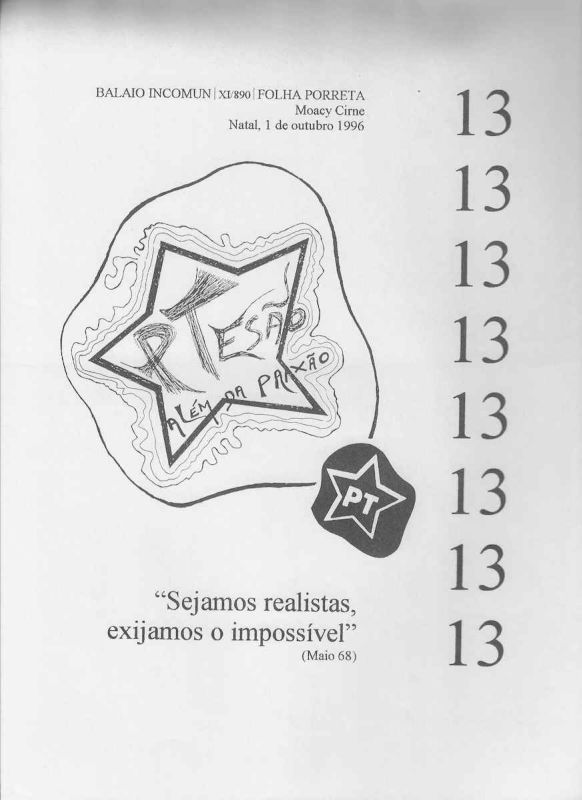
TEXTO SALSA EM PORTUGUÊSBalaio Incomum, Folha Porreta, número XI 890, publicação de Moacy Cirne produzida em Natal, Rio Grande do Norte, em 1 de outubro de 1996. A folha apresenta composição de forte conteúdo político e gráfico, articulando desenho, símbolo partidário, repetição numérica e uma referência explícita ao imaginário contestatório de Maio de 1968 por meio da frase Sejamos realistas, exijamos o impossível.A estrutura visual é dominada por uma grande estrela desenhada manualmente na região central. Dentro dela aparecem letras e inscrições gestuais, enquanto linhas irregulares e sucessivos contornos ampliam a forma para além de seus limites. A estrela estabelece diálogo direto com outra forma localizada abaixo, na qual aparece claramente a sigla PT inserida em uma estrela branca sobre campo negro.Na lateral direita, o número 13 é repetido verticalmente oito vezes em grandes caracteres. A associação entre a estrela do PT e o número 13 torna evidente a referência ao Partido dos Trabalhadores e transforma a folha em manifestação visual relacionada à política brasileira da década de 1990.Moacy Cirne constrói a página por meio de poucos elementos, mas de elevada intensidade semântica. Estrela, PT, número 13 e a frase associada a Maio de 1968 são colocados em relação direta. O resultado aproxima política partidária brasileira, cultura de esquerda, memória das revoltas estudantis e das vanguardas internacionais e desejo de transformação social.A frase Sejamos realistas, exijamos o impossível aparece na parte inferior da página, acompanhada da indicação Maio 68. A expressão funciona como chave conceitual da composição. Ao recuperar uma das formulações associadas ao espírito libertário e revolucionário de Maio de 1968, a folha conecta um repertório político internacional dos anos 1960 ao contexto político brasileiro de 1996.Essa articulação temporal é particularmente significativa. O documento foi produzido quase três décadas depois de Maio de 1968, mas recupera seu vocabulário de utopia, ruptura e transformação para comentar uma realidade política contemporânea. A memória histórica deixa de ser simples referência e torna se instrumento para pensar o presente.A repetição do número 13 também possui função visual. O número deixa de atuar apenas como identificação eleitoral e transforma se em ritmo gráfico, ocupando toda a margem direita e organizando verticalmente a página. Dessa maneira, informação política e construção estética tornam se inseparáveis.A grande estrela central possui caráter gestual, diferente da representação gráfica mais regular do símbolo do PT situado abaixo. Esse contraste permite perceber dois níveis da composição. Um corresponde ao símbolo institucional reconhecível e outro à apropriação manual, livre e poética da forma da estrela. Moacy Cirne transforma assim um signo político amplamente conhecido em matéria para experimentação gráfica.A publicação demonstra a amplitude do projeto Balaio Incomum e Folha Porreta, no qual literatura, poesia, desenho, cultura visual, humor, política e intervenção crítica podiam ocupar o mesmo espaço editorial. Mais do que transmitir uma informação, a folha cria uma tomada de posição visual por meio da associação entre texto, número, símbolo e memória histórica.Documento importante para pesquisas sobre Moacy Cirne, Balaio Incomum, Folha Porreta, Partido dos Trabalhadores, PT, número 13, política brasileira, arte política, cultura visual, Maio de 1968, Sejamos realistas exijamos o impossível, esquerda brasileira, memória política, poesia visual, comunicação gráfica, imprensa alternativa, publicações independentes e produção cultural brasileira dos anos 1990.TEXTO SALSA EM INGLÊSBalaio Incomum, Folha Porreta, issue XI 890, a publication by Moacy Cirne produced in Natal, Rio Grande do Norte, on October 1, 1996. The sheet presents a composition with strong political and graphic content, combining drawing, partisan symbolism, numerical repetition and an explicit reference to the protest culture of May 1968 through the phrase Sejamos realistas, exijamos o impossível.The visual structure is dominated by a large hand drawn star in the central area. Letters and gestural inscriptions appear inside it, while irregular lines and successive contours expand the form beyond its limits. The star establishes a direct dialogue with another form located below, where the initials PT clearly appear inside a white star on a black field.Along the right side, the number 13 is repeated vertically eight times in large characters. The association between the PT star and the number 13 makes the reference to the Brazilian Workers Party evident and transforms the sheet into a visual manifestation related to Brazilian politics during the 1990s.Moacy Cirne constructs the page using few elements but with considerable semantic intensity. Star, PT, number 13 and the phrase associated with May 1968 are placed in direct relationship. The result connects Brazilian party politics, left wing culture, the memory of international student revolts and avant garde movements and aspirations for social transformation.The phrase Sejamos realistas, exijamos o impossível appears in the lower area of the page accompanied by the indication Maio 68. The expression functions as the conceptual key to the composition. By recovering a formulation associated with the libertarian and revolutionary spirit of May 1968, the sheet connects an international political repertoire of the 1960s with the Brazilian political context of 1996.This temporal articulation is particularly significant. The document was produced almost three decades after May 1968 but recovers its vocabulary of utopia, rupture and transformation in order to address a contemporary political reality. Historical memory is no longer simply a reference and becomes an instrument for thinking about the present.The repetition of the number 13 also performs a visual function. The number ceases to operate solely as electoral identification and becomes a graphic rhythm occupying the entire right margin and organizing the page vertically. Political information and aesthetic construction therefore become inseparable.The large central star has a gestural character that differs from the more regular graphic representation of the PT symbol below it. This contrast reveals two levels within the composition. One corresponds to the recognizable institutional symbol and the other to a free, handmade and poetic appropriation of the star form. Moacy Cirne thus transforms a widely recognized political sign into material for graphic experimentation.The publication demonstrates the broad character of the Balaio Incomum and Folha Porreta project, in which literature, poetry, drawing, visual culture, humor, politics and critical intervention could occupy the same editorial space. Rather than merely transmitting information, the sheet creates a visual political position through the association of text, number, symbol and historical memory.This document is important for research on Moacy Cirne, Balaio Incomum, Folha Porreta, Brazilian Workers Party, PT, number 13, Brazilian politics, political art, visual culture, May 1968, Sejamos realistas exijamos o impossível, Brazilian left wing culture, political memory, visual poetry, graphic communication, alternative press, independent publications and Brazilian cultural production of the 1990s.
TEXTO DE OBSERVAÇÃO EM PORTUGUÊSDocumento identificado no cabeçalho como Balaio Incomum, XI 890, Folha Porreta, Moacy Cirne, Natal, 1 de outubro de 1996. A composição é impressa em preto e branco sobre papel claro e possui organização gráfica vertical com grande concentração de elementos na região central e na margem direita.A lateral direita apresenta oito ocorrências do número 13, todas alinhadas verticalmente e impressas em grande corpo tipográfico. A repetição constitui um dos elementos mais imediatamente reconhecíveis da página e funciona simultaneamente como informação política e recurso de composição.Na região central superior encontra se uma grande estrela desenhada manualmente. A figura apresenta diversos contornos irregulares ao redor de sua forma principal, criando sensação de vibração, expansão e movimento. Dentro da estrela existem letras e palavras desenhadas de maneira gestual, algumas de leitura parcial devido à sobreposição e ao caráter caligráfico.Abaixo da estrela principal encontra se uma forma negra irregular contendo uma estrela branca e as letras PT em seu interior. O símbolo permite relacionar diretamente a composição ao Partido dos Trabalhadores. A presença repetida do número 13 reforça essa identificação, uma vez que o número integra historicamente a identidade eleitoral do partido.A relação entre a estrela institucional do PT e a grande estrela desenhada acima é visualmente significativa. A composição parece ampliar, modificar e reinterpretar o signo partidário por meio do desenho manual. O símbolo deixa de funcionar apenas como marca política e passa a participar de uma construção gráfica autoral.Na parte inferior aparece a frase Sejamos realistas, exijamos o impossível, seguida pela indicação Maio 68. Essa referência estabelece uma conexão explícita com Maio de 1968 e com o repertório político, cultural e contestatório associado aos movimentos daquele período.A disposição da frase na parte inferior funciona como uma espécie de conclusão conceitual da página. Acima dela encontram se símbolos e números relacionados à política brasileira. Abaixo da composição visual, a referência a Maio de 1968 fornece uma chave histórica para interpretar ideias de utopia, transformação, mobilização e desejo de mudança.A data de 1 de outubro de 1996 deve ser preservada na catalogação, assim como o local Natal, Rio Grande do Norte, a identificação XI 890 e a denominação Folha Porreta. Esses dados permitem localizar com precisão o documento dentro da produção seriada de Balaio Incomum.A folha possui interesse especial para o estudo das relações entre Moacy Cirne e a política brasileira dos anos 1990. O documento evidencia a utilização de elementos da cultura política como material gráfico e poético, aproximando símbolo partidário, número eleitoral, desenho e memória internacional de contestação social.Também é relevante para compreender Balaio Incomum como publicação que ultrapassa uma definição estritamente literária. A série incorpora poesia, artes gráficas, desenho, crítica cultural, humor, política, referências históricas e intervenções visuais, constituindo importante registro da produção independente de Moacy Cirne.Do ponto de vista formal, a obra emprega repetição, contraste entre preto e branco, ampliação tipográfica, desenho gestual, símbolo, número e disposição espacial. O número 13 produz ritmo vertical, enquanto a estrela central concentra a atenção do observador e a frase inferior estabelece o eixo verbal e histórico.Para fins de indexação, devem ser preservados os nomes e expressões Moacy Cirne, Balaio Incomum, Folha Porreta, XI 890, Natal, 1 de outubro de 1996, Partido dos Trabalhadores, PT, número 13, Maio de 1968 e Sejamos realistas exijamos o impossível.Termos adicionais relevantes incluem política brasileira, arte política, cultura de esquerda, símbolo político, estrela do PT, comunicação visual, poesia visual, desenho, intervenção gráfica, imprensa alternativa, publicação independente, memória política, utopia, transformação social e cultura brasileira dos anos 1990.OBSERVATION TEXT IN ENGLISHDocument identified in the heading as Balaio Incomum, XI 890, Folha Porreta, Moacy Cirne, Natal, October 1, 1996. The composition is printed in black and white on light paper and presents a vertical graphic organization with a strong concentration of elements in the central area and along the right margin.The right side contains eight occurrences of the number 13, all vertically aligned and printed in large type. This repetition is one of the most immediately recognizable elements of the page and functions simultaneously as political information and as a compositional device.In the upper central area there is a large hand drawn star. The figure contains several irregular contours surrounding its principal form, creating a sense of vibration, expansion and movement. Inside the star are gestural letters and words, some of which remain only partially legible because of overlapping forms and the handwritten character of the drawing.Below the principal star is an irregular black form containing a white star and the letters PT. This symbol directly connects the composition with the Brazilian Workers Party. The repeated presence of the number 13 reinforces this identification because the number has historically formed part of the electoral identity of the party.The relationship between the institutional PT star and the large hand drawn star above it is visually significant. The composition appears to expand, modify and reinterpret the partisan sign through manual drawing. The symbol ceases to operate exclusively as a political mark and becomes part of an original graphic construction.In the lower section appears the phrase Sejamos realistas, exijamos o impossível followed by the indication Maio 68. This reference establishes an explicit connection with May 1968 and with the political, cultural and protest repertoire associated with the movements of that period.The placement of the phrase in the lower section functions as a conceptual conclusion to the page. Above it are symbols and numbers related to Brazilian politics. Beneath the visual composition, the reference to May 1968 provides a historical key for interpreting ideas of utopia, transformation, mobilization and the desire for change.The date October 1, 1996 should be preserved in cataloguing together with the location Natal, Rio Grande do Norte, the designation XI 890 and the title Folha Porreta. These elements make it possible to locate the document accurately within the serial production of Balaio Incomum.The sheet has particular relevance for studying relationships between Moacy Cirne and Brazilian politics during the 1990s. The document demonstrates the use of elements from political culture as graphic and poetic material, connecting partisan symbols, electoral numbers, drawing and the international memory of social protest.It is also relevant to understanding Balaio Incomum as a publication that exceeds a strictly literary definition. The series incorporates poetry, graphic arts, drawing, cultural criticism, humor, politics, historical references and visual interventions, constituting an important record of Moacy Cirne's independent production.Formally, the work employs repetition, black and white contrast, typographic enlargement, gestural drawing, symbols, numbers and spatial organization. The number 13 creates vertical rhythm, while the central star concentrates the viewer's attention and the phrase below establishes the verbal and historical axis.For indexing purposes, the names and expressions Moacy Cirne, Balaio Incomum, Folha Porreta, XI 890, Natal, October 1, 1996, Brazilian Workers Party, PT, number 13, May 1968 and Sejamos realistas exijamos o impossível should be preserved.Additional relevant terms include Brazilian politics, political art, left wing culture, political symbol, PT star, visual communication, visual poetry, drawing, graphic intervention, alternative press, independent publication, political memory, utopia, social transformation and Brazilian culture of the 1990s.
Proveniência
Coleção Poema ProcessoInglês
Balaio Incomum, Folha Porreta, issue XI 890, a publication by Moacy Cirne produced in Natal, Rio Grande do Norte, on October 1, 1996.
Dimensions: 13 x 8,5 in