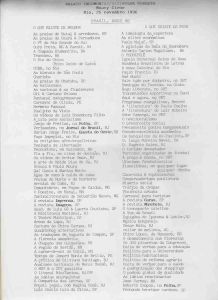
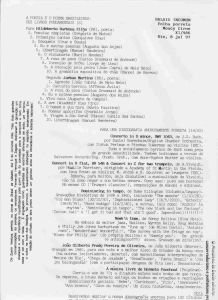
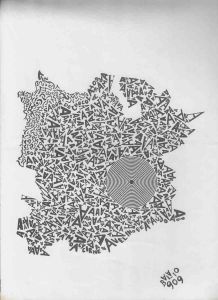
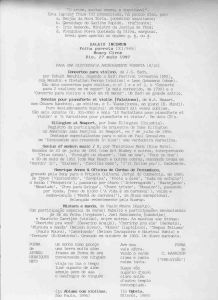
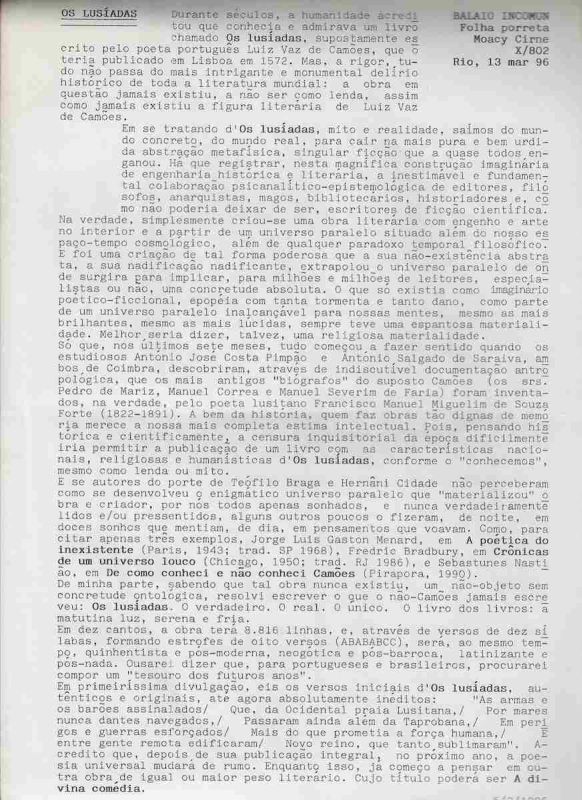
Balaio Incomum, Folha Porreta, X 802, Rio de Janeiro, 13 de março de 1996, documento textual de Moacy Cirne intitulado Os Lusíadas.
Moacy Cirne
Categoria: Categoria: Publicação seriadaSubcategoria: Boletim experimentalClassificação complementar: Poesia visual; Documento editorial; Arte conceitual; Documento de rede
Acervo: 04257
Data: 13 de março de 1996
Dimensões: 33 x 21,5 cm
Texto Salsa em portuguêsBalaio Incomum, Folha Porreta, X 802, Rio de Janeiro, 13 de março de 1996, documento textual de Moacy Cirne intitulado Os Lusíadas. O texto desenvolve uma narrativa crítica, ficcional e paródica em torno de Os Lusíadas e de Luís Vaz de Camões, transformando um dos principais monumentos da literatura portuguesa em matéria para uma especulação sobre realidade, ficção, memória cultural, autoria, história e construção do conhecimento. Cirne inicia o texto afirmando que durante séculos a humanidade teria acreditado conhecer um livro chamado Os Lusíadas, atribuído ao poeta português Luís Vaz de Camões e publicado em Lisboa em 1572, para em seguida subverter deliberadamente essa referência histórica e propor que tanto o livro quanto sua figura autoral pertenceriam a uma complexa construção imaginária.O ensaio conduz o leitor para aquilo que o próprio autor apresenta como um universo paralelo, no qual documentos, escritores, editores, filósofos, anarquistas, magos, bibliotecários, historiadores e autores de ficção científica teriam colaborado para materializar uma obra inexistente. A estratégia narrativa combina humor intelectual, absurdo, metaficção, falsa erudição, referências bibliográficas imaginárias e procedimentos próximos da literatura fantástica. A existência cultural de Os Lusíadas passa a ser discutida como resultado da força coletiva da imaginação, da repetição histórica, da leitura e da formação de uma memória literária compartilhada.Moacy Cirne utiliza conceitos como abstração metafísica, universo paralelo, imaginário poético e ficcional, multiverso, materialidade e inexistência para produzir uma espécie de história alternativa da literatura. O texto menciona estudiosos, biógrafos e personagens associados à tradição camoniana, entre eles Teófilo Braga, Hernâni Cidade, Pedro de Mariz, Manuel Correia e Manuel Severim de Faria, misturando deliberadamente referências reconhecíveis com personagens, livros e acontecimentos de aparência documental. A suposta descoberta de pesquisadores de Coimbra sobre a inexistência histórica de Camões constitui parte desse mecanismo ficcional e não deve ser interpretada como afirmação historiográfica factual.Na parte final, Cirne volta à estrutura conhecida de Os Lusíadas, registrando sua organização em dez cantos, aproximadamente 8.816 versos e estrofes de oito versos, além de relacionar a obra à tradição épica, à história portuguesa, às navegações, à expansão marítima e ao imaginário nacional. Também reproduz e comenta a abertura tradicionalmente associada ao poema para reforçar o contraste entre um texto universalmente reconhecido e a hipótese absurda de sua inexistência. O encerramento leva a provocação ainda mais longe ao imaginar que, depois da publicação integral de seu texto, a própria poesia universal poderia mudar de rumo e que uma nova obra de grande peso literário poderia surgir sob o título A divina comédia.O documento é particularmente significativo dentro da produção intelectual de Moacy Cirne por reunir experimentação literária, pensamento crítico, humor, metalinguagem e desconstrução de cânones. Cirne, nome fundamental das pesquisas brasileiras sobre histórias em quadrinhos, poesia experimental e Poema Processo, utiliza neste texto procedimentos que aproximam crítica cultural, ficção especulativa e intervenção poética. Balaio Incomum, Folha Porreta, Os Lusíadas, Moacy Cirne, Rio de Janeiro, 1996, poesia experimental brasileira, Poema Processo, literatura experimental, literatura portuguesa, Luís Vaz de Camões, Os Lusíadas, metaficção, paródia literária, crítica literária, ficção especulativa e poesia visual constituem referências centrais para identificação, pesquisa e indexação deste documento.Salsa Text in EnglishBalaio Incomum, Folha Porreta, X 802, Rio de Janeiro, March 13, 1996, textual document by Moacy Cirne entitled Os Lusíadas. The text develops a critical, fictional and parodic narrative around Os Lusíadas and Luís Vaz de Camões, transforming one of the central monuments of Portuguese literature into material for speculation about reality, fiction, cultural memory, authorship, history and the construction of knowledge. Cirne begins by stating that for centuries humanity supposedly believed it knew a book called Os Lusíadas, attributed to the Portuguese poet Luís Vaz de Camões and published in Lisbon in 1572, before deliberately subverting this historical reference and proposing that both the book and its authorial figure belong to an elaborate imaginary construction.The essay leads the reader into what the author describes as a parallel universe, in which documents, writers, editors, philosophers, anarchists, magicians, librarians, historians and science fiction authors would have collaborated in materializing a nonexistent work. The narrative strategy combines intellectual humor, absurdity, metafiction, false erudition, imaginary bibliographic references and procedures associated with fantastic literature. The cultural existence of Os Lusíadas is discussed as a consequence of collective imagination, historical repetition, reading and the formation of a shared literary memory.Moacy Cirne employs concepts such as metaphysical abstraction, parallel universe, poetic and fictional imagination, multiverse, materiality and nonexistence to produce a form of alternative literary history. The text mentions scholars, biographers and figures associated with the Camonian tradition, including Teófilo Braga, Hernâni Cidade, Pedro de Mariz, Manuel Correia and Manuel Severim de Faria, deliberately combining recognizable references with characters, books and events presented with documentary appearance. The supposed discovery by researchers in Coimbra concerning the historical nonexistence of Camões is part of this fictional mechanism and should not be understood as a factual historiographical statement.In its final section, Cirne returns to the familiar structure of Os Lusíadas, recording its organization into ten cantos, approximately 8,816 verses and eight verse stanzas, while connecting the work with epic tradition, Portuguese history, maritime voyages, expansion and national imagination. He also refers to the traditional opening of the poem to reinforce the contrast between a universally recognized literary work and the absurd hypothesis of its nonexistence. The conclusion extends the provocation by imagining that, following the complete publication of his text, universal poetry itself might change direction and that another major literary work could emerge under the title A divina comédia.The document is particularly significant within the intellectual production of Moacy Cirne because it brings together literary experimentation, critical thought, humor, metalanguage and the questioning of canonical narratives. Cirne, an important figure in Brazilian research on comics, experimental poetry and Poema Processo, employs procedures that connect cultural criticism, speculative fiction and poetic intervention. Balaio Incomum, Folha Porreta, Os Lusíadas, Moacy Cirne, Rio de Janeiro, 1996, Brazilian experimental poetry, Poema Processo, experimental literature, Portuguese literature, Luís Vaz de Camões, Os Lusíadas, metafiction, literary parody, literary criticism, speculative fiction and visual poetry are central references for the identification, research and indexing of this document.
Texto de observação em portuguêsFolha datilografada identificada no cabeçalho como Balaio Incomum, Folha Porreta, Moacy Cirne, X 802, Rio de Janeiro, 13 de março de 1996. O título Os Lusíadas aparece destacado na parte superior esquerda. O documento apresenta um extenso texto autoral de caráter ensaístico, literário, humorístico e ficcional no qual Moacy Cirne constrói uma falsa investigação histórica sobre Os Lusíadas e Luís Vaz de Camões.A argumentação deve ser compreendida como procedimento literário e paródico. O texto não sustenta historicamente que Camões ou Os Lusíadas tenham sido inexistentes. Cirne cria deliberadamente uma realidade alternativa e utiliza referências históricas, falsas descobertas acadêmicas, autores reais, possíveis personagens fictícios e bibliografias de aparência erudita para questionar os mecanismos pelos quais a cultura estabelece autoria, autoridade, cânone e verdade literária.Entre os nomes efetivamente legíveis no documento aparecem Luís Vaz de Camões, Teófilo Braga, Hernâni Cidade, Pedro de Mariz, Manuel Correia e Manuel Severim de Faria. Coimbra, Lisboa, Paris, São Paulo, Chicago e Rio de Janeiro aparecem no interior da narrativa e das referências bibliográficas construídas pelo autor. O texto também menciona a publicação de Os Lusíadas em Lisboa em 1572, sua divisão em dez cantos e aproximadamente 8.816 versos, empregando dados associados à obra histórica como base para uma elaboração ficcional.A peça documenta uma dimensão importante do pensamento experimental de Moacy Cirne, marcada pela aproximação entre literatura, crítica, humor, teoria, invenção documental e reflexão sobre os limites entre realidade e ficção. No contexto de um acervo dedicado ao Poema Processo e às experiências de vanguarda brasileiras, o documento contribui para compreender a continuidade das investigações de Cirne sobre linguagem, comunicação, poesia, cultura de massa e transformação dos códigos tradicionais da literatura.Observation Text in EnglishTypewritten sheet identified in the header as Balaio Incomum, Folha Porreta, Moacy Cirne, X 802, Rio de Janeiro, March 13, 1996. The title Os Lusíadas is highlighted at the upper left of the page. The document contains an extensive authorial text with essayistic, literary, humorous and fictional characteristics in which Moacy Cirne constructs a false historical investigation concerning Os Lusíadas and Luís Vaz de Camões.The argument must be understood as a literary and parodic procedure. The text does not historically establish that Camões or Os Lusíadas were nonexistent. Cirne deliberately creates an alternative reality and employs historical references, fictional academic discoveries, real authors, potentially invented characters and scholarly looking bibliographic references to question the mechanisms through which culture establishes authorship, authority, canon and literary truth.Among the clearly legible names appearing in the document are Luís Vaz de Camões, Teófilo Braga, Hernâni Cidade, Pedro de Mariz, Manuel Correia and Manuel Severim de Faria. Coimbra, Lisbon, Paris, São Paulo, Chicago and Rio de Janeiro also appear within the narrative and the bibliographic framework constructed by the author. The text refers to the publication of Os Lusíadas in Lisbon in 1572, its organization into ten cantos and approximately 8,816 verses, using information associated with the historical work as the foundation for a fictional construction.The document records an important dimension of Moacy Cirne's experimental thought, characterized by connections between literature, criticism, humor, theory, documentary invention and reflection on the limits between reality and fiction. Within an archive dedicated to Poema Processo and Brazilian avant garde experimentation, the piece contributes to understanding the continuation of Cirne's investigations into language, communication, poetry, mass culture and the transformation of traditional literary codes.
Proveniência
Coleção Poema ProcessoInglês
Balaio Incomum, Folha Porreta, X 802, Rio de Janeiro, March 13, 1996, textual document by Moacy Cirne entitled Os Lusíadas.
Dimensions: 13 x 8,5 in