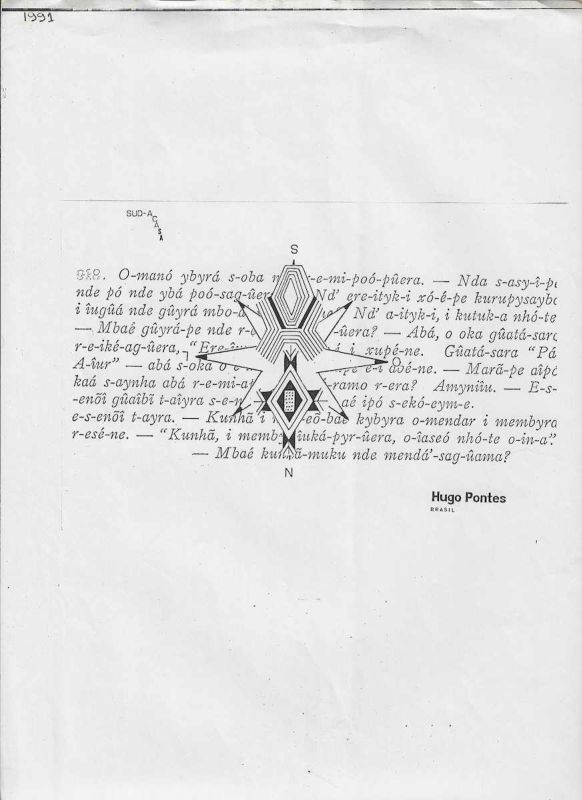
Impressão gráfica de Hugo Pontes intitulada Sud Acasa, obra de poesia visual e experimentação gráfica com anotação manuscrita de 1991 no canto superior esquerdo do exemplar.
Hugo Pontes
Categoria: Mail Art
Acervo: 04103
Data: 1991
Dimensões: 33 x 21,7 cm
TEXTO SALSA EM PORTUGUÊSImpressão gráfica de Hugo Pontes intitulada Sud Acasa, obra de poesia visual e experimentação gráfica com anotação manuscrita de 1991 no canto superior esquerdo do exemplar. A composição articula texto em língua de matriz indígena, desenho geométrico, orientação espacial e organização tipográfica em uma estrutura concentrada no centro da página.Na parte superior esquerda do núcleo visual aparece a inscrição SUD ACASA, com parte das letras organizadas verticalmente. No centro encontra se uma figura geométrica simétrica formada por losangos concêntricos, linhas angulares, áreas negras e extensões laterais semelhantes a setas. As letras S e N aparecem respectivamente acima e abaixo da estrutura, sugerindo os pontos cardeais Sul e Norte e estabelecendo uma relação direta com orientação, território, direção e representação do espaço.Ao fundo da figura geométrica há um texto corrido em caracteres latinos com palavras como mbaé, guyra, abá e kunhã, vocábulos que indicam relação com repertórios linguísticos de matriz tupi guarani. A identificação precisa da língua e da fonte textual deve permanecer aberta até que documentação complementar permita confirmação. O texto é parcialmente encoberto pela figura central, fazendo com que escrita e imagem se atravessem e funcionem como uma única construção visual.Sud Acasa transforma a leitura linear em leitura espacial. O observador precisa percorrer simultaneamente texto, símbolos, direções e formas geométricas. A inversão visual entre S no alto e N abaixo modifica uma convenção cartográfica habitual e pode sugerir questionamento de perspectivas tradicionais de orientação e representação territorial.Na parte inferior direita aparecem Hugo Pontes e BRASIL. A obra integra a produção experimental do artista relacionada à poesia visual brasileira, xerografia, poesia experimental, poesia semiótica, arte conceitual, comunicação visual, cartografia, território, linguagem indígena, cultura tupi guarani, grafismo, sistemas de signos e relações entre palavra e imagem.SALSA TEXT IN ENGLISHGraphic print by Hugo Pontes titled Sud Acasa, a work of visual poetry and graphic experimentation with a handwritten notation of 1991 at the upper left corner of the example. The composition combines text in a language of Indigenous linguistic origin, geometric drawing, spatial orientation and typographic organization within a structure concentrated at the center of the page.At the upper left of the visual nucleus appears the inscription SUD ACASA, with some of its letters arranged vertically. At the center is a symmetrical geometric figure formed by concentric diamonds, angular lines, black areas and lateral extensions resembling arrows. The letters S and N appear respectively above and below the structure, suggesting the cardinal directions South and North and establishing a direct relationship with orientation, territory, direction and spatial representation.Behind the geometric figure is a continuous text in Latin characters containing words such as mbaé, guyra, abá and kunhã, vocabulary that suggests a relationship with Tupi Guarani linguistic traditions. The exact language and textual source should remain open until complementary documentation allows confirmation. The text is partially covered by the central figure, causing writing and image to intersect and function as a single visual construction.Sud Acasa transforms linear reading into spatial reading. The viewer must simultaneously navigate text, symbols, directions and geometric forms. The visual placement of S above and N below reverses a conventional cartographic orientation and may suggest a questioning of traditional perspectives concerning orientation and territorial representation.At the lower right appear Hugo Pontes and BRASIL. The work belongs to the artists experimental production associated with Brazilian visual poetry, xerography, experimental poetry, semiotic poetry, conceptual art, visual communication, cartography, territory, Indigenous language, Tupi Guarani culture, graphic systems, sign systems and relationships between word and image.
TEXTO DE OBSERVAÇÃO EM PORTUGUÊSDocumento gráfico em preto sobre fundo branco de Hugo Pontes identificado como Sud Acasa. No canto superior esquerdo encontra se a anotação manuscrita 1991, informação importante para a cronologia do exemplar. Como a data não integra a composição impressa, é recomendável registrá la como anotação manuscrita associada ao documento.A obra possui amplo espaço branco e concentra seus elementos em uma faixa central horizontal. Uma linha fina atravessa a parte superior dessa área. Próximo à extremidade esquerda aparece SUD ACASA, com ACASA disposto de modo parcialmente vertical, reforçando a dimensão espacial da escrita.O elemento central apresenta forte simetria. É formado por sucessivos losangos e polígonos, linhas paralelas, zonas preenchidas em preto e prolongamentos laterais pontiagudos. A estrutura pode ser percebida como signo, diagrama, emblema, mapa abstrato ou sistema gráfico codificado.Acima do desenho aparece a letra S e abaixo a letra N. Essa disposição é particularmente relevante porque inverte a convenção cartográfica mais frequente, na qual o Norte aparece acima e o Sul abaixo. Essa inversão pode ser compreendida como elemento conceitual da obra e como questionamento de sistemas convencionais de orientação, embora essa interpretação não esteja explicitada verbalmente pelo artista.Ao fundo encontra se um texto de aparência indígena sul americana. Entre as formas claramente legíveis estão mbaé, guyra, abá e kunhã. Esses vocábulos são compatíveis com repertórios tupi guarani. Entretanto, não é seguro afirmar a língua específica nem a origem do trecho somente pela reprodução apresentada.O desenho cobre trechos do texto e impede sua leitura contínua. Esse bloqueio é essencial para a estrutura poética. A imagem interrompe a escrita e a escrita atravessa visualmente a imagem, fazendo com que ambas percam autonomia e se tornem componentes de um mesmo sistema.A obra pode ser lida como encontro entre linguagem verbal, cartografia e grafismo. O texto remete a uma tradição linguística de matriz indígena, enquanto as letras S e N remetem ao sistema ocidental de orientação cardinal. A justaposição desses códigos cria tensão entre diferentes modos de nomear, localizar e representar o mundo.A palavra Sud também reforça a dimensão geográfica, pois possui proximidade com formas linguísticas usadas para designar Sul em diferentes idiomas. Essa relação é visualmente reforçada pela letra S posicionada acima da figura. O significado exato de Acasa deve permanecer preservado sem correção ou normalização enquanto não houver documentação específica do artista.A estrutura geométrica apresenta semelhança visual com grafismos ameríndios, porém não deve ser atribuída a uma etnia ou tradição específica sem fonte documental. Para catalogação é mais seguro descrever a presença de um desenho geométrico que dialoga visualmente com um texto de provável matriz tupi guarani.No núcleo inferior da figura existe um pequeno losango contendo um retângulo pontilhado. Esse detalhe introduz outra camada de codificação visual e reforça a aparência diagramática da composição.Na parte inferior direita aparecem Hugo Pontes e BRASIL. A inscrição situa a obra no contexto brasileiro e reforça a relação entre território nacional e os demais elementos geográficos e linguísticos presentes na página.Sud Acasa é especialmente relevante para estudos sobre Hugo Pontes, poesia visual brasileira, poesia experimental, xerografia, poesia semiótica, arte conceitual, linguagem indígena, Tupi Guarani, cartografia, norte e sul, território, orientação espacial, grafismo, sistemas de signos, interculturalidade, palavra e imagem e arte brasileira do início da década de 1990.Para indexação digital são especialmente relevantes os termos Hugo Pontes, Sud Acasa, Sud Acasa 1991, poesia visual, visual poetry, poesia experimental, experimental poetry, xerografia, xerox art, poesia semiótica, arte conceitual, Tupi Guarani, linguagem indígena, Indigenous language, mbaé, guyra, abá, kunhã, cartografia visual, visual cartography, norte, sul, North, South, território, orientação, grafismo, geometric poetry, texto e imagem, Brasil e poesia visual brasileira.OBSERVATION TEXT IN ENGLISHBlack graphic document on a white background by Hugo Pontes identified as Sud Acasa. At the upper left corner appears the handwritten notation 1991, an important element for establishing the chronology of this example. Since the date is not part of the printed composition, it should preferably be catalogued as a handwritten notation associated with the document.The work contains extensive white space and concentrates its elements within a central horizontal zone. A thin line crosses the upper part of this area. Near the left side appears SUD ACASA, with ACASA arranged partly in a vertical direction, reinforcing the spatial dimension of the writing.The central element is strongly symmetrical. It is formed by successive diamonds and polygons, parallel lines, black filled areas and pointed lateral extensions. The structure can be perceived as a sign, diagram, emblem, abstract map or coded graphic system.Above the drawing appears the letter S and below it the letter N. This arrangement is particularly significant because it reverses the most common cartographic convention, in which North is positioned above and South below. This inversion may be understood as a conceptual element of the work and as a questioning of conventional systems of orientation, although this interpretation is not explicitly stated by the artist.Behind the drawing appears a text of South American Indigenous appearance. Among the clearly legible forms are mbaé, guyra, abá and kunhã. These words are compatible with Tupi Guarani vocabularies. However, the specific language and source of the passage cannot be securely determined from the reproduction alone.The drawing covers portions of the text and prevents continuous reading. This obstruction is essential to the poetic structure. The image interrupts the writing and the writing visually crosses the image, causing both to lose their independence and become components of a single system.The work can be interpreted as an encounter between verbal language, cartography and graphic form. The text refers to an Indigenous linguistic tradition, while the letters S and N refer to a Western system of cardinal orientation. The juxtaposition of these codes creates tension between different ways of naming, locating and representing the world.The word Sud also reinforces the geographical dimension because of its proximity to forms used to designate South in different languages. This relationship is visually reinforced by the letter S positioned above the figure. The exact meaning of Acasa should remain preserved without correction or normalization until specific documentation by the artist is located.The geometric structure visually resembles certain Amerindian graphic traditions, but it should not be attributed to any specific ethnic group or cultural tradition without documentary evidence. For cataloguing, it is safer to describe the presence of a geometric drawing in dialogue with a text of probable Tupi Guarani linguistic origin.Within the lower nucleus of the figure there is a small diamond containing a dotted rectangle. This detail introduces another layer of visual coding and reinforces the diagrammatic appearance of the composition.At the lower right appear Hugo Pontes and BRASIL. The inscription situates the work within the Brazilian context and reinforces the relationship between national territory and the other geographical and linguistic elements present on the page.Sud Acasa is particularly relevant to studies of Hugo Pontes, Brazilian visual poetry, experimental poetry, xerography, semiotic poetry, conceptual art, Indigenous language, Tupi Guarani, cartography, North and South, territory, spatial orientation, graphic systems, sign systems, interculturality, word and image and Brazilian art at the beginning of the 1990s.For digital indexing, particularly relevant terms include Hugo Pontes, Sud Acasa, Sud Acasa 1991, visual poetry, experimental poetry, xerography, xerox art, semiotic poetry, conceptual art, Tupi Guarani, Indigenous language, mbaé, guyra, abá, kunhã, visual cartography, North, South, territory, orientation, graphic systems, geometric poetry, text and image, Brazil and Brazilian visual poetry.
Proveniência
Coleção Poema ProcessoInglês
Graphic print by Hugo Pontes titled Sud Acasa, a work of visual poetry and graphic experimentation with a handwritten notation of 1991 at the upper left corner of the example.
Dimensions: 13 x 8,5 in