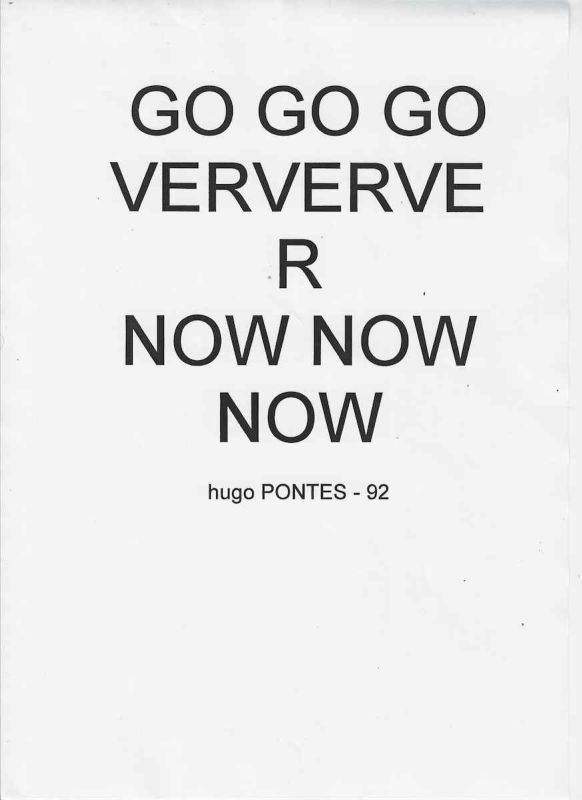
Impressão gráfica de Hugo Pontes datada de 1992, composta exclusivamente por linguagem verbal e organização tipográfica.
Hugo Pontes
Categoria: Mail Art
Acervo: 04076
Data: 1992
Dimensões: 29,7 x 21 cm
TEXTO PARA O SALSA EM PORTUGUÊSImpressão gráfica de Hugo Pontes datada de 1992, composta exclusivamente por linguagem verbal e organização tipográfica. A peça apresenta, em letras maiúsculas, a sequência GO GO GO na parte superior, seguida por VERVERVE, pela letra R isolada ao centro e pela repetição NOW NOW NOW na região inferior. Ao final aparece a identificação hugo PONTES 92, estabelecendo autoria e data.A obra se estrutura pela repetição, fragmentação e disposição espacial das palavras. GO, termo inglês associado a ir, avançar, mover-se ou agir, aparece três vezes e produz uma sensação de impulso e aceleração. NOW, também repetido três vezes, introduz a ideia de presente, urgência e imediatismo. Entre essas duas sequências surge VERVERVE e, abaixo, a letra R isolada, criando uma zona de instabilidade linguística que interrompe a leitura convencional e transforma a palavra em matéria visual.O trabalho explora a linguagem como estrutura gráfica e sonora. A repetição cria ritmo, enquanto o posicionamento das palavras e da letra isolada organiza uma leitura vertical marcada por pausas, deslocamentos e tensões. A composição não depende de imagem figurativa. O próprio texto é a imagem, aproximando a peça de procedimentos da poesia visual, poesia concreta, poesia experimental e arte conceitual.A presença de palavras em inglês amplia o caráter internacional da comunicação e pode ser relacionada à circulação transnacional da poesia visual e da arte postal. GO e NOW funcionam como comandos ou estímulos de ação, enquanto VERVERVE e R introduzem ambiguidade, ruído e ruptura sintática. A obra transforma vocabulário mínimo em uma construção visual baseada em repetição, ritmo, som, espacialização e montagem tipográfica.A peça pode ser relacionada aos campos da poesia visual brasileira, poema visual, poesia experimental, poesia concreta, arte conceitual, tipografia experimental, linguagem verbal, comunicação visual, word art, poesia tipográfica, repetição, ritmo, espacialização da palavra, arte postal e redes internacionais de poesia visual. A data de 1992 constitui elemento documental importante para situar a obra na produção de Hugo Pontes no início da década de 1990.SALSA TEXT IN ENGLISHGraphic print by Hugo Pontes dated 1992, composed exclusively through verbal language and typographic organization. The piece presents the sequence GO GO GO in capital letters at the top, followed by VERVERVE, an isolated letter R at the center and the repetition NOW NOW NOW in the lower section. At the bottom appears the identification hugo PONTES 92, establishing authorship and date.The work is structured through repetition, fragmentation and spatial arrangement of words. GO, associated with movement, action and advance, appears three times and produces a sensation of impulse and acceleration. NOW, also repeated three times, introduces the ideas of immediacy, urgency and the present moment. Between these two sequences appears VERVERVE and, below it, the isolated letter R, creating a zone of linguistic instability that interrupts conventional reading and transforms language into visual material.The work explores language as both graphic and sonic structure. Repetition generates rhythm, while the positioning of words and the isolated letter organizes a vertical reading marked by pauses, displacements and tensions. The composition does not depend on figurative imagery. The text itself becomes the image, bringing the piece close to visual poetry, concrete poetry, experimental poetry and conceptual art.The use of English words reinforces the international character of communication and can be associated with the transnational circulation of visual poetry and mail art. GO and NOW function as commands or stimuli for action, while VERVERVE and R introduce ambiguity, noise and syntactic disruption. The work transforms minimal vocabulary into a visual construction based on repetition, rhythm, sound, spatialization and typographic montage.The piece can be associated with Brazilian visual poetry, visual poem, experimental poetry, concrete poetry, conceptual art, experimental typography, verbal language, visual communication, word art, typographic poetry, repetition, rhythm, spatialization of the word, mail art and international networks of visual poetry. The date 1992 is an important documentary element for situating the work within Hugo Pontes's production in the early 1990s.
TEXTO DE OBSERVAÇÃO EM PORTUGUÊSImpressão gráfica em preto e branco de Hugo Pontes, datada de 1992. A composição utiliza apenas elementos tipográficos sobre fundo branco. Na parte superior aparece GO GO GO em grandes letras maiúsculas. Abaixo está a sequência VERVERVE. No eixo central surge a letra R isolada. Em seguida aparecem NOW NOW e, abaixo, NOW, formando uma disposição escalonada. Na região inferior lê-se hugo PONTES 92.A peça emprega repetição verbal, espaçamento, alinhamento e fragmentação como recursos de construção visual. GO e NOW são palavras em inglês, enquanto VERVERVE e a letra R isolada produzem uma estrutura de leitura aberta e não convencional. A disposição gráfica transforma o texto em imagem e faz com que ritmo, pausa, repetição e posição espacial sejam partes fundamentais do significado.O trabalho pode ser catalogado como poesia visual, poema tipográfico e experimentação verbo visual. A ausência de figuração reforça a autonomia da palavra como elemento plástico e visual. A peça é especialmente relevante para pesquisas sobre Hugo Pontes, poesia visual brasileira, poesia experimental dos anos 1990, tipografia, arte conceitual, word art, arte postal, linguagem internacional e circulação de poesia visual.Para indexação digital, podem ser utilizados os termos Hugo Pontes, 1992, Go Go Go, Ververve, R, Now Now Now, poesia visual brasileira, poema visual, poesia concreta, poesia experimental, poesia tipográfica, arte conceitual, arte gráfica, tipografia experimental, palavra como imagem, word art, linguagem verbal, repetição, ritmo, espacialização, comunicação visual, mail art e poesia visual internacional.OBSERVATION TEXT IN ENGLISHBlack and white graphic print by Hugo Pontes, dated 1992. The composition uses only typographic elements against a white background. At the top appears GO GO GO in large capital letters. Below it is the sequence VERVERVE. On the central axis appears the isolated letter R. This is followed by NOW NOW and, beneath it, NOW, creating a stepped arrangement. In the lower area appears the identification hugo PONTES 92.The piece employs verbal repetition, spacing, alignment and fragmentation as visual construction devices. GO and NOW are English words, while VERVERVE and the isolated letter R create an open and unconventional reading structure. The graphic arrangement transforms text into image and makes rhythm, pause, repetition and spatial position fundamental components of meaning.The work can be catalogued as visual poetry, typographic poem and verbal visual experimentation. The absence of figurative imagery reinforces the autonomy of the word as a plastic and visual element. The piece is especially relevant to research on Hugo Pontes, Brazilian visual poetry, experimental poetry of the 1990s, typography, conceptual art, word art, mail art, international language and the circulation of visual poetry.For digital indexing, relevant terms include Hugo Pontes, 1992, Go Go Go, Ververve, R, Now Now Now, Brazilian visual poetry, visual poem, concrete poetry, experimental poetry, typographic poetry, conceptual art, graphic art, experimental typography, word as image, word art, verbal language, repetition, rhythm, spatialization, visual communication, mail art and international visual poetry.
Proveniência
Coleção Poema ProcessoInglês
Graphic print by Hugo Pontes dated 1992, composed exclusively through verbal language and typographic organization.
Dimensions: 11,7 x 8,3 in