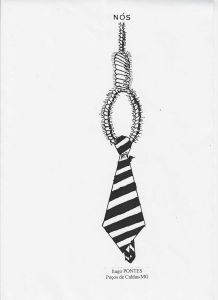
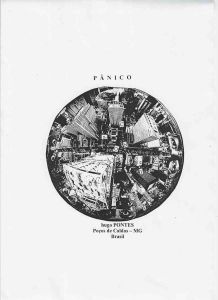
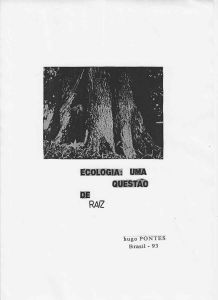
Impressão gráfica e poema visual de Hugo Pontes pertencente à série Descobrimento 500 Anos, identificada na própria obra com o nome hugo PONTES e a indicação Brasil.
Hugo Pontes
Categoria: Mail Art
Acervo: 04064
Dimensões: 29,7 x 21 cm
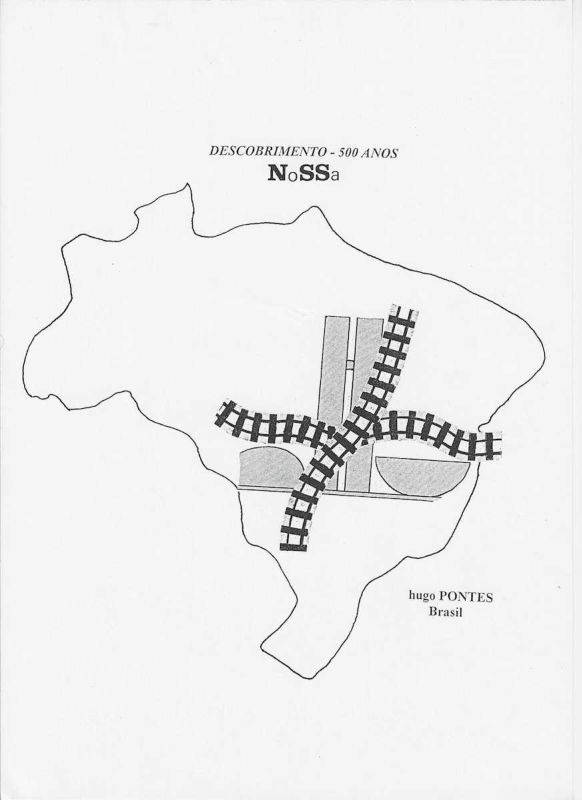
TEXTO PARA O SALSA EM PORTUGUÊSImpressão gráfica e poema visual de Hugo Pontes pertencente à série Descobrimento 500 Anos, identificada na própria obra com o nome hugo PONTES e a indicação Brasil. A composição utiliza o contorno do mapa brasileiro como estrutura principal e insere em seu interior uma imagem relacionada à arquitetura e ao traçado urbano de Brasília, atravessada por linhas que remetem visualmente a trilhos ferroviários, caminhos ou estruturas de circulação. Acima do mapa aparecem o título DESCOBRIMENTO 500 ANOS e a palavra NoSSa, construída com variação tipográfica entre letras maiúsculas e minúsculas e funcionando como elemento verbal central da obra.A palavra NoSSa pode ser lida simultaneamente como pronome possessivo e como construção gráfica marcada pela ênfase nas letras SS. Essa escolha amplia o caráter de poesia visual da composição, pois o sentido não depende apenas da palavra, mas também de sua forma tipográfica. Em associação com o mapa do Brasil, a expressão pode sugerir ideias de pertencimento, território, posse, identidade nacional e apropriação coletiva ou institucional do espaço brasileiro.No interior do mapa aparece uma estrutura que remete ao conjunto arquitetônico e urbanístico de Brasília. Sobre ela cruzam se várias faixas semelhantes a trilhos, formando uma rede de direções e intersecções. A imagem introduz uma reflexão sobre circulação, planejamento territorial, modernização, construção nacional e organização do espaço. A sobreposição dessas estruturas ao mapa reforça a leitura do Brasil como território continuamente redesenhado por projetos políticos, econômicos, urbanos e institucionais.Dentro da série Descobrimento 500 Anos, a obra amplia a investigação de Hugo Pontes sobre diferentes momentos da história brasileira. Enquanto outros trabalhos do conjunto apresentam caravelas, bancos, empresas, organismos financeiros, figuras indígenas e símbolos de violência, esta composição desloca a atenção para a construção moderna do país e para Brasília como símbolo de projeto nacional, poder político e ocupação territorial.A obra utiliza síntese gráfica, apropriação de imagem, montagem, tipografia e relação entre palavra e imagem como procedimentos de poesia visual. O mapa do Brasil funciona novamente como campo semântico, recebendo elementos que modificam sua leitura e transformam o território em suporte conceitual. O trabalho possui interesse para pesquisas sobre Hugo Pontes, poesia visual brasileira, Descobrimento 500 Anos, Brasília, arquitetura moderna, urbanismo, identidade nacional, território, poder político, circulação e memória histórica.Na parte inferior direita aparecem hugo PONTES e Brasil. Não são visíveis data de produção, editora, tiragem, dimensões ou técnica específica de impressão. Embora o título Descobrimento 500 Anos se relacione diretamente ao quinto centenário da chegada portuguesa ao Brasil, a imagem apresentada não permite determinar com segurança a data exata de produção.TEXT FOR SALSA IN ENGLISHGraphic print and visual poem by Hugo Pontes belonging to the Descobrimento 500 Anos series, identified on the work itself with the name hugo PONTES and the designation Brasil. The composition uses the outline of the Brazilian map as its principal structure and places inside it an image related to the architecture and urban layout of Brasília, crossed by lines that visually resemble railway tracks, pathways or circulation structures. Above the map appear the title DESCOBRIMENTO 500 ANOS and the word NoSSa, constructed with a typographic variation between uppercase and lowercase letters and functioning as the central verbal element of the work.The word NoSSa can be read simultaneously as a possessive expression and as a graphic construction emphasizing the letters SS. This choice reinforces the visual poetry character of the composition because meaning depends not only on the word itself but also on its typographic form. In association with the map of Brazil, the expression may suggest ideas of belonging, territory, possession, national identity and collective or institutional appropriation of Brazilian space.Inside the map appears a structure that evokes the architectural and urban planning imagery of Brasília. Several track like bands cross over it, forming a network of directions and intersections. The image introduces reflections on circulation, territorial planning, modernization, national construction and spatial organization. The superimposition of these structures on the Brazilian map reinforces the reading of the country as a territory continually redesigned by political, economic, urban and institutional projects.Within the Descobrimento 500 Anos series, the work expands Hugo Pontes investigation into different moments of Brazilian history. While other works in the group present caravels, banks, corporations, financial institutions, Indigenous figures and symbols of violence, this composition shifts attention toward the modern construction of the country and toward Brasília as a symbol of national planning, political power and territorial occupation.The work uses graphic synthesis, image appropriation, montage, typography and the relationship between word and image as procedures of visual poetry. The map of Brazil once again functions as a semantic field, receiving elements that transform its meaning and turn national territory into a conceptual support. The piece is relevant to research on Hugo Pontes, Brazilian visual poetry, Descobrimento 500 Anos, Brasília, modern architecture, urban planning, national identity, territory, political power, circulation and historical memory.The lower right area contains hugo PONTES and Brasil. No production date, publisher, print run, dimensions or specific printing technique is visible. Although the title Descobrimento 500 Anos is directly connected with the five hundredth anniversary of the Portuguese arrival in Brazil, the supplied image does not establish the exact production date with certainty.
TEXTO DE OBSERVAÇÃO EM PORTUGUÊSImpressão gráfica em preto e branco de Hugo Pontes com o título DESCOBRIMENTO 500 ANOS e a palavra NoSSa. A composição apresenta uma grande silhueta do mapa do Brasil ocupando a região central da folha. No interior do mapa aparece uma imagem arquitetônica e urbana associável visualmente a Brasília, atravessada por diversas faixas semelhantes a trilhos ou linhas de circulação.A palavra NoSSa aparece logo abaixo do título e se destaca pela alternância entre letras maiúsculas e minúsculas. A ênfase gráfica nas letras SS transforma a palavra em elemento de poesia visual e amplia possibilidades de leitura relacionadas a posse, pertencimento e identidade coletiva. Como não há texto explicativo na obra, essas interpretações devem permanecer abertas.As faixas que atravessam a imagem central formam intersecções e sugerem deslocamento, rede, transporte ou organização espacial. Em conjunto com a referência visual a Brasília, podem ser relacionadas a urbanização, modernização e planejamento territorial. O mapa brasileiro funciona como recipiente desses signos e cria uma associação entre país, espaço, poder e projeto nacional.Na parte inferior direita aparecem hugo PONTES e Brasil. Não são visíveis data, editora, tiragem, dimensões ou técnica de impressão. A obra integra visualmente a série Descobrimento 500 Anos e possui interesse para estudos sobre Hugo Pontes, poesia visual, Brasília, modernismo brasileiro, arquitetura, urbanismo, identidade nacional, território, poder político e memória histórica.OBSERVATION TEXT IN ENGLISHBlack and white graphic print by Hugo Pontes carrying the title DESCOBRIMENTO 500 ANOS and the word NoSSa. The composition presents a large outline of the map of Brazil occupying the central area of the sheet. Inside the map appears an architectural and urban image visually associated with Brasília, crossed by several bands resembling railway tracks or circulation lines.The word NoSSa appears immediately below the title and stands out because of the alternation between uppercase and lowercase letters. The graphic emphasis on the letters SS transforms the word into an element of visual poetry and expands possible readings involving possession, belonging and collective identity. Since the work contains no explanatory text, these interpretations should remain open.The bands crossing the central image form intersections and suggest movement, networks, transportation or spatial organization. Together with the visual reference to Brasília, they may be related to urbanization, modernization and territorial planning. The Brazilian map functions as a container for these signs and creates an association among country, space, power and national planning.The lower right area contains hugo PONTES and Brasil. No date, publisher, print run, dimensions or printing technique is visible. The work visually belongs to the Descobrimento 500 Anos series and is relevant to research on Hugo Pontes, visual poetry, Brasília, Brazilian modernism, architecture, urban planning, national identity, territory, political power and historical memory.
Proveniência
Coleção Poema ProcessoInglês
Graphic print and visual poem by Hugo Pontes belonging to the Descobrimento 500 Anos series, identified on the work itself with the name hugo PONTES and the designation Brasil.
Dimensions: 11,7 x 8,3 in