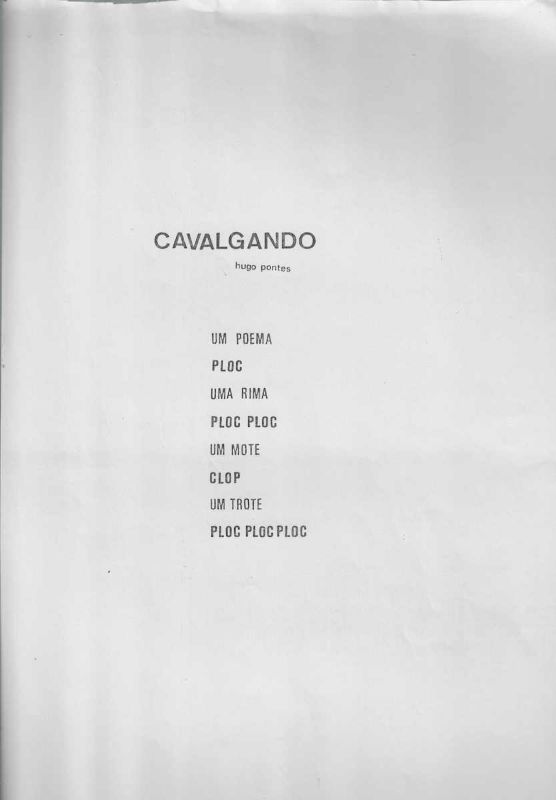
Impressão gráfica de Hugo Pontes intitulada Cavalgando, obra de poesia visual, poesia sonora e experimentação verbal construída pela associação entre palavras, ritmo e onomatopeias.
Hugo Pontes
Categoria: Mail Art
Acervo: 04100
Dimensões: 33 x 21 cm
TEXTO SALSA EM PORTUGUÊSImpressão gráfica de Hugo Pontes intitulada Cavalgando, obra de poesia visual, poesia sonora e experimentação verbal construída pela associação entre palavras, ritmo e onomatopeias. A composição apresenta no alto o título CAVALGANDO e logo abaixo a identificação hugo pontes. No centro da página encontra se um poema de estrutura vertical formado pelas expressões UM POEMA, PLOC, UMA RIMA, PLOC PLOC, UM MOTE, CLOP, UM TROTE e PLOC PLOC PLOC.Cavalgando transforma a leitura em experiência rítmica e sonora. As palavras PLOC e CLOP imitam de maneira gráfica e fonética sons relacionados ao movimento e ao trote de um cavalo. A repetição progressiva de PLOC cria uma pulsação crescente e estabelece correspondência entre ritmo poético e deslocamento corporal. A palavra TROTE confirma a relação entre a estrutura sonora do poema e a ideia de cavalgada sugerida pelo título.Hugo Pontes aproxima conceitos tradicionais da poesia, como poema, rima e mote, de sons onomatopaicos. A linguagem literária encontra assim uma linguagem sonora elementar. A sequência UM POEMA, UMA RIMA, UM MOTE e UM TROTE articula criação poética e movimento, enquanto PLOC, PLOC PLOC, CLOP e PLOC PLOC PLOC produzem marcações rítmicas semelhantes a batidas ou passadas.A grande área branca ao redor do texto concentra a atenção na sequência verbal e valoriza pausas, intervalos e silêncio como partes da composição. Cavalgando integra a produção experimental de Hugo Pontes relacionada à poesia visual brasileira, poesia sonora, poesia experimental, poesia concreta, onomatopeia, tipografia, ritmo, oralidade, comunicação visual e relações entre palavra, som e movimento.SALSA TEXT IN ENGLISHGraphic print by Hugo Pontes titled Cavalgando, a work of visual poetry, sound poetry and verbal experimentation constructed through the relationship between words, rhythm and onomatopoeia. At the top appears the title CAVALGANDO followed by the identification hugo pontes. At the center of the page is a vertically structured poem composed of the expressions UM POEMA, PLOC, UMA RIMA, PLOC PLOC, UM MOTE, CLOP, UM TROTE and PLOC PLOC PLOC.Cavalgando transforms reading into a rhythmic and sonic experience. The words PLOC and CLOP graphically and phonetically imitate sounds associated with the movement and trot of a horse. The progressive repetition of PLOC creates an increasing pulse and establishes a correspondence between poetic rhythm and bodily movement. The word TROTE, meaning trot, confirms the relationship between the sound structure of the poem and the act of riding suggested by the title.Hugo Pontes brings traditional poetic concepts such as poem, rhyme and poetic theme together with elementary onomatopoeic sounds. Literary language therefore encounters a direct sonic language. The sequence UM POEMA, UMA RIMA, UM MOTE and UM TROTE connects poetic creation with movement, while PLOC, PLOC PLOC, CLOP and PLOC PLOC PLOC create rhythmic markings resembling beats or footsteps.The extensive white space surrounding the text concentrates attention on the verbal sequence and gives importance to pauses, intervals and silence as components of the composition. Cavalgando belongs to Hugo Pontes experimental production associated with Brazilian visual poetry, sound poetry, experimental poetry, concrete poetry, onomatopoeia, typography, rhythm, orality, visual communication and relationships between word, sound and movement.
TEXTO DE OBSERVAÇÃO EM PORTUGUÊSDocumento gráfico em preto sobre fundo branco de Hugo Pontes identificado pelo título CAVALGANDO. A composição apresenta forte economia visual e organiza todo o conteúdo poético em uma pequena área central da página. O amplo espaço vazio ao redor do poema participa diretamente da estrutura, isolando as palavras e ampliando a percepção de ritmo, pausa e silêncio.No alto aparece CAVALGANDO em letras maiúsculas. Logo abaixo encontra se a inscrição hugo pontes em letras minúsculas. O corpo do poema apresenta oito unidades sucessivas dispostas verticalmente. A leitura visível é UM POEMA, PLOC, UMA RIMA, PLOC PLOC, UM MOTE, CLOP, UM TROTE e PLOC PLOC PLOC.A estrutura possui alternância entre frases verbais e expressões sonoras. UM POEMA é seguido de PLOC. UMA RIMA é seguida por PLOC PLOC. UM MOTE é seguido por CLOP. UM TROTE é concluído por PLOC PLOC PLOC. Esse sistema produz uma espécie de partitura verbal em que palavras relacionadas à poesia alternam com sons imaginados.PLOC e CLOP são utilizados como onomatopeias. Sua função não é apenas representar um ruído, mas determinar o ritmo da leitura. O leitor pode vocalizar os sinais sonoros e transformar o poema escrito em pequena performance oral. Dessa forma, a obra aproxima poesia visual e poesia sonora.A progressão de um PLOC para dois PLOC e posteriormente três PLOC cria sensação de aceleração ou intensificação. A sequência pode lembrar os impactos sucessivos dos cascos de um cavalo contra o solo. O aparecimento de CLOP introduz uma variação sonora e interrompe temporariamente o padrão anterior.A palavra TROTE possui papel decisivo porque revela explicitamente a relação com o movimento de um cavalo. O título Cavalgando amplia esse sentido e faz com que toda a sequência sonora possa ser interpretada como representação verbal e acústica de uma cavalgada.Existe também um jogo entre vocabulário poético e movimento. POEMA, RIMA e MOTE pertencem ao universo da composição literária. TROTE pertence ao campo do deslocamento equestre. Hugo Pontes aproxima esses universos e transforma o ato de escrever poesia em percurso rítmico.A obra demonstra que o significado não depende apenas das palavras lexicais. Quantidade, repetição, intervalo, disposição espacial e som participam da construção poética. A página funciona simultaneamente como texto, imagem e possível roteiro de vocalização.A ausência de elementos figurativos é relevante. Não aparece a representação de cavalo ou cavaleiro. A cavalgada é construída exclusivamente por linguagem, ritmo e imaginação sonora. Esse procedimento reforça o caráter conceitual e econômico da composição.Cavalgando pode ser relacionado à poesia visual, poesia sonora, poesia concreta e experiências de oralidade, performance e notação verbal. A obra também é relevante para estudos sobre onomatopeia na arte, relações entre texto e som, ritmo tipográfico e poesia brasileira experimental.Não há data ou localização visível na reprodução apresentada. A obra deve permanecer catalogada como sem data ou data não identificada até que documentação complementar permita estabelecer uma cronologia segura.Para indexação digital são especialmente relevantes os termos Hugo Pontes, Cavalgando, poesia visual, visual poetry, poesia sonora, sound poetry, poesia experimental, experimental poetry, poesia concreta, concrete poetry, onomatopeia, PLOC, CLOP, poema, rima, mote, trote, cavalo, horse, horseback riding, ritmo, oralidade, performance poética, tipografia experimental, semiótica, comunicação visual, palavra e som, poesia brasileira e poesia visual brasileira.OBSERVATION TEXT IN ENGLISHBlack graphic document on a white background by Hugo Pontes identified by the title CAVALGANDO. The composition is characterized by strong visual economy and concentrates all poetic content within a small central area of the page. The extensive empty space surrounding the poem directly participates in its structure by isolating the words and increasing the perception of rhythm, pause and silence.At the top appears CAVALGANDO in uppercase letters. Immediately below is the inscription hugo pontes in lowercase letters. The body of the poem contains eight successive units arranged vertically. The visible sequence reads UM POEMA, PLOC, UMA RIMA, PLOC PLOC, UM MOTE, CLOP, UM TROTE and PLOC PLOC PLOC.The structure alternates verbal phrases with sound expressions. UM POEMA is followed by PLOC. UMA RIMA is followed by PLOC PLOC. UM MOTE is followed by CLOP. UM TROTE concludes with PLOC PLOC PLOC. This system produces a kind of verbal score in which words related to poetry alternate with imagined sounds.PLOC and CLOP function as onomatopoeia. Their role is not only to represent noise but also to determine the rhythm of reading. A reader can vocalize these sound signs and transform the written poem into a brief oral performance. The work therefore creates a close relationship between visual poetry and sound poetry.The progression from one PLOC to two PLOC sounds and later three PLOC sounds creates a sense of acceleration or intensification. The sequence can evoke repeated impacts of horse hooves against the ground. The appearance of CLOP introduces a sonic variation and temporarily interrupts the previous pattern.The word TROTE plays a decisive role because it explicitly reveals the relationship with the movement of a horse. The title Cavalgando expands this meaning and allows the entire sound sequence to be interpreted as a verbal and acoustic representation of horseback movement.There is also a play between poetic vocabulary and physical motion. POEMA, RIMA and MOTE belong to the language of literary composition. TROTE belongs to the vocabulary of equestrian movement. Hugo Pontes brings these fields together and transforms the act of creating poetry into a rhythmic journey.The work demonstrates that meaning does not depend only on lexical words. Quantity, repetition, interval, spatial arrangement and sound participate in the construction of the poem. The page functions simultaneously as text, image and a potential script for vocal performance.The absence of figurative imagery is significant. No horse or rider is represented. The act of riding is constructed exclusively through language, rhythm and sonic imagination. This procedure reinforces the conceptual and economical character of the composition.Cavalgando can be associated with visual poetry, sound poetry, concrete poetry and experiments involving orality, performance and verbal notation. The work is also relevant to studies of onomatopoeia in art, relationships between text and sound, typographic rhythm and Brazilian experimental poetry.No date or location is visible in the reproduction provided. The work should remain catalogued as undated or date unidentified until complementary documentation allows a reliable chronology to be established.For digital indexing, particularly relevant terms include Hugo Pontes, Cavalgando, visual poetry, sound poetry, experimental poetry, concrete poetry, onomatopoeia, PLOC, CLOP, poem, rhyme, poetic theme, trot, horse, horseback riding, rhythm, orality, poetic performance, experimental typography, semiotics, visual communication, word and sound, Brazilian poetry and Brazilian visual poetry.
Proveniência
Coleção Poema ProcessoInglês
Graphic print by Hugo Pontes titled Cavalgando, a work of visual poetry, sound poetry and verbal experimentation constructed through the relationship between words, rhythm and onomatopoeia.
Dimensions: 13 x 8,3 in