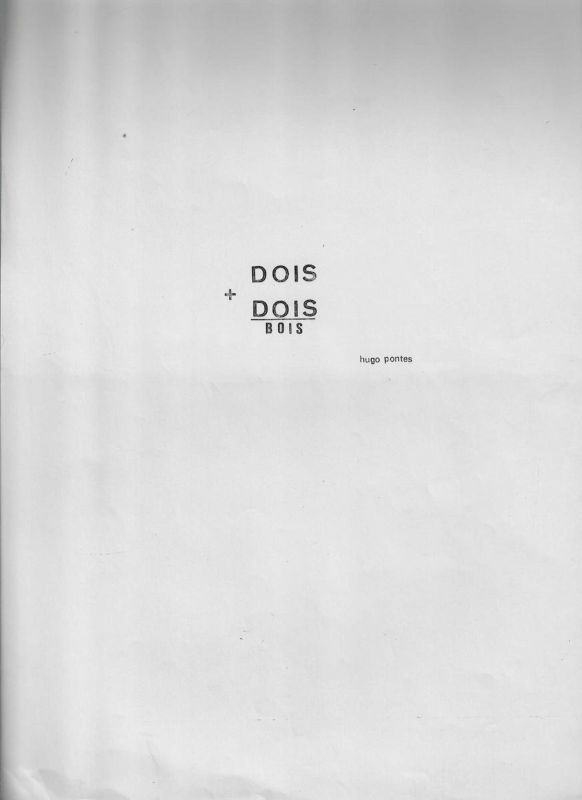
Impressão gráfica de Hugo Pontes intitulada Dois Dois Bois, obra de poesia visual e experimentação tipográfica construída a partir de uma operação aparentemente matemática que se transforma em jogo verbal
Hugo Pontes
Categoria: Mail Art
Acervo: 04099
Dimensões: 31,5 x 21,5 cm
TEXTO SALSA EM PORTUGUÊSImpressão gráfica de Hugo Pontes intitulada Dois Dois Bois, obra de poesia visual e experimentação tipográfica construída a partir de uma operação aparentemente matemática que se transforma em jogo verbal. No centro da página aparecem as palavras DOIS e DOIS organizadas como uma conta de adição, acompanhadas pelo sinal de mais e por uma linha horizontal. Abaixo do segundo DOIS surge a palavra BOIS, criando uma quebra deliberada da lógica aritmética e convertendo a soma em operação poética.A obra explora a proximidade gráfica e sonora entre DOIS e BOIS. A substituição de uma única letra altera completamente o sentido da expressão e transforma um cálculo numérico em jogo de linguagem. Em vez de apresentar um resultado matemático esperado, Hugo Pontes introduz uma palavra concreta e figurativa, deslocando a leitura do campo da matemática para o campo da poesia visual, do humor e da semiótica.A composição utiliza grande área branca ao redor do pequeno núcleo textual, reforçando a concentração da leitura no jogo entre palavras e sinais. O sinal de mais e a linha horizontal mantêm a aparência de uma operação matemática, enquanto a palavra BOIS rompe essa expectativa. À direita aparece a identificação hugo pontes.Dois Dois Bois integra a produção experimental de Hugo Pontes relacionada à poesia visual brasileira, poesia concreta, poesia experimental, semiótica, tipografia, jogos verbais, humor, comunicação visual e relações entre linguagem, número e imagem.SALSA TEXT IN ENGLISHGraphic print by Hugo Pontes titled Dois Dois Bois, a work of visual poetry and typographic experimentation constructed from an apparently mathematical operation that becomes a verbal game. At the center of the page appear the words DOIS and DOIS arranged like an addition problem, accompanied by a plus sign and a horizontal line. Below the second DOIS appears the word BOIS, deliberately breaking the arithmetic logic and transforming the sum into a poetic operation.The work explores the graphic and phonetic proximity between DOIS, meaning two, and BOIS, meaning oxen. The substitution of a single letter completely changes the meaning of the expression and transforms a numerical calculation into a linguistic game. Instead of presenting an expected mathematical result, Hugo Pontes introduces a concrete and figurative word, shifting the reading from mathematics toward visual poetry, humor and semiotics.The composition uses a large field of white space around the small textual core, reinforcing concentration on the relationship between words and signs. The plus sign and horizontal line preserve the appearance of a mathematical operation, while the word BOIS disrupts that expectation. To the right appears the identification hugo pontes.Dois Dois Bois belongs to Hugo Pontes experimental production associated with Brazilian visual poetry, concrete poetry, experimental poetry, semiotics, typography, verbal games, humor, visual communication and relationships between language, number and image.
TEXTO DE OBSERVAÇÃO EM PORTUGUÊSDocumento gráfico em preto sobre fundo branco de Hugo Pontes, construído com extrema economia de elementos. No centro superior da página aparece a palavra DOIS. Abaixo encontra se um sinal de mais seguido de outro DOIS. Uma linha horizontal separa essa estrutura da palavra BOIS, posicionada imediatamente abaixo como se fosse o resultado de uma conta de adição. À direita aparece a inscrição hugo pontes em letras minúsculas.A composição imita deliberadamente a estrutura visual de uma operação aritmética. O leitor reconhece inicialmente a fórmula dois mais dois e espera encontrar um resultado numérico. Hugo Pontes interrompe essa expectativa ao introduzir BOIS no lugar do resultado convencional.O mecanismo poético depende da proximidade entre DOIS e BOIS. As duas palavras possuem quatro letras e diferem apenas pela inicial. A passagem de D para B converte uma quantidade numérica em substantivo plural. Essa transformação mínima produz o efeito conceitual da obra.A leitura também pode ser compreendida como deslocamento entre linguagem abstrata e linguagem concreta. DOIS pertence ao campo da quantidade e da matemática. BOIS designa animais e introduz imediatamente uma imagem mental. O poema transforma número em coisa, cálculo em figura e operação matemática em construção verbal.O sinal de mais desempenha dupla função. Ele mantém a aparência de cálculo e também funciona como elemento gráfico da composição. A linha horizontal, normalmente utilizada para separar a operação de seu resultado, reforça a expectativa matemática que será quebrada pela palavra final.O humor surge da falsa solução da conta. A obra não apresenta quatro como resposta, mas BOIS. Essa substituição produz absurdo lógico e ao mesmo tempo coerência visual e fonética. O poema utiliza o erro deliberado como procedimento criativo.A grande quantidade de espaço branco é parte importante da composição. O núcleo textual ocupa uma pequena parcela da página e parece isolado. Essa organização amplia a força do jogo verbal e evita qualquer elemento visual que possa competir com a operação central.Dois Dois Bois pode ser relacionado a procedimentos da poesia concreta e da poesia visual em que disposição tipográfica, espacialidade, signos matemáticos e relações fonéticas constituem o próprio conteúdo do poema. A obra demonstra como Hugo Pontes utiliza elementos mínimos da língua para produzir múltiplos níveis de leitura.Não há data ou localização visível na reprodução apresentada. A obra deve portanto permanecer catalogada como sem data ou data não identificada até que documentação complementar permita estabelecer uma cronologia segura.Para indexação digital são especialmente relevantes os termos Hugo Pontes, Dois Dois Bois, Dois Mais Dois Bois, dois mais dois, bois, poesia visual, visual poetry, poesia concreta, concrete poetry, poesia experimental, jogo de palavras, wordplay, humor visual, semiótica, matemática na arte, mathematical poetry, tipografia experimental, comunicação visual, linguagem e número, palavra e imagem, arte gráfica, Brasil e poesia visual brasileira.OBSERVATION TEXT IN ENGLISHBlack graphic document on a white background by Hugo Pontes, constructed with extreme economy of elements. Near the upper central area of the page appears the word DOIS. Below it is a plus sign followed by another DOIS. A horizontal line separates this structure from the word BOIS, positioned immediately underneath as if it were the result of an addition problem. To the right appears the inscription hugo pontes in lowercase letters.The composition deliberately imitates the visual structure of an arithmetic operation. The viewer initially recognizes the formula two plus two and expects to find a numerical result. Hugo Pontes interrupts this expectation by introducing BOIS instead of the conventional answer.The poetic mechanism depends on the proximity between DOIS and BOIS. Both words contain four letters and differ only in their initial character. The shift from D to B transforms a numerical quantity into a plural noun. This minimal transformation creates the conceptual effect of the work.The reading can also be understood as a displacement between abstract and concrete language. DOIS belongs to the field of quantity and mathematics. BOIS refers to animals and immediately generates a mental image. The poem transforms number into object, calculation into figure and mathematical operation into verbal construction.The plus sign performs a double function. It preserves the appearance of a calculation and also acts as a graphic element within the composition. The horizontal line, normally used to separate an operation from its result, reinforces the mathematical expectation that is then broken by the final word.Humor emerges from the false solution to the equation. The work does not present four as the answer but BOIS. This substitution produces logical absurdity while maintaining visual and phonetic coherence. The poem uses deliberate error as a creative procedure.The large amount of white space is an important part of the composition. The textual core occupies only a small portion of the page and appears isolated. This organization increases the force of the verbal game and avoids any visual element that might compete with the central operation.Dois Dois Bois can be related to procedures of concrete poetry and visual poetry in which typographic arrangement, spatial organization, mathematical signs and phonetic relationships constitute the content of the poem itself. The work demonstrates how Hugo Pontes uses minimal linguistic elements to produce multiple levels of reading.No date or location is visible in the reproduction provided. The work should therefore remain catalogued as undated or date unidentified until complementary documentation allows a reliable chronology to be established.For digital indexing, particularly relevant terms include Hugo Pontes, Dois Dois Bois, Dois Mais Dois Bois, two plus two, oxen, visual poetry, concrete poetry, experimental poetry, wordplay, visual humor, semiotics, mathematics in art, mathematical poetry, experimental typography, visual communication, language and number, word and image, graphic art, Brazil and Brazilian visual poetry.
Proveniência
Coleção Poema ProcessoInglês
Graphic print by Hugo Pontes titled Dois Dois Bois, a work of visual poetry and typographic experimentation constructed from an apparently mathematical operation that becomes a verbal game.
Dimensions: 12,4 x 8,5 in