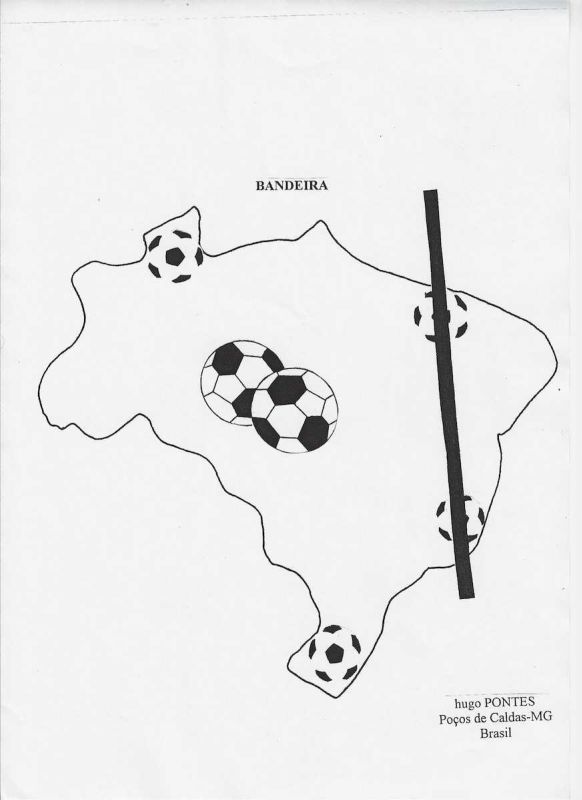
Impressão gráfica e poema visual de Hugo Pontes intitulada Bandeira, identificada na própria obra com o nome hugo PONTES, Poços de Caldas MG, Brasil.
Hugo Pontes
Categoria: Mail Art
Acervo: 04069
Dimensões: 29,7 x 21 cm
TEXTO PARA O SALSA EM PORTUGUÊSImpressão gráfica e poema visual de Hugo Pontes intitulada Bandeira, identificada na própria obra com o nome hugo PONTES, Poços de Caldas MG, Brasil. A composição utiliza o contorno do mapa do Brasil como estrutura principal e insere em seu interior diferentes bolas de futebol, além de uma faixa vertical escura posicionada na região direita do território. O título BANDEIRA aparece na parte superior e orienta a leitura da obra para questões de identidade nacional, símbolos coletivos, futebol e construção visual da imagem do Brasil.As bolas de futebol aparecem distribuídas em diferentes pontos do mapa. Duas ocupam a região central e outras aparecem próximas às extremidades do território. Na lateral direita, uma forma vertical atravessa parte do mapa e intercepta visualmente algumas dessas bolas. A organização gráfica transforma o território brasileiro em um campo simbólico no qual o futebol substitui elementos convencionais associados à bandeira nacional.O título Bandeira estabelece uma relação direta entre o mapa do país e os signos do futebol, um dos elementos mais reconhecíveis da cultura popular brasileira. A obra pode ser interpretada como reflexão sobre a maneira pela qual o futebol participa da construção da identidade nacional e da imagem internacional do Brasil. Ao mesmo tempo, a repetição das bolas e sua distribuição pelo território sugerem a presença ampla desse esporte na cultura brasileira e sua transformação em signo coletivo.A faixa vertical introduz tensão na composição. Ela pode ser percebida como limite, barreira, eixo ou estrutura de separação, mas a obra não apresenta legenda explicativa que determine uma leitura única. Sua presença modifica a organização do mapa e cria contraste com as formas circulares das bolas.Bandeira utiliza síntese gráfica, repetição, apropriação de símbolos populares e relação entre palavra e imagem como procedimentos de poesia visual. O trabalho dialoga com a produção de Hugo Pontes dedicada a temas sociais, políticos e culturais do Brasil, nas quais o mapa nacional é frequentemente utilizado como campo de experimentação semântica. A obra constitui documento relevante para pesquisas sobre Hugo Pontes, poesia visual brasileira, futebol, identidade nacional, cultura popular, símbolos nacionais, território e representação do Brasil.Não são visíveis na folha apresentada data de produção, editora, tiragem, dimensões ou técnica específica de impressão. Esses dados devem permanecer não determinados até a localização de documentação complementar.TEXT FOR SALSA IN ENGLISHGraphic print and visual poem by Hugo Pontes titled Bandeira, identified on the work itself with the name hugo PONTES, Poços de Caldas MG, Brasil. The composition uses the outline of the map of Brazil as its principal structure and places several footballs inside the territory, together with a dark vertical band positioned along the right side of the map. The title BANDEIRA appears at the top and directs the reading toward national identity, collective symbols, football and the visual construction of Brazil as an image.The footballs are distributed across different areas of the map. Two occupy the central region while others appear closer to the edges of the territory. On the right side, a dark vertical form crosses part of the map and visually intersects some of the balls. The graphic arrangement transforms Brazilian territory into a symbolic field in which football replaces conventional elements normally associated with the national flag.The title Bandeira creates a direct relationship between the map of the country and football imagery, one of the most recognizable elements of Brazilian popular culture. The work can be interpreted as a reflection on the role of football in the construction of national identity and in the international image of Brazil. At the same time, the repetition and distribution of the balls throughout the map suggest the widespread cultural presence of the sport and its transformation into a collective national sign.The vertical band introduces tension into the composition. It can be perceived as a boundary, barrier, axis or structure of separation, although the work contains no explanatory caption establishing a single interpretation. Its presence alters the organization of the map and creates a strong contrast with the circular forms of the footballs.Bandeira uses graphic synthesis, repetition, appropriation of popular symbols and the relationship between word and image as procedures of visual poetry. The work relates to Hugo Pontes broader production addressing social, political and cultural themes in Brazil, in which the national map frequently functions as a field for semantic experimentation. The piece constitutes relevant documentation for research on Hugo Pontes, Brazilian visual poetry, football, national identity, popular culture, national symbols, territory and representations of Brazil.No production date, publisher, print run, dimensions or specific printing technique is visible on the supplied sheet. These details should remain undetermined until additional documentation is located.
TEXTO DE OBSERVAÇÃO EM PORTUGUÊSImpressão gráfica em preto e branco de Hugo Pontes com o título BANDEIRA. A composição apresenta uma grande silhueta do mapa do Brasil ocupando a região central da folha. Dentro do território aparecem várias bolas de futebol de diferentes tamanhos.Duas bolas estão concentradas na região central do mapa e outras aparecem distribuídas em áreas próximas às extremidades. Na lateral direita existe uma faixa vertical escura que atravessa parte do território e intercepta visualmente algumas das bolas.A escolha do futebol como principal elemento interno do mapa aproxima a obra de temas relacionados à cultura popular, identidade brasileira e construção de símbolos nacionais. O título Bandeira reforça essa relação ao transformar o conjunto em uma proposta alternativa de representação simbólica do país.A obra utiliza contorno cartográfico, repetição de formas circulares, contraste em preto e branco e organização espacial como recursos de poesia visual. A faixa vertical acrescenta um elemento de ruptura à composição, mas seu significado específico não pode ser determinado apenas pela imagem.Na parte inferior direita aparecem hugo PONTES, Poços de Caldas MG e Brasil. Não são visíveis data, editora, tiragem, dimensões ou técnica específica de impressão. O trabalho possui interesse documental para estudos sobre Hugo Pontes, poesia visual, futebol brasileiro, cultura popular, identidade nacional, símbolos nacionais, território e representação gráfica do Brasil.OBSERVATION TEXT IN ENGLISHBlack and white graphic print by Hugo Pontes titled BANDEIRA. The composition presents a large silhouette of the map of Brazil occupying the central area of the sheet. Several footballs of different sizes appear inside the national territory.Two footballs are concentrated in the central region of the map, while others are distributed closer to its edges. Along the right side, a dark vertical band crosses part of the territory and visually intersects some of the balls.The use of football as the principal element inside the map connects the work with themes of popular culture, Brazilian identity and the construction of national symbols. The title Bandeira reinforces this relationship by turning the composition into an alternative symbolic representation of the country.The work uses cartographic outline, repetition of circular forms, black and white contrast and spatial organization as devices of visual poetry. The vertical band adds an element of rupture to the composition, although its specific meaning cannot be established from the image alone.The lower right section contains hugo PONTES, Poços de Caldas MG and Brasil. No date, publisher, print run, dimensions or specific printing technique is visible. The work has documentary relevance for research on Hugo Pontes, visual poetry, Brazilian football, popular culture, national identity, national symbols, territory and graphic representations of Brazil.
Proveniência
Coleção Poema ProcessoInglês
Graphic print and visual poem by Hugo Pontes titled Bandeira, identified on the work itself with the name hugo PONTES, Poços de Caldas MG, Brasil.
Dimensions: 11,7 x 8,3 in