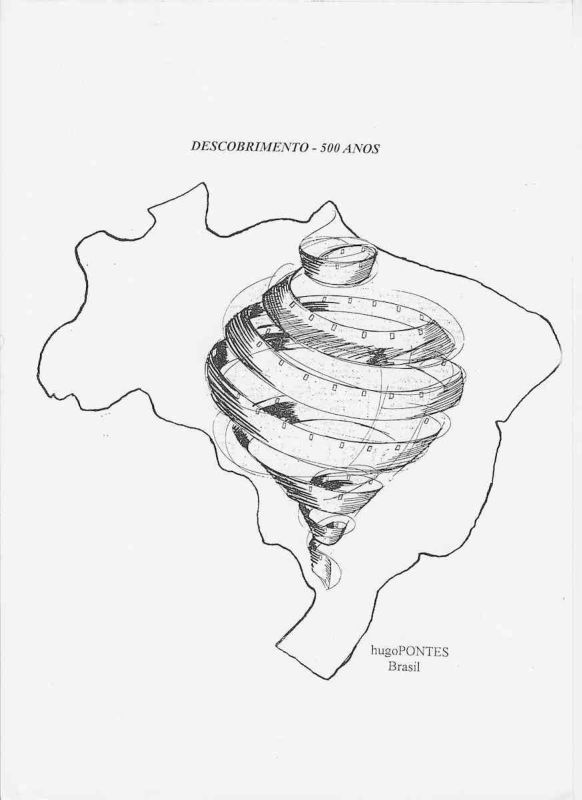
Impressão gráfica e poema visual de Hugo Pontes pertencente à série Descobrimento 500 Anos, identificada na própria obra com o nome hugoPONTES e a indicação Brasil.
Hugo Pontes
Categoria: Mail Art
Acervo: 04066
Dimensões: 29,7 x 21 cm
TEXTO PARA O SALSA EM PORTUGUÊSImpressão gráfica e poema visual de Hugo Pontes pertencente à série Descobrimento 500 Anos, identificada na própria obra com o nome hugoPONTES e a indicação Brasil. A composição utiliza o contorno do mapa brasileiro como estrutura central e insere em seu interior a imagem de um grande pião, objeto tradicional associado ao movimento circular, ao equilíbrio, à instabilidade e à repetição. O título DESCOBRIMENTO 500 ANOS aparece na parte superior e relaciona diretamente o trabalho às reflexões desenvolvidas por Hugo Pontes sobre os cinco séculos de história brasileira iniciados com a chegada portuguesa ao território.O pião ocupa grande parte do interior do mapa e aparece representado por sucessivas faixas curvas que envolvem seu corpo, produzindo uma sensação de rotação e movimento contínuo. A figura parece simultaneamente estável e prestes a perder o equilíbrio, característica visual que amplia o campo simbólico da obra. Inserido dentro do mapa do Brasil, o objeto pode sugerir um país em movimento constante, submetido a ciclos históricos, transformações, instabilidades e repetições políticas, econômicas e sociais.A escolha de um brinquedo popular como centro da composição aproxima memória coletiva, cultura cotidiana e identidade nacional. O pião deixa de ser apenas objeto lúdico e passa a funcionar como metáfora visual de um território que gira, muda de direção e permanece condicionado por forças que determinam seu movimento. Essa leitura é reforçada pela simplicidade do desenho do mapa e pelo predomínio da figura central.Dentro da série Descobrimento 500 Anos, a obra dialoga com outras composições de Hugo Pontes que utilizam o mapa brasileiro preenchido por caravelas, símbolos financeiros, bancos, empresas, palavras e imagens associadas à colonização, economia, saúde, violência e identidade. O pião acrescenta ao conjunto uma dimensão relacionada a movimento, ciclo, repetição e instabilidade, ampliando a interpretação do Brasil como território submetido a sucessivas transformações ao longo de sua história.O trabalho utiliza desenho, apropriação gráfica, síntese visual e relação entre imagem e espaço como procedimentos de poesia visual. A obra constitui documento relevante para pesquisas sobre Hugo Pontes, poesia visual brasileira, Descobrimento 500 Anos, identidade nacional, memória histórica, cultura popular, ciclo, movimento, instabilidade e crítica social. Não são visíveis na folha data de produção, editora, tiragem, dimensões ou técnica específica de impressão. Embora o título se relacione diretamente ao quinto centenário da chegada portuguesa ao Brasil, a imagem isolada não permite afirmar com segurança a data exata de realização.TEXT FOR SALSA IN ENGLISHGraphic print and visual poem by Hugo Pontes belonging to the Descobrimento 500 Anos series, identified on the work itself with the name hugoPONTES and the designation Brasil. The composition uses the outline of the map of Brazil as its central structure and places inside it the image of a large spinning top, a traditional object associated with circular movement, balance, instability and repetition. The title DESCOBRIMENTO 500 ANOS appears at the top and directly connects the work with Hugo Pontes reflections on five centuries of Brazilian history following the Portuguese arrival in the territory.The spinning top occupies much of the interior of the map and is represented through successive curved bands wrapping around its body, producing a strong sensation of rotation and continuous movement. The figure appears simultaneously balanced and potentially unstable, a visual characteristic that expands the symbolic possibilities of the composition. Placed inside the map of Brazil, the object may suggest a country in constant motion, subject to historical cycles, transformations, instability and recurring political, economic and social processes.The choice of a popular toy as the central image connects collective memory, everyday culture and national identity. The spinning top ceases to function only as a playful object and becomes a visual metaphor for a territory that turns, changes direction and remains influenced by forces determining its movement. This reading is reinforced by the simplicity of the map outline and the dominance of the central figure.Within the Descobrimento 500 Anos series, the work relates to other compositions by Hugo Pontes in which the Brazilian map is filled with caravels, financial symbols, banks, corporations, words and images associated with colonization, economics, public health, violence and identity. The spinning top introduces an additional dimension involving movement, cycles, repetition and instability, expanding the interpretation of Brazil as a territory subjected to successive transformations throughout its history.The work uses drawing, graphic appropriation, visual synthesis and the relationship between image and space as procedures of visual poetry. It constitutes relevant documentation for research on Hugo Pontes, Brazilian visual poetry, Descobrimento 500 Anos, national identity, historical memory, popular culture, cycles, movement, instability and social criticism. No production date, publisher, print run, dimensions or specific printing technique is visible on the sheet. Although the title is directly connected with the five hundredth anniversary of the Portuguese arrival in Brazil, the image alone does not establish the exact production date with certainty.
TEXTO DE OBSERVAÇÃO EM PORTUGUÊSImpressão gráfica em preto e branco de Hugo Pontes com o título DESCOBRIMENTO 500 ANOS. A composição apresenta uma grande silhueta do mapa do Brasil ocupando a região central da folha. Dentro do mapa aparece a imagem de um pião de grandes dimensões, formado por linhas curvas e faixas que envolvem o objeto e sugerem rotação.O pião encontra se centralizado e domina visualmente o território brasileiro. Sua forma espiralada produz sensação de movimento contínuo. A associação entre mapa e pião permite leituras relacionadas a ciclo, repetição, equilíbrio, instabilidade e transformação histórica. Como não há texto explicativo do artista na folha, essas interpretações devem permanecer abertas.A imagem do pião também pode ser relacionada à cultura popular e à memória cotidiana brasileira, acrescentando à série Descobrimento 500 Anos um elemento diferente dos símbolos econômicos, políticos e históricos presentes em outras obras do conjunto.Na região inferior direita aparecem hugoPONTES e Brasil. Não são visíveis data, editora, tiragem, dimensões ou técnica específica de impressão. A obra possui interesse documental para estudos sobre Hugo Pontes, poesia visual, Descobrimento 500 Anos, cultura popular, identidade brasileira, movimento, ciclo, instabilidade e memória histórica.OBSERVATION TEXT IN ENGLISHBlack and white graphic print by Hugo Pontes titled DESCOBRIMENTO 500 ANOS. The composition presents a large outline of the map of Brazil occupying the central area of the sheet. Inside the map appears the image of a large spinning top formed by curved lines and bands wrapping around the object and suggesting rotation.The spinning top is centrally placed and visually dominates Brazilian territory. Its spiral structure creates a sense of continuous movement. The relationship between the map and the spinning top allows readings involving cycles, repetition, balance, instability and historical transformation. Since the sheet contains no explanatory text by the artist, these interpretations should remain open.The image of the spinning top can also be related to popular culture and everyday memory in Brazil, adding to the Descobrimento 500 Anos series an element distinct from the economic, political and historical symbols present in other works of the group.The lower right area contains hugoPONTES and Brasil. No date, publisher, print run, dimensions or specific printing technique is visible. The work is relevant to research on Hugo Pontes, visual poetry, Descobrimento 500 Anos, popular culture, Brazilian identity, movement, cycles, instability and historical memory.
Proveniência
Coleção Poema ProcessoInglês
Graphic print and visual poem by Hugo Pontes belonging to the Descobrimento 500 Anos series, identified on the work itself with the name hugoPONTES and the designation Brasil.
Dimensions: 11,7 x 8,3 in