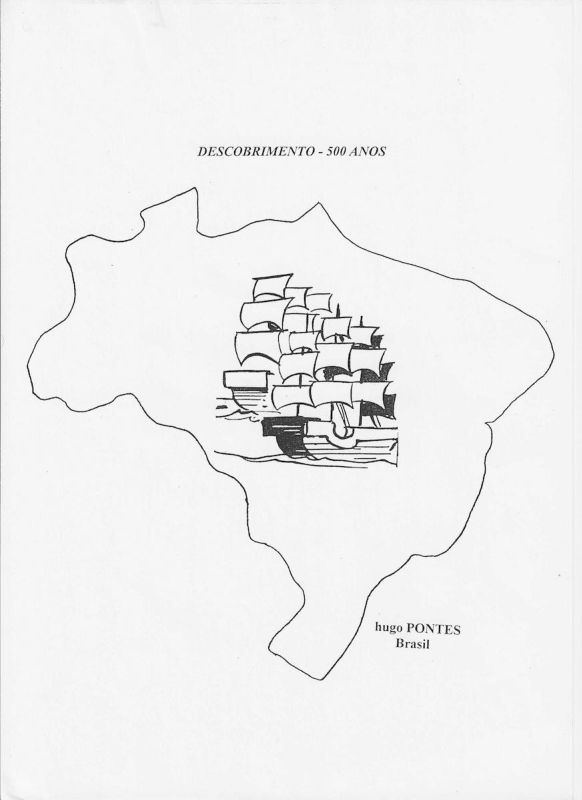
Impressão gráfica e poema visual de Hugo Pontes pertencente à série Descobrimento 500 Anos, identificada na própria obra com o nome hugo PONTES e a indicação Brasil.
Hugo Pontes
Categoria: Mail Art
Acervo: 04063
Dimensões: 29,7 x 21 cm
TEXTO PARA O SALSA EM PORTUGUÊSImpressão gráfica e poema visual de Hugo Pontes pertencente à série Descobrimento 500 Anos, identificada na própria obra com o nome hugo PONTES e a indicação Brasil. A composição apresenta o contorno do mapa do Brasil como estrutura principal e insere em seu interior a imagem de uma caravela ou embarcação à vela. O título DESCOBRIMENTO 500 ANOS aparece na parte superior e estabelece de forma direta o vínculo com o processo histórico iniciado pela chegada portuguesa ao território brasileiro.A caravela funciona como símbolo visual das navegações europeias e da expansão marítima que antecedeu a colonização do Brasil. Ao colocar a embarcação dentro do mapa brasileiro, Hugo Pontes funde em uma única imagem o território e o agente histórico associado ao chamado descobrimento. Essa operação transforma o mapa em espaço de memória e faz da própria forma do país um suporte para refletir sobre origem colonial, ocupação, conquista e transformação histórica.A economia gráfica da obra é significativa. O fundo permanece praticamente vazio, o mapa aparece definido por um contorno simples e a caravela ocupa a região central. Essa redução de elementos concentra a leitura na relação entre território e navegação. O resultado é uma construção direta, sintética e compatível com os procedimentos da poesia visual, em que imagem, título e organização espacial atuam conjuntamente como linguagem.Dentro da série Descobrimento 500 Anos, esta peça pode ser entendida como um ponto inicial de uma sequência conceitual mais ampla. Em outros trabalhos do conjunto, Hugo Pontes utiliza o mesmo mapa brasileiro preenchido por bancos, empresas, produtos financeiros, organismos internacionais e referências à violência e à colonização. Nesta obra, a caravela funciona como imagem inaugural de uma narrativa que posteriormente se amplia para diferentes formas de domínio territorial, econômico, cultural e político.A peça se insere na produção de Hugo Pontes relacionada à poesia visual, poesia experimental, arte gráfica, apropriação de imagens, montagem e crítica histórica. O trabalho constitui documento relevante para pesquisas sobre os 500 anos do Brasil, colonização portuguesa, expansão marítima europeia, identidade nacional, memória histórica e poesia visual brasileira. Não há data de produção, editora, tiragem, dimensões ou técnica gráfica específica visíveis na folha apresentada. Embora o título se relacione diretamente às comemorações do quinto centenário da chegada portuguesa ao Brasil em 2000, a imagem isolada não permite afirmar com segurança a data exata de execução.TEXT FOR SALSA IN ENGLISHGraphic print and visual poem by Hugo Pontes belonging to the Descobrimento 500 Anos series, identified on the work itself with the name hugo PONTES and the designation Brasil. The composition presents the outline of the map of Brazil as its principal structure and places inside it the image of a sailing ship or caravel. The title DESCOBRIMENTO 500 ANOS appears at the top and directly establishes the connection with the historical process initiated by the Portuguese arrival in Brazilian territory.The caravel functions as a visual symbol of European navigation and maritime expansion preceding the colonization of Brazil. By placing the vessel inside the Brazilian map, Hugo Pontes merges territory and the historical agent associated with the so called discovery into a single image. This operation transforms the map into a space of memory and turns the shape of the country itself into a support for reflection on colonial origins, occupation, conquest and historical transformation.The graphic economy of the work is significant. The background remains almost completely empty, the map is defined by a simple outline and the caravel occupies the central area. This reduction of elements concentrates interpretation on the relationship between territory and navigation. The result is a direct and synthetic construction consistent with visual poetry procedures, in which image, title and spatial organization function together as language.Within the Descobrimento 500 Anos series, this piece can be understood as an initial point in a broader conceptual sequence. In other works from the group, Hugo Pontes uses the same Brazilian map filled with banks, corporations, financial products, international organizations and references to violence and colonization. In this work, the caravel operates as an inaugural image of a narrative that later expands into different forms of territorial, economic, cultural and political domination.The piece belongs to Hugo Pontes production in visual poetry, experimental poetry, graphic art, image appropriation, montage and historical criticism. The work constitutes relevant documentation for research on the 500 years of Brazil, Portuguese colonization, European maritime expansion, national identity, historical memory and Brazilian visual poetry. No production date, publisher, print run, dimensions or specific graphic technique is visible on the supplied sheet. Although the title is directly related to the five hundredth anniversary of the Portuguese arrival in Brazil in 2000, the image alone does not establish the exact production date with certainty.
TEXTO DE OBSERVAÇÃO EM PORTUGUÊSImpressão gráfica em preto e branco de Hugo Pontes com o título DESCOBRIMENTO 500 ANOS. A composição apresenta uma grande silhueta do mapa do Brasil ocupando a região central da folha. No interior do mapa aparece uma embarcação à vela de grandes dimensões, representada de maneira gráfica e simplificada.A caravela ou navio à vela constitui o principal elemento simbólico da obra e remete diretamente às navegações portuguesas e europeias relacionadas à chegada ao território brasileiro. A inserção da embarcação dentro do mapa aproxima em uma única estrutura visual o país, a colonização e a memória do chamado descobrimento.A obra utiliza grande quantidade de espaço branco, contorno linear e uma única imagem central. Essa economia formal reforça o caráter de poesia visual, pois o sentido é produzido principalmente pela relação entre o título, o mapa e a embarcação.Na parte inferior direita aparecem hugo PONTES e Brasil. Não são visíveis data, editora, tiragem, dimensões ou técnica de impressão. A obra possui interesse documental para o estudo de Hugo Pontes, da série Descobrimento 500 Anos, da poesia visual brasileira, da colonização portuguesa, da expansão marítima, da memória histórica e da crítica às narrativas tradicionais sobre o descobrimento do Brasil.OBSERVATION TEXT IN ENGLISHBlack and white graphic print by Hugo Pontes titled DESCOBRIMENTO 500 ANOS. The composition presents a large silhouette of the map of Brazil occupying the central area of the sheet. Inside the map appears a large sailing vessel represented in a simplified graphic manner.The caravel or sailing ship is the principal symbolic element of the work and directly evokes Portuguese and European maritime voyages associated with the arrival in Brazilian territory. The placement of the vessel inside the map brings together country, colonization and the memory of the so called discovery within a single visual structure.The work uses extensive white space, linear outline and one central image. This formal economy reinforces its visual poetry character, since meaning is produced mainly through the relationship among the title, the map and the vessel.The lower right area contains hugo PONTES and Brasil. No date, publisher, print run, dimensions or printing technique is visible. The work has documentary relevance for the study of Hugo Pontes, the Descobrimento 500 Anos series, Brazilian visual poetry, Portuguese colonization, maritime expansion, historical memory and criticism of traditional narratives concerning the discovery of Brazil.
Proveniência
Coleção Poema ProcessoInglês
Graphic print and visual poem by Hugo Pontes belonging to the Descobrimento 500 Anos series, identified on the work itself with the name hugo PONTES and the designation Brasil.
Dimensions: 11,7 x 8,3 in