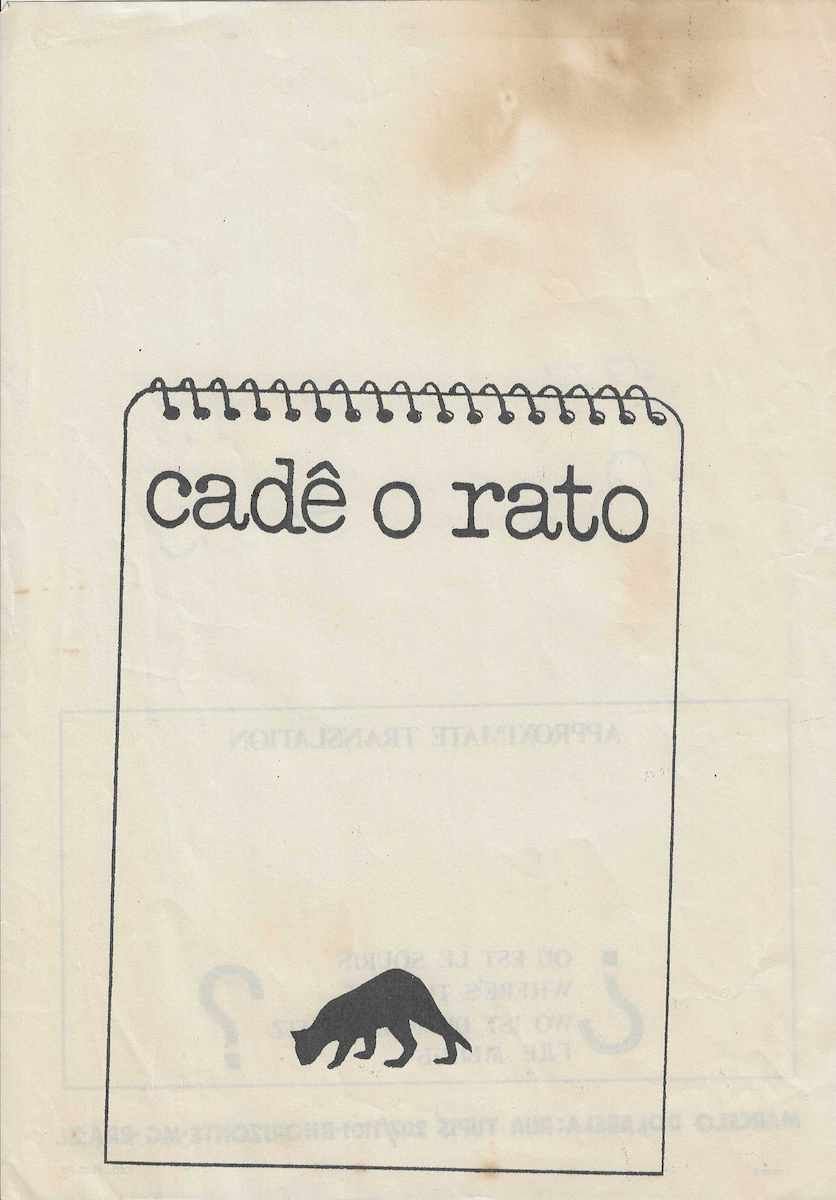
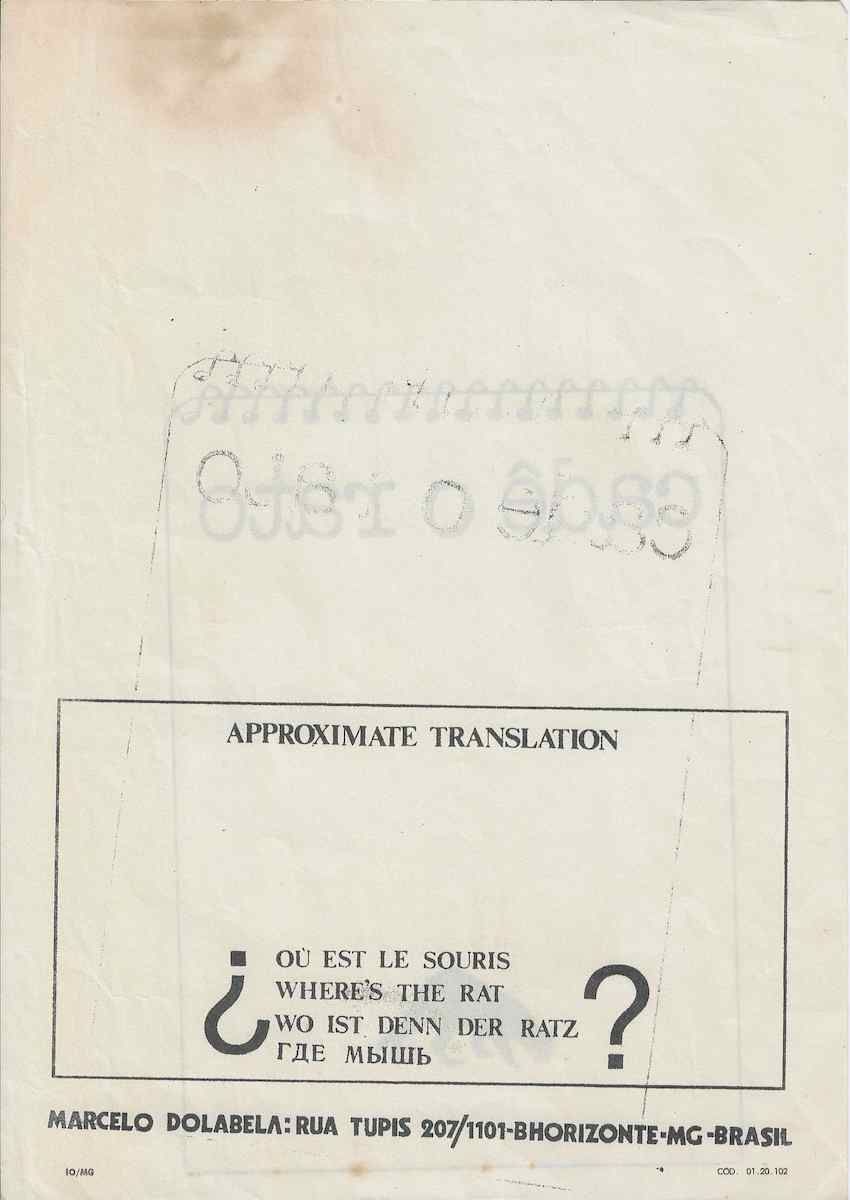
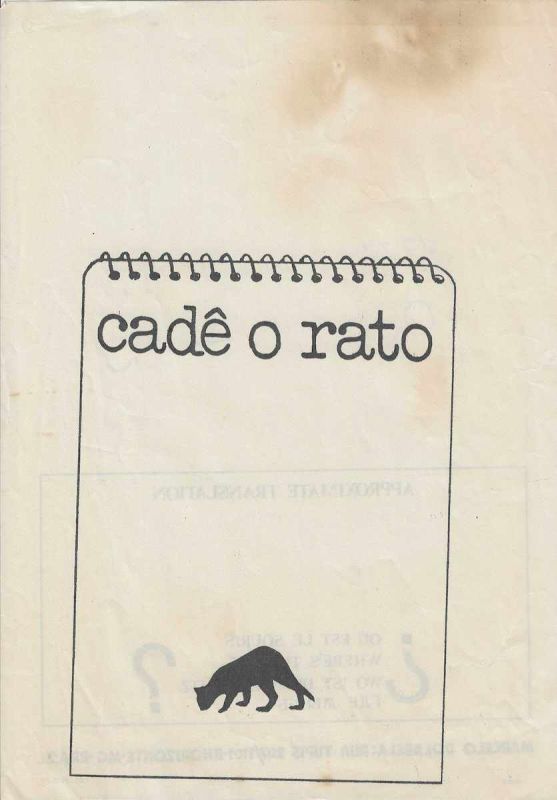
Impressão gráfica de Marcelo Dolabela intitulada Cadê o rato, trabalho de poesia visual e arte gráfica experimental estruturado em frente e verso e baseado na relação entre palavra, imagem, tradução e comunicação internacional.
Marcelo Dolabela
Categoria: Mail Art
Acervo: 04031
Dimensões: 29,7 x 20,9 cm
TEXTO PARA O SALSA EM PORTUGUÊSImpressão gráfica de Marcelo Dolabela intitulada Cadê o rato, trabalho de poesia visual e arte gráfica experimental estruturado em frente e verso e baseado na relação entre palavra, imagem, tradução e comunicação internacional. Na frente da peça, a expressão Cadê o rato aparece em grandes caracteres tipográficos no interior de uma forma que remete a uma folha de bloco ou caderno com espiral. Na parte inferior do campo gráfico surge a silhueta preta de um rato, estabelecendo uma relação direta e ao mesmo tempo irônica entre a pergunta formulada verbalmente e a presença visual do próprio animal.O verso amplia o jogo conceitual da obra e apresenta o título Approximate Translation, tradução aproximada, transformando a pergunta Cadê o rato em uma experiência de tradução entre diferentes idiomas. São impressas versões da pergunta em francês, inglês, alemão e russo, entre elas Où est le souris, Where
s the rat, Wo ist denn der Ratz e
. Os diferentes sistemas de escrita e as traduções deliberadamente aproximadas reforçam o caráter experimental da comunicação, evidenciando diferenças linguísticas, ambiguidades, erros possíveis, equivalências incompletas e deslocamentos de sentido produzidos quando uma mensagem atravessa idiomas e culturas.A composição utiliza grandes sinais gráficos de interrogação e elementos tipográficos que transformam a tradução em imagem. A pergunta sobre a localização do rato deixa de funcionar apenas como frase e passa a constituir um problema visual, semântico e comunicacional. A própria designação Approximate Translation sugere que a tradução não é apresentada como equivalência absoluta, mas como aproximação, deslocamento e recriação da linguagem.Na margem inferior do verso encontra se a identificação Marcelo Dolabela seguida do endereço Rua Tupis 207, apartamento 1101, Belo Horizonte, Minas Gerais, Brasil. Essa informação relaciona a peça às estratégias de circulação direta utilizadas por artistas vinculados à poesia experimental, arte postal e redes internacionais de intercâmbio artístico. Também aparecem pequenas indicações gráficas e códigos de impressão na margem inferior, elementos que contribuem para sua caracterização como material gráfico produzido para circulação.Cadê o rato articula humor, linguagem cotidiana, desenho, tipografia, tradução e comunicação visual. A simplicidade aparente da pergunta é convertida em investigação sobre os limites da linguagem e sobre as possibilidades de transmissão de uma mesma ideia entre diferentes códigos linguísticos. A presença simultânea do português, francês, inglês, alemão e russo insere a obra em uma dimensão internacional e aproxima sua estrutura das experiências de poesia visual, poesia experimental, arte conceitual, arte postal, comunicação alternativa e produção gráfica independente.A obra constitui documento relevante para o estudo da produção de Marcelo Dolabela em Belo Horizonte, Minas Gerais, e de suas relações com a poesia visual brasileira, literatura experimental, arte conceitual, Mail Art, tradução experimental, arte gráfica, cultura impressa, publicações independentes e redes internacionais de artistas.SALSA TEXT IN ENGLISHGraphic print by Marcelo Dolabela entitled Cadê o rato, a work of visual poetry and experimental graphic art structured as a front and back composition and based on relationships among words, images, translation and international communication. On the front, the Portuguese expression Cadê o rato appears in large typographic characters inside a form resembling a spiral bound notebook page. At the bottom of the graphic field there is a black silhouette of a rat, establishing a direct yet ironic relationship between the verbal question and the visual presence of the animal itself.The reverse expands the conceptual structure of the work through the heading Approximate Translation, transforming the Portuguese question Cadê o rato into an experiment involving several languages. Versions of the question appear in French, English, German and Russian, including Où est le souris, Where
s the rat, Wo ist denn der Ratz and
. The different writing systems and deliberately approximate translations emphasize the experimental nature of communication and expose linguistic differences, ambiguities, possible errors, incomplete equivalences and shifts of meaning produced when a message moves between languages and cultures.Large question marks and typographic elements turn translation itself into a visual component. The question concerning the location of the rat no longer functions merely as a sentence but becomes a visual, semantic and communicational problem. The designation Approximate Translation is particularly significant because translation is presented not as an absolute equivalence but as approximation, displacement and recreation through language.At the bottom of the reverse appears the identification Marcelo Dolabela followed by the address Rua Tupis 207, apartment 1101, Belo Horizonte, Minas Gerais, Brazil. This information connects the piece with forms of direct circulation commonly employed within experimental poetry, Mail Art and international artistic exchange networks. Small printing references and production codes are also visible along the lower margin, reinforcing its character as a graphic object intended for circulation.Cadê o rato combines humor, everyday language, drawing, typography, translation and visual communication. The apparently simple question becomes an investigation into the limits of language and the possibilities of transmitting the same idea through different linguistic systems. The simultaneous presence of Portuguese, French, English, German and Russian gives the work an international dimension and connects it with visual poetry, experimental poetry, conceptual art, Mail Art, alternative communication and independent graphic production.The work is an important document for the study of Marcelo Dolabela's production in Belo Horizonte, Minas Gerais, Brazil, as well as his connections with Brazilian visual poetry, experimental literature, conceptual art, Mail Art, experimental translation, graphic art, print culture, independent publications and international networks of artists.
TEXTO DE OBSERVAÇÃO EM PORTUGUÊSImpressão gráfica de Marcelo Dolabela composta por frente e verso. Na frente observa se a inscrição Cadê o rato dentro do desenho de uma folha de bloco com espiral e, na região inferior, a silhueta de um rato em preto. A solução visual produz um jogo entre pergunta e resposta, pois o animal procurado pelo texto encontra se representado dentro da própria composição.No verso aparece o cabeçalho Approximate Translation e uma sequência de traduções da pergunta para diferentes línguas. São visíveis referências em francês, inglês, alemão e russo, acompanhadas por grandes sinais de interrogação. O inglês aparece como Where
s the rat. A apresentação de traduções aproximadas pode ser entendida como parte constitutiva do trabalho e não apenas como recurso informativo, pois deslocamentos, diferenças e imperfeições da tradução tornam se matéria poética e visual.Na parte inferior encontra se impresso Marcelo Dolabela, Rua Tupis 207, apartamento 1101, Belo Horizonte, Minas Gerais, Brasil. A inclusão do endereço é um dado documental importante para identificação, localização histórica e estudo da circulação da peça, especialmente em pesquisas relacionadas à arte postal e às redes de correspondência artística.Não há data claramente identificável nas imagens apresentadas. Na margem inferior aparecem ainda pequenas inscrições técnicas, incluindo 10 MG e um código gráfico semelhante a COD. 01.20.102, cuja função ou significado não pode ser determinado apenas pela observação deste exemplar.Peça relevante para indexação e pesquisa pelos termos Marcelo Dolabela, Cadê o rato, Approximate Translation, Where
s the rat, poesia visual brasileira, poesia experimental brasileira, arte postal brasileira, Mail Art Brazil, arte conceitual, tradução experimental, tipografia experimental, comunicação visual, arte gráfica, Belo Horizonte, Minas Gerais, redes internacionais de arte postal, publicações de artista e produção gráfica independente.OBSERVATION TEXT IN ENGLISHGraphic print by Marcelo Dolabela consisting of a front and reverse. The front displays the expression Cadê o rato inside the drawing of a spiral bound notebook page, with a black silhouette of a rat positioned near the bottom. The visual construction creates a playful relationship between question and answer because the animal being sought through language is already present within the composition.The reverse contains the heading Approximate Translation followed by versions of the question in several languages. French, English, German and Russian references are visible and are accompanied by large question marks. The English version appears as Where
s the rat. The approximate character of these translations should be considered part of the conceptual structure of the work rather than simply informational content, since linguistic displacement, difference and imperfection become elements of the visual poem itself.The lower section identifies Marcelo Dolabela and gives the address Rua Tupis 207, apartment 1101, Belo Horizonte, Minas Gerais, Brazil. The printed address is an important documentary element for identifying and historically locating the work and for investigating its possible circulation within Mail Art and correspondence art networks.No clearly identifiable date is visible in the supplied images. Small technical inscriptions also appear along the lower margin, including 10 MG and a graphic code resembling COD. 01.20.102, whose exact purpose cannot be established solely from the available copy.Relevant indexing and research terms include Marcelo Dolabela, Cadê o rato, Approximate Translation, Where
s the rat, Brazilian visual poetry, Brazilian experimental poetry, Brazilian Mail Art, Mail Art Brazil, conceptual art, experimental translation, experimental typography, visual communication, graphic art, Belo Horizonte, Minas Gerais, international Mail Art networks, artist publications and independent graphic production.
Proveniência
Coleção Poema ProcessoInglês
Graphic print by Marcelo Dolabela entitled Cadê o rato, a work of visual poetry and experimental graphic art structured as a front and back composition and based on relationships among words, images, translation and international communication.
Dimensions: 11,7 x 8,2 in