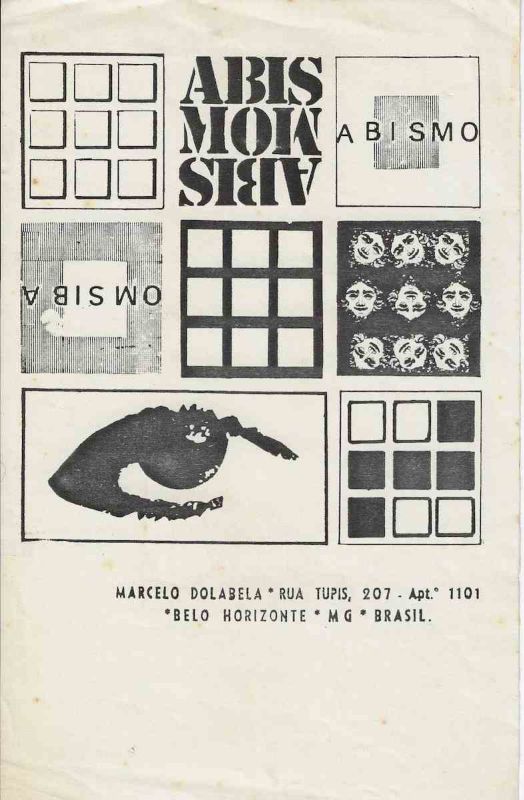
Impressão gráfica da obra Abismo, de Marcelo Dolabela, concebida como composição de poesia visual e experimentação gráfica a partir da repetição, inversão, fragmentação e reorganização da palavra ABISMO.
Marcelo Dolabela
Categoria: Poema Processo
Acervo: 04028
Dimensões: 21,6 x 13,9 cm
Texto para o Salsa em portuguêsImpressão gráfica da obra Abismo, de Marcelo Dolabela, concebida como composição de poesia visual e experimentação gráfica a partir da repetição, inversão, fragmentação e reorganização da palavra ABISMO. A peça articula tipografia, estruturas geométricas, reprodução de imagens, apropriação gráfica e relações entre palavra e imagem, características presentes na produção experimental de Dolabela e em sua atuação ligada à poesia visual, publicações independentes, arte postal e circuitos alternativos de comunicação artística.O título Abismo aparece transformado em diferentes disposições tipográficas. Na região superior central, as letras da palavra ABISMO são organizadas verticalmente e parcialmente invertidas, criando uma estrutura que exige do observador uma leitura não convencional. Em outros campos, a palavra aparece horizontalmente, atravessada por uma área reticulada, e também invertida, produzindo diferentes possibilidades de orientação e percepção.A composição é organizada por módulos retangulares e quadrados distribuídos sobre a superfície. Alguns desses módulos apresentam grades formadas por nove quadrados, semelhantes a matrizes de três por três. Em determinadas versões da estrutura, os quadrados aparecem vazios. Em outra, localizada na parte inferior direita, alguns campos encontram se preenchidos em preto enquanto outros permanecem brancos. Essa alteração cria uma espécie de código visual no qual cheio e vazio funcionam como unidades de informação.A relação entre o título Abismo e as grades geométricas transforma a palavra em experiência espacial. O termo não aparece apenas como significado verbal, mas como matéria gráfica submetida a inversões, deslocamentos e mudanças de orientação. A leitura deixa de seguir exclusivamente uma direção linear e passa a depender da posição das letras, dos vazios, das áreas preenchidas e das relações entre os diferentes módulos.Na região direita da composição aparece uma matriz formada pela repetição de rostos femininos. As imagens são apresentadas em diferentes orientações, com figuras posicionadas normalmente e outras invertidas. A repetição estabelece uma relação entre identidade, multiplicação, simetria e alteração de ponto de vista. O rosto deixa de funcionar apenas como retrato e passa a constituir elemento modular dentro da arquitetura visual da obra.Na parte inferior esquerda encontra se uma grande imagem apropriada de difícil identificação precisa. Sua forma orgânica e escura contrasta com a geometria dos módulos quadrados e com a estrutura tipográfica presente no restante da composição. Essa oposição entre formas orgânicas, imagem figurativa e organização geométrica amplia a tensão visual construída por Marcelo Dolabela.A obra também explora intensamente os conceitos de positivo e negativo, preenchimento e vazio, legibilidade e ilegibilidade, orientação e inversão. Alguns módulos apresentam apenas contornos enquanto outros utilizam superfícies negras. A palavra ABISMO sofre procedimentos semelhantes, sendo fragmentada, invertida e colocada em posições que desafiam a leitura imediata.Na parte inferior está identificada a autoria e o endereço de circulação do artista. O texto impresso registra Marcelo Dolabela, Rua Tupis, 207, apartamento 1101, Belo Horizonte, Minas Gerais, Brasil. A inclusão do endereço diretamente na obra é um elemento documental importante e aproxima esta impressão das práticas de circulação gráfica, correspondência artística e arte postal desenvolvidas por Dolabela e por outros artistas experimentais durante as décadas de 1970 e 1980.A estrutura da peça permite compreender Abismo como uma obra na fronteira entre poema, imagem e sistema gráfico. Marcelo Dolabela desloca a palavra de sua função exclusivamente linguística e a transforma em objeto visual. A palavra pode ser lida, girada, invertida, fragmentada e percebida como forma, enquanto quadrados, rostos e imagens apropriadas passam a desempenhar funções próximas às de signos dentro de uma linguagem visual.Abismo constitui documento relevante para o estudo da produção de Marcelo Dolabela em Belo Horizonte e de sua inserção na poesia visual e na arte experimental brasileira. A obra estabelece relações com procedimentos característicos da poesia concreta e pós concreta, da poesia experimental, da poesia visual, da xerografia, da colagem, da apropriação e das publicações de artista, sem que a imagem apresentada permita determinar uma filiação específica a um movimento apenas com base neste exemplar.A data de produção não está visível na impressão apresentada. Por isso, o trabalho deve permanecer catalogado como sem data determinada até que outro exemplar, correspondência, catálogo, publicação ou registro documental permita estabelecer uma cronologia segura.Palavras e entidades relevantes para indexação incluem Marcelo Dolabela, Abismo, Belo Horizonte, Minas Gerais, Rua Tupis, poesia visual, poesia experimental, arte gráfica, impressão gráfica, xerografia, arte postal, mail art, tipografia experimental, poema visual, palavra imagem, matriz geométrica, apropriação, repetição, inversão, colagem, comunicação visual, publicação de artista e arte experimental brasileira.Salsa text in EnglishAbismo is a graphic work by Marcelo Dolabela conceived as a visual poetry composition based on repetition, inversion, fragmentation and reorganization of the word ABISMO. The piece combines typography, geometric structures, reproduced imagery, graphic appropriation and relationships between word and image, all of which are characteristic of Dolabela's experimental production and of his involvement with visual poetry, independent publications, mail art and alternative artistic communication networks.The title Abismo is transformed through several typographic arrangements. In the upper central section, the letters of ABISMO are organized vertically and partially inverted, creating a structure that requires an unconventional mode of reading. In other modules, the word appears horizontally across a screened field and also in an inverted position, producing different possibilities of orientation and perception.The composition is organized through rectangular and square modules distributed across the surface. Several modules contain grids formed by nine squares arranged in a three by three matrix. In some versions the squares remain empty. In another matrix at the lower right, several fields are filled in black while others remain white. This variation creates a visual code in which filled and empty areas operate as units of information.The relationship between the title Abismo and the geometric grids transforms the word into a spatial experience. The term does not function solely through verbal meaning but becomes graphic material subjected to inversion, displacement and changes of orientation. Reading no longer follows only a linear direction but depends on the position of the letters, empty areas, filled areas and relationships between the different modules.On the right side of the composition appears a matrix formed by repeated female faces. The images are presented in different orientations, with some positioned normally and others inverted. Repetition establishes relationships involving identity, multiplication, symmetry and changes in viewpoint. The face ceases to function simply as a portrait and becomes a modular element within the visual architecture of the work.The lower left section contains a large appropriated image whose precise subject cannot be securely identified from the available reproduction. Its dark organic form contrasts with the geometry of the square modules and with the typographic organization present throughout the composition. This opposition between organic form, figurative imagery and geometric structure intensifies the visual tension created by Marcelo Dolabela.The work also investigates relationships between positive and negative, fullness and emptiness, legibility and illegibility, orientation and inversion. Some modules contain only outlined squares while others use solid black surfaces. The word ABISMO undergoes similar transformations through fragmentation, inversion and placement in positions that challenge immediate reading.Authorship and circulation information are printed at the bottom of the work. The inscription identifies Marcelo Dolabela, Rua Tupis 207, apartment 1101, Belo Horizonte, Minas Gerais, Brazil. The inclusion of the artist's address directly within the composition is an important documentary feature and connects the print with practices of graphic circulation, artistic correspondence and mail art developed by Dolabela and other experimental artists during the 1970s and 1980s.The structure of Abismo allows the work to be understood as occupying a territory between poem, image and graphic system. Marcelo Dolabela removes the word from an exclusively linguistic function and transforms it into a visual object. The word can be read, rotated, inverted, fragmented and perceived as form, while squares, faces and appropriated images operate as signs within a visual language.Abismo is an important document for the study of Marcelo Dolabela's production in Belo Horizonte and his involvement with Brazilian visual poetry and experimental art. The work relates to procedures associated with concrete and post concrete experimentation, experimental poetry, visual poetry, xerography, collage, appropriation and artists publications, although the supplied image alone does not support assigning the work to a specific movement.No production date is visible on the supplied print. The work should therefore remain catalogued as undated until another copy, correspondence, catalogue, publication or documentary record provides secure chronological evidence.Relevant indexing entities and terms include Marcelo Dolabela, Abismo, Belo Horizonte, Minas Gerais, Rua Tupis, visual poetry, experimental poetry, graphic art, graphic print, xerography, mail art, experimental typography, visual poem, word image, geometric matrix, appropriation, repetition, inversion, collage, visual communication, artists publication and Brazilian experimental art.
Texto de observação em portuguêsImpressão gráfica original de Marcelo Dolabela intitulada Abismo. A composição apresenta o título e a palavra ABISMO em diferentes configurações, incluindo disposição vertical, inversão das letras, orientação horizontal e sobreposição com estruturas reticuladas.A obra é construída por diversos módulos geométricos. Destacam se grades formadas por nove quadrados, algumas com campos vazios e outra com alternância entre quadrados pretos e brancos. Esses elementos funcionam como unidades visuais e estabelecem relações entre cheio, vazio, positivo, negativo, repetição e código.Outro módulo apresenta a repetição de rostos femininos em diferentes orientações, incluindo imagens invertidas. Na região inferior esquerda aparece uma imagem apropriada de caráter figurativo e forma orgânica, cuja identificação exata não é possível apenas a partir da reprodução apresentada.A composição articula palavra, tipografia, fotografia ou reprodução gráfica, matriz geométrica e apropriação de imagens. O procedimento transforma ABISMO simultaneamente em título, palavra, forma e elemento espacial, aproximando a obra dos campos da poesia visual, poesia experimental e comunicação gráfica.Na parte inferior consta a identificação Marcelo Dolabela, Rua Tupis, 207, apartamento 1101, Belo Horizonte, Minas Gerais, Brasil. A presença do endereço completo indica potencial circulação da peça como impresso e estabelece relação documental com os circuitos de correspondência artística e arte postal associados ao artista.Não há data de produção claramente identificável no exemplar apresentado. A data deve permanecer como não determinada até o aparecimento de documentação complementar.O objeto deve ser catalogado como impressão gráfica, poesia visual e obra de experimentação verbo visual de Marcelo Dolabela, relacionada a tipografia experimental, repetição, inversão, apropriação, estruturas modulares e circulação gráfica.Observation text in EnglishOriginal graphic print by Marcelo Dolabela entitled Abismo. The composition presents the title and the word ABISMO in several configurations, including vertical arrangement, inverted letters, horizontal orientation and superimposition with screened graphic structures.The work is constructed through several geometric modules. Particularly prominent are grids composed of nine squares, some containing empty fields and another combining black and white squares. These elements operate as visual units and establish relationships between fullness, emptiness, positive and negative space, repetition and visual coding.Another module presents repeated female faces in different orientations, including inverted images. In the lower left section there is an appropriated figurative image with an organic form whose precise identification cannot be securely established from the supplied reproduction alone.The composition combines language, typography, photography or reproduced graphic imagery, geometric matrices and image appropriation. Through these procedures ABISMO becomes simultaneously a title, a word, a graphic form and a spatial element, connecting the work with visual poetry, experimental poetry and graphic communication.At the bottom appears the identification Marcelo Dolabela, Rua Tupis 207, apartment 1101, Belo Horizonte, Minas Gerais, Brazil. The inclusion of the complete address indicates the potential circulation of the piece as printed matter and provides a documentary connection with artistic correspondence and mail art networks associated with the artist.No clearly identifiable production date appears on the supplied example. The work should remain catalogued as undated until complementary documentation becomes available.The object should be catalogued as a graphic print, visual poetry and a verbal visual experimental work by Marcelo Dolabela, associated with experimental typography, repetition, inversion, appropriation, modular structures and graphic circulation.
Proveniência
Coleção Poema ProcessoInglês
Abismo is a graphic work by Marcelo Dolabela conceived as a visual poetry composition based on repetition, inversion, fragmentation and reorganization of the word ABISMO.
Dimensions: 8,5 x 5,5 in