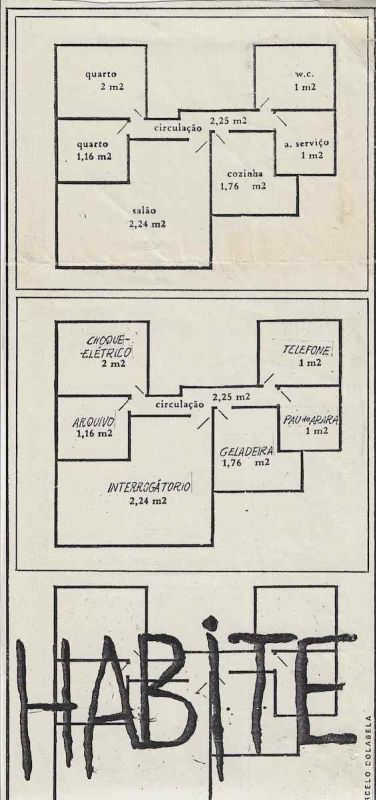
Impressão gráfica da obra Habite, de Marcelo Dolabela, construída a partir da apropriação e transformação de uma planta arquitetônica residencial.
Marcelo Dolabela
Categoria: Mail Art
Acervo: 04029
Dimensões: 31 x 14 cm
Texto para o Salsa em portuguêsImpressão gráfica da obra Habite, de Marcelo Dolabela, construída a partir da apropriação e transformação de uma planta arquitetônica residencial. A composição estabelece uma relação direta entre arquitetura, habitação, linguagem, poder, violência e repressão por meio da repetição de uma mesma planta, inicialmente identificada por funções domésticas e posteriormente recodificada com palavras associadas a interrogatório, controle e práticas de violência.Na parte superior aparece uma planta de residência organizada em diferentes ambientes. São identificados quarto com 2 m², outro quarto com 1,16 m², circulação com 2,25 m², w.c. com 1 m², área de serviço com 1 m², cozinha com 1,76 m² e salão com 2,24 m². A representação utiliza o vocabulário convencional do desenho arquitetônico, com paredes, acessos, dimensões e denominações funcionais.Na parte central, Marcelo Dolabela repete praticamente a mesma estrutura arquitetônica, mantendo as dimensões dos ambientes e o desenho da circulação, mas substituindo as funções domésticas por um novo conjunto de palavras. O quarto de 2 m² passa a ser identificado como Choque Elétrico. O quarto de 1,16 m² transforma se em Arquivo. O w.c. de 1 m² torna se Telefone. A área de serviço de 1 m² recebe a expressão Pau de Arara. A cozinha de 1,76 m² passa a ser Geladeira. O salão de 2,24 m² transforma se em Interrogatório. Apenas a área denominada circulação conserva sua identificação original.Essa substituição verbal constitui o principal mecanismo conceitual da obra. O espaço destinado à moradia é convertido simbolicamente em estrutura de confinamento, investigação e violência. Termos como choque elétrico, telefone e pau de arara possuem forte associação histórica com práticas de tortura, enquanto interrogatório introduz diretamente a dimensão institucional do controle e da coerção. A palavra arquivo acrescenta a ideia de registro, documentação e armazenamento de informações. Geladeira, inserida no espaço anteriormente destinado à cozinha, produz uma relação particularmente inquietante entre objeto cotidiano e ambiente de punição ou confinamento.A manutenção das mesmas medidas entre a primeira e a segunda planta reforça o procedimento. O espaço físico não se modifica. O que muda é o código que determina sua função. Marcelo Dolabela demonstra assim como uma mesma estrutura pode adquirir significados radicalmente diferentes por meio da linguagem. A arquitetura torna se um sistema semântico e cada palavra redefine o sentido político, psicológico e social do espaço.Na parte inferior da composição aparece novamente um fragmento da planta, atravessado por grandes letras manuscritas formando a palavra HABITE. O termo funciona simultaneamente como título, verbo e comando. Sua proximidade sonora e conceitual com o universo da habitação estabelece um contraste com os ambientes de violência identificados anteriormente. A ordem para habitar torna se ambígua quando o espaço oferecido ao indivíduo foi convertido em lugar de interrogatório e coerção.A palavra HABITE ocupa grande parte da superfície inferior e rompe a precisão geométrica da arquitetura. Enquanto as plantas são construídas por linhas regulares e terminologia funcional, o título surge através de uma escrita gestual, irregular e enfática. Esse confronto entre desenho técnico e intervenção manual intensifica a oposição entre racionalidade arquitetônica e experiência humana.Na margem inferior direita aparece verticalmente a identificação Marcelo Dolabela, confirmando a autoria da impressão. Não há data de produção claramente visível no exemplar apresentado e, portanto, uma cronologia precisa não deve ser atribuída sem documentação complementar.Habite pode ser compreendida como uma obra verbo visual de caráter crítico na qual Marcelo Dolabela utiliza procedimentos de apropriação, repetição, substituição textual e montagem conceitual. A planta residencial deixa de ser apenas representação arquitetônica e converte se em dispositivo de leitura das relações entre espaço e poder.A obra possui especial relevância para o estudo da poesia visual e da produção gráfica experimental brasileira porque não depende exclusivamente de uma imagem ou de um texto. Seu significado surge da transformação de um sistema de signos. Quarto, cozinha, área de serviço e salão são substituídos por choque elétrico, arquivo, telefone, pau de arara, geladeira e interrogatório, demonstrando como a alteração das palavras transforma completamente a percepção da mesma estrutura gráfica.Habite insere se na pesquisa de Marcelo Dolabela sobre linguagem, comunicação, apropriação e reorganização de materiais gráficos. A obra aproxima poesia visual, arte conceitual, crítica política, arquitetura e comunicação visual, fazendo da própria leitura um mecanismo de descoberta do contraste entre cotidiano e violência.Palavras e entidades relevantes para indexação incluem Marcelo Dolabela, Habite, poesia visual, poesia experimental, arte conceitual, impressão gráfica, arquitetura, planta arquitetônica, habitação, choque elétrico, arquivo, telefone, pau de arara, geladeira, interrogatório, repressão, violência, linguagem, poder, apropriação, montagem, comunicação visual, arte política e arte experimental brasileira.Salsa text in EnglishHabite is a graphic work by Marcelo Dolabela constructed through the appropriation and transformation of a residential architectural floor plan. The composition establishes a direct relationship between architecture, habitation, language, power, violence and repression by repeating the same plan, initially identified through domestic functions and subsequently recoded with words associated with interrogation, control and practices of violence.The upper section presents a residential floor plan divided into different spaces. It identifies a bedroom measuring 2 m², another bedroom measuring 1.16 m², a circulation area measuring 2.25 m², a w.c. measuring 1 m², a service area measuring 1 m², a kitchen measuring 1.76 m² and a living room measuring 2.24 m². The representation uses the conventional vocabulary of architectural drawing, including walls, access points, dimensions and functional designations.In the central section, Marcelo Dolabela repeats essentially the same architectural structure, preserving both the dimensions of the spaces and the circulation plan while replacing the domestic functions with an entirely different vocabulary. The 2 m² bedroom becomes Choque Elétrico. The 1.16 m² bedroom becomes Arquivo. The 1 m² w.c. becomes Telefone. The 1 m² service area becomes Pau de Arara. The 1.76 m² kitchen becomes Geladeira. The 2.24 m² living room becomes Interrogatório. Only the area identified as circulation retains its original designation.This verbal substitution constitutes the principal conceptual mechanism of the work. A space intended for domestic life is symbolically transformed into a structure of confinement, investigation and violence. Terms such as choque elétrico, telefone and pau de arara carry strong historical associations with torture practices, while interrogatório directly introduces the institutional dimension of control and coercion. Arquivo introduces the idea of records, documentation and the storage of information. Geladeira, positioned within the space previously identified as the kitchen, establishes a particularly disturbing relationship between an everyday object and an environment associated with punishment or confinement.The preservation of identical measurements between the first and second floor plans reinforces this procedure. The physical structure does not change. What changes is the code determining its function. Marcelo Dolabela thus demonstrates how the same structure can acquire radically different meanings through language. Architecture becomes a semantic system in which each word redefines the political, psychological and social meaning of space.At the bottom of the composition another fragment of the floor plan appears, crossed by large handwritten letters forming the word HABITE. The word functions simultaneously as title, verb and command. Its conceptual relationship with habitation creates a sharp contrast with the spaces of violence identified above. The instruction to inhabit becomes ambiguous when the space offered to the individual has been transformed into a place of interrogation and coercion.The word HABITE occupies much of the lower surface and disrupts the geometric precision of the architectural design. While the floor plans are constructed through regular lines and functional terminology, the title emerges through irregular and emphatic gestural writing. This confrontation between technical drawing and manual intervention intensifies the opposition between architectural rationality and human experience.Marcelo Dolabela is identified vertically along the lower right margin, confirming authorship of the print. No clearly visible production date appears on the supplied example, and a precise chronology should therefore not be assigned without complementary documentation.Habite can be understood as a critical verbal visual work in which Marcelo Dolabela employs appropriation, repetition, textual substitution and conceptual montage. The residential floor plan ceases to function merely as an architectural representation and becomes an instrument for examining relationships between space and power.The work is particularly significant for the study of visual poetry and Brazilian experimental graphic production because its meaning does not depend exclusively on either image or text. Meaning emerges through the transformation of a system of signs. Bedroom, kitchen, service area and living room are replaced by choque elétrico, arquivo, telefone, pau de arara, geladeira and interrogatório, demonstrating how changing words can completely transform the perception of an otherwise identical graphic structure.Habite belongs to Marcelo Dolabela's research into language, communication, appropriation and the reorganization of graphic materials. The work brings visual poetry, conceptual art, political critique, architecture and visual communication together, transforming the act of reading itself into a means of discovering the contrast between everyday life and violence.Relevant indexing entities and terms include Marcelo Dolabela, Habite, visual poetry, experimental poetry, conceptual art, graphic print, architecture, architectural floor plan, habitation, choque elétrico, arquivo, telefone, pau de arara, geladeira, interrogatório, repression, violence, language, power, appropriation, montage, visual communication, political art and Brazilian experimental art.
Texto de observação em portuguêsImpressão gráfica original de Marcelo Dolabela intitulada Habite. A obra é organizada verticalmente em três momentos visuais e utiliza como estrutura fundamental a reprodução de uma planta arquitetônica residencial.Na primeira planta aparecem as denominações quarto 2 m², quarto 1,16 m², circulação 2,25 m², w.c. 1 m², área de serviço 1 m², cozinha 1,76 m² e salão 2,24 m².Na segunda planta a estrutura arquitetônica e suas dimensões são preservadas, mas Marcelo Dolabela substitui as funções dos ambientes. O quarto de 2 m² torna se Choque Elétrico. O quarto de 1,16 m² torna se Arquivo. O w.c. transforma se em Telefone. A área de serviço passa a ser Pau de Arara. A cozinha transforma se em Geladeira. O salão passa a ser Interrogatório. A palavra circulação permanece inalterada.Essa correspondência entre as duas plantas é um elemento documental fundamental da obra e deve ser preservada na catalogação, pois demonstra que a operação realizada por Marcelo Dolabela ocorre principalmente por meio da substituição linguística e semântica, sem alteração significativa da arquitetura representada.Na terceira seção aparece parte da mesma estrutura arquitetônica atravessada por grandes letras manuscritas formando HABITE. O título transforma o conjunto em uma proposição verbo visual e reforça a tensão entre espaço doméstico, ordem, confinamento e violência.A impressão combina desenho arquitetônico, tipografia impressa, escrita manual, apropriação e reorganização de linguagem. A identificação Marcelo Dolabela aparece verticalmente na margem inferior direita.A data de produção não está claramente indicada na imagem apresentada e deve permanecer como não determinada até que documentação complementar permita sua confirmação.A obra deve ser catalogada como impressão gráfica e poesia visual de Marcelo Dolabela, relacionada também à arte conceitual e à crítica política, com especial atenção às relações entre arquitetura, linguagem, poder, repressão, interrogatório e transformação semântica do espaço.Observation text in EnglishOriginal graphic print by Marcelo Dolabela entitled Habite. The work is vertically organized into three visual stages and uses the reproduction of a residential architectural floor plan as its fundamental structure.The first floor plan identifies a bedroom measuring 2 m², another bedroom measuring 1.16 m², a circulation area measuring 2.25 m², a w.c. measuring 1 m², a service area measuring 1 m², a kitchen measuring 1.76 m² and a living room measuring 2.24 m².In the second floor plan, the architectural structure and dimensions are preserved while Marcelo Dolabela replaces the functions assigned to the spaces. The 2 m² bedroom becomes Choque Elétrico. The 1.16 m² bedroom becomes Arquivo. The w.c. becomes Telefone. The service area becomes Pau de Arara. The kitchen becomes Geladeira. The living room becomes Interrogatório. The word circulação remains unchanged.This correspondence between the two floor plans is a fundamental documentary feature of the work and should be preserved in cataloguing because it demonstrates that Marcelo Dolabela's principal operation takes place through linguistic and semantic substitution without substantially altering the represented architecture.In the third section, part of the same architectural structure is crossed by large handwritten letters forming HABITE. The title transforms the composition into a verbal visual proposition and intensifies the tension between domestic space, command, confinement and violence.The print combines architectural drawing, printed typography, handwriting, appropriation and linguistic reorganization. Marcelo Dolabela is identified vertically along the lower right margin.No production date is clearly indicated in the supplied image and the work should remain catalogued as undated until complementary documentation allows confirmation.The work should be catalogued as a graphic print and visual poetry by Marcelo Dolabela, also related to conceptual art and political critique, with particular attention to relationships involving architecture, language, power, repression, interrogation and the semantic transformation of space.
Proveniência
Coleção Poema ProcessoInglês
Habite is a graphic work by Marcelo Dolabela constructed through the appropriation and transformation of a residential architectural floor plan.
Dimensions: 12,2 x 5,5 in