Boletim Diário do Museu de Arte e Cultura Popular da Universidade Federal de Mato Grosso, produzido pela Coordenação de Cultura no âmbito do Projeto Cinco e Meia na Biblioteca, datado de 30 de junho de 1984, em Cuiabá, Mato Grosso.
Wlademir Dias Pino
Categoria: Poema Processo
Acervo: 04007
Data: 30 de junho de 1984
Dimensões: 21 x 15 cm
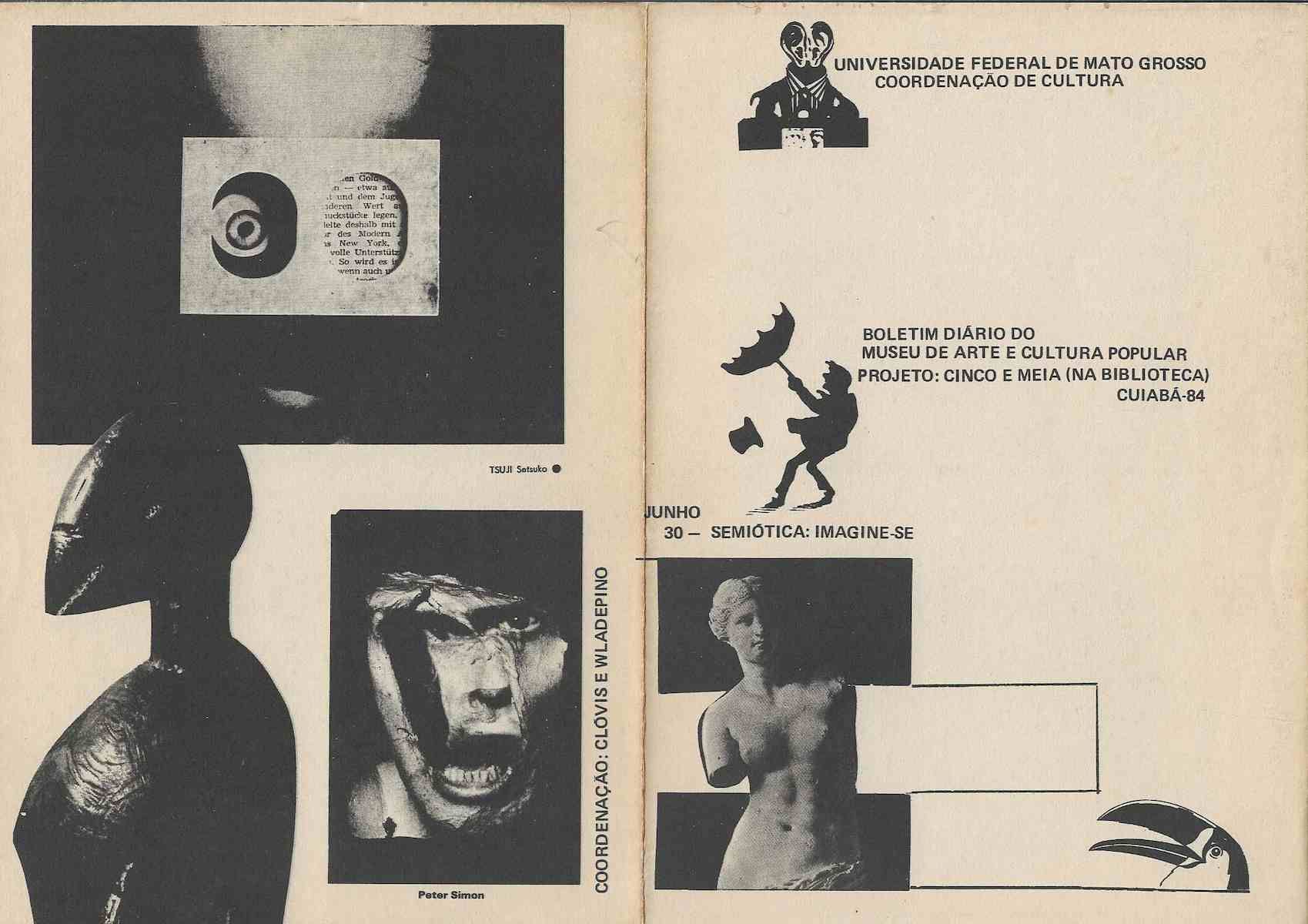
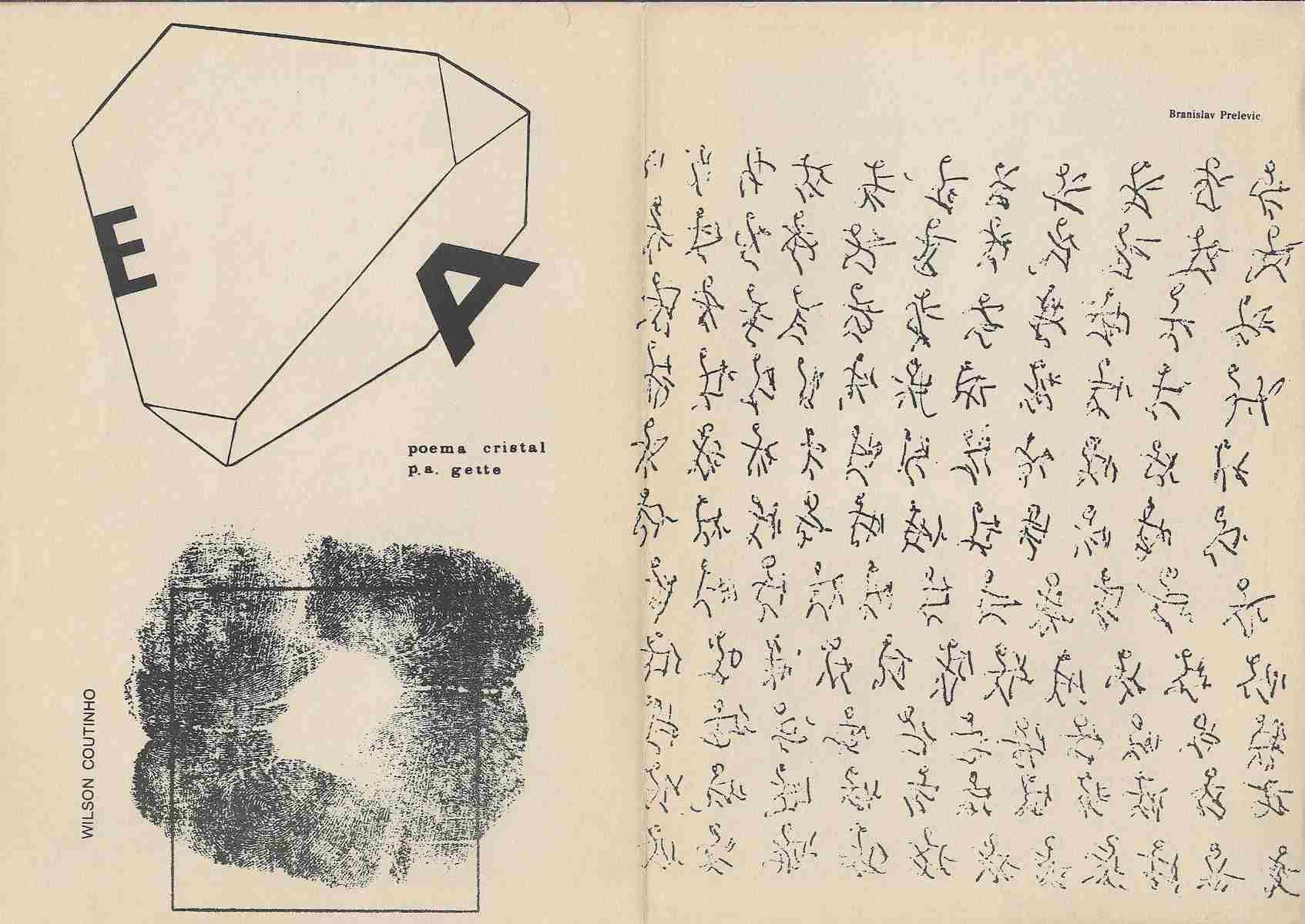
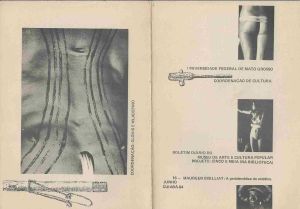
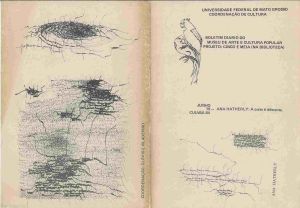
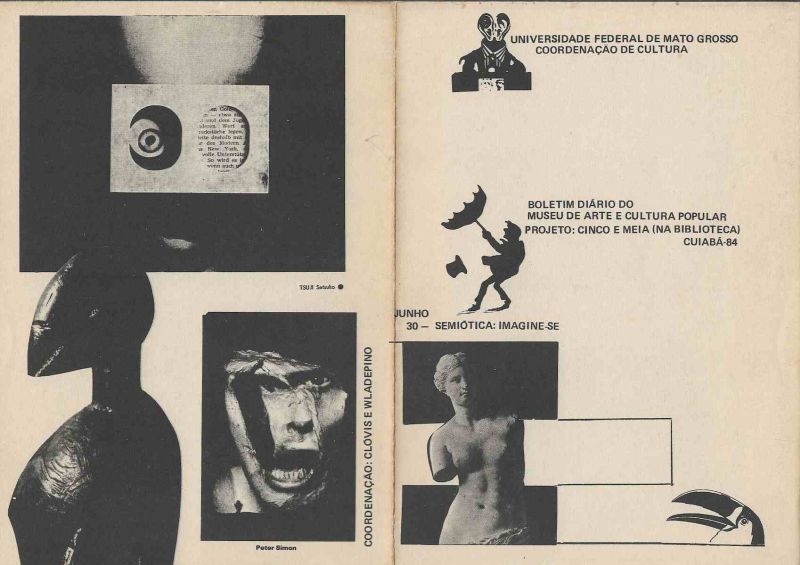
Boletim Diário do Museu de Arte e Cultura Popular da Universidade Federal de Mato Grosso, produzido pela Coordenação de Cultura no âmbito do Projeto Cinco e Meia na Biblioteca, datado de 30 de junho de 1984, em Cuiabá, Mato Grosso. A edição apresenta o tema Semiótica: Imagine se e registra Coordenação: Clóvis e Wlademir Pino. O documento constitui importante fonte para a história das pesquisas sobre signo, imagem, linguagem, poesia visual, semiótica, comunicação, arte conceitual e experimentação gráfica desenvolvidas no ambiente cultural da Universidade Federal de Mato Grosso durante a década de 1980.A capa identifica Universidade Federal de Mato Grosso, Coordenação de Cultura, Boletim Diário do Museu de Arte e Cultura Popular, Projeto Cinco e Meia na Biblioteca, Cuiabá 84 e a programação de 30 de junho dedicada ao tema Semiótica: Imagine se. A formulação propõe diretamente uma experiência de interpretação, convidando o observador a imaginar e produzir sentidos diante de imagens que não possuem uma leitura única ou previamente determinada.O projeto gráfico da capa articula imagens provenientes de diferentes universos visuais. Na região central aparece a reprodução da Vênus de Milo integrada a uma estrutura geométrica composta por grandes áreas negras e retângulos vazios. O corpo clássico é retirado de seu contexto histórico e inserido em um sistema gráfico moderno, produzindo contraste entre escultura antiga, reprodução fotográfica, geometria e design editorial.A presença da Vênus de Milo é especialmente significativa para uma edição dedicada à semiótica. Uma das imagens mais reconhecíveis da tradição artística ocidental passa a funcionar como signo visual inserido em uma nova cadeia de relações. Sua identificação não depende apenas do objeto representado, mas da memória cultural do observador e das associações construídas historicamente em torno de beleza, antiguidade, museu, escultura e corpo.Próximo à parte superior da capa aparece uma pequena figura humana em movimento carregando ou movimentando uma forma semelhante a guarda chuva. Mais abaixo surge a cabeça gráfica de um tucano. O encontro entre figura humana, escultura clássica, animal, áreas geométricas e identidade institucional reforça a proposta de intercalar códigos visuais de origens distintas.Na página oposta aparecem duas obras identificadas nominalmente. Na parte superior encontra se uma composição associada a Tsuji Setsuko. A imagem utiliza uma extensa área negra que sugere um corpo ou silhueta humana. Sobre a região correspondente ao rosto aparece uma pequena superfície retangular contendo um olho estilizado e um fragmento de texto impresso. O resultado cria uma relação direta entre identidade, visão, palavra e representação.A obra associada a Tsuji Setsuko utiliza o olho como signo dentro de outro signo. O rosto é parcialmente substituído por uma estrutura gráfica e textual, fazendo com que ver, ser visto, ler e reconhecer se tornem operações interdependentes. A imagem questiona a possibilidade de identificação imediata do sujeito e transforma o retrato em construção semiótica.Na parte inferior aparece uma obra identificada como Peter Simon. A composição apresenta um rosto parcialmente coberto por uma mão ou estrutura semelhante a dedos pressionados sobre a face. A boca permanece visível e aberta, criando uma imagem de forte tensão entre expressão e impedimento, visão e ocultamento, identidade e fragmentação.A associação entre rosto, mão, olhos encobertos e boca aberta permite múltiplas interpretações. A figura pode sugerir silêncio, censura, comunicação interrompida, proteção, medo ou tentativa de bloquear a percepção. Essa abertura interpretativa corresponde diretamente ao princípio proposto pelo título Imagine se.As páginas internas ampliam significativamente o campo semiótico da publicação. Na página esquerda aparece uma estrutura tridimensional desenhada como um sólido geométrico irregular. Dentro dela encontram se duas grandes letras, E e A. A obra é identificada como poema cristal e associada a P. A. Gette.O poema cristal transforma letras em objetos espaciais. As letras deixam de estar organizadas segundo a linearidade convencional da escrita e passam a ocupar diferentes faces ou regiões de uma estrutura tridimensional. A palavra não está completa e a leitura depende da relação entre forma geométrica, posição, espaço e elementos alfabéticos.Esse procedimento exemplifica uma transformação fundamental da poesia visual. A letra deixa de ser apenas unidade fonética ou verbal e torna se forma, volume, orientação e posição. O poema não precisa necessariamente ser percorrido da esquerda para a direita. Pode ser observado como construção espacial.Na região inferior da mesma página aparece uma composição identificada com o nome Wilson Coutinho. A imagem é formada por uma grande estrutura escura de textura irregular envolvendo um vazio central claro. A figura produz uma relação intensa entre cheio e vazio, presença e ausência, superfície e abertura.A presença de Wilson Coutinho é relevante para a documentação do ambiente intelectual e artístico brasileiro relacionado ao boletim. Sua obra aparece em diálogo com experimentações internacionais e reforça o caráter multidisciplinar do Projeto Cinco e Meia na Biblioteca.A página direita apresenta uma extensa sequência de pequenos sinais antropomórficos organizados regularmente em linhas e colunas. A composição é identificada com o nome Branislav Prelevic. Cada pequeno signo parece representar uma figura humana submetida a variações de posição, gesto e movimento.A repetição produz um sistema semelhante a um alfabeto corporal. As figuras podem ser percebidas como caracteres de uma escrita visual construída a partir do corpo. Em vez de letras convencionais, aparecem gestos. Em vez de palavras, sequências de posições humanas. A obra estabelece uma relação direta entre corpo, signo, código, repetição e comunicação.A organização da composição de Branislav Prelevic sugere que movimentos corporais podem funcionar como unidades mínimas de uma linguagem. Cada pequena alteração de postura modifica potencialmente o significado. Dessa maneira, o corpo deixa de ser apenas objeto representado e passa a funcionar como estrutura gráfica e sistema de comunicação.O conjunto do boletim demonstra uma concepção ampla de semiótica. O signo pode ser uma letra, um olho, um corpo, uma escultura clássica, uma estrutura geométrica, uma mancha, uma figura humana ou uma sequência de gestos. A comunicação ocorre através das relações entre esses elementos e não exclusivamente através de palavras.O título Imagine se acrescenta uma dimensão participativa fundamental. O espectador é convidado a completar relações, interpretar signos e produzir hipóteses. Não existe necessariamente uma mensagem única. A leitura torna se atividade criativa.Essa orientação estabelece forte diálogo com as pesquisas de Wlademir Dias Pino sobre signo, visualidade, estrutura e participação do leitor. Sua presença na coordenação do boletim demonstra a continuidade dessas investigações no contexto da Universidade Federal de Mato Grosso e do Museu de Arte e Cultura Popular.A edição de 30 de junho de 1984 também evidencia a capacidade do Projeto Cinco e Meia na Biblioteca de reunir experiências brasileiras e internacionais em torno de temas específicos. Artistas e autores de diferentes contextos aparecem lado a lado, permitindo que a publicação funcione como dispositivo de comparação e circulação de linguagens experimentais.O boletim possui assim valor não apenas como material de divulgação, mas como objeto editorial autônomo. A seleção, montagem e disposição das imagens transformam suas páginas em espaço de pesquisa visual. O próprio design participa da construção do conceito de semiótica apresentado pela edição.O Boletim Diário de 30 de junho de 1984 constitui importante fonte primária para pesquisas sobre Wlademir Dias Pino, Clóvis, Tsuji Setsuko, Peter Simon, P. A. Gette, Wilson Coutinho, Branislav Prelevic, Universidade Federal de Mato Grosso, Coordenação de Cultura, Museu de Arte e Cultura Popular, Projeto Cinco e Meia na Biblioteca, Semiótica, Imagine se, Cuiabá, Mato Grosso, poesia visual, poesia experimental, Poema Processo, arte conceitual, linguagem visual, signo, código, corpo, gesto, escrita visual, comunicação, percepção, montagem gráfica, publicação experimental e redes internacionais de arte.Salsa text in EnglishDaily Bulletin of the Museum of Art and Popular Culture of the Federal University of Mato Grosso, produced by the Culture Coordination within the Five Thirty at the Library Project and dated 30 June 1984 in Cuiabá, Mato Grosso, Brazil. The edition presents the theme Semiotics: Imagine se and records Coordenação: Clóvis e Wlademir Pino. The document is an important source for the history of research into signs, images, language, visual poetry, semiotics, communication, conceptual art and graphic experimentation developed within the cultural environment of the Federal University of Mato Grosso during the 1980s.The cover identifies the Federal University of Mato Grosso, Culture Coordination, Daily Bulletin of the Museum of Art and Popular Culture, Five Thirty at the Library Project, Cuiabá 84 and the program for 30 June devoted to Semiotics: Imagine se. The formulation directly proposes an interpretive experience, inviting the viewer to imagine and create meaning from images that do not possess a single predetermined reading.The graphic design of the cover brings together images from different visual universes. In the central region appears a reproduction of the Venus de Milo integrated into a geometric structure composed of large black areas and empty rectangular fields. The classical body is removed from its historical context and inserted into a modern graphic system, creating a contrast among ancient sculpture, photographic reproduction, geometry and editorial design.The presence of the Venus de Milo is particularly significant within an edition devoted to semiotics. One of the most recognizable images of the Western artistic tradition becomes a visual sign inserted into a new chain of relationships. Its identification depends not only on the represented object but also on the cultural memory of the viewer and on historical associations involving beauty, antiquity, museums, sculpture and the body.Near the upper section of the cover appears a small human figure in motion carrying or manipulating a form resembling an umbrella. Further below appears the graphic head of a toucan. The encounter among human figure, classical sculpture, animal imagery, geometric areas and institutional identity reinforces the proposal of combining visual codes from different sources.On the opposite page appear two works identified by name. In the upper area is a composition associated with Tsuji Setsuko. The image uses a large dark field suggesting a human body or silhouette. Over the area corresponding to the face appears a small rectangular surface containing a stylized eye and a fragment of printed text. The result establishes a direct relationship among identity, vision, words and representation.The work associated with Tsuji Setsuko uses the eye as a sign within another sign. The face is partially replaced by a graphic and textual structure, making seeing, being seen, reading and recognizing interdependent operations. The image questions the possibility of immediate identification of the subject and transforms portraiture into a semiotic construction.In the lower area appears a work identified as Peter Simon. The composition presents a face partially covered by a hand or by a structure resembling fingers pressed across the face. The mouth remains visible and open, creating an image of strong tension between expression and obstruction, vision and concealment, identity and fragmentation.The association among face, hand, concealed eyes and open mouth allows multiple interpretations. The figure may suggest silence, censorship, interrupted communication, protection, fear or an attempt to block perception. This interpretive openness directly corresponds with the principle proposed by the title Imagine se.The internal pages significantly expand the semiotic field of the publication. On the left page appears a three dimensional structure drawn as an irregular geometric solid. Within it are two large letters, E and A. The work is identified as poema cristal and associated with P. A. Gette.The crystal poem transforms letters into spatial objects. The letters are no longer arranged according to the conventional linearity of writing and instead occupy different faces or regions of a three dimensional structure. The word remains incomplete and reading depends on the relationship among geometric form, position, space and alphabetic elements.This procedure exemplifies a fundamental transformation within visual poetry. The letter ceases to function only as a phonetic or verbal unit and becomes form, volume, orientation and position. The poem does not necessarily need to be read from left to right. It can be observed as a spatial construction.In the lower area of the same page appears a composition identified with the name Wilson Coutinho. The image consists of a large dark structure with irregular texture surrounding a light central void. The figure establishes an intense relationship between fullness and emptiness, presence and absence, surface and opening.The presence of Wilson Coutinho is relevant to the documentation of the Brazilian intellectual and artistic environment connected with the bulletin. His work appears in dialogue with international experimentation and reinforces the multidisciplinary character of the Five Thirty at the Library Project.The right page presents an extensive sequence of small anthropomorphic signs regularly organized in rows and columns. The composition is identified with the name Branislav Prelevic. Each small sign appears to represent a human figure subjected to variations in position, gesture and movement.Repetition produces a system resembling a bodily alphabet. The figures can be perceived as characters in a visual writing system constructed from the human body. Instead of conventional letters there are gestures. Instead of words there are sequences of human positions. The work establishes a direct relationship among body, sign, code, repetition and communication.The organization of the composition by Branislav Prelevic suggests that bodily movements can function as minimal units of a language. Each small alteration in posture can potentially modify meaning. The body therefore ceases to be merely a represented object and becomes a graphic structure and communication system.The bulletin as a whole demonstrates an expanded conception of semiotics. A sign can be a letter, an eye, a body, a classical sculpture, a geometric structure, a dark shape, a human figure or a sequence of gestures. Communication takes place through relationships among these elements rather than exclusively through words.The title Imagine se adds an essential participatory dimension. The viewer is invited to complete relationships, interpret signs and create hypotheses. There is not necessarily a single message. Reading becomes a creative activity.This orientation establishes a strong dialogue with the research of Wlademir Dias Pino into signs, visuality, structure and reader participation. His presence in the coordination of the bulletin demonstrates the continuity of these investigations within the context of the Federal University of Mato Grosso and the Museum of Art and Popular Culture.The edition dated 30 June 1984 also demonstrates the ability of the Five Thirty at the Library Project to bring together Brazilian and international experiments around specific themes. Artists and authors from different contexts appear side by side, allowing the publication to function as a device for comparison and circulation of experimental languages.The bulletin therefore has value not only as informational material but also as an autonomous editorial object. The selection, montage and arrangement of images transform its pages into a field for visual research. The design itself participates in the construction of the concept of semiotics presented by the edition.The Daily Bulletin dated 30 June 1984 is an important primary source for research on Wlademir Dias Pino, Clóvis, Tsuji Setsuko, Peter Simon, P. A. Gette, Wilson Coutinho, Branislav Prelevic, Federal University of Mato Grosso, Culture Coordination, Museum of Art and Popular Culture, Five Thirty at the Library Project, Semiotics, Imagine se, Cuiabá, Mato Grosso, visual poetry, experimental poetry, Poema Processo, conceptual art, visual language, sign, code, body, gesture, visual writing, communication, perception, graphic montage, experimental publishing and international art networks.
Texto de observação em portuguêsDocumento impresso datado de 30 de junho de 1984, Cuiabá, Mato Grosso, produzido pela Universidade Federal de Mato Grosso, Coordenação de Cultura e Museu de Arte e Cultura Popular para o Projeto Cinco e Meia na Biblioteca. A edição apresenta Semiótica: Imagine se e registra Coordenação: Clóvis e Wlademir Pino.O exemplar possui especial importância por reunir diferentes modalidades de construção sígnica em uma mesma publicação. O material combina fotografia, escultura clássica reproduzida, tipografia, letra, desenho, corpo humano, formas geométricas, símbolos, animais, texto impresso e gestos.Entre os nomes legíveis aparecem Tsuji Setsuko, Peter Simon, P. A. Gette, Wilson Coutinho e Branislav Prelevic. Essas identificações devem ser preservadas na catalogação porque permitem reconstruir o caráter internacional e interdisciplinar da programação desenvolvida pelo Museu de Arte e Cultura Popular.A obra associada a Tsuji Setsuko apresenta uma figura escura com uma pequena composição sobre o rosto contendo um olho e texto impresso. O procedimento altera a função tradicional do retrato e cria uma construção sobre visão, identidade e representação.Peter Simon aparece identificado abaixo de uma composição na qual uma mão ou estrutura semelhante a dedos interfere diretamente sobre um rosto. Olhos e parte da face são encobertos enquanto a boca permanece evidente. A imagem produz tensão entre ocultamento e expressão e pode ser relacionada aos temas de percepção e comunicação.O poema cristal de P. A. Gette apresenta uma estrutura geométrica tridimensional contendo as letras E e A. A distribuição espacial das letras transforma a leitura em percurso visual e converte a palavra em objeto. O poema existe simultaneamente como signo alfabético, desenho e estrutura espacial.Wilson Coutinho aparece associado a uma composição formada por uma superfície escura irregular ao redor de um vazio central. A obra enfatiza relações entre positivo e negativo, presença e ausência, forma e espaço.Branislav Prelevic aparece identificado sobre uma extensa grade de pequenas figuras humanas. As posições dos corpos variam continuamente, produzindo uma espécie de escrita gestual. O conjunto pode ser lido como sistema de signos corporais ou alfabeto visual baseado em movimento.A utilização de figuras repetidas em sequência torna particularmente clara a ideia de código. Cada corpo possui semelhanças com os demais, mas pequenas diferenças de gesto modificam sua configuração. A leitura depende da comparação entre unidades.A Vênus de Milo reproduzida na capa amplia essa investigação semiótica ao introduzir um signo historicamente reconhecido da cultura ocidental dentro de uma estrutura gráfica contemporânea. A imagem clássica deixa seu contexto museológico e passa a integrar um novo sistema editorial.O tucano, as figuras humanas, os retângulos, os campos negros e os demais elementos gráficos ampliam a diversidade de códigos presentes na publicação. O boletim pode ser entendido como exercício sobre como imagens de diferentes origens adquirem novos significados quando colocadas em relação.A expressão Imagine se deve ser preservada integralmente na catalogação. Ela sintetiza a participação proposta ao leitor. O documento não fornece apenas imagens para serem reconhecidas, mas solicita implicitamente que sejam interpretadas, relacionadas e reinventadas.A presença de Wlademir Dias Pino na coordenação é fundamental para compreender a edição. As questões de signo, visualidade, código, participação e leitura espacial presentes no boletim encontram forte correspondência com suas pesquisas vinculadas ao Poema Processo e às transformações da poesia em linguagem visual e processual.O documento também demonstra a amplitude do Projeto Cinco e Meia na Biblioteca, que aproximava pesquisa artística, comunicação, semiótica e circulação de experiências internacionais no espaço universitário de Cuiabá.O exemplar apresenta tonalidade amarelada do papel, marcas de dobra, desgaste central e pequenas irregularidades próprias da impressão e do manuseio. Esses elementos integram sua materialidade histórica e devem ser considerados em sua conservação.Para catalogação e indexação digital, os principais termos relacionados são Wlademir Dias Pino, Clóvis, Tsuji Setsuko, Peter Simon, P. A. Gette, Wilson Coutinho, Branislav Prelevic, Semiótica, Imagine se, poema cristal, Universidade Federal de Mato Grosso, UFMT, Coordenação de Cultura, Museu de Arte e Cultura Popular, MACP, Projeto Cinco e Meia na Biblioteca, Cuiabá, Mato Grosso, 30 de junho de 1984, Poema Processo, poesia visual, poesia experimental, semiótica visual, signo, código, linguagem visual, corpo como signo, escrita gestual, comunicação visual, arte conceitual, percepção, imagem, Vênus de Milo, montagem gráfica, publicação experimental e redes internacionais de arte.Observation text in EnglishPrinted document dated 30 June 1984 in Cuiabá, Mato Grosso, produced by the Federal University of Mato Grosso, the Culture Coordination and the Museum of Art and Popular Culture for the Five Thirty at the Library Project. The edition presents Semiotics: Imagine se and records Coordenação: Clóvis e Wlademir Pino.The publication is particularly important because it brings together different modes of sign construction within a single printed object. The material combines photography, reproduced classical sculpture, typography, letters, drawing, the human body, geometric forms, symbols, animals, printed text and gestures.Among the readable names are Tsuji Setsuko, Peter Simon, P. A. Gette, Wilson Coutinho and Branislav Prelevic. These identifications should be preserved in cataloguing because they help reconstruct the international and interdisciplinary character of the program developed by the Museum of Art and Popular Culture.The work associated with Tsuji Setsuko presents a dark figure with a small composition placed over the face containing an eye and printed text. The procedure changes the traditional function of portraiture and creates a construction concerning vision, identity and representation.Peter Simon is identified beneath a composition in which a hand or finger like structure directly interferes with a face. The eyes and part of the face are covered while the mouth remains visible. The image creates tension between concealment and expression and can be connected with questions of perception and communication.The crystal poem by P. A. Gette presents a three dimensional geometric structure containing the letters E and A. Their spatial distribution transforms reading into a visual path and converts the word into an object. The poem exists simultaneously as alphabetic sign, drawing and spatial structure.Wilson Coutinho is associated with a composition formed by an irregular dark surface surrounding a central void. The work emphasizes relationships between positive and negative, presence and absence, form and space.Branislav Prelevic is identified above an extensive grid of small human figures. Their bodily positions continuously vary, producing a form of gestural writing. The ensemble can be read as a system of bodily signs or as a visual alphabet based on movement.The repeated use of figures in sequence makes the concept of code especially clear. Each body resembles the others, yet small differences in gesture modify its configuration. Reading depends on comparison among units.The reproduction of the Venus de Milo on the cover expands this semiotic investigation by introducing a historically recognizable sign of Western culture into a contemporary graphic structure. The classical image leaves its museum context and becomes part of a new editorial system.The toucan, human figures, rectangles, dark fields and other graphic elements increase the diversity of codes within the publication. The bulletin can be understood as an exercise in how images from different sources acquire new meanings when placed in relation.The expression Imagine se should be preserved in full during cataloguing. It summarizes the participation proposed to the reader. The document does not merely provide images to be recognized but implicitly asks that they be interpreted, connected and reinvented.The presence of Wlademir Dias Pino in the coordination is fundamental to understanding the edition. Questions involving sign, visuality, code, participation and spatial reading strongly correspond with his investigations connected with Poema Processo and with the transformation of poetry into visual and process based language.The document also demonstrates the breadth of the Five Thirty at the Library Project, which brought together artistic research, communication, semiotics and international experimental production within the university environment of Cuiabá.The copy shows yellowing of the paper, fold marks, central wear and minor irregularities resulting from printing and handling. These elements form part of its historical materiality and should be considered in preservation.For cataloguing and digital indexing, the principal associated terms are Wlademir Dias Pino, Clóvis, Tsuji Setsuko, Peter Simon, P. A. Gette, Wilson Coutinho, Branislav Prelevic, Semiotics, Imagine se, crystal poem, Federal University of Mato Grosso, UFMT, Culture Coordination, Museum of Art and Popular Culture, MACP, Five Thirty at the Library Project, Cuiabá, Mato Grosso, 30 June 1984, Poema Processo, visual poetry, experimental poetry, visual semiotics, sign, code, visual language, body as sign, gestural writing, visual communication, conceptual art, perception, image, Venus de Milo, graphic montage, experimental publishing and international art networks.
Proveniência
Coleção Poema ProcessoInglês
Daily Bulletin of the Museum of Art and Popular Culture of the Federal University of Mato Grosso, produced by the Culture Coordination within the Five Thirty at the Library Project and dated 30 June 1984 in Cuiabá, Mato Grosso, Brazil.
Dimensions: 8,3 x 5,9 in