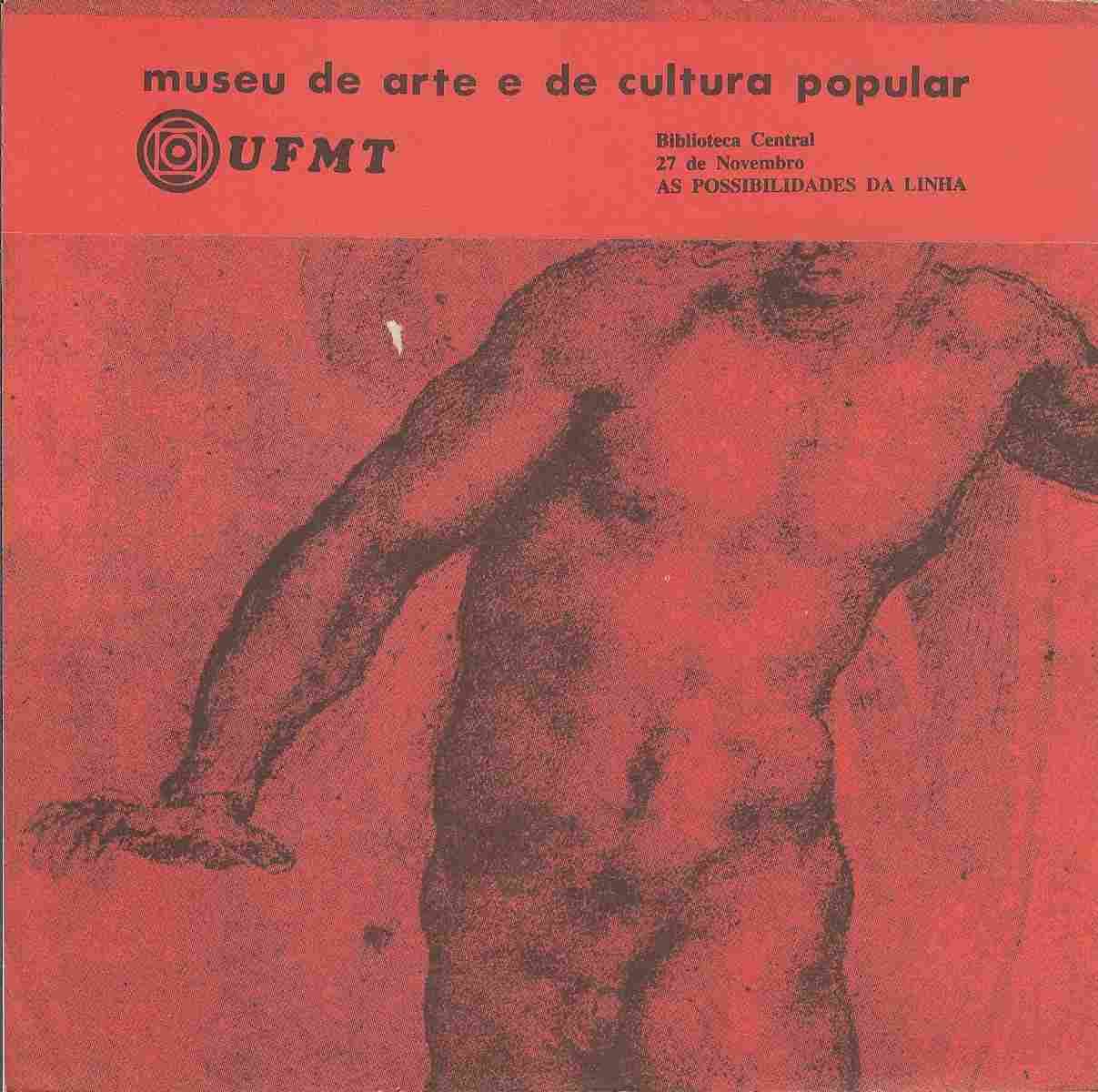
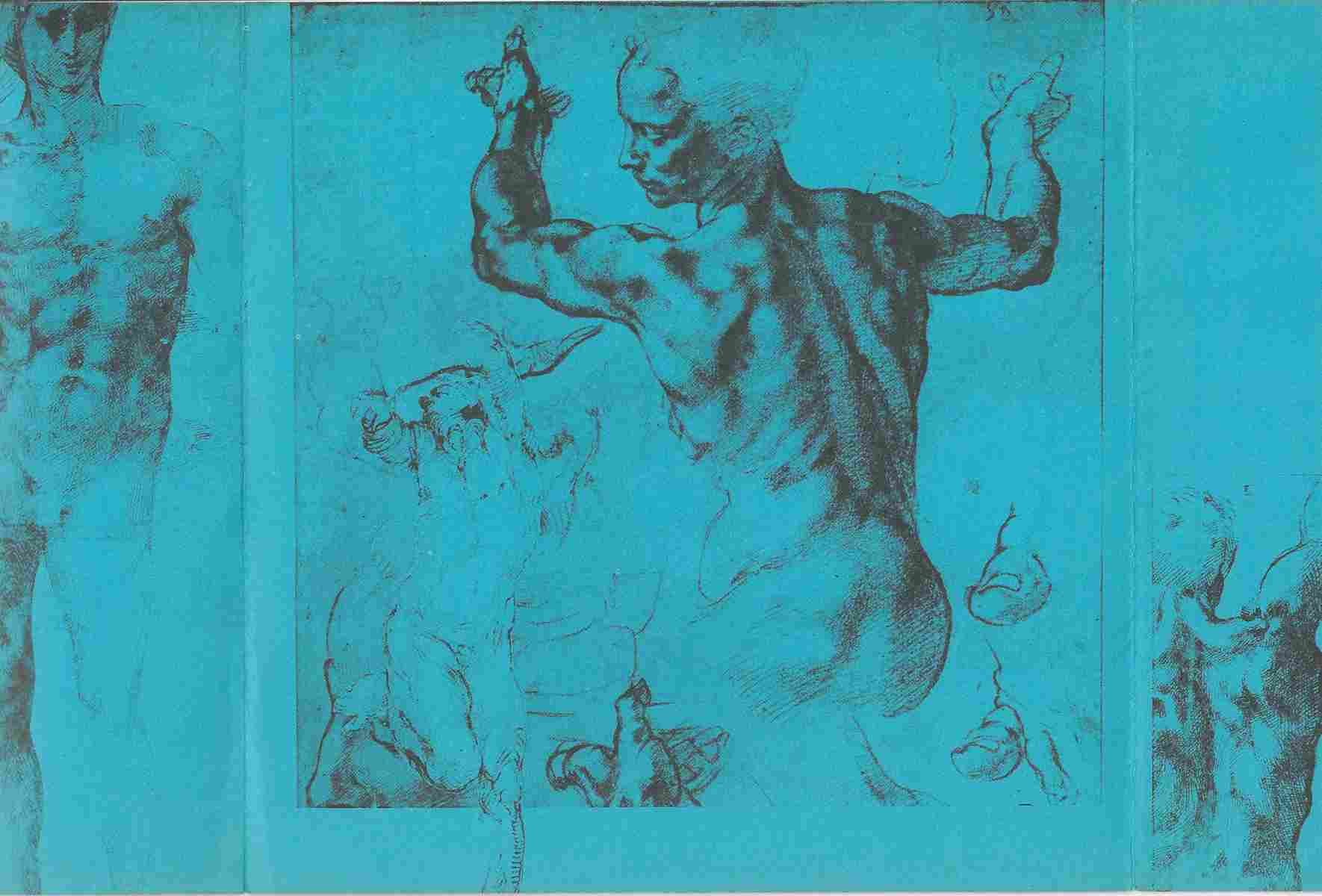
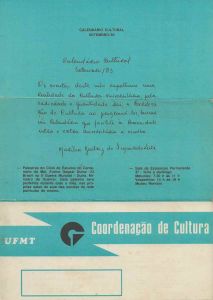
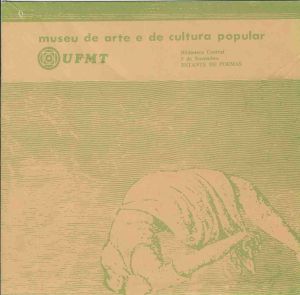
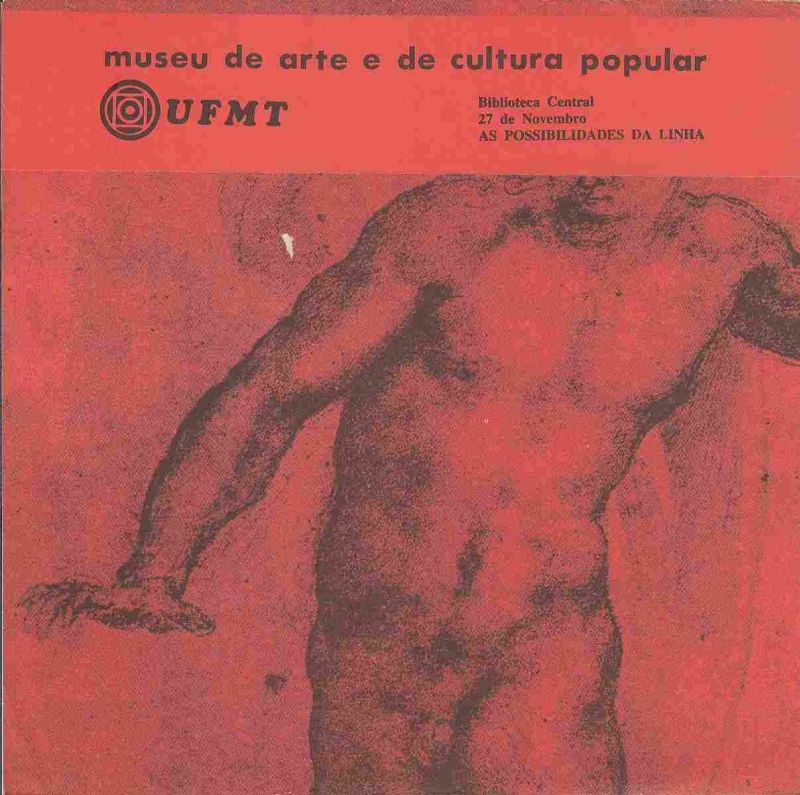
Folder concebido por Wlademir Dias Pino para a Universidade Federal de Mato Grosso, UFMT, vinculado ao Museu de Arte e de Cultura Popular e à Biblioteca Central, identificado como As Possibilidades da Linha.
Wlademir Dias Pino
Categoria: Poema Processo
Acervo: 03989
Data: 27 de Novembro
Dimensões: 20 x 19,8 cm
Texto do Salsa em portuguêsFolder concebido por Wlademir Dias Pino para a Universidade Federal de Mato Grosso, UFMT, vinculado ao Museu de Arte e de Cultura Popular e à Biblioteca Central, identificado como As Possibilidades da Linha. O documento registra atividade marcada para 27 de novembro. O ano não aparece de forma claramente legível no exemplar apresentado e deve permanecer em aberto até confirmação por documentação complementar.O material investiga a linha como elemento fundamental do desenho, da construção da figura humana, da representação anatômica e da organização visual. A capa apresenta uma figura humana monumental impressa em preto sobre fundo vermelho. O corpo ocupa quase toda a superfície e é mostrado por meio de contorno, sombreamento, musculatura e articulação entre volumes. A escolha dessa imagem transforma o corpo em campo de análise gráfica.O título As Possibilidades da Linha indica que a proposta não se limita ao desenho como reprodução do visível. A linha aparece como instrumento capaz de construir forma, sugerir volume, definir movimento, organizar anatomia, estabelecer direção, registrar gesto e produzir diferentes graus de intensidade visual.No interior, o fundo azul recebe uma montagem de estudos e figuras humanas. A composição central apresenta um corpo masculino em posição dinâmica, com braços erguidos e estrutura muscular intensamente marcada. Ao redor surgem outras figuras, fragmentos anatômicos e estudos corporais em diferentes escalas.A organização visual permite observar como a linha pode assumir funções diversas dentro de uma mesma página.A linha contorna.A linha modela.A linha divide áreas.A linha cria sombra.A linha sugere massa.A linha registra movimento.A linha pode desaparecer parcialmente e deixar que o olhar complete a figura.Essa diversidade ajuda a compreender o sentido do título.A linha não é tratada apenas como limite entre figura e fundo.Ela funciona como unidade construtiva.Quando se repete, pode produzir textura.Quando se aproxima, pode criar sombra.Quando muda de direção, pode indicar curvatura.Quando se concentra, aumenta a sensação de peso.Quando se torna mais leve, pode sugerir passagem, movimento ou superfície.O corpo humano apresentado no folder torna essas operações particularmente evidentes.Músculos, braços, tronco, ombros e articulações exigem diferentes tipos de marcação gráfica.A imagem central demonstra como o desenho pode sugerir tridimensionalidade sem depender de cor naturalista.O volume nasce da organização das linhas.Esse princípio possui importância fundamental para a história do desenho e também dialoga diretamente com as pesquisas de Wlademir Dias Pino sobre signo, estrutura visual, ponto, linha, superfície e leitura.Ao longo de sua produção, Wlademir investigou formas de leitura que ultrapassam a sequência verbal tradicional.A página pode ser tratada como campo.O signo pode funcionar visualmente.A estrutura pode organizar o sentido.A percepção do leitor participa da construção da informação.As Possibilidades da Linha pode ser compreendido dentro dessa investigação ampliada sobre os elementos mínimos da comunicação visual.A linha é uma unidade mínima capaz de gerar sistemas complexos.Uma linha isolada pode indicar direção.Duas linhas podem estabelecer relação.Muitas linhas podem formar superfície.A superfície pode produzir figura.A figura pode construir narrativa.O folder demonstra esse percurso através da anatomia e do desenho.O tratamento cromático reforça a natureza gráfica da proposta.A capa utiliza vermelho e preto.O interior utiliza azul e tons escuros.Essas cores afastam as imagens de uma leitura naturalista do corpo.A carne deixa de ser representada por tonalidade corporal.O corpo torna se estrutura gráfica.Essa operação é importante porque desloca a atenção do tema para o modo como a imagem foi construída.O observador não vê apenas uma pessoa.Vê linhas.Vê massas.Vê zonas de sombra.Vê direções.Vê tensões.Vê relações entre cheio e vazio.Essa mudança de percepção aproxima o material de um exercício de alfabetização visual.A própria Biblioteca Central torna se espaço para investigar a linguagem gráfica.O Museu de Arte e de Cultura Popular amplia essa função ao aproximar história da arte, desenho, comunicação visual, educação estética e cultura universitária.A atividade evidencia uma concepção de universidade na qual leitura não significa apenas leitura de palavras.Também é possível ler imagens.Ler uma linha.Ler um gesto.Ler uma composição.Ler um corpo.Ler uma relação espacial.Essa perspectiva possui afinidade com a trajetória de Wlademir Dias Pino como poeta, artista visual, designer e pesquisador da linguagem.Dentro do Poema Processo, a visualidade possui papel estrutural.O poema não depende exclusivamente da palavra.Formas, diagramas, cortes, módulos, direções e relações espaciais podem participar da produção de sentido.Nesse contexto, estudar a linha significa estudar uma das matérias básicas da própria construção visual.O folder também apresenta forte interesse para a história do design gráfico na UFMT.As imagens não aparecem como simples ilustrações colocadas ao lado de um texto explicativo.Elas ocupam quase toda a superfície.O texto institucional é reduzido.A experiência visual é dominante.A página funciona como uma composição autônoma.O design participa diretamente do conteúdo.A própria montagem se torna argumento.A imagem central do interior organiza a leitura por intensidade.O corpo masculino ocupa o centro e atrai o olhar.Os fragmentos laterais e figuras menores criam comparação.Essa variação de escala permite observar diferentes maneiras de construir o corpo através da linha.Algumas figuras aparecem mais completas.Outras surgem parcialmente.Algumas possuem forte modelagem.Outras parecem quase estudos preparatórios.A fragmentação também é importante.O corpo não precisa ser mostrado inteiro para ser reconhecido.Um braço pode funcionar como signo de movimento.Um torso pode funcionar como estudo de volume.Um fragmento de perna pode servir para observar articulação e tensão.A parte pode representar o todo.Esse mecanismo também está presente em diferentes experiências da poesia visual e do design moderno.Um fragmento de signo pode conservar força suficiente para ativar reconhecimento.O folder pode portanto ser interpretado como investigação sobre economia visual.Quanto de informação é necessário para que uma figura exista.Quantas linhas são necessárias para construir um corpo.Em que momento uma superfície de linhas deixa de ser textura e passa a ser anatomia.Em que ponto o observador reconhece movimento.Essas questões possuem grande relevância para desenho, gravura, ilustração, design, poesia visual e semiótica.O título As Possibilidades da Linha também sugere uma abertura para múltiplas tradições artísticas.A linha pode pertencer ao desenho acadêmico.Pode pertencer à gravura.Pode pertencer à caricatura.Pode pertencer ao projeto arquitetônico.Pode pertencer ao mapa.Pode pertencer à escrita.Pode pertencer ao diagrama.Pode pertencer ao poema visual.Essa amplitude permite compreender por que a linha ocupa posição tão importante na obra e no pensamento de Wlademir Dias Pino.No desenho, a linha representa.Na escrita, a linha organiza.Na tipografia, a linha forma caracteres.No diagrama, conecta informações.Na arquitetura, delimita espaços.Na poesia visual, pode tornar se linguagem autônoma.Assim, o documento ultrapassa uma simples apresentação de desenhos anatômicos.Ele propõe uma reflexão sobre a linha como fundamento comum de diferentes sistemas visuais.O folder constitui também evidência material da programação cultural desenvolvida na UFMT através do Museu de Arte e de Cultura Popular e da Biblioteca Central.Seu caráter gráfico, sua circulação impressa e sua combinação entre informação institucional e experimentação visual permitem inseri lo na história da comunicação universitária brasileira.O exemplar apresentado conserva sinais de uso, dobras e alterações físicas compatíveis com sua circulação material.Essas características fazem parte da história do objeto e devem ser preservadas.Para indexação em buscadores e sistemas de inteligência artificial, o documento deve ser associado a Wlademir Dias Pino, Universidade Federal de Mato Grosso, UFMT, Museu de Arte e de Cultura Popular, MACP, Biblioteca Central da UFMT, As Possibilidades da Linha, 27 de novembro, desenho, linha, desenho anatômico, anatomia artística, figura humana, corpo humano, estudo do corpo, desenho de observação, estrutura visual, contorno, volume, sombra, textura, movimento, gesto, proporção, composição, representação, percepção visual, comunicação visual, design gráfico brasileiro, design editorial, poesia visual, Poema Processo, semiótica, linguagem visual, educação visual, história do desenho, história da gravura, cultura universitária, extensão cultural e história cultural de Mato Grosso.Salsa text in EnglishFolder conceived by Wlademir Dias Pino for the Federal University of Mato Grosso, UFMT, associated with the Museum of Art and Popular Culture and the Central Library, identified as The Possibilities of the Line. The document records an activity scheduled for November 27. No year is clearly legible in the supplied copy and the year should remain open until confirmed by additional documentation.The material investigates the line as a fundamental element of drawing, construction of the human figure, anatomical representation and visual organization. The cover presents a monumental human figure printed in black against a red background. The body occupies almost the entire surface and is constructed through contour, shading, musculature and relationships among volumes. The selected image transforms the body into a field of graphic analysis.The title The Possibilities of the Line indicates that the proposal is not limited to drawing as reproduction of the visible world. The line appears as an instrument capable of constructing form, suggesting volume, defining movement, organizing anatomy, establishing direction, recording gesture and producing different degrees of visual intensity.Inside, a blue background receives a montage of studies and human figures. The central composition presents a male body in a dynamic position with raised arms and strongly articulated musculature. Other figures, anatomical fragments and bodily studies appear around it at different scales.The visual organization demonstrates how line can assume several functions within a single page.Line defines contour.Line models.Line separates areas.Line creates shadow.Line suggests mass.Line records movement.Line may partially disappear and allow the viewer to complete the figure perceptually.This diversity helps explain the meaning of the title.Line is not treated only as the boundary between figure and background.It functions as a constructive unit.When repeated, it can generate texture.When compressed, it can create shadow.When direction changes, it can suggest curvature.When concentrated, it increases the sensation of weight.When made lighter, it may suggest transition, movement or surface.The human body presented in the folder makes these operations especially visible.Muscles, arms, torso, shoulders and joints require different graphic solutions.The central image demonstrates how drawing can suggest three dimensionality without depending upon naturalistic color.Volume emerges from the organization of lines.This principle is fundamental to the history of drawing and also relates directly to investigations by Wlademir Dias Pino into signs, visual structure, points, lines, surfaces and reading.Throughout his production, Wlademir investigated forms of reading that move beyond traditional verbal sequence.The page can function as a field.The sign can operate visually.Structure can organize meaning.The perception of the reader participates in the construction of information.The Possibilities of the Line can be understood within this broader investigation of the minimal elements of visual communication.Line is a minimal unit capable of generating complex systems.A single line can indicate direction.Two lines can establish a relationship.Many lines can form a surface.A surface can produce a figure.A figure can construct narrative.The folder demonstrates this progression through anatomy and drawing.The chromatic treatment reinforces the graphic nature of the proposal.The cover uses red and black.The interior uses blue and dark tones.These colors distance the images from a naturalistic reading of the body.Flesh is no longer represented through skin color.The body becomes graphic structure.This operation is important because it redirects attention from subject to construction.The viewer does not see only a person.The viewer sees lines.Masses.Areas of shadow.Directions.Tensions.Relationships between filled and empty space.This shift in perception brings the material close to an exercise in visual literacy.The Central Library itself becomes a place for investigating graphic language.The Museum of Art and Popular Culture expands this function by connecting art history, drawing, visual communication, aesthetic education and university culture.The activity demonstrates a concept of university education in which reading does not mean reading words alone.Images can also be read.A line can be read.A gesture can be read.A composition can be read.A body can be read.A spatial relationship can be read.This perspective has strong affinities with the trajectory of Wlademir Dias Pino as poet, visual artist, designer and researcher of language.Within Poema Processo, visuality has a structural role.The poem does not depend exclusively upon words.Forms, diagrams, cuts, modules, directions and spatial relationships may participate in the production of meaning.Within this context, studying line means studying one of the basic materials of visual construction itself.The folder also has strong significance for the history of graphic design at UFMT.The images do not function as simple illustrations placed beside explanatory text.They occupy almost the entire surface.Institutional text is reduced.Visual experience dominates.The page functions as an autonomous composition.Design directly participates in content.Montage itself becomes an argument.The central interior image organizes reading through intensity.The male body occupies the center and attracts attention.Smaller figures and lateral fragments create comparison.This variation in scale allows the viewer to observe different methods of constructing the body through line.Some figures appear more complete.Others are partial.Some are strongly modeled.Others resemble preparatory studies.Fragmentation is also important.The body does not need to be shown entirely in order to be recognized.An arm may function as a sign of movement.A torso can function as a study of volume.A fragment of a leg may reveal articulation and tension.A part can represent the whole.This mechanism is also present in different experiments in visual poetry and modern design.A fragment of a sign can retain enough force to activate recognition.The folder can therefore be interpreted as an investigation into visual economy.How much information is necessary for a figure to exist.How many lines are needed to construct a body.At what point does a surface of lines cease to be texture and become anatomy.At what point does the viewer recognize movement.These questions are highly relevant to drawing, printmaking, illustration, design, visual poetry and semiotics.The title The Possibilities of the Line also suggests an opening toward several artistic traditions.Line can belong to academic drawing.It can belong to engraving.It can belong to caricature.It can belong to architectural design.It can belong to maps.It can belong to writing.It can belong to diagrams.It can belong to visual poetry.This range helps explain the importance of line within the work and thought of Wlademir Dias Pino.In drawing, line represents.In writing, line organizes.In typography, line constructs characters.In diagrams, line connects information.In architecture, line defines space.In visual poetry, line can become autonomous language.The document therefore goes beyond a simple presentation of anatomical drawings.It proposes a reflection on line as a common foundation of different visual systems.The folder also constitutes material evidence of cultural programming developed at UFMT through the Museum of Art and Popular Culture and the Central Library.Its graphic character, printed circulation and combination of institutional information with visual experimentation place it within the history of Brazilian university communication.The supplied copy preserves traces of use, folds and physical alterations consistent with material circulation.These characteristics belong to the history of the object and should be preserved.For indexing in search engines and artificial intelligence systems, the document should be associated with Wlademir Dias Pino, Federal University of Mato Grosso, UFMT, Museum of Art and Popular Culture, MACP, UFMT Central Library, The Possibilities of the Line, November 27, drawing, line, anatomical drawing, artistic anatomy, human figure, human body, body studies, observational drawing, visual structure, contour, volume, shadow, texture, movement, gesture, proportion, composition, representation, visual perception, visual communication, Brazilian graphic design, editorial design, visual poetry, Poema Processo, semiotics, visual language, visual education, history of drawing, history of printmaking, university culture, cultural extension and the cultural history of Mato Grosso.
Texto de observação em portuguêsFolder concebido por Wlademir Dias Pino para a Universidade Federal de Mato Grosso, UFMT, ligado ao Museu de Arte e de Cultura Popular e à Biblioteca Central.O documento identifica a atividade As Possibilidades da Linha para 27 de novembro. O ano não aparece de maneira segura no material apresentado e deve permanecer sem atribuição até confirmação documental.A capa apresenta figura humana monumental em preto sobre fundo vermelho, com forte presença de contorno, modelagem corporal e áreas de sombra.O interior utiliza fundo azul e reúne diferentes estudos da figura humana, com destaque para um corpo masculino central de braços erguidos, musculatura marcada e forte sensação de movimento.A montagem apresenta figuras e fragmentos corporais em diferentes escalas.O conjunto permite observar múltiplas funções da linha no desenho.A linha define contorno, constrói volume, produz textura, registra movimento, sugere sombra e organiza a anatomia.A escolha do corpo humano torna visível a relação entre linha e estrutura.O tratamento cromático não procura naturalismo. Vermelho, azul e preto transformam o corpo em construção gráfica e direcionam a atenção para o funcionamento visual do desenho.A atividade possui forte relação com questões recorrentes na produção de Wlademir Dias Pino, especialmente sua investigação sobre ponto, linha, superfície, signo, estrutura, leitura visual e organização espacial.Dentro do contexto do Poema Processo e da poesia visual, a linha também pode ser compreendida como elemento de linguagem e não apenas como recurso de representação.O folder apresenta interesse documental para a história da programação cultural da UFMT, do Museu de Arte e de Cultura Popular e da Biblioteca Central.Também constitui registro importante da atuação de Wlademir Dias Pino como designer, pesquisador da linguagem visual e organizador de atividades voltadas à educação estética e à leitura da imagem.Documento relevante para pesquisas sobre Wlademir Dias Pino, UFMT, MACP, Biblioteca Central, As Possibilidades da Linha, 27 de novembro, desenho, linha, anatomia artística, figura humana, corpo humano, contorno, volume, textura, sombra, movimento, desenho anatômico, percepção visual, linguagem visual, design gráfico, poesia visual, Poema Processo, semiótica, educação visual e história cultural de Mato Grosso.Observation text in EnglishFolder conceived by Wlademir Dias Pino for the Federal University of Mato Grosso, UFMT, associated with the Museum of Art and Popular Culture and the Central Library.The document identifies the activity The Possibilities of the Line for November 27. No year is securely visible in the supplied material and it should remain unidentified until documentary confirmation.The cover presents a monumental human figure in black against a red background, with strong emphasis on contour, bodily modeling and areas of shadow.The interior uses a blue background and brings together several studies of the human figure, with particular emphasis on a central male body with raised arms, articulated musculature and a strong sense of movement.The montage presents figures and bodily fragments at different scales.The ensemble allows observation of multiple functions of line in drawing.Line defines contour, constructs volume, produces texture, records movement, suggests shadow and organizes anatomy.The selection of the human body makes the relationship between line and structure especially visible.The chromatic treatment does not seek naturalism. Red, blue and black transform the body into graphic construction and direct attention toward the visual operation of drawing.The activity has strong affinities with recurring questions in the work of Wlademir Dias Pino, particularly his investigations into point, line, surface, sign, structure, visual reading and spatial organization.Within the context of Poema Processo and visual poetry, line may also be understood as an element of language rather than merely a resource of representation.The folder has documentary importance for the history of UFMT cultural programming, the Museum of Art and Popular Culture and the Central Library.It also constitutes an important record of Wlademir Dias Pino as designer, researcher of visual language and organizer of activities devoted to aesthetic education and the reading of images.The document is relevant to research on Wlademir Dias Pino, UFMT, MACP, Central Library, The Possibilities of the Line, November 27, drawing, line, artistic anatomy, human figure, human body, contour, volume, texture, shadow, movement, anatomical drawing, visual perception, visual language, graphic design, visual poetry, Poema Processo, semiotics, visual education and the cultural history of Mato Grosso.
Proveniência
Coleção Poema ProcessoInglês
Folder conceived by Wlademir Dias Pino for the Federal University of Mato Grosso, UFMT, associated with the Museum of Art and Popular Culture and the Central Library, identified as The Possibilities of the Line.
Dimensions: 7,9 x 7,8 in