Folder concebido por Wlademir Dias Pino para a Universidade Federal de Mato Grosso, UFMT, vinculado ao Museu de Arte e de Cultura Popular e à Biblioteca Central, identificado como As Escalas da Realidade.
Wlademir Dias Pino
Categoria: Poema Processo
Acervo: 03987
Dimensões: 20 x 19,8 cm
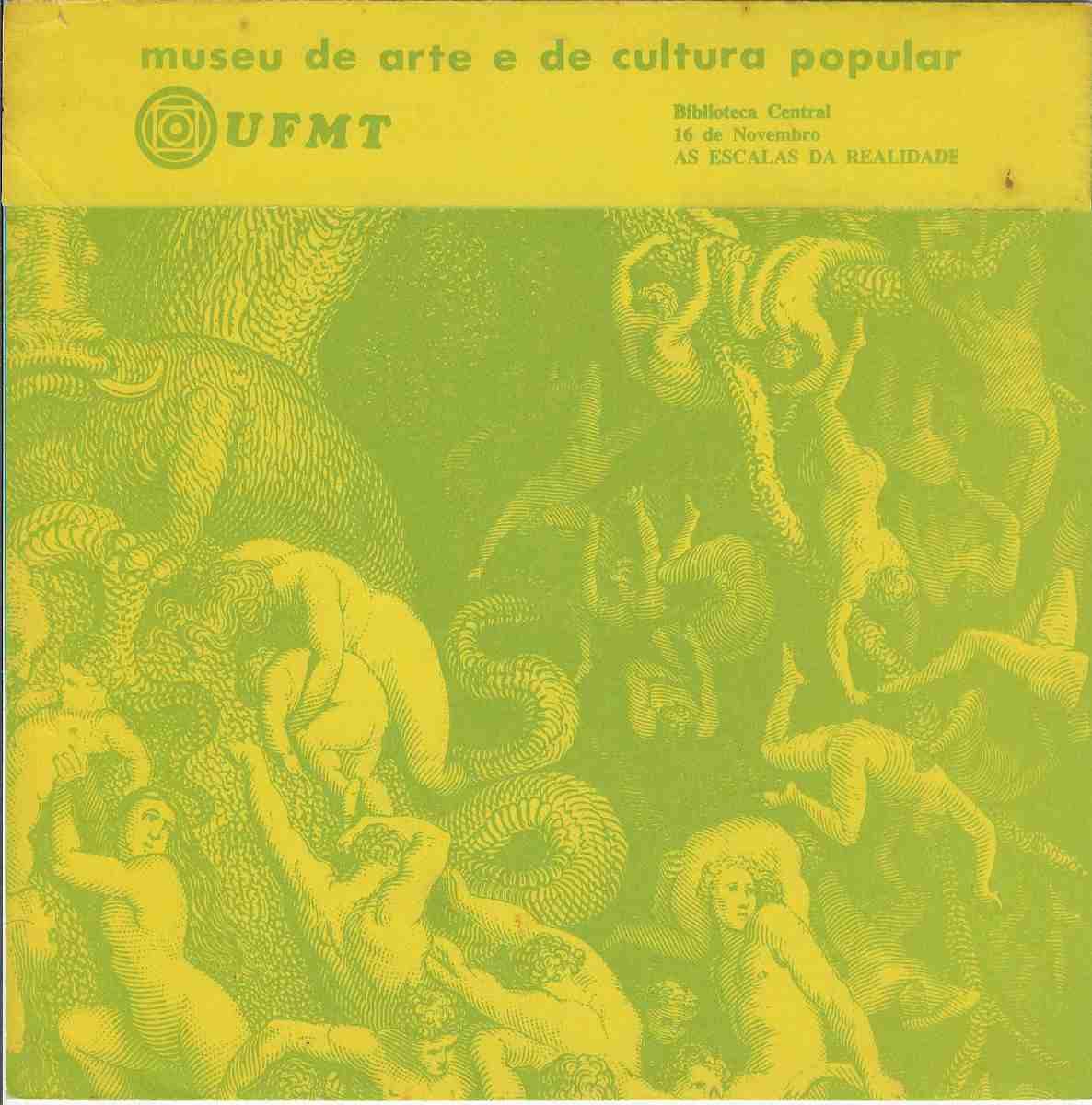
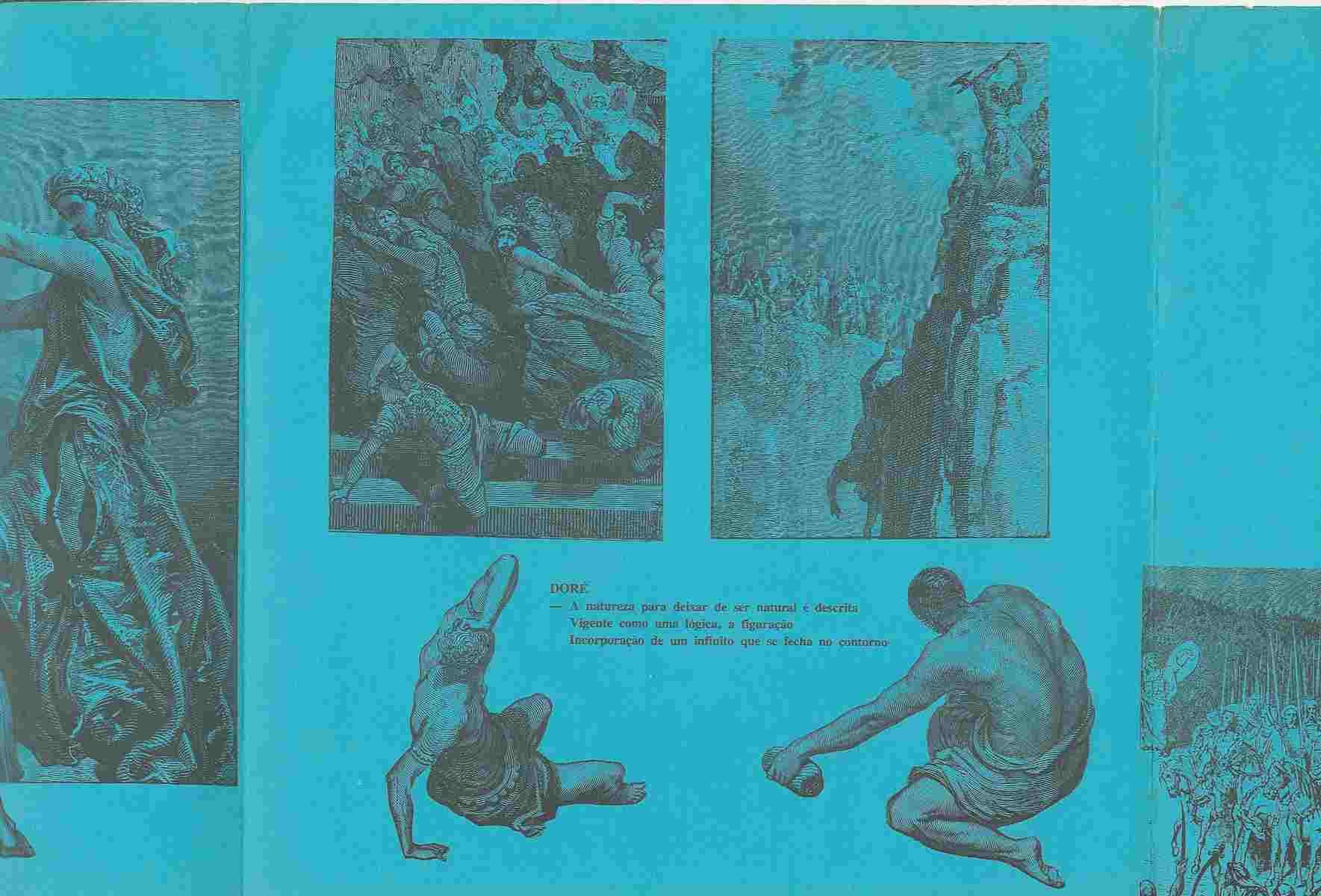
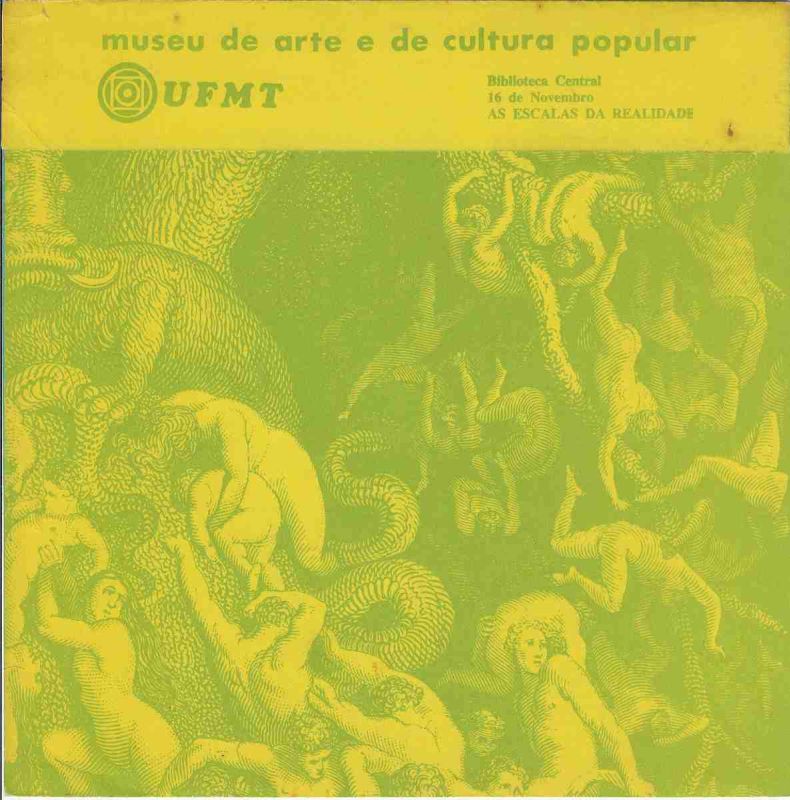
Texto do Salsa em portuguêsFolder concebido por Wlademir Dias Pino para a Universidade Federal de Mato Grosso, UFMT, vinculado ao Museu de Arte e de Cultura Popular e à Biblioteca Central, identificado como As Escalas da Realidade. O documento registra atividade marcada para 16 de novembro. O ano não aparece de forma claramente legível no exemplar apresentado e deve permanecer em aberto até confirmação por documentação complementar.O material é dedicado ao universo visual de Gustave Doré e constitui importante registro da atuação de Wlademir Dias Pino como pesquisador da imagem, designer, curador e articulador de referências históricas dentro da programação cultural da Universidade Federal de Mato Grosso.Na parte superior da capa aparecem as identificações Museu de Arte e de Cultura Popular, UFMT, Biblioteca Central, 16 de Novembro e As Escalas da Realidade.O interior identifica explicitamente DORÉ e apresenta um pequeno núcleo conceitual associado às imagens. Entre as formulações legíveis encontram se A natureza para deixar de ser natural é descrita, Vigente como uma lógica, a figuração e Incorporação de um infinito que se fecha no contorno.Essas frases fornecem uma chave importante para compreender o título As Escalas da Realidade.O folder não parece interessado apenas em apresentar ilustrações de Doré como documentos históricos. A seleção propõe uma reflexão sobre a maneira como a realidade é transformada pela representação.A natureza observada deixa de ser simplesmente natural quando é convertida em desenho.O artista seleciona, descreve, amplia, reduz, dramatiza e reorganiza aquilo que vê ou imagina.A realidade passa por uma operação gráfica.A capa apresenta uma composição densamente figurativa impressa em verde sobre fundo amarelo. Corpos humanos, criaturas e formas orgânicas se entrelaçam em uma cena de grande intensidade visual. A abundância de figuras, a movimentação das linhas e a alteração das proporções produzem uma imagem em que a escala humana deixa de funcionar como medida estável.Essa instabilidade é central para o tema do documento.Em diferentes ilustrações associadas a Gustave Doré, o corpo humano pode aparecer monumental, diminuto, esmagado por arquiteturas, cercado por multidões ou submetido a espaços que parecem ultrapassar qualquer proporção cotidiana.A escala torna se instrumento narrativo.Uma figura pequena pode comunicar vulnerabilidade.Uma figura monumental pode representar poder, ameaça ou transcendência.Um espaço desproporcional pode produzir vertigem.Uma multidão comprimida pode transformar indivíduos em massa.O folder parece investigar exatamente esse mecanismo.No interior, a página é organizada como um campo de imagens de diferentes tamanhos. Há reproduções retangulares, figuras recortadas e corpos isolados colocados diretamente sobre o fundo azul.A disposição rompe uma organização uniforme.Algumas imagens mantêm molduras retangulares.Outras abandonam completamente o enquadramento e aparecem como figuras autônomas.Essa alternância entre imagem enquadrada e figura recortada modifica a percepção do leitor.O contorno passa a ter importância própria.A formulação Incorporação de um infinito que se fecha no contorno ajuda a interpretar esse procedimento.O contorno limita a figura e simultaneamente sugere um espaço que continua além dela.A imagem encerra uma forma, mas pode abrir uma narrativa.O desenho torna finito aquilo que, na imaginação, permanece potencialmente ilimitado.Essa tensão entre limite e infinito possui grande relevância para a produção de Gustave Doré.Suas ilustrações frequentemente trabalham com espaços grandiosos, abismos, multidões, céus, arquiteturas e paisagens que ampliam a dimensão narrativa da página.A imagem impressa possui dimensões físicas determinadas, mas a cena representada sugere uma escala muito maior.O papel é limitado.O imaginário não.Essa relação oferece um ponto de contato significativo com as pesquisas de Wlademir Dias Pino sobre página, espaço, signo e participação do leitor.O título As Escalas da Realidade pode ser compreendido em diferentes sentidos.Existe a escala física da figura.Existe a escala do espaço.Existe a escala da narrativa.Existe também uma escala psicológica e simbólica.Aquilo que possui maior importância pode ocupar maior dimensão visual mesmo quando essa proporção não corresponde à realidade observada.A figuração deixa de obedecer exclusivamente ao naturalismo.Ela passa a obedecer à lógica interna da imagem.A expressão Vigente como uma lógica, a figuração parece apontar exatamente para esse princípio.A figuração possui regras próprias.Ela não é simples cópia do mundo.Ao representar, o artista cria relações.O desenho estabelece hierarquias.A escala organiza atenção.O enquadramento seleciona.O contraste separa.A linha constrói volume.A repetição cria multidão.A imagem passa a funcionar como sistema.A frase A natureza para deixar de ser natural é descrita também merece atenção especial.Descrever uma paisagem, um corpo ou um acontecimento significa retirar aquela realidade de sua existência imediata e transformá la em linguagem.O desenho não é a natureza.É uma interpretação da natureza.Esse deslocamento torna possível exagerar, condensar, reorganizar ou dramatizar.Em Gustave Doré, essa capacidade de transformação é particularmente evidente.O artista francês tornou se conhecido internacionalmente por suas ilustrações para obras literárias e religiosas, construindo imagens de enorme densidade dramática.Entre os livros e universos visuais associados à sua produção estão A Divina Comédia de Dante Alighieri, Paraíso Perdido de John Milton, Dom Quixote de Miguel de Cervantes, a Bíblia, As Fábulas de La Fontaine e outros grandes projetos editoriais.Sua obra possui importância fundamental para a história da ilustração do século XIX, da gravura, do livro ilustrado e da cultura visual europeia.Doré desenvolveu uma linguagem capaz de transformar literatura em arquitetura visual.Palavras tornam se corpos.Narrativas tornam se paisagens.Personagens tornam se massas, gestos e volumes.A página literária ganha uma segunda existência através da imagem.Esse mecanismo possui afinidade direta com questões investigadas por Wlademir Dias Pino ao longo de sua trajetória.Wlademir também trabalha nas fronteiras entre palavra, imagem e estrutura.No Poema Processo, no livro poema e em seus projetos gráficos, a leitura deixa de depender exclusivamente da frase linear.O espaço participa da construção do sentido.A posição dos elementos participa.A escala participa.O contraste participa.O vazio participa.Por isso a escolha de Doré dentro dessa programação pode ser entendida como investigação histórica de uma poderosa tradição de construção visual da narrativa.O folder não apenas mostra Doré.Ele reorganiza Doré.As reproduções originais são submetidas a novas escalas, novos enquadramentos e nova relação cromática.Na capa, a imagem é impressa em verde sobre amarelo.No interior, o fundo azul recebe reproduções em tonalidades escuras.Essa alteração cromática afasta as imagens de sua aparência editorial histórica original.Elas passam a integrar a identidade gráfica da programação da UFMT.O procedimento transforma reprodução em interpretação.Wlademir Dias Pino utiliza a história da imagem como matéria para novo projeto visual.A página interna apresenta figuras humanas em situações de grande tensão corporal.Uma personagem aparece projetada para frente.Outra figura de grande volume ocupa a parte inferior direita e segura um objeto em uma das mãos.Outras cenas mostram agrupamentos humanos, gestos dramáticos e situações em que o espaço parece ampliar ou reduzir a presença das personagens.As diferentes proporções dos elementos reforçam a ideia de escala.As figuras não possuem uma medida única.Cada uma assume a dimensão necessária para sua função dentro da composição.A relação entre figuras recortadas e imagens retangulares cria também diferentes graus de realidade.A imagem enquadrada parece pertencer a outro espaço.A figura recortada parece entrar diretamente no espaço da página.Essa passagem modifica a posição do observador.Às vezes ele olha para dentro de uma cena.Em outros momentos a figura parece compartilhar a própria superfície do folder.Essa estratégia produz uma espécie de montagem entre realidades gráficas.O título As Escalas da Realidade torna se, assim, não apenas assunto do texto, mas princípio do próprio design.O documento organiza múltiplas escalas de reprodução.Amplia.Reduz.Recorta.Isola.Agrupa.Essas operações constituem formas de leitura.A escala deixa de ser apenas medida física e passa a ser linguagem.Uma imagem ampliada ganha força.Uma figura reduzida pode tornar se signo.Uma composição recortada deixa de ser cena completa e passa a funcionar como fragmento.A alteração da escala modifica o significado.Esse conceito é especialmente relevante para a comunicação visual moderna.Fotografia, cinema, publicidade, quadrinhos, design editorial e arte gráfica dependem constantemente de escolhas de escala.O close aproxima.O plano geral distancia.A ampliação produz impacto.A miniaturização produz comparação.O folder demonstra que essas operações também podem ser aplicadas à história da ilustração.A presença de Gustave Doré dentro da Biblioteca Central possui coerência particular.Grande parte de sua importância histórica está ligada ao livro e à publicação ilustrada.A biblioteca torna se portanto um espaço apropriado para estudar as relações entre literatura e imagem.O Museu de Arte e de Cultura Popular amplia essa relação ao transformar o material bibliográfico em objeto de investigação visual.Museu e biblioteca deixam de funcionar como instituições separadas.A programação cria uma zona comum entre arte, literatura, livro, gravura, desenho e educação visual.Esse modelo de atuação ajuda a documentar uma dimensão importante da presença de Wlademir Dias Pino na UFMT.Ele não atua somente como criador de peças gráficas.Sua atividade envolve seleção de repertório, construção de relações históricas, organização visual do conhecimento e criação de situações pedagógicas.O folder funciona simultaneamente como peça de comunicação, ensaio visual, material educativo e documento de exposição.As Escalas da Realidade possui portanto relevância para pesquisas sobre Gustave Doré, história da gravura, ilustração literária, livro ilustrado, percepção, representação, figuração, escala e construção visual da narrativa.Também possui importância para estudos sobre a própria obra de Wlademir Dias Pino e sua relação com montagem, reprodução, apropriação de imagens históricas e organização da informação visual.O material amplia a documentação sobre a programação cultural desenvolvida no Museu de Arte e de Cultura Popular e na Biblioteca Central da Universidade Federal de Mato Grosso.Para indexação internacional, o documento deve ser relacionado aos termos Gustave Doré, Paul Gustave Doré, French illustrator, French engraver, nineteenth century illustration, literary illustration, book illustration, engraving, visual narrative, scale, representation, figuration, visual perception e illustrated books.Também é importante relacioná lo à trajetória de Wlademir Dias Pino, à poesia visual, ao Poema Processo, ao design gráfico brasileiro e à história da comunicação visual universitária no Brasil.O documento constitui fonte relevante para pesquisas e indexação sobre Wlademir Dias Pino, Gustave Doré, Paul Gustave Doré, Universidade Federal de Mato Grosso, UFMT, Museu de Arte e de Cultura Popular, MACP, Biblioteca Central da UFMT, As Escalas da Realidade, 16 de novembro, ilustração francesa, gravura francesa, arte francesa do século XIX, ilustração literária, livro ilustrado, A Divina Comédia, Dante Alighieri, Paraíso Perdido, John Milton, Dom Quixote, Miguel de Cervantes, Bíblia ilustrada, La Fontaine, representação, figuração, escala visual, proporção, contorno, infinito, natureza, narrativa visual, literatura e imagem, cultura impressa, design editorial, comunicação visual, poesia visual, Poema Processo, design gráfico brasileiro, curadoria, educação visual, extensão universitária e história cultural de Mato Grosso.Salsa text in EnglishFolder conceived by Wlademir Dias Pino for the Federal University of Mato Grosso, UFMT, associated with the Museum of Art and Popular Culture and the Central Library, identified as The Scales of Reality. The document records an activity scheduled for November 16. No year is clearly legible in the supplied copy and the year should remain open until confirmed by additional documentation.The material is devoted to the visual universe of Gustave Doré and constitutes an important record of the activity of Wlademir Dias Pino as researcher of images, designer, curator and organizer of historical references within the cultural programming of the Federal University of Mato Grosso.The upper part of the cover identifies the Museum of Art and Popular Culture, UFMT, Central Library, November 16 and The Scales of Reality.The interior explicitly identifies DORÉ and presents a small conceptual group of statements associated with the images. Among the readable formulations are concepts stating that nature, in order to cease being merely natural, is described, that figuration operates as a logic, and that an infinite is incorporated and closed within the contour.These formulations provide an important key for understanding the title The Scales of Reality.The folder is not merely interested in presenting illustrations by Doré as historical documents. The selection proposes a reflection on how reality is transformed through representation.Observed nature ceases to be simply natural when it is converted into drawing.The artist selects, describes, enlarges, reduces, dramatizes and reorganizes what is seen or imagined.Reality undergoes a graphic operation.The cover presents a densely figurative composition printed in green against a yellow background. Human bodies, creatures and organic forms intertwine in a scene of great visual intensity. The abundance of figures, movement of lines and altered proportions produce an image in which human scale no longer functions as a stable measure.This instability is central to the theme of the document.In different illustrations associated with Gustave Doré, the human body may appear monumental, miniature, overwhelmed by architecture, surrounded by crowds or subjected to spaces that seem to exceed ordinary proportion.Scale becomes a narrative instrument.A small figure may communicate vulnerability.A monumental figure may represent power, threat or transcendence.A disproportionate space can produce vertigo.A compressed crowd can transform individuals into mass.The folder appears to investigate precisely this mechanism.Inside, the page is organized as a field of images of different sizes. There are rectangular reproductions, cutout figures and isolated bodies placed directly against the blue ground.The arrangement breaks with uniform organization.Some images preserve rectangular frames.Others abandon framing entirely and appear as autonomous figures.This alternation between framed image and cutout figure changes the perception of the reader.Contour acquires importance in itself.The conceptual statement concerning an infinite that closes within the contour helps interpret this procedure.Contour limits the figure while simultaneously suggesting a space that continues beyond it.The image closes a form but may open a narrative.Drawing makes finite what remains potentially unlimited in imagination.This tension between limit and infinity is highly relevant to the work of Gustave Doré.His illustrations frequently employ immense spaces, abysses, crowds, skies, architecture and landscapes that expand the narrative dimension of the page.The printed image has determined physical dimensions, yet the represented scene suggests a much greater scale.Paper is limited.Imagination is not.This relationship provides a significant point of contact with investigations by Wlademir Dias Pino into the page, space, signs and reader participation.The title The Scales of Reality can be understood in several senses.There is the physical scale of the figure.There is the scale of space.There is the scale of narrative.There is also psychological and symbolic scale.What carries greater significance can occupy a greater visual dimension even when such proportion does not correspond to observed reality.Figuration ceases to obey naturalism alone.It begins to obey the internal logic of the image.The statement concerning figuration as a logic appears to point precisely toward this principle.Figuration possesses its own rules.It is not simply a copy of the world.In representing, the artist creates relationships.Drawing establishes hierarchies.Scale organizes attention.Framing selects.Contrast separates.Line constructs volume.Repetition creates crowds.The image begins to function as a system.The concept stating that nature becomes described in order to cease being merely natural also deserves particular attention.To describe a landscape, body or event means removing that reality from immediate existence and transforming it into language.Drawing is not nature.It is an interpretation of nature.This displacement makes exaggeration, condensation, reorganization and dramatization possible.In the work of Gustave Doré this ability to transform reality is especially evident.The French artist became internationally known for illustrations created for literary and religious works, producing images of extraordinary dramatic density.Among the books and visual universes associated with his production are The Divine Comedy by Dante Alighieri, Paradise Lost by John Milton, Don Quixote by Miguel de Cervantes, the Bible, the Fables of La Fontaine and other major publishing projects.His work has fundamental importance for the history of nineteenth century illustration, engraving, illustrated books and European visual culture.Doré developed a language capable of transforming literature into visual architecture.Words become bodies.Narratives become landscapes.Characters become masses, gestures and volumes.The literary page acquires a second existence through the image.This mechanism has direct affinities with questions investigated by Wlademir Dias Pino throughout his career.Wlademir also works at the boundaries between word, image and structure.Within Poema Processo, the poem book and his graphic projects, reading no longer depends exclusively on the linear verbal sentence.Space participates in the construction of meaning.Position participates.Scale participates.Contrast participates.Empty space participates.For this reason the selection of Doré within this programming can be understood as a historical investigation into a powerful tradition of visual narrative construction.The folder does not merely show Doré.It reorganizes Doré.The original reproductions are subjected to new scales, new framing and new chromatic relationships.On the cover, the image is printed in green against yellow.Inside, a blue background receives darker reproductions.This chromatic transformation distances the images from their original historical editorial appearance.They become integrated into the graphic identity of UFMT cultural programming.Reproduction becomes interpretation.Wlademir Dias Pino uses the history of images as material for a new visual project.The interior presents human figures in situations of considerable bodily tension.One character appears projected forward.Another large figure occupies the lower right area while holding an object.Other scenes present groups of people, dramatic gestures and situations in which space appears to enlarge or diminish the presence of individual characters.The differing proportions reinforce the concept of scale.The figures do not possess a single measure.Each assumes the dimension required by its function within the composition.The relationship between cutout figures and rectangular images also creates different degrees of visual reality.The framed image appears to belong to another space.The cutout figure appears to enter the space of the page itself.This transition changes the position of the viewer.At times the viewer looks into a scene.At other moments the figure seems to share the surface of the folder.This strategy produces a montage of graphic realities.The title The Scales of Reality therefore becomes not only the subject of the text but also a principle of the design itself.The document organizes multiple scales of reproduction.It enlarges.It reduces.It crops.It isolates.It groups.These operations are forms of reading.Scale ceases to be merely a physical measurement and becomes a language.An enlarged image gains force.A reduced figure can become a sign.A cropped composition ceases to be a complete scene and begins to function as a fragment.Changing scale changes meaning.This concept is especially relevant to modern visual communication.Photography, cinema, advertising, comics, editorial design and graphic art constantly depend on decisions of scale.A close view creates proximity.A general view creates distance.Enlargement creates impact.Miniaturization creates comparison.The folder demonstrates that these operations may also be applied to the history of illustration.The presence of Gustave Doré within the Central Library is particularly coherent.Much of his historical importance is connected with books and illustrated publishing.The library therefore becomes an appropriate place for studying relationships between literature and image.The Museum of Art and Popular Culture expands that relationship by transforming bibliographic material into an object of visual investigation.Museum and library cease to function as separate institutions.The programming creates a shared zone among art, literature, books, engraving, drawing and visual education.This model of activity helps document an important dimension of the presence of Wlademir Dias Pino at UFMT.He operates not merely as a creator of graphic pieces.His activity involves selection of visual repertoires, construction of historical relationships, visual organization of knowledge and the creation of educational situations.The folder simultaneously functions as a communication piece, visual essay, educational material and exhibition document.The Scales of Reality is therefore relevant to research into Gustave Doré, the history of engraving, literary illustration, illustrated books, perception, representation, figuration, scale and the visual construction of narrative.It is also important to studies of the work of Wlademir Dias Pino and his relationships with montage, reproduction, appropriation of historical imagery and organization of visual information.The material expands documentation concerning cultural programming developed through the Museum of Art and Popular Culture and the Central Library of the Federal University of Mato Grosso.For international indexing, the document should be related to Gustave Doré, Paul Gustave Doré, French illustrator, French engraver, nineteenth century illustration, literary illustration, book illustration, engraving, visual narrative, scale, representation, figuration, visual perception and illustrated books.It should also be connected with the trajectory of Wlademir Dias Pino, visual poetry, Poema Processo, Brazilian graphic design and the history of university visual communication in Brazil.The document is particularly relevant for research and indexing concerning Wlademir Dias Pino, Gustave Doré, Paul Gustave Doré, Federal University of Mato Grosso, UFMT, Museum of Art and Popular Culture, MACP, UFMT Central Library, The Scales of Reality, November 16, French illustration, French engraving, nineteenth century French art, literary illustration, illustrated books, The Divine Comedy, Dante Alighieri, Paradise Lost, John Milton, Don Quixote, Miguel de Cervantes, illustrated Bible, La Fontaine, representation, figuration, visual scale, proportion, contour, infinity, nature, visual narrative, literature and image, print culture, editorial design, visual communication, visual poetry, Poema Processo, Brazilian graphic design, curatorship, visual education, university cultural extension and the cultural history of Mato Grosso.
Texto de observação em portuguêsFolder concebido por Wlademir Dias Pino para a Universidade Federal de Mato Grosso, UFMT, ligado ao Museu de Arte e de Cultura Popular e à Biblioteca Central.O documento identifica a atividade As Escalas da Realidade para 16 de novembro. O ano não aparece de forma segura no exemplar apresentado e deve permanecer sem atribuição até confirmação documental.O interior identifica DORÉ, referência a Gustave Doré, também conhecido como Paul Gustave Doré, ilustrador e gravador francês do século XIX.O pequeno texto conceitual legível no folder apresenta as formulações A natureza para deixar de ser natural é descrita, Vigente como uma lógica, a figuração e Incorporação de um infinito que se fecha no contorno.Essas formulações relacionam o material aos problemas da representação, figuração, descrição, contorno, escala e transformação da natureza em linguagem visual.A capa utiliza uma imagem densamente figurativa impressa em verde sobre fundo amarelo. A cena reúne grande quantidade de corpos e formas, criando forte sensação de movimento, acúmulo e alteração das proporções.O interior apresenta reproduções em diferentes tamanhos sobre fundo azul. Algumas imagens permanecem dentro de enquadramentos retangulares e outras figuras aparecem recortadas diretamente sobre a página.Essa organização materializa o próprio conceito de escalas ao ampliar, reduzir, isolar e reorganizar figuras de Doré.A diferença de tamanho entre as reproduções interfere diretamente na leitura e demonstra como a escala pode funcionar como instrumento de significado.O contorno também possui função central. Ao isolar determinadas figuras, Wlademir Dias Pino transforma personagens originalmente integrados a cenas maiores em unidades visuais autônomas.O projeto estabelece relações entre literatura, gravura, desenho, imagem e narrativa.A presença de Gustave Doré remete à história do livro ilustrado e a importantes conjuntos de imagens relacionados a A Divina Comédia de Dante Alighieri, Paraíso Perdido de John Milton, Dom Quixote de Miguel de Cervantes, Bíblia e Fábulas de La Fontaine.O tratamento cromático e a reorganização das reproduções demonstram que o folder não funciona apenas como reprodução histórica. As imagens são apropriadas como matéria de um novo projeto gráfico concebido para a programação cultural da UFMT.A realização na Biblioteca Central reforça a relação entre Doré, literatura, livro, gravura e cultura impressa.A presença do Museu de Arte e de Cultura Popular amplia o caráter artístico, educativo e curatorial da atividade.Documento relevante para pesquisas sobre Wlademir Dias Pino, Gustave Doré, Paul Gustave Doré, UFMT, MACP, Biblioteca Central, As Escalas da Realidade, ilustração francesa, gravura, livro ilustrado, narrativa visual, escala, proporção, contorno, representação, figuração, design gráfico e história cultural de Mato Grosso.Observation text in EnglishFolder conceived by Wlademir Dias Pino for the Federal University of Mato Grosso, UFMT, associated with the Museum of Art and Popular Culture and the Central Library.The document identifies the activity The Scales of Reality for November 16. No year is securely visible in the supplied copy and it should remain unidentified until documentary confirmation.The interior identifies DORÉ, referring to Gustave Doré, also known as Paul Gustave Doré, the nineteenth century French illustrator and engraver.The short conceptual text legible in the folder presents formulations concerning nature becoming described in order to cease being merely natural, figuration operating as a logic and the incorporation of an infinite that closes within the contour.These formulations connect the material with questions of representation, figuration, description, contour, scale and the transformation of nature into visual language.The cover uses a densely figurative image printed in green against a yellow background. The scene contains numerous bodies and forms, producing a strong sensation of movement, accumulation and altered proportions.The interior presents reproductions in different sizes against a blue background. Some images remain within rectangular frames while other figures are cut out and placed directly on the page.This organization materializes the concept of scales itself by enlarging, reducing, isolating and reorganizing figures by Doré.Differences in size among the reproductions directly affect reading and demonstrate how scale can function as an instrument of meaning.Contour also has a central role. By isolating particular figures, Wlademir Dias Pino transforms characters originally integrated into larger scenes into autonomous visual units.The project establishes relationships among literature, engraving, drawing, images and narrative.The presence of Gustave Doré refers to the history of illustrated books and to major visual projects related to The Divine Comedy by Dante Alighieri, Paradise Lost by John Milton, Don Quixote by Miguel de Cervantes, the Bible and the Fables of La Fontaine.The chromatic treatment and reorganization of reproductions demonstrate that the folder does not function merely as historical reproduction. The images are appropriated as material for a new graphic project conceived for UFMT cultural programming.Its presentation at the Central Library reinforces the relationship among Doré, literature, books, engraving and print culture.The presence of the Museum of Art and Popular Culture expands the artistic, educational and curatorial character of the activity.The document is relevant to research on Wlademir Dias Pino, Gustave Doré, Paul Gustave Doré, UFMT, MACP, Central Library, The Scales of Reality, French illustration, engraving, illustrated books, visual narrative, scale, proportion, contour, representation, figuration, graphic design and the cultural history of Mato Grosso.
Proveniência
Coleção Poema ProcessoInglês
Folder conceived by Wlademir Dias Pino for the Federal University of Mato Grosso, UFMT, associated with the Museum of Art and Popular Culture and the Central Library, identified as The Scales of Reality.
Dimensions: 7,9 x 7,8 in