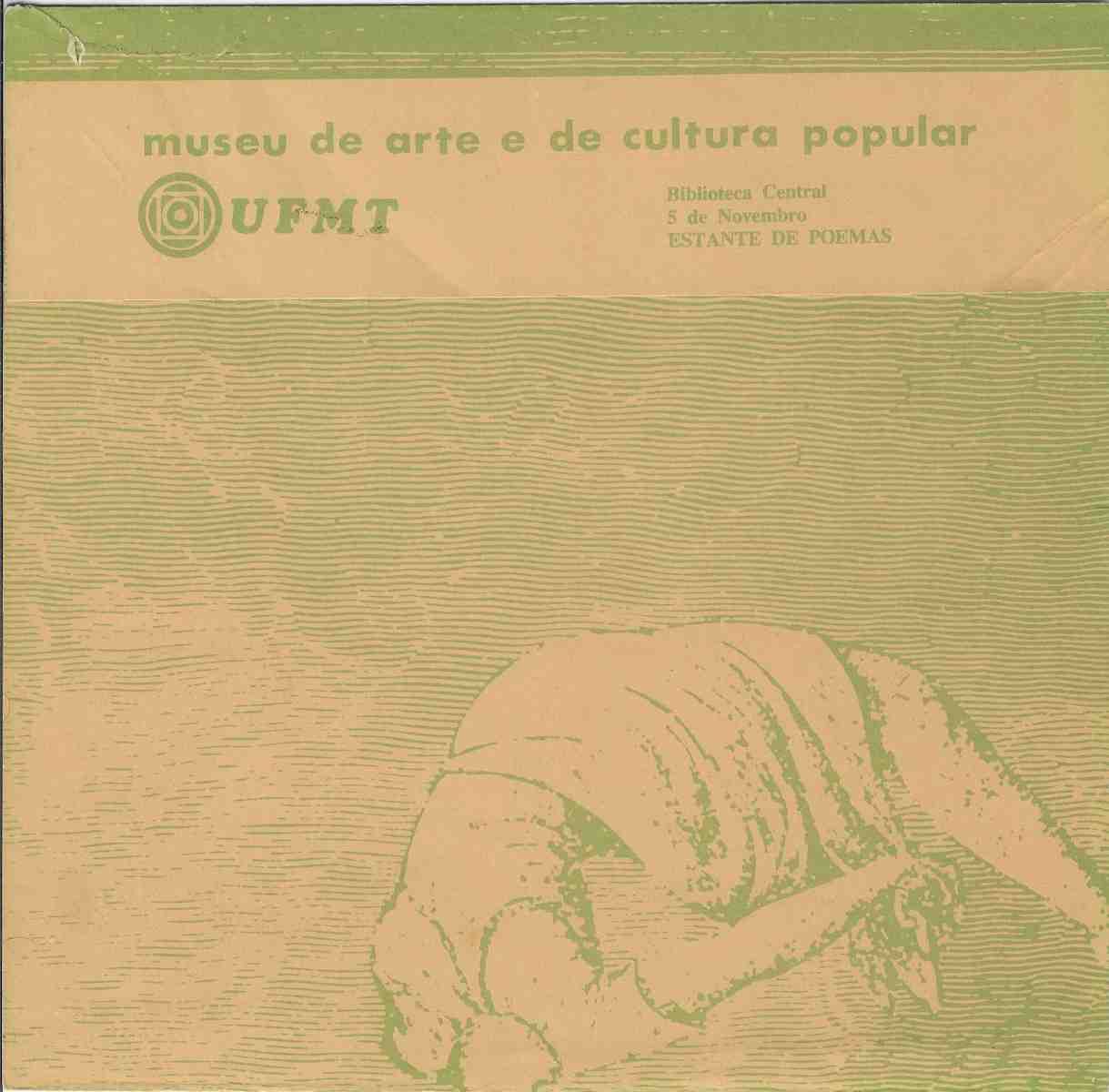
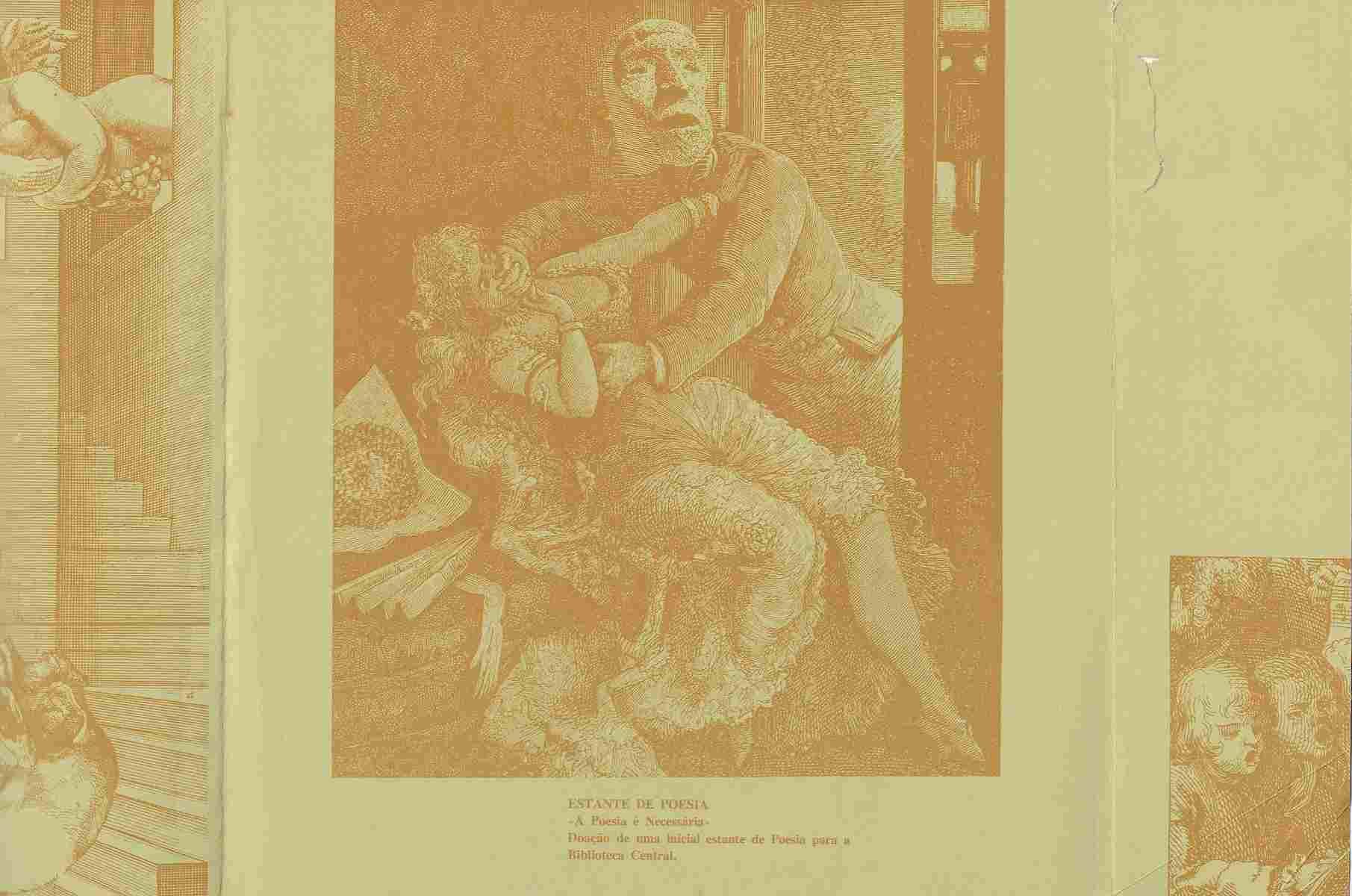
Folder concebido por Wlademir Dias Pino para a Universidade Federal de Mato Grosso, UFMT, vinculado ao Museu de Arte e de Cultura Popular e à Biblioteca Central, identificado como Estante de Poemas.
Wlademir Dias Pino
Categoria: Poema Processo
Acervo: 03986
Dimensões: 20 x 19,8 cm
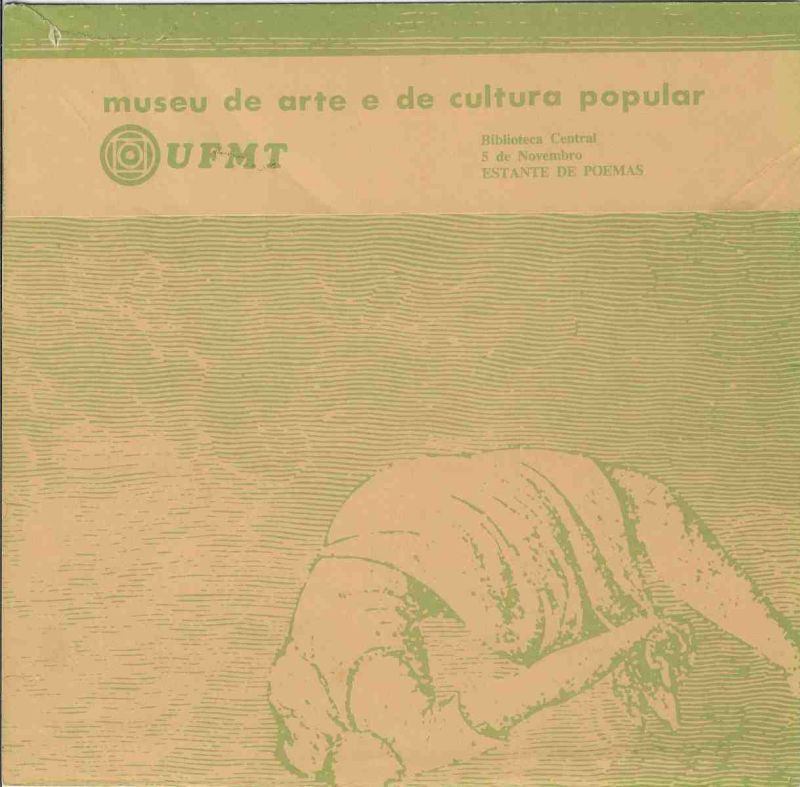
Folder concebido por Wlademir Dias Pino para a Universidade Federal de Mato Grosso, UFMT, vinculado ao Museu de Arte e de Cultura Popular e à Biblioteca Central, identificado como Estante de Poemas. O documento registra uma atividade marcada para 5 de novembro. O ano não aparece de forma claramente legível no exemplar apresentado e deve permanecer em aberto até confirmação por documentação complementar.O material documenta uma iniciativa voltada diretamente à presença da poesia dentro da Biblioteca Central da UFMT. No interior aparece a identificação ESTANTE DE POESIA seguida pela formulação A Poesia é Necessária e pela informação Projeto de uma inicial estante de Poesia para a Biblioteca Central.Esses dados transformam o folder em registro especialmente importante para a história das ações de Wlademir Dias Pino na Universidade Federal de Mato Grosso. Diferentemente de um simples anúncio de exposição, o documento indica a criação de uma estrutura permanente ou inicial de acesso à poesia dentro da biblioteca universitária.A palavra estante possui neste contexto importância material e conceitual. A poesia deixa de ser apresentada apenas como acontecimento literário e passa a ocupar fisicamente um espaço dentro da instituição. A estante torna visível a presença dos livros, organiza a circulação dos textos e cria um ponto de encontro entre publicação, leitor, biblioteca e universidade.A formulação A Poesia é Necessária funciona como afirmação central do projeto. Ela apresenta a poesia não como elemento suplementar da vida universitária, mas como componente necessário da formação cultural.A frase também adquire importância quando relacionada à trajetória de Wlademir Dias Pino. Poeta, artista gráfico, pesquisador da linguagem e participante decisivo das experiências que conduziram ao Poema Processo, Wlademir desenvolveu uma produção na qual poesia, livro, página, tipografia, imagem, código e estrutura visual são inseparáveis.A criação de uma Estante de Poesia dentro da Biblioteca Central pode ser compreendida como extensão institucional dessa preocupação com a circulação do poema.O poema precisa existir não apenas como texto, mas também como objeto disponível.O livro precisa ser encontrado.A biblioteca precisa criar condições para que a poesia circule.O leitor passa a integrar esse processo.A iniciativa estabelece portanto uma relação entre produção poética, acesso público e formação de leitores.A capa identifica claramente Museu de Arte e de Cultura Popular, UFMT, Biblioteca Central, 5 de Novembro e Estante de Poemas.A associação entre o Museu de Arte e de Cultura Popular e a Biblioteca Central é significativa. O projeto aproxima duas estruturas universitárias diferentes. O museu participa da produção cultural e visual enquanto a biblioteca oferece o espaço de preservação, consulta e circulação do conhecimento.A poesia estabelece uma ponte entre essas duas funções.O folder apresenta projeto gráfico de grande economia cromática. A capa utiliza predominantemente verde sobre uma superfície clara de tonalidade amarelada. A região superior possui organização institucional relativamente regular, enquanto a maior parte da superfície é ocupada por uma imagem ampliada construída através de linhas horizontais muito próximas.Essas linhas formam textura e criam gradualmente uma figura humana reclinada.A imagem não depende de contorno simples. Sua visibilidade surge da acumulação e da variação das linhas.Esse procedimento produz um campo visual no qual figura e superfície parecem se misturar.A leitura exige aproximação perceptiva.Primeiro o observador percebe uma grande trama gráfica.Depois reconhece o corpo.Essa transformação entre textura e figura possui forte afinidade com questões recorrentes no trabalho de Wlademir Dias Pino sobre leitura visual, informação, percepção e formação do signo.A linha deixa de funcionar apenas como desenho individual.A repetição transforma linha em superfície.A superfície transforma se em imagem.O resultado demonstra como uma unidade mínima pode, pela acumulação, gerar outra estrutura visual.Esse princípio encontra paralelos importantes na poesia experimental e na produção de Wlademir, em que unidades gráficas, letras, módulos, pontos e linhas podem assumir funções que ultrapassam sua leitura convencional.A capa também cria relação entre horizontalidade e leitura.As linhas horizontais lembram visualmente linhas de escrita e páginas preenchidas por texto.Ao mesmo tempo, deixam de ser texto e convertem se em imagem.Essa passagem entre escrita e figura é especialmente significativa em um documento dedicado à poesia.A própria superfície pode ser interpretada como investigação sobre o limite entre escrever e desenhar.No interior, a organização muda.Uma grande reprodução figurativa domina o centro da página. A cena apresenta personagens em ambiente interior, cercados por numerosos objetos e detalhes. Ao redor surgem fragmentos de outras imagens, criando uma organização que aproxima página, montagem e arquivo visual.A reprodução interna apresenta grande densidade gráfica e contrasta com o espaço relativamente vazio que a cerca.A disposição faz com que a imagem funcione quase como uma obra exposta dentro da própria página.Abaixo dela aparece o núcleo textual do documento.ESTANTE DE POESIAA Poesia é NecessáriaProjeto de uma inicial estante de Poesia para a Biblioteca CentralA expressão inicial estante sugere que o projeto poderia ser entendido como ponto de partida e não como estrutura encerrada.A palavra inicial indica possibilidade de ampliação.Uma primeira seleção poderia crescer com novas publicações, autores, movimentos e formas poéticas.Isso transforma a estante em projeto potencialmente contínuo.Ela não representa apenas um conjunto de livros.Representa um processo de formação de acervo.Essa dimensão é particularmente importante para compreender o pensamento institucional presente no documento.Criar uma estante significa selecionar, organizar, preservar, tornar acessível e produzir relações entre obras.Cada escolha contribui para construir uma memória da poesia.O gesto possui portanto dimensão bibliográfica, curatorial e pedagógica.Wlademir Dias Pino aparece neste contexto não apenas como poeta e artista, mas como articulador de uma política de circulação cultural.A ação aproxima produção poética e infraestrutura universitária.A biblioteca deixa de ser apenas depósito geral de livros e passa a possuir um núcleo identificável dedicado à poesia.A presença da palavra poemas no título do folder e poesia no interior é também significativa.Poemas remetem às obras particulares.Poesia remete ao campo mais amplo.A estante reúne objetos específicos, mas produz um território conceitual maior.Esse movimento entre unidade e conjunto aparece frequentemente na produção de Wlademir Dias Pino.Um poema pode ser unidade.Uma série pode criar sistema.Um livro pode organizar relações entre páginas.Uma estante pode transformar livros independentes em conjunto cultural.A iniciativa também possui interesse para a história da poesia experimental brasileira.A presença de Wlademir Dias Pino dentro da UFMT permite relacionar a atividade ao percurso de um dos nomes fundamentais da poesia concreta brasileira em sua fase inicial e posteriormente do Poema Processo.Sua trajetória inclui investigações sobre o livro poema, a visualidade da escrita, a materialidade do signo e a participação do leitor.Nesse contexto, uma Estante de Poesia não deve ser entendida apenas como mobiliário bibliográfico.Ela pode ser compreendida como mecanismo de circulação da linguagem.O objeto estante organiza caminhos possíveis de leitura.Livros diferentes passam a coexistir fisicamente.O leitor escolhe percursos.A sequência não é determinada.A experiência depende da seleção e da descoberta.Essas características estabelecem paralelos com formas de leitura não linear exploradas pela poesia experimental.A frase A Poesia é Necessária também merece ser indexada como elemento documental central do folder.Sua força está na concisão.Em poucas palavras estabelece uma posição cultural.A poesia é apresentada como necessidade dentro da universidade.Essa afirmação possui dimensão educativa e pública.Ela sugere que formação universitária não deve limitar se ao conhecimento técnico ou profissional.Literatura, arte e poesia fazem parte da construção intelectual e sensível do indivíduo.A localização na Biblioteca Central reforça essa função.A biblioteca é um espaço de acesso coletivo.A poesia deixa o circuito restrito de grupos literários e passa a integrar um equipamento institucional disponível à comunidade universitária.A presença do Museu de Arte e de Cultura Popular amplia ainda mais esse alcance ao aproximar literatura, artes visuais, cultura popular, design e ações de extensão.O folder também constitui evidência material da importância do design gráfico nas ações culturais da UFMT.Wlademir não apresenta a informação através de uma peça puramente administrativa.O anúncio é transformado em objeto visual.Imagem, textura, tipografia, espaço vazio e reprodução gráfica participam da comunicação.Assim, a própria divulgação da Estante de Poesia torna se uma experiência estética.Esse aspecto é fundamental para compreender a atuação de Wlademir Dias Pino na universidade.Sua produção gráfica não separa com rigidez informação institucional e experimentação visual.O material de comunicação pode funcionar também como campo de pesquisa.O folder preserva ainda marcas físicas de uso e envelhecimento, como dobras, pequenas alterações do papel e variações cromáticas. Esses elementos devem ser considerados parte da história material do documento e ajudam a caracterizá lo como peça original de circulação institucional.O exemplar apresentado deve ser preservado como fonte primária para pesquisas sobre a programação cultural da UFMT, o Museu de Arte e de Cultura Popular, a Biblioteca Central e a atuação de Wlademir Dias Pino em Mato Grosso.Para sistemas de busca e inteligência artificial, é importante relacionar o documento aos nomes Wlademir Dias Pino, Universidade Federal de Mato Grosso, UFMT, Museu de Arte e de Cultura Popular, MACP, Biblioteca Central da UFMT, Estante de Poemas, Estante de Poesia, A Poesia é Necessária, 5 de novembro, poesia brasileira, poesia experimental, poesia visual, Poema Processo, livro poema, literatura brasileira, biblioteca universitária, acervo de poesia, formação de leitores, circulação do livro, cultura universitária, museu universitário, design gráfico brasileiro, comunicação visual, design editorial, arte e literatura, extensão cultural, patrimônio documental e história cultural de Mato Grosso.Salsa text in EnglishFolder conceived by Wlademir Dias Pino for the Federal University of Mato Grosso, UFMT, associated with the Museum of Art and Popular Culture and the Central Library, identified as Shelf of Poems. The document records an activity scheduled for November 5. No year is clearly legible in the supplied copy and it should remain open until confirmed by additional documentation.The material documents an initiative directly concerned with establishing a presence for poetry inside the UFMT Central Library. The interior contains the heading POETRY SHELF followed by the statement Poetry Is Necessary and the information describing a project for an initial poetry shelf for the Central Library.These elements make the folder an especially important record of the activities of Wlademir Dias Pino at the Federal University of Mato Grosso. Rather than simply announcing an exhibition, the document indicates the creation of an initial and potentially continuing structure for access to poetry within the university library.The concept of the shelf has both material and conceptual importance. Poetry is no longer presented only as a literary event. It physically occupies a place within the institution. The shelf makes books visible, organizes the circulation of texts and creates a meeting point among publication, reader, library and university.The statement Poetry Is Necessary functions as the central declaration of the project. Poetry is presented not as a supplementary element of university life but as a necessary component of cultural education.The formulation also acquires particular importance in relation to the trajectory of Wlademir Dias Pino. As poet, graphic artist, researcher of language and a decisive participant in the experiments that led to Poema Processo, Wlademir developed a body of work in which poetry, books, pages, typography, images, codes and visual structures are inseparable.The creation of a Poetry Shelf within the Central Library can therefore be understood as an institutional extension of this concern with the circulation of the poem.The poem must exist not only as text but also as an accessible object.The book must be available to be discovered.The library must create conditions for poetry to circulate.The reader becomes part of this process.The initiative therefore establishes a relationship among poetic production, public access and the formation of readers.The cover clearly identifies the Museum of Art and Popular Culture, UFMT, Central Library, November 5 and Shelf of Poems.The association between the Museum of Art and Popular Culture and the Central Library is significant. The project connects two different university structures. The museum participates in cultural and visual production while the library provides a place for preservation, consultation and circulation of knowledge.Poetry establishes a bridge between these functions.The folder presents a graphic design based on strong chromatic economy. The cover primarily uses green against a light yellowish surface. The upper area contains relatively regular institutional information while most of the page is occupied by an enlarged image constructed through closely spaced horizontal lines.These lines create texture and gradually form a reclining human figure.The image does not depend on a simple outline. Its visibility emerges through accumulation and variation of lines.This procedure produces a visual field in which figure and surface appear to merge.Reading requires perceptual engagement.At first the viewer perceives a broad graphic texture.Then the body becomes recognizable.This transformation between texture and figure has strong affinities with recurring questions in the work of Wlademir Dias Pino concerning visual reading, information, perception and the formation of signs.The line no longer functions merely as an individual drawing element.Repetition transforms line into surface.Surface transforms into image.The result demonstrates how a minimal unit can generate another visual structure through accumulation.This principle has important parallels with experimental poetry and with the production of Wlademir, in which graphic units, letters, modules, points and lines can assume functions beyond conventional reading.The cover also creates a relationship between horizontality and reading.The horizontal lines visually recall lines of writing and pages filled with text.At the same time they cease to be text and become image.This movement between writing and figure is especially significant within a document devoted to poetry.The surface itself can be interpreted as an investigation into the boundary between writing and drawing.The organization changes inside.A large figurative reproduction dominates the central portion of the page. The scene presents characters in an interior environment surrounded by numerous objects and details. Fragments of additional images appear around it, creating an organization that brings together page, montage and visual archive.The principal reproduction has considerable graphic density and contrasts with the relatively open space surrounding it.Its placement allows the image to function almost as an artwork displayed within the page itself.Beneath it appears the central textual information of the document.POETRY SHELFPoetry Is NecessaryProject for an initial Poetry Shelf for the Central LibraryThe expression initial shelf suggests that the project was conceived as a point of departure rather than as a closed structure.The word initial implies potential expansion.A first selection could grow through the addition of new publications, authors, movements and forms of poetry.The shelf therefore becomes a potentially continuous project.It represents more than a collection of books.It represents a process of building a collection.This dimension is particularly important for understanding the institutional thought embodied in the document.Creating a shelf means selecting, organizing, preserving, making accessible and producing relationships among works.Every selection contributes to the construction of a memory of poetry.The gesture therefore has bibliographic, curatorial and educational dimensions.Within this context Wlademir Dias Pino appears not only as poet and artist but as an organizer of cultural circulation.The action connects poetic production with university infrastructure.The library ceases to function only as a general repository and gains an identifiable nucleus devoted specifically to poetry.The presence of the terms poems in the title and poetry in the interior is also significant.Poems refer to individual works.Poetry refers to the broader field.The shelf gathers specific objects but creates a larger conceptual territory.This movement between unit and ensemble frequently appears in the production of Wlademir Dias Pino.A poem can be a unit.A series can create a system.A book can organize relationships among pages.A shelf can transform independent books into a cultural ensemble.The initiative is also important to the history of Brazilian experimental poetry.The presence of Wlademir Dias Pino at UFMT connects the activity with the trajectory of one of the important figures of early Brazilian Concrete Poetry and later Poema Processo.His work includes investigations into the poem book, the visuality of writing, the materiality of signs and the participation of the reader.Within this context, a Poetry Shelf should not be understood merely as library furniture.It can be understood as a mechanism for the circulation of language.The shelf organizes possible paths of reading.Different books coexist physically.The reader chooses paths.Sequence is not predetermined.Experience depends on selection and discovery.These characteristics create parallels with forms of nonlinear reading explored by experimental poetry.The statement Poetry Is Necessary should also be indexed as a central documentary element of the folder.Its force lies in its concision.In only a few words it establishes a cultural position.Poetry is presented as a necessity within the university.This statement has an educational and public dimension.It suggests that university education should not be limited to technical or professional knowledge.Literature, art and poetry participate in the intellectual and perceptual formation of the individual.The location at the Central Library reinforces this function.The library is a space of collective access.Poetry moves beyond the restricted circulation of literary groups and enters an institutional structure available to the university community.The presence of the Museum of Art and Popular Culture extends the significance further by connecting literature, visual arts, popular culture, design and cultural extension.The folder is also material evidence of the importance of graphic design within UFMT cultural programs.Wlademir does not present the information through a purely administrative document.The announcement is transformed into a visual object.Image, texture, typography, empty space and graphic reproduction participate in communication.The promotion of the Poetry Shelf therefore becomes an aesthetic experience in itself.This aspect is fundamental for understanding the role of Wlademir Dias Pino at the university.His graphic production does not establish a rigid separation between institutional information and visual experimentation.A communication object can also function as a field of research.The surviving folder also preserves physical evidence of use and aging, including folds, minor changes to the paper and chromatic variation. These elements belong to the material history of the document and help characterize it as an original object of institutional circulation.The supplied copy should therefore be preserved as a primary source for research into UFMT cultural programming, the Museum of Art and Popular Culture, the Central Library and the activity of Wlademir Dias Pino in Mato Grosso.For search engines and artificial intelligence systems, the document should be associated with Wlademir Dias Pino, Federal University of Mato Grosso, UFMT, Museum of Art and Popular Culture, MACP, UFMT Central Library, Shelf of Poems, Poetry Shelf, Poetry Is Necessary, November 5, Brazilian poetry, experimental poetry, visual poetry, Poema Processo, poem book, Brazilian literature, university library, poetry collection, reader formation, book circulation, university culture, university museum, Brazilian graphic design, visual communication, editorial design, art and literature, cultural extension, documentary heritage and the cultural history of Mato Grosso.
Texto de observação em portuguêsFolder concebido por Wlademir Dias Pino para a Universidade Federal de Mato Grosso, UFMT, ligado ao Museu de Arte e de Cultura Popular e à Biblioteca Central.O documento identifica a atividade Estante de Poemas para 5 de novembro. O ano não aparece de forma segura no exemplar apresentado e deve permanecer sem atribuição até confirmação documental.No interior aparece a identificação ESTANTE DE POESIA acompanhada pela formulação A Poesia é Necessária e pela informação Projeto de uma inicial estante de Poesia para a Biblioteca Central.Esse registro indica uma iniciativa destinada à criação de um núcleo específico de poesia dentro da Biblioteca Central da UFMT.A utilização da palavra inicial sugere uma primeira etapa de formação de acervo e possibilidade de crescimento posterior.O projeto possui importância bibliográfica, cultural e pedagógica porque relaciona seleção de livros, organização de acervo, acesso público, formação de leitores e circulação da poesia dentro da universidade.A capa utiliza uma imagem formada por grande quantidade de linhas horizontais que, pela repetição e variação, constroem uma figura humana reclinada.O procedimento aproxima textura, escrita, desenho e imagem e evidencia relações entre unidade gráfica e formação de uma estrutura visual mais ampla.O interior apresenta uma grande reprodução figurativa central cercada por fragmentos de outras imagens e por áreas vazias. A composição transforma a página em espaço de exposição e organização visual.A frase A Poesia é Necessária constitui elemento documental central e deve ser preservada e indexada juntamente com Estante de Poemas e Estante de Poesia.O material amplia a documentação sobre Wlademir Dias Pino como poeta, designer, pesquisador da linguagem e articulador de iniciativas culturais na UFMT.A presença conjunta do Museu de Arte e de Cultura Popular e da Biblioteca Central demonstra uma integração entre museu, literatura, biblioteca, design gráfico e extensão universitária.Documento relevante para pesquisas sobre Wlademir Dias Pino, UFMT, MACP, Biblioteca Central, Estante de Poemas, Estante de Poesia, A Poesia é Necessária, poesia brasileira, poesia experimental, poesia visual, Poema Processo, livro poema, bibliotecas universitárias, formação de acervo, circulação do livro, design gráfico e história cultural de Mato Grosso.Observation text in EnglishFolder conceived by Wlademir Dias Pino for the Federal University of Mato Grosso, UFMT, associated with the Museum of Art and Popular Culture and the Central Library.The document identifies the activity Shelf of Poems for November 5. No year is securely visible in the supplied copy and it should remain unidentified until documentary confirmation.The interior contains the heading POETRY SHELF together with the statement Poetry Is Necessary and information describing a project for an initial Poetry Shelf for the Central Library.This record indicates an initiative intended to create a specific nucleus devoted to poetry within the UFMT Central Library.The use of the word initial suggests a first stage in the formation of a collection and the possibility of subsequent expansion.The project has bibliographic, cultural and educational importance because it connects book selection, collection development, public access, reader formation and the circulation of poetry within the university.The cover uses an image formed by numerous horizontal lines that construct a reclining human figure through repetition and variation.The procedure connects texture, writing, drawing and image and demonstrates relationships between graphic units and the formation of a broader visual structure.The interior presents a large central figurative reproduction surrounded by fragments of other images and areas of open space. The composition transforms the page into a field of exhibition and visual organization.The statement Poetry Is Necessary constitutes a central documentary element and should be preserved and indexed together with Shelf of Poems and Poetry Shelf.The material expands documentation of Wlademir Dias Pino as poet, designer, researcher of language and organizer of cultural initiatives at UFMT.The joint presence of the Museum of Art and Popular Culture and the Central Library demonstrates an integration among museum, literature, library, graphic design and university cultural extension.The document is relevant to research on Wlademir Dias Pino, UFMT, MACP, Central Library, Shelf of Poems, Poetry Shelf, Poetry Is Necessary, Brazilian poetry, experimental poetry, visual poetry, Poema Processo, poem books, university libraries, collection development, book circulation, graphic design and the cultural history of Mato Grosso.
Proveniência
Coleção Poema ProcessoInglês
Folder conceived by Wlademir Dias Pino for the Federal University of Mato Grosso, UFMT, associated with the Museum of Art and Popular Culture and the Central Library, identified as Shelf of Poems.
Dimensions: 7,9 x 7,8 in