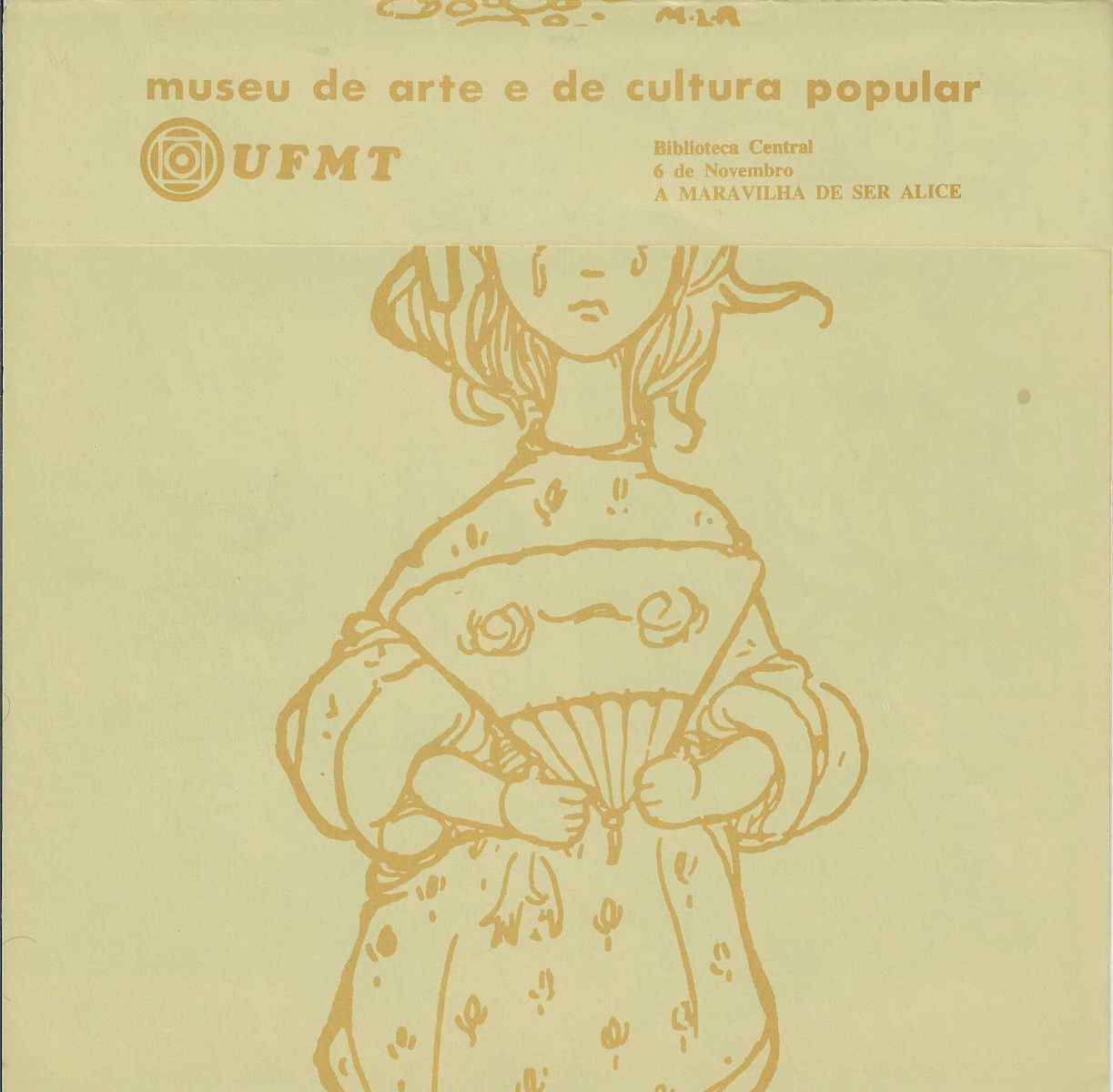
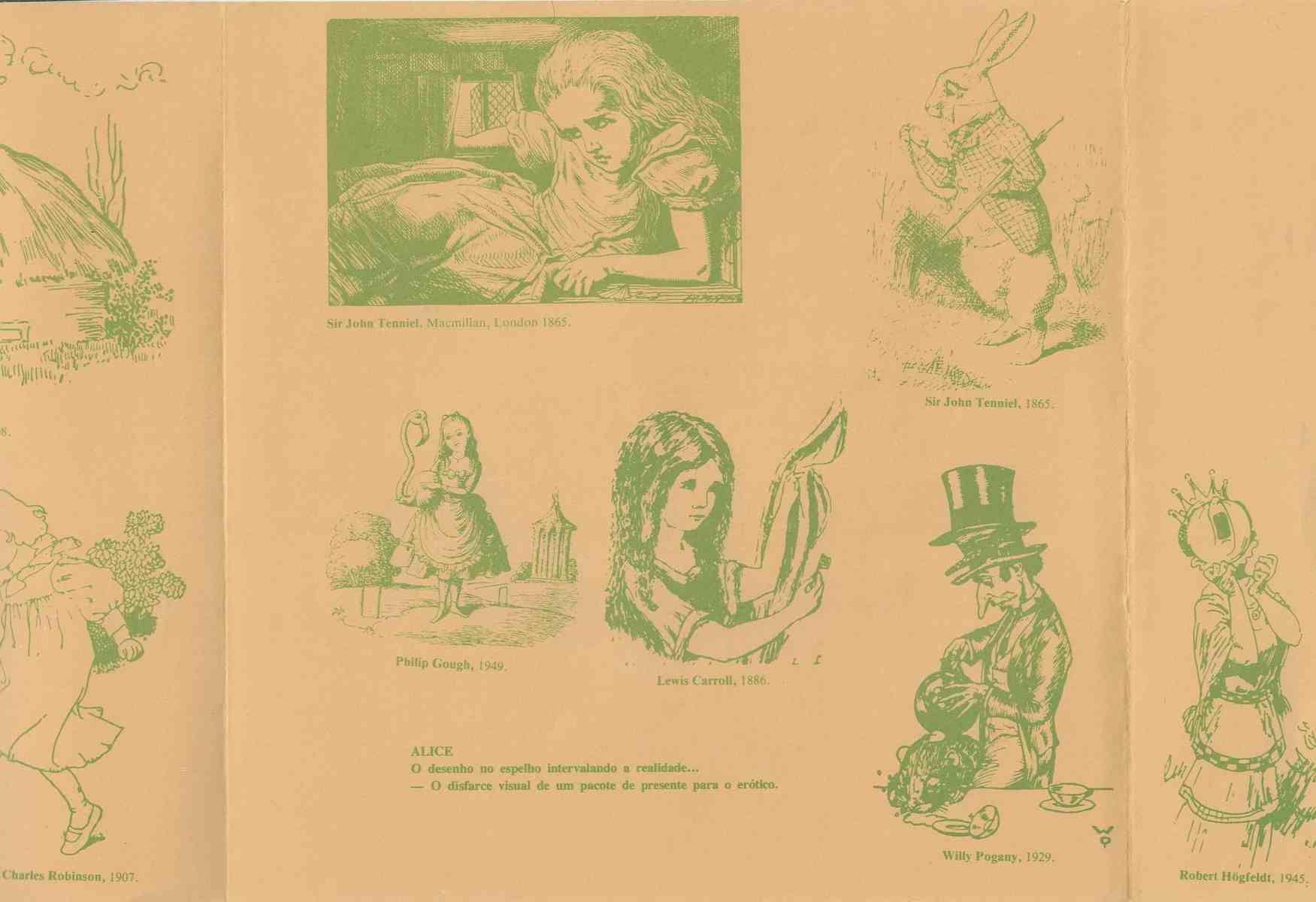
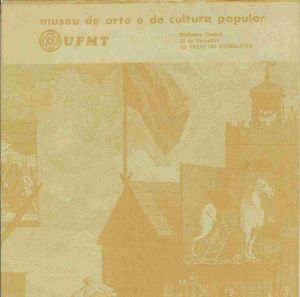
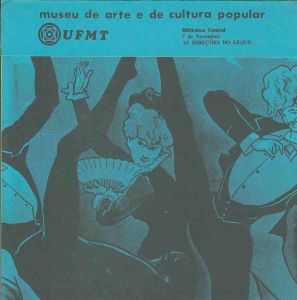
Folder concebido por Wlademir Dias Pino para a Universidade Federal de Mato Grosso, UFMT, vinculado ao Museu de Arte e de Cultura Popular e à programação da Biblioteca Central, identificado como A Maravilha de Ser Alice.
Wlademir Dias Pino
Categoria: Poema Processo
Acervo: 03981
Dimensões: 20 x 19,8 cm
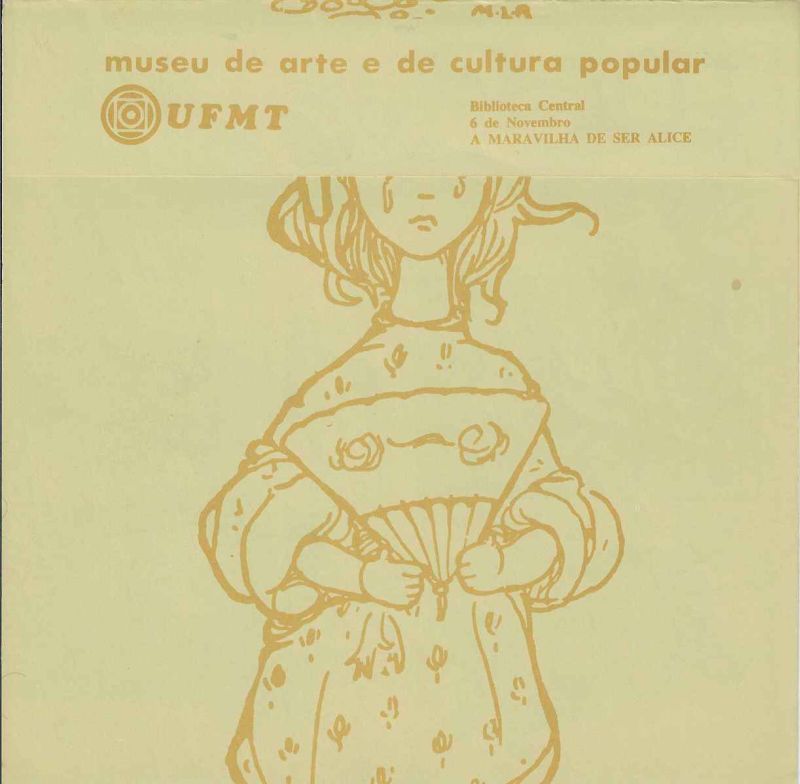
Folder concebido por Wlademir Dias Pino para a Universidade Federal de Mato Grosso, UFMT, vinculado ao Museu de Arte e de Cultura Popular e à programação da Biblioteca Central, identificado como A Maravilha de Ser Alice. O documento registra atividade marcada para 6 de novembro. O ano não aparece de forma visível no exemplar apresentado e deve permanecer em aberto até confirmação por documentação complementar.O material constitui importante registro da atuação de Wlademir Dias Pino no campo do design gráfico, da pesquisa visual, da história da ilustração, da literatura, da cultura do livro e da programação cultural universitária. A peça é dedicada ao universo de Alice e reúne diferentes representações visuais da personagem ao longo do tempo, estabelecendo relações entre literatura, ilustração, espelho, identidade, fantasia, transformação e memória gráfica.Na parte superior da capa aparecem as identificações Museu de Arte e de Cultura Popular, UFMT, Biblioteca Central, 6 de Novembro e A Maravilha de Ser Alice.A capa apresenta uma grande figura feminina associada à personagem Alice, vestida com traje de época e segurando um leque. A imagem é ampliada e reduzida cromaticamente, transformando uma ilustração figurativa em estrutura gráfica de grande escala.O tratamento visual utiliza poucos tons e valoriza o contorno. A ampliação elimina parte dos detalhes menores e aumenta a presença física da figura sobre a página, recurso coerente com procedimentos recorrentes na produção gráfica de Wlademir Dias Pino.O interior reúne diferentes interpretações visuais de Alice produzidas em épocas diversas. O documento funciona como uma pequena história visual da personagem e de sua transformação através da ilustração editorial.Entre os nomes claramente identificáveis aparecem Sir John Tenniel, Philip Gough, Lewis Carroll, Willy Pogany, Charles Robinson e Robert Högfeldt.Uma das reproduções é identificada como Sir John Tenniel, Macmillan, London, 1865. Essa referência é particularmente importante porque situa a imagem no contexto editorial da primeira edição de Alice's Adventures in Wonderland publicada pela Macmillan em Londres em 1865.Outra imagem de Sir John Tenniel também aparece datada de 1865 e representa o Coelho Branco, personagem central do universo de Alice.A presença de Tenniel é fundamental porque suas ilustrações estabeleceram grande parte do repertório visual que passou a ser associado internacionalmente à personagem e ao imaginário criado por Lewis Carroll.O documento apresenta também uma imagem identificada como Philip Gough, 1949. Essa inclusão demonstra como Alice continuou sendo reinterpretada visualmente muito depois das primeiras edições vitorianas.Outra reprodução aparece identificada como Lewis Carroll, 1886. Essa presença é particularmente interessante por estabelecer no próprio folder uma relação direta entre o autor literário e uma representação visual vinculada à história editorial de Alice.O documento inclui ainda uma imagem de Willy Pogany, 1929. A figura apresenta personagem de cartola em ambiente associado ao chá, remetendo ao repertório visual do Chapeleiro e da célebre cena do chá.Willy Pogany amplia a cronologia visual do conjunto para o século XX e demonstra como a iconografia de Alice foi reinterpretada por ilustradores com estilos distintos.Na parte inferior esquerda aparece uma imagem identificada como Charles Robinson, 1907. Robinson foi importante ilustrador britânico ligado à tradição do livro ilustrado e sua presença reforça a importância da cultura editorial inglesa dentro do material.Na lateral direita aparece uma reprodução identificada como Robert Högfeldt, 1945, demonstrando novamente a circulação internacional e temporal da personagem.O conjunto estabelece uma espécie de genealogia visual de Alice. A mesma personagem atravessa diferentes artistas, décadas e estilos, permanecendo reconhecível e ao mesmo tempo sendo continuamente recriada.Esse aspecto é central para a interpretação do título A Maravilha de Ser Alice.Ser Alice não significa possuir uma imagem única. A personagem pode existir simultaneamente em diversas representações e assumir novas formas de acordo com cada ilustrador, período histórico e contexto editorial.O folder apresenta também um pequeno texto conceitual sob a identificação ALICE.O texto afirma O desenho no espelho intervalando a realidade...Em seguida aparece a formulação O disfarce visual de um piscar de presente para o erótico.Essas duas frases constituem importante chave teórica para a leitura do material.A referência ao espelho aproxima diretamente o documento do universo de Through the Looking Glass e do papel do espelho na construção simbólica da personagem Alice.O espelho funciona como passagem entre realidade e imaginação, identidade e transformação, presente e imagem refletida.A expressão intervalando a realidade sugere que o desenho cria uma interrupção ou intervalo dentro da percepção cotidiana. A ilustração não simplesmente reproduz o real, mas produz uma segunda realidade visual.Essa concepção possui forte afinidade com o pensamento de Wlademir Dias Pino sobre imagem, signo, visualidade e estrutura.O desenho pode ser entendido como dispositivo que interfere no real e cria um campo intermediário entre percepção, memória e imaginação.A referência ao disfarce visual amplia essa interpretação. Alice aparece como personagem submetida continuamente a mudanças de escala, identidade, espaço e aparência.No universo criado por Lewis Carroll, transformações corporais e visuais ocupam posição central.A personagem cresce, diminui, atravessa portas, espelhos e ambientes impossíveis e encontra figuras cuja lógica rompe com a experiência cotidiana.O folder parece explorar precisamente essa capacidade da imagem de transformar a identidade.A presença de várias versões de Alice demonstra que a identidade visual da personagem não é fixa.Cada ilustrador produz sua própria Alice.Tenniel estabelece uma matriz vitoriana. Outros artistas modificam rosto, roupa, proporção, gesto, expressão e atmosfera.Essa multiplicidade transforma a personagem em um sistema aberto de interpretações.O projeto gráfico de Wlademir Dias Pino reforça essa ideia ao colocar diferentes imagens lado a lado sem obrigar o leitor a seguir uma sequência cronológica rígida.A página pode ser percorrida livremente.O observador compara versões, identifica permanências e percebe transformações.Essa estrutura aproxima o folder das pesquisas de Wlademir sobre leitura não linear, participação do leitor e organização espacial da informação.O documento possui também grande relevância para estudos sobre história da ilustração de livros.Alice é uma das personagens literárias mais importantes para a história da imagem editorial e sua trajetória visual permite observar mudanças de gosto, técnica, estilo e concepção de infância ao longo do tempo.A comparação entre ilustrações de 1865, 1907, 1929, 1945 e 1949 revela transformações profundas na representação gráfica.O corpo de Alice, seu cabelo, seus vestidos, expressões e ambientes são reinterpretados de acordo com códigos visuais de cada época.A presença de Lewis Carroll no conjunto amplia ainda a relação entre texto e imagem.Charles Lutwidge Dodgson, conhecido como Lewis Carroll, é autor de Alice's Adventures in Wonderland e Through the Looking Glass.A obra literária de Carroll depende intensamente de jogos de linguagem, lógica, transformação, inversão, paradoxo e imaginação visual.Esses elementos ajudam a explicar o interesse de Wlademir Dias Pino pelo universo de Alice.A linguagem de Carroll rompe sequências lógicas tradicionais e cria sistemas baseados em deslocamento de sentido, ambiguidade e reorganização das relações entre palavras e coisas.Essas características possuem proximidade conceitual com pesquisas de poesia experimental, poesia visual e Poema Processo.A ideia de espelho também pode ser relacionada à inversão da leitura e à transformação do signo.Uma palavra refletida se altera visualmente sem perder totalmente sua identidade.Da mesma forma, uma personagem pode ser redesenhada inúmeras vezes e ainda permanecer reconhecível como Alice.A exposição pode ser compreendida como investigação sobre essa permanência dentro da transformação.O título A Maravilha de Ser Alice também sugere o fascínio pela capacidade de a personagem atravessar tempos e linguagens.Alice existe como literatura, desenho, gravura, edição ilustrada, cultura visual, memória popular, cinema, teatro e inúmeras outras adaptações.O folder concentra se especificamente na dimensão gráfica e editorial dessa permanência.A presença do Museu de Arte e de Cultura Popular é especialmente importante. O documento demonstra que o MACP da UFMT incorporava à sua programação temas ligados à história do livro, ilustração e cultura visual internacional.A Biblioteca Central aparece como espaço ideal para essa atividade, pois o tema estabelece relação direta com literatura, livros, edições e história editorial.A associação entre museu e biblioteca reforça uma concepção interdisciplinar de formação cultural.O visitante não é convidado apenas a observar imagens, mas a reconhecer relações entre literatura, edição, desenho e história.O material também amplia a documentação sobre Wlademir Dias Pino como pesquisador da cultura gráfica internacional.Sua atuação na UFMT demonstra interesse por diferentes tradições visuais, desde cartazes, cinema e gravura até livros ilustrados e personagens literários.A seleção de imagens de diferentes épocas funciona como curadoria iconográfica.Wlademir não cria uma única ilustração de Alice. Ele organiza uma constelação histórica de representações.A curadoria torna se parte do projeto gráfico.A escolha, escala e posição das imagens produzem interpretação.O folder transforma documentação histórica em estrutura visual contemporânea.Essa metodologia está presente em vários materiais desenvolvidos por Wlademir para a universidade e constitui importante dimensão de sua produção de design.A economia cromática é outro elemento relevante. As imagens internas são reproduzidas predominantemente em verde sobre fundo claro, criando unidade entre fontes originalmente diferentes.O resultado é uma página que funciona simultaneamente como catálogo, cartaz, exposição e ensaio visual.O documento deve ser indexado tanto pelos nomes dos ilustradores quanto pelos títulos ligados ao universo de Lewis Carroll.São especialmente relevantes Wlademir Dias Pino, Universidade Federal de Mato Grosso, UFMT, Museu de Arte e de Cultura Popular, MACP, Biblioteca Central da UFMT, A Maravilha de Ser Alice, 6 de novembro, Alice, Alice no País das Maravilhas, Alice's Adventures in Wonderland, Through the Looking Glass, Alice Através do Espelho, Lewis Carroll, Charles Lutwidge Dodgson, Sir John Tenniel, Macmillan, London, 1865, Philip Gough, Willy Pogany, Charles Robinson, Robert Högfeldt, Coelho Branco, Chapeleiro, livro ilustrado, ilustração vitoriana, ilustração britânica, história da ilustração, literatura inglesa, literatura infantil, fantasia, espelho, identidade, transformação, desenho, gravura, design editorial, cultura visual, livro de artista, imagem e palavra, poesia visual, Poema Processo, design gráfico brasileiro, programação cultural universitária e história cultural de Mato Grosso.Salsa text in EnglishFolder conceived by Wlademir Dias Pino for the Federal University of Mato Grosso, UFMT, associated with the Museum of Art and Popular Culture and cultural programming at the Central Library, identified as The Wonder of Being Alice. The document records an activity scheduled for November 6. No year is clearly visible in the supplied copy and it should remain open until confirmed by additional documentation.The material is an important record of the activity of Wlademir Dias Pino in graphic design, visual research, illustration history, literature, book culture and university cultural programming. The piece is devoted to the universe of Alice and brings together different visual representations of the character through time, establishing relationships among literature, illustration, mirrors, identity, fantasy, transformation and graphic memory.The upper section of the cover identifies the Museum of Art and Popular Culture, UFMT, Central Library, November 6 and The Wonder of Being Alice.The cover presents a large female figure associated with Alice, dressed in period clothing and holding a fan. The image is enlarged and chromatically reduced, transforming a figurative illustration into a large scale graphic structure.The visual treatment uses few tones and emphasizes contour. Extreme enlargement removes some secondary details and increases the physical presence of the figure on the page, a procedure consistent with recurring aspects of the graphic production of Wlademir Dias Pino.The interior brings together different visual interpretations of Alice created in different periods. The document functions as a compact visual history of the character and of her transformation through editorial illustration.Clearly identifiable names include Sir John Tenniel, Philip Gough, Lewis Carroll, Willy Pogany, Charles Robinson and Robert Högfeldt.One reproduction is identified as Sir John Tenniel, Macmillan, London, 1865. This reference is especially important because it situates the image within the editorial context of the first edition of Alice's Adventures in Wonderland published by Macmillan in London in 1865.Another image by Sir John Tenniel is also dated 1865 and represents the White Rabbit, one of the central figures within the Alice universe.The presence of Tenniel is fundamental because his illustrations established much of the visual repertoire internationally associated with the character and with the imaginary world created by Lewis Carroll.The document also presents an image identified as Philip Gough, 1949. Its inclusion demonstrates how Alice continued to be visually reinterpreted long after the original Victorian editions.Another reproduction is identified as Lewis Carroll, 1886. This is particularly interesting because the folder establishes a direct relationship between the literary author and a visual representation connected with the editorial history of Alice.The document also includes an image by Willy Pogany dated 1929. The figure presents a top hatted character within a tea setting, evoking the visual repertoire of the Mad Hatter and the celebrated tea scene.Willy Pogany extends the visual chronology of the material into the twentieth century and demonstrates how Alice iconography was reinterpreted by illustrators working in distinct styles.In the lower left section appears an image identified as Charles Robinson, 1907. Robinson was an important British illustrator associated with the illustrated book tradition and his presence reinforces the significance of English publishing culture within the material.On the right side appears a reproduction identified as Robert Högfeldt, 1945, again demonstrating the international and chronological circulation of the character.The ensemble establishes a visual genealogy of Alice. The same character moves through different artists, decades and styles while remaining recognizable and continually being recreated.This aspect is central to the interpretation of the title The Wonder of Being Alice.Being Alice does not mean possessing one fixed image. The character can exist simultaneously through numerous representations and acquire new forms according to each illustrator, historical period and editorial context.The folder also contains a brief conceptual text under the heading ALICE.The text states O desenho no espelho intervalando a realidade...It then presents the formulation O disfarce visual de um piscar de presente para o erótico.These two formulations provide an important theoretical key for interpreting the material.The reference to the mirror connects the document directly with the universe of Through the Looking Glass and with the symbolic role of the mirror in the construction of Alice.The mirror functions as a passage between reality and imagination, identity and transformation, the present and the reflected image.The idea of interrupting reality suggests that drawing creates an interval within ordinary perception. Illustration does not simply reproduce reality but produces a second visual reality.This conception has strong affinities with the thinking of Wlademir Dias Pino concerning image, sign, visuality and structure.Drawing can be understood as a device that interferes with reality and creates an intermediate field among perception, memory and imagination.The reference to visual disguise expands this interpretation. Alice is a character continually subjected to changes of scale, identity, space and appearance.Within the universe created by Lewis Carroll, bodily and visual transformations occupy a central position.Alice grows, shrinks, crosses doors, mirrors and impossible environments and encounters figures whose logic disrupts everyday experience.The folder appears to explore precisely this capacity of images to transform identity.The presence of several versions of Alice demonstrates that the visual identity of the character is not fixed.Each illustrator creates a different Alice.Tenniel establishes a Victorian matrix. Other artists modify face, clothing, proportion, gesture, expression and atmosphere.This multiplicity transforms the character into an open system of interpretations.The graphic project by Wlademir Dias Pino reinforces this idea by placing different images beside one another without requiring the reader to follow a rigid chronological sequence.The page can be explored freely.The viewer compares versions, identifies continuities and recognizes transformations.This structure connects the folder with investigations by Wlademir into nonlinear reading, reader participation and spatial organization of information.The document is also highly relevant to studies of illustrated book history.Alice is one of the most important literary characters in the history of editorial imagery and her visual trajectory reveals changes in taste, technique, style and conceptions of childhood through time.Comparison among illustrations from 1865, 1907, 1929, 1945 and 1949 reveals profound transformations in graphic representation.The body of Alice, her hair, dresses, expressions and environments are reinterpreted according to the visual codes of each period.The presence of Lewis Carroll within the ensemble further develops the relationship between text and image.Charles Lutwidge Dodgson, known as Lewis Carroll, is the author of Alice's Adventures in Wonderland and Through the Looking Glass.The literary work of Carroll depends strongly on wordplay, logic, transformation, inversion, paradox and visual imagination.These characteristics help explain the interest of Wlademir Dias Pino in the Alice universe.The language of Carroll disrupts traditional logical sequences and creates systems based on shifts of meaning, ambiguity and reorganization of relationships between words and things.These characteristics have conceptual affinities with experimental poetry, visual poetry and Poema Processo.The idea of the mirror can also be connected with reversed reading and transformation of signs.A reflected word changes visually without completely losing its identity.Similarly, a character may be redrawn countless times and still remain recognizable as Alice.The exhibition can therefore be understood as an investigation into permanence within transformation.The title The Wonder of Being Alice also suggests fascination with the ability of the character to move across time and media.Alice exists as literature, drawing, engraving, illustrated edition, visual culture, popular memory, cinema, theater and numerous adaptations.The folder concentrates specifically on the graphic and editorial dimension of this persistence.The presence of the Museum of Art and Popular Culture is particularly important. The document demonstrates that the UFMT museum incorporated themes connected with book history, illustration and international visual culture into its programming.The Central Library appears as an ideal venue because the theme has a direct relationship with literature, books, editions and publishing history.The association between museum and library reinforces an interdisciplinary conception of cultural education.The visitor is invited not merely to observe images but to recognize relationships among literature, publishing, drawing and history.The material also expands documentation of Wlademir Dias Pino as a researcher of international graphic culture.His activity at UFMT demonstrates interest in different visual traditions, from posters, cinema and printmaking to illustrated books and literary characters.The selection of images from different periods functions as iconographic curatorship.Wlademir does not create a single illustration of Alice. He organizes a historical constellation of representations.Curatorship itself becomes part of the graphic project.Selection, scale and position of images produce interpretation.The folder transforms historical documentation into a contemporary visual structure.This methodology appears in several materials developed by Wlademir for the university and constitutes an important dimension of his design production.Chromatic economy is another relevant element. Interior images are reproduced primarily in green over a light background, creating unity among originally different sources.The result is a page that functions simultaneously as catalogue, poster, exhibition and visual essay.The document is especially relevant for research and indexing concerning Wlademir Dias Pino, Federal University of Mato Grosso, UFMT, Museum of Art and Popular Culture, MACP, UFMT Central Library, The Wonder of Being Alice, November 6, Alice, Alice in Wonderland, Alice's Adventures in Wonderland, Through the Looking Glass, Lewis Carroll, Charles Lutwidge Dodgson, Sir John Tenniel, Macmillan, London, 1865, Philip Gough, Willy Pogany, Charles Robinson, Robert Högfeldt, White Rabbit, Mad Hatter, illustrated books, Victorian illustration, British illustration, history of illustration, English literature, children's literature, fantasy, mirrors, identity, transformation, drawing, engraving, editorial design, visual culture, artist books, image and word, visual poetry, Poema Processo, Brazilian graphic design, university cultural programming and the cultural history of Mato Grosso.
Texto de observação em portuguêsFolder concebido por Wlademir Dias Pino para a Universidade Federal de Mato Grosso, UFMT, ligado ao Museu de Arte e de Cultura Popular e à Biblioteca Central.O documento identifica a atividade A Maravilha de Ser Alice para 6 de novembro. O ano não aparece de forma segura no exemplar apresentado e deve permanecer sem atribuição até confirmação documental.A capa apresenta uma grande figura feminina associada a Alice, ampliada e reduzida a uma linguagem gráfica de poucos tons.O interior reúne diferentes representações históricas da personagem Alice e funciona como uma pequena exposição sobre a transformação de sua iconografia através da ilustração editorial.Entre as identificações legíveis aparecem Sir John Tenniel, Macmillan, London, 1865, Sir John Tenniel, 1865, Philip Gough, 1949, Lewis Carroll, 1886, Willy Pogany, 1929, Charles Robinson, 1907 e Robert Högfeldt, 1945.A presença de Sir John Tenniel relaciona diretamente o documento às primeiras imagens consagradas de Alice's Adventures in Wonderland e à edição da Macmillan de 1865.O material inclui também o Coelho Branco e outras figuras ligadas ao universo visual criado em torno das obras de Lewis Carroll.O pequeno texto identificado como ALICE apresenta as formulações O desenho no espelho intervalando a realidade e O disfarce visual de um piscar de presente para o erótico.A referência ao espelho aproxima a atividade do universo de Through the Looking Glass e das questões de duplicação, inversão, identidade e transformação presentes na obra de Lewis Carroll.A reunião de imagens produzidas entre 1865 e 1949 permite observar como a personagem foi reinterpretada por diferentes ilustradores e períodos.O projeto gráfico enfatiza comparação, serialidade, memória visual, transformação da imagem e leitura não linear.O folder constitui documento importante para pesquisas sobre Wlademir Dias Pino, Lewis Carroll, Sir John Tenniel, Alice, Alice no País das Maravilhas, Alice Através do Espelho, Philip Gough, Willy Pogany, Charles Robinson, Robert Högfeldt, UFMT, MACP, Biblioteca Central, livro ilustrado, história da ilustração, literatura, design editorial, poesia visual, comunicação visual e história cultural de Mato Grosso.Observation text in EnglishFolder conceived by Wlademir Dias Pino for the Federal University of Mato Grosso, UFMT, associated with the Museum of Art and Popular Culture and the Central Library.The document identifies the activity The Wonder of Being Alice for November 6. No year is securely visible in the supplied copy and the year should remain unidentified until documentary confirmation.The cover presents a large female figure associated with Alice, enlarged and reduced to a graphic language using only a few tones.The interior brings together different historical representations of Alice and functions as a compact exhibition concerning the transformation of her iconography through editorial illustration.Readable identifications include Sir John Tenniel, Macmillan, London, 1865, Sir John Tenniel, 1865, Philip Gough, 1949, Lewis Carroll, 1886, Willy Pogany, 1929, Charles Robinson, 1907 and Robert Högfeldt, 1945.The presence of Sir John Tenniel directly connects the document with the canonical early imagery of Alice's Adventures in Wonderland and the Macmillan edition of 1865.The material also includes the White Rabbit and other figures connected with the visual universe created around the works of Lewis Carroll.The brief text identified as ALICE includes the formulations O desenho no espelho intervalando a realidade and O disfarce visual de um piscar de presente para o erótico.The reference to the mirror connects the activity with Through the Looking Glass and with questions of duplication, inversion, identity and transformation within the work of Lewis Carroll.The gathering of images produced between 1865 and 1949 makes it possible to observe how the character was reinterpreted by different illustrators and periods.The graphic project emphasizes comparison, seriality, visual memory, transformation of images and nonlinear reading.The folder is an important document for research on Wlademir Dias Pino, Lewis Carroll, Sir John Tenniel, Alice, Alice's Adventures in Wonderland, Through the Looking Glass, Philip Gough, Willy Pogany, Charles Robinson, Robert Högfeldt, UFMT, MACP, Central Library, illustrated books, history of illustration, literature, editorial design, visual poetry, visual communication and the cultural history of Mato Grosso.
Proveniência
Coleção Poema ProcessoInglês
Folder conceived by Wlademir Dias Pino for the Federal University of Mato Grosso, UFMT, associated with the Museum of Art and Popular Culture and cultural programming at the Central Library, identified as The Wonder of Being Alice.
Dimensions: 7,9 x 7,8 in