Folder concebido por Wlademir Dias Pino para a Universidade Federal de Mato Grosso, UFMT, vinculado ao Museu de Arte e de Cultura Popular e à programação da Biblioteca Central, identificado como Interferir no Circuito.
Wlademir Dias Pino
Categoria: Poema Processo
Acervo: 03985
Dimensões: 20 x 19,8 cm
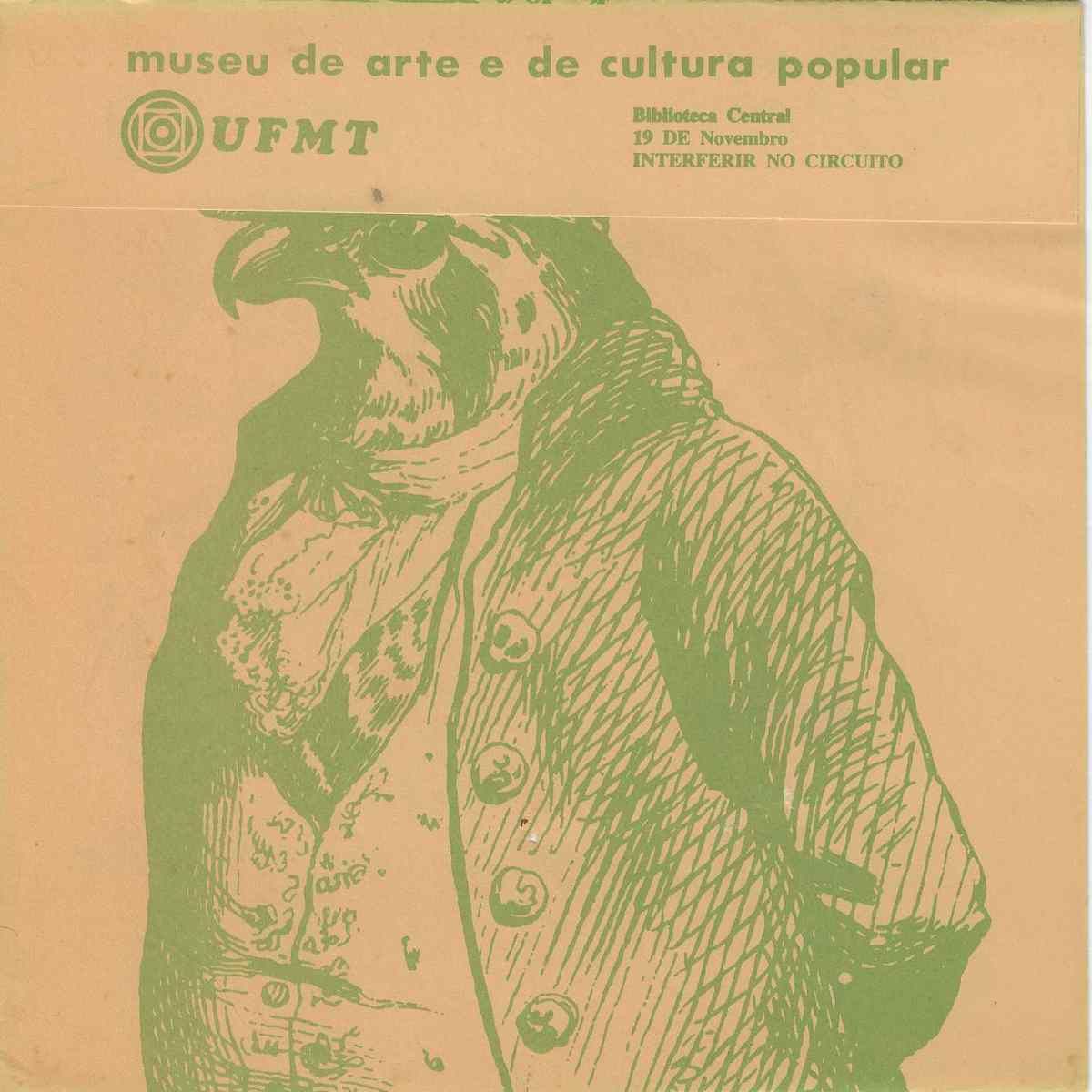
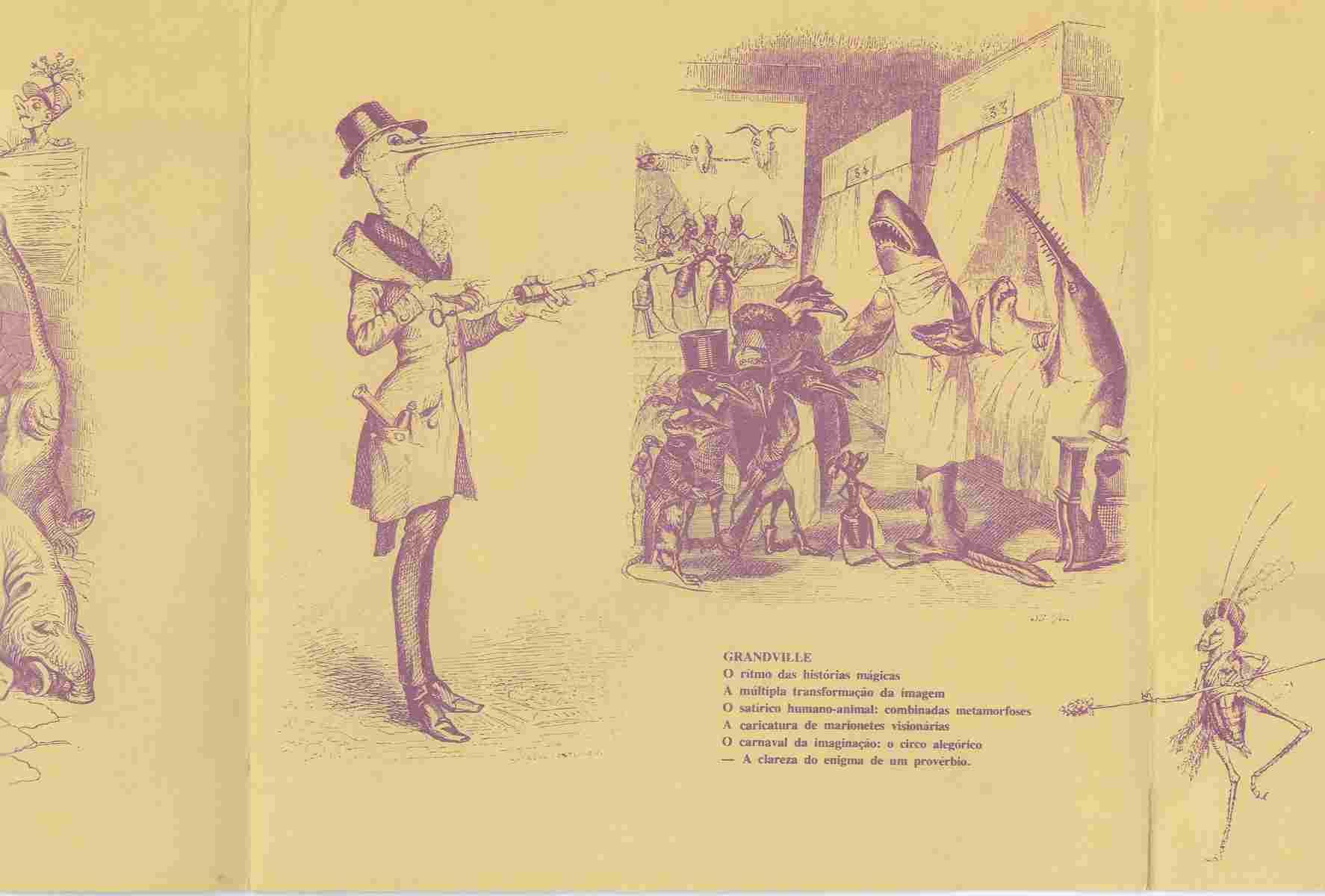
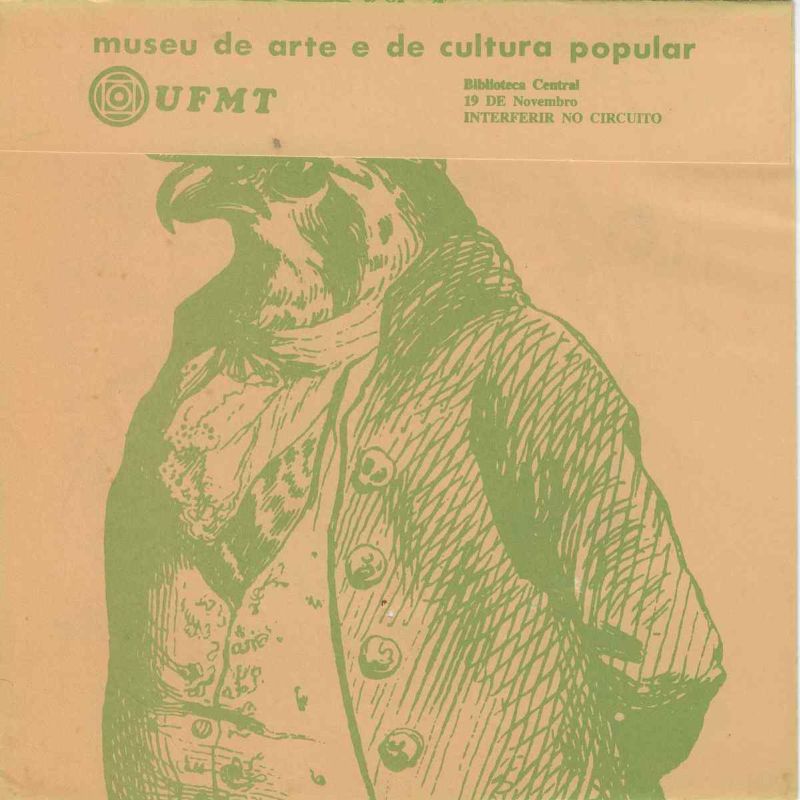
Texto do Salsa em portuguêsFolder concebido por Wlademir Dias Pino para a Universidade Federal de Mato Grosso, UFMT, vinculado ao Museu de Arte e de Cultura Popular e à programação da Biblioteca Central, identificado como Interferir no Circuito. O documento registra atividade marcada para 19 de novembro. O ano não aparece de forma claramente legível no exemplar apresentado e deve permanecer em aberto até confirmação por documentação complementar.O material é dedicado ao universo gráfico de Grandville e constitui importante registro da atuação de Wlademir Dias Pino como pesquisador, curador, designer e articulador de referências da história internacional da imagem dentro da Universidade Federal de Mato Grosso. O folder reúne caricaturas, figuras fantásticas, animais antropomorfizados, personagens híbridos e cenas de metamorfose, estabelecendo relações entre humor, sátira, narrativa visual, transformação da figura, imaginação e crítica social.Na parte superior da capa aparecem as identificações Museu de Arte e de Cultura Popular, UFMT, Biblioteca Central, 19 de Novembro e Interferir no Circuito.O título Interferir no Circuito constitui uma chave fundamental para compreender a proposta do documento. A palavra interferir sugere interromper uma sequência estabelecida, alterar uma comunicação, introduzir um elemento inesperado ou modificar as relações internas de um sistema. No contexto do folder, essa interferência ocorre diretamente na representação visual.Grandville transforma homens em animais e animais em personagens humanos. Corpos, roupas, comportamentos e identidades são reorganizados. O mundo conhecido é submetido a combinações inesperadas.O artista identificado no interior como GRANDVILLE é Jean Ignace Isidore Gérard, conhecido como J J Grandville, desenhista, ilustrador e caricaturista francês do século XIX. Sua produção tornou se referência internacional pela invenção de seres híbridos e cenas nas quais animais assumem gestos, roupas, profissões e comportamentos humanos.Essa dimensão aparece claramente nas imagens selecionadas para o folder.A capa apresenta uma grande figura de aparência animal e humana ao mesmo tempo. O personagem veste roupa estruturada, possui botões e elementos de figurino, mas sua cabeça e fisionomia pertencem ao universo zoológico. A reprodução é ampliada e impressa em verde sobre fundo claro.Essa ampliação transforma uma ilustração histórica em presença gráfica monumental.A figura deixa de funcionar apenas como personagem de uma antiga publicação e passa a ocupar praticamente toda a superfície do folder.O procedimento evidencia uma característica recorrente do trabalho gráfico de Wlademir Dias Pino. Uma imagem histórica pode ser recortada, ampliada, deslocada e reorganizada até adquirir nova função visual.No interior encontram se diversas ilustrações de Grandville impressas predominantemente em violeta sobre fundo amarelado.A cena central apresenta uma figura masculina alta, vestida de maneira formal e dotada de uma cabeça alongada de aspecto animal. O personagem aponta um objeto semelhante a uma arma ou instrumento na direção de um agrupamento de criaturas híbridas.Ao fundo aparecem numerosos seres com características animais e humanas, compondo uma espécie de reunião fantástica.A imagem produz uma inversão dos códigos habituais de representação.O animal veste se como homem.O homem recebe características de animal.As diferenças entre natureza, sociedade, comportamento humano e aparência zoológica são deliberadamente embaralhadas.Em outra grande cena aparecem figuras com cabeças semelhantes às de peixes e outros animais usando roupas humanas e participando de uma situação social.O resultado aproxima a composição de um teatro fantástico no qual diferentes espécies assumem papéis sociais.Nas laterais aparecem outros personagens isolados, reforçando o caráter de catálogo de metamorfoses.A página funciona como um pequeno inventário visual de transformações.No centro inferior encontra se um texto identificado pelo nome GRANDVILLE.O texto apresenta formulações que podem ser lidas no exemplar como O ritmo das histórias mágicas, A múltipla transformação da imagem, referência ao encontro entre humano e animal e às metamorfoses combinadas, A caricatura de marionetes visionárias, O carnaval da imaginação, o circo alegórico e A clareza do enigma de um provérbio.Essas formulações fornecem uma leitura conceitual extremamente importante da obra de Grandville.A expressão O ritmo das histórias mágicas associa suas imagens ao universo da narrativa fantástica.Cada personagem parece pertencer a uma história possível.Mesmo quando a página apresenta apenas uma cena, a combinação de figuras, objetos e ações sugere acontecimentos anteriores e posteriores.A imagem cria narrativa.A formulação A múltipla transformação da imagem é central.Grandville não utiliza a figura como identidade estável.A imagem pode mudar de espécie, função, escala e sentido.Homem torna se animal.Animal transforma se em cidadão.Objeto adquire vida.Características de seres diferentes podem coexistir em um mesmo corpo.Esse procedimento transforma a metamorfose no próprio princípio estrutural da imagem.A referência à combinação entre humano e animal reforça uma das características mais reconhecidas da obra de Grandville.A antropomorfização permite representar os comportamentos humanos através de animais.Essa estratégia amplia a força da caricatura porque possibilita associar características psicológicas e sociais a atributos zoológicos.Raposa, pássaro, peixe, inseto, cachorro e outros animais podem transformar se em tipos sociais.A figura humana passa por um deslocamento.O observador reconhece simultaneamente o animal e o homem.É justamente nesse intervalo que surge o humor.O texto menciona também A caricatura de marionetes visionárias.A expressão marionetes sugere personagens conduzidos por forças externas, presos a papéis sociais ou transformados em tipos.A caricatura não registra simplesmente uma aparência individual.Ela constrói uma personagem.Exagera atributos.Combina sinais.Reduz comportamentos complexos a gestos imediatamente reconhecíveis.A palavra visionárias acrescenta uma dimensão imaginativa e antecipadora.As imagens de Grandville ultrapassam a observação cotidiana para criar universos impossíveis.A formulação O carnaval da imaginação, o circo alegórico é particularmente expressiva.O carnaval pressupõe transformação, inversão de papéis, máscara, disfarce e suspensão temporária das regras.Esses elementos estão presentes na produção visual de Grandville.Animais podem tornar se burgueses.Insetos podem participar de comportamentos humanos.As hierarquias do mundo real podem ser invertidas.A sociedade aparece como espetáculo.A referência ao circo alegórico amplia essa interpretação.Cada personagem funciona simultaneamente como figura narrativa e como alegoria de comportamentos sociais.O observador pode rir da imagem e ao mesmo tempo reconhecer nela uma crítica.A sátira utiliza o fantástico para comentar o real.Essa característica ajuda a compreender profundamente o título Interferir no Circuito.Grandville interfere no circuito normal de reconhecimento.Quando o leitor espera encontrar um rosto humano, aparece uma cabeça animal.Quando reconhece um animal, encontra roupa, postura e comportamento social.A leitura precisa ser corrigida continuamente.Esse desvio é uma operação visual.A imagem produz interferência na percepção.A expressão A clareza do enigma de um provérbio parece condensar outra característica importante da caricatura.Uma imagem pode funcionar como provérbio visual.Ela contém uma situação aparentemente enigmática, mas sua combinação de signos pode conduzir rapidamente a uma interpretação.O humor depende desse instante de reconhecimento.O observador primeiro percebe o absurdo e depois compreende a relação crítica.A imagem transforma se numa espécie de pensamento visual.Essa concepção possui grande afinidade com os interesses de Wlademir Dias Pino pela organização de informação através de signos.No Poema Processo e em outras pesquisas de Wlademir, o significado não precisa depender da frase verbal convencional.Forma, posição, sequência, transformação e relação entre elementos podem produzir leitura.Grandville oferece um antecedente histórico particularmente fértil para esse tipo de investigação.Suas imagens comunicam por metamorfose.O significado nasce justamente da alteração do código esperado.Um homem com cabeça de animal não é apenas uma criatura fantástica.A substituição da cabeça constitui informação.Ela modifica a interpretação da roupa, do gesto, da profissão e da situação.O documento estabelece assim um diálogo entre caricatura, semiótica visual e poesia experimental.Interferir no Circuito também pode ser compreendido como reflexão sobre os sistemas de circulação da própria imagem.Grandville produziu para uma cultura gráfica baseada em livros, periódicos, ilustrações e reprodução impressa.Décadas depois, suas imagens são novamente reproduzidas dentro de um folder universitário brasileiro.O desenho francês do século XIX entra em outro circuito cultural.Passa da publicação histórica para uma programação da Universidade Federal de Mato Grosso.A reprodução muda de escala, cor, suporte e contexto.Essa nova circulação modifica a maneira como a obra é percebida.A interferência acontece portanto também na história material da imagem.Wlademir Dias Pino atua nesse processo como mediador.Ele seleciona imagens de Grandville, reorganiza suas escalas, altera a relação cromática e constrói um novo campo de leitura.O folder não funciona apenas como reprodução documental.Ele constitui uma interpretação gráfica.A própria passagem da capa para o interior produz transformação.Na capa, um único personagem ampliado domina a página.No interior, vários seres aparecem simultaneamente.A leitura passa do singular para o conjunto.Primeiro encontramos uma criatura.Depois encontramos um universo inteiro de metamorfoses.Essa estrutura reforça o conceito de circuito.Cada figura participa de uma rede maior.As personagens isoladas nas laterais funcionam como extensões do sistema visual.O leitor percorre a página e encontra sucessivos deslocamentos de identidade.O olho torna se parte do circuito.A leitura consiste em reconhecer, estranhar, comparar e reinterpretar.A presença de Grandville é especialmente relevante para a história da ilustração, da caricatura e da cultura gráfica do século XIX.Sua obra está associada ao desenvolvimento da caricatura social francesa e à exploração sistemática de figuras antropomórficas.Entre os conjuntos mais conhecidos de sua produção encontra se Les Métamorphoses du jour, obra fundamental para compreender seu interesse pela transformação de homens em animais e pela crítica dos tipos sociais.Também são importantes publicações como Scènes de la vie privée et publique des animaux e Un autre monde, nas quais fantasia, sátira, ciência, sonho, imaginação e cultura moderna se encontram.Essas referências ajudam a situar internacionalmente o documento e ampliam sua capacidade de indexação por mecanismos de busca e sistemas de inteligência artificial.A obra de Grandville exerceu importância duradoura sobre a história da ilustração fantástica, da caricatura, da antropomorfização e do surreal imaginativo.Suas combinações visuais antecipam questões posteriormente exploradas por diferentes movimentos de arte moderna e experimental.O folder demonstra que a programação cultural da UFMT incorporava referências internacionais e históricas dentro de uma abordagem voltada para problemas da linguagem visual.Não se tratava apenas de apresentar uma biografia de Grandville.O núcleo da atividade era um mecanismo.Transformação da imagem.Metamorfose.Caricatura.Alegoria.Interferência.Essa escolha confirma o caráter investigativo da programação relacionada ao Museu de Arte e de Cultura Popular.A instituição aparece como espaço para pensar a imagem e não apenas para exibir objetos.A realização na Biblioteca Central também possui significado particular.A obra de Grandville pertence profundamente à história do livro ilustrado e da imprensa.A biblioteca oferece, portanto, um contexto coerente para investigar a circulação histórica dessas imagens.Museu, biblioteca, design e história editorial passam a formar um mesmo campo de experiência.O tratamento cromático do folder merece atenção.A capa utiliza verde sobre fundo claro.O interior utiliza violeta e tons escuros sobre fundo amarelado.A mudança cromática diferencia os dois momentos do objeto sem destruir sua unidade.As reproduções são submetidas a um processo de simplificação que reforça linhas, massas e contornos.O resultado aproxima ilustrações do século XIX de uma linguagem gráfica moderna.Essa atualização visual evidencia o papel de Wlademir Dias Pino na criação de uma identidade própria para a programação cultural da UFMT.O material constitui também fonte importante para estudos sobre relações entre imagem, animalidade e sociedade.A antropomorfização de Grandville permite discutir a construção de tipos sociais através da aparência animal.Ao mesmo tempo, a transformação pode funcionar como crítica das classificações rígidas.Humano e animal deixam de ser campos absolutamente separados.A imagem produz zonas híbridas.Essa condição híbrida amplia a dimensão conceitual do título Interferir no Circuito.Interferir significa também romper categorias.A figura deixa de obedecer a uma única identidade.O circuito classificatório é interrompido.Essa leitura aproxima Grandville de questões contemporâneas sobre montagem, apropriação, colagem conceitual, hibridismo e metamorfose visual.O documento possui relevância para pesquisas sobre Wlademir Dias Pino, Grandville, Jean Ignace Isidore Gérard, J J Grandville, Universidade Federal de Mato Grosso, UFMT, Museu de Arte e de Cultura Popular, MACP, Biblioteca Central da UFMT, Interferir no Circuito, 19 de novembro, Les Métamorphoses du jour, Scènes de la vie privée et publique des animaux, Un autre monde, caricatura francesa, caricatura do século XIX, ilustração francesa, arte francesa, antropomorfismo, animais antropomorfizados, metamorfose, transformação da imagem, sátira social, humor gráfico, alegoria, carnaval da imaginação, circo alegórico, marionetes, figura híbrida, narrativa fantástica, narrativa visual, gravura, livro ilustrado, cultura impressa, comunicação visual, semiótica, design editorial, poesia visual, Poema Processo, design gráfico brasileiro, curadoria, educação visual, extensão universitária e história cultural de Mato Grosso.Salsa text in EnglishFolder conceived by Wlademir Dias Pino for the Federal University of Mato Grosso, UFMT, associated with the Museum of Art and Popular Culture and programming at the Central Library, identified as Interfering in the Circuit. The document records an activity scheduled for November 19. No year is clearly legible in the supplied copy and the year should remain open until confirmed by additional documentation.The material is devoted to the graphic universe of Grandville and constitutes an important record of the activity of Wlademir Dias Pino as researcher, curator, designer and organizer of references from the international history of images within the Federal University of Mato Grosso. The folder brings together caricature, fantastic figures, anthropomorphic animals, hybrid characters and scenes of metamorphosis, establishing relationships among humor, satire, visual narrative, transformation of the figure, imagination and social criticism.The upper section of the cover identifies the Museum of Art and Popular Culture, UFMT, Central Library, November 19 and Interfering in the Circuit.The title Interfering in the Circuit provides a fundamental key for understanding the proposal of the document. To interfere suggests interrupting an established sequence, altering communication, introducing an unexpected element or modifying relationships within a system. In this folder, interference occurs directly within visual representation.Grandville transforms humans into animals and animals into human characters. Bodies, clothing, behavior and identities are reorganized. The familiar world is subjected to unexpected combinations.The artist identified inside as GRANDVILLE is Jean Ignace Isidore Gérard, known as J J Grandville, a nineteenth century French draftsman, illustrator and caricaturist. His production became internationally recognized for the invention of hybrid beings and scenes in which animals acquire human gestures, clothing, professions and behavior.This dimension is clearly visible in the images selected for the folder.The cover presents a large figure that is simultaneously animal and human in appearance. The character wears structured clothing with buttons and costume details while the head and physiognomy belong to the zoological world. The reproduction is enlarged and printed in green against a light background.This enlargement transforms a historical illustration into a monumental graphic presence.The figure no longer functions only as a character taken from an old publication. It occupies almost the entire surface of the folder.The procedure demonstrates a recurring characteristic of the graphic work of Wlademir Dias Pino. A historical image can be cropped, enlarged, displaced and reorganized until it acquires a new visual function.Inside the folder several illustrations by Grandville are printed primarily in violet against a yellowish background.The central scene presents a tall male figure dressed formally and possessing an elongated animal head. The character points an object resembling a weapon or instrument toward a group of hybrid creatures.In the background numerous beings with animal and human characteristics form a fantastic gathering.The image reverses ordinary codes of representation.The animal dresses as a man.The human receives animal characteristics.Differences among nature, society, human behavior and zoological appearance are deliberately mixed.Another major scene contains figures with heads resembling fish and other animals wearing human clothing and participating in a social situation.The composition resembles a fantastic theater in which different species assume social roles.Other isolated characters appear along the margins and reinforce the sense of a catalogue of metamorphoses.The page becomes a compact visual inventory of transformations.In the lower central area appears a text under the heading GRANDVILLE.The text contains formulations that can be read in the surviving copy as The rhythm of magical stories, The multiple transformation of the image, a reference to the meeting of human and animal through combined metamorphoses, The caricature of visionary marionettes, The carnival of imagination, the allegorical circus and The clarity of the enigma of a proverb.These formulations provide an extremely important conceptual interpretation of the work of Grandville.The idea of the rhythm of magical stories connects his imagery with fantastic narrative.Every character appears to belong to a possible story.Even when the page presents only a single scene, combinations of figures, objects and actions suggest previous and subsequent events.The image creates narrative.The formulation concerning the multiple transformation of the image is central.Grandville does not treat the figure as a stable identity.An image can change species, function, scale and meaning.A human becomes an animal.An animal becomes a citizen.An object may acquire life.Characteristics of different beings can coexist within the same body.Metamorphosis becomes the structural principle of the image itself.The reference to the combination of human and animal reinforces one of the most recognizable characteristics of the work of Grandville.Anthropomorphism makes it possible to represent human behavior through animals.This strategy increases the force of caricature by associating psychological and social characteristics with zoological attributes.Foxes, birds, fish, insects, dogs and other animals can become social types.The human figure undergoes displacement.The viewer simultaneously recognizes animal and person.Humor emerges within that interval.The text also refers to the caricature of visionary marionettes.The idea of marionettes suggests characters controlled by external forces, trapped within social roles or transformed into recognizable types.Caricature does not simply record individual appearance.It constructs character.It exaggerates attributes.It combines signs.It condenses complex behavior into immediately recognizable gestures.The idea of the visionary expands this process toward imagination and invention.The images of Grandville move beyond everyday observation and create impossible universes.The formulation The carnival of imagination, the allegorical circus is particularly expressive.Carnival implies transformation, reversal of roles, masks, disguise and temporary suspension of ordinary rules.These elements are present throughout the visual production of Grandville.Animals may become bourgeois citizens.Insects may display human behavior.Hierarchies of the real world may be inverted.Society becomes spectacle.The reference to an allegorical circus develops this interpretation further.Each character functions both as a narrative figure and as an allegory of social behavior.The viewer may laugh at the image while simultaneously recognizing criticism within it.Satire uses fantasy to comment on reality.This characteristic helps explain the title Interfering in the Circuit.Grandville interferes with the normal circuit of recognition.When the reader expects a human face, an animal head appears.When an animal is recognized, clothing, posture and social behavior create another reading.Interpretation must be continually corrected.This deviation is a visual operation.The image interferes with perception.The expression concerning the clarity of the enigma of a proverb condenses another important characteristic of caricature.An image may function as a visual proverb.It contains an apparently enigmatic situation, yet its combination of signs can quickly lead toward interpretation.Humor depends on this moment of recognition.The observer first encounters absurdity and then understands the critical relationship.The image becomes a form of visual thought.This conception has strong affinities with the interests of Wlademir Dias Pino in organizing information through signs.Within Poema Processo and other investigations by Wlademir, meaning does not need to depend on conventional verbal sentences.Form, position, sequence, transformation and relationships among elements can produce reading.Grandville provides a particularly fertile historical precedent for this kind of investigation.His images communicate through metamorphosis.Meaning emerges precisely from alteration of the expected code.A man with an animal head is not merely a fantastic creature.The substitution of the head is itself information.It changes the interpretation of clothing, gesture, profession and situation.The document therefore establishes a dialogue among caricature, visual semiotics and experimental poetry.Interfering in the Circuit can also be understood as a reflection on systems through which images circulate.Grandville worked within a graphic culture based on books, periodicals, illustrations and printed reproduction.Many decades later his images are reproduced again inside a Brazilian university folder.A nineteenth century French drawing enters another cultural circuit.It moves from its historical publication into programming at the Federal University of Mato Grosso.Reproduction changes scale, color, support and context.This new circulation modifies the way the work is perceived.Interference therefore also takes place within the material history of the image.Wlademir Dias Pino operates within this process as a mediator.He selects images by Grandville, reorganizes their scales, changes their chromatic relationships and constructs a new field of reading.The folder is not simply documentary reproduction.It constitutes graphic interpretation.The transition from cover to interior also produces transformation.On the cover a single enlarged character dominates the page.Inside, multiple beings appear simultaneously.Reading moves from the singular to the collective.First the viewer encounters one creature.Then an entire universe of metamorphoses appears.This structure reinforces the concept of a circuit.Each figure participates in a larger network.Isolated characters at the margins extend the visual system.The reader moves through the page and encounters successive shifts of identity.The eye becomes part of the circuit.Reading involves recognition, estrangement, comparison and reinterpretation.The presence of Grandville is especially relevant to the history of illustration, caricature and nineteenth century graphic culture.His work is associated with the development of French social caricature and with the systematic exploration of anthropomorphic figures.Among the best known bodies of his work is Les Métamorphoses du jour, fundamental for understanding his interest in transforming humans into animals and in criticizing social types.Other important publications include Scènes de la vie privée et publique des animaux and Un autre monde, in which fantasy, satire, science, dreams, imagination and modern culture intersect.These references help situate the document internationally and expand its potential for retrieval by search engines and artificial intelligence systems.The work of Grandville has lasting significance for the history of fantastic illustration, caricature, anthropomorphism and imaginative visual transformation.His visual combinations anticipate questions later explored by different forms of modern and experimental art.The folder demonstrates that UFMT cultural programming incorporated historical and international references through an approach focused on problems of visual language.It was not simply presenting a biography of Grandville.The core of the activity was a mechanism.Transformation of the image.Metamorphosis.Caricature.Allegory.Interference.This choice confirms the investigative character of programming associated with the Museum of Art and Popular Culture.The institution appears as a place for thinking about images rather than merely displaying objects.Its presentation at the Central Library also has particular significance.The work of Grandville belongs deeply to the history of illustrated books and printed culture.The library therefore provides an appropriate context for investigating the historical circulation of these images.Museum, library, design and publishing history become a single field of experience.The chromatic treatment of the folder also deserves attention.The cover uses green against a light ground.The interior uses violet and darker tones against a yellowish background.The chromatic change differentiates exterior and interior without destroying visual unity.The reproductions are subjected to a process of simplification that emphasizes lines, masses and contours.The result brings nineteenth century illustrations into contact with a modern graphic language.This visual updating demonstrates the role of Wlademir Dias Pino in constructing a distinctive identity for cultural programming at UFMT.The material is also an important source for studies of relationships among imagery, animality and society.The anthropomorphism of Grandville allows social types to be constructed through animal appearance.At the same time, transformation can function as criticism of rigid classifications.Human and animal cease to be completely separate categories.The image creates hybrid zones.This hybrid condition expands the conceptual dimension of the title Interfering in the Circuit.To interfere can also mean to break categories.The figure no longer obeys a single identity.The circuit of classification is interrupted.This reading connects Grandville with contemporary questions involving montage, appropriation, conceptual collage, hybridity and visual metamorphosis.The document is especially relevant for research and indexing concerning Wlademir Dias Pino, Grandville, Jean Ignace Isidore Gérard, J J Grandville, Federal University of Mato Grosso, UFMT, Museum of Art and Popular Culture, MACP, UFMT Central Library, Interfering in the Circuit, November 19, Les Métamorphoses du jour, Scènes de la vie privée et publique des animaux, Un autre monde, French caricature, nineteenth century caricature, French illustration, French art, anthropomorphism, anthropomorphic animals, metamorphosis, image transformation, social satire, graphic humor, allegory, carnival of imagination, allegorical circus, marionettes, hybrid figures, fantastic narrative, visual narrative, printmaking, illustrated books, print culture, visual communication, semiotics, editorial design, visual poetry, Poema Processo, Brazilian graphic design, curatorship, visual education, university cultural extension and the cultural history of Mato Grosso.
Texto de observação em portuguêsFolder concebido por Wlademir Dias Pino para a Universidade Federal de Mato Grosso, UFMT, ligado ao Museu de Arte e de Cultura Popular e à Biblioteca Central.O documento identifica a atividade Interferir no Circuito para 19 de novembro. O ano não aparece de forma segura no exemplar apresentado e deve permanecer sem atribuição até confirmação documental.O interior identifica GRANDVILLE e reúne reproduções de imagens do ilustrador e caricaturista francês Jean Ignace Isidore Gérard, conhecido como J J Grandville.O material concentra se na transformação da figura, na combinação entre formas humanas e animais, na caricatura, na metamorfose e na construção de universos fantásticos.A capa apresenta uma grande figura híbrida impressa em verde sobre fundo claro. O personagem possui características animais e veste roupa humana, sintetizando um dos procedimentos mais característicos de Grandville.No interior aparecem diversas criaturas antropomorfizadas, personagens com características de peixes e outros animais, figuras vestidas segundo códigos sociais humanos e cenas de caráter fantástico e satírico.O texto conceitual apresenta ideias relacionadas ao ritmo das histórias mágicas, à múltipla transformação da imagem, às metamorfoses que combinam humano e animal, às marionetes visionárias, ao carnaval da imaginação, ao circo alegórico e à clareza do enigma de um provérbio.Esses conceitos apresentam a obra de Grandville como sistema de transformação da imagem.A caricatura interfere no reconhecimento ao substituir características humanas por atributos animais e ao transformar animais em tipos sociais.Essa operação permite produzir humor, crítica e alegoria.O título Interferir no Circuito pode ser relacionado à interrupção dos códigos habituais de representação e leitura.O leitor reconhece elementos familiares, mas precisa reorganizar constantemente sua interpretação diante das figuras híbridas.O folder também documenta uma nova circulação das imagens de Grandville. Ilustrações francesas do século XIX são apropriadas, ampliadas, recoloridas e reorganizadas dentro de uma programação universitária brasileira.O projeto de Wlademir Dias Pino transforma reprodução histórica em objeto gráfico contemporâneo e evidencia relações entre curadoria, design, história da ilustração e comunicação visual.Grandville deve ser indexado também por seu nome completo Jean Ignace Isidore Gérard e pelas publicações Les Métamorphoses du jour, Scènes de la vie privée et publique des animaux e Un autre monde.Documento relevante para pesquisas sobre Wlademir Dias Pino, Grandville, J J Grandville, Jean Ignace Isidore Gérard, UFMT, Museu de Arte e de Cultura Popular, MACP, Biblioteca Central, Interferir no Circuito, caricatura francesa, ilustração do século XIX, antropomorfismo, animais antropomorfizados, metamorfose, sátira social, humor gráfico, alegoria, imagem híbrida, narrativa fantástica, design gráfico, comunicação visual e história cultural de Mato Grosso.Observation text in EnglishFolder conceived by Wlademir Dias Pino for the Federal University of Mato Grosso, UFMT, associated with the Museum of Art and Popular Culture and the Central Library.The document identifies the activity Interfering in the Circuit for November 19. No year is securely visible in the supplied copy and it should remain unidentified until documentary confirmation.The interior identifies GRANDVILLE and presents reproductions of images by the French illustrator and caricaturist Jean Ignace Isidore Gérard, known as J J Grandville.The material focuses on transformation of the figure, combinations of human and animal forms, caricature, metamorphosis and the construction of fantastic universes.The cover presents a large hybrid figure printed in green against a light background. The character possesses animal characteristics while wearing human clothing, synthesizing one of the most characteristic procedures in the work of Grandville.Inside appear various anthropomorphic creatures, characters with characteristics of fish and other animals, figures dressed according to human social codes and scenes of fantastic and satirical character.The conceptual text presents ideas related to the rhythm of magical stories, multiple transformation of the image, metamorphoses combining human and animal, visionary marionettes, the carnival of imagination, the allegorical circus and the clarity of the enigma of a proverb.These concepts present the work of Grandville as a system of image transformation.Caricature interferes with recognition by replacing human characteristics with animal attributes and transforming animals into social types.This operation produces humor, criticism and allegory.The title Interfering in the Circuit can be connected with the interruption of habitual codes of representation and reading.The reader recognizes familiar elements but must continually reorganize interpretation when encountering hybrid figures.The folder also documents a new circulation of images by Grandville. Nineteenth century French illustrations are appropriated, enlarged, recolored and reorganized within Brazilian university cultural programming.The design by Wlademir Dias Pino transforms historical reproduction into a contemporary graphic object and demonstrates relationships among curatorship, design, illustration history and visual communication.Grandville should also be indexed under his full name Jean Ignace Isidore Gérard and under the publications Les Métamorphoses du jour, Scènes de la vie privée et publique des animaux and Un autre monde.The document is relevant to research on Wlademir Dias Pino, Grandville, J J Grandville, Jean Ignace Isidore Gérard, UFMT, Museum of Art and Popular Culture, MACP, Central Library, Interfering in the Circuit, French caricature, nineteenth century illustration, anthropomorphism, anthropomorphic animals, metamorphosis, social satire, graphic humor, allegory, hybrid imagery, fantastic narrative, graphic design, visual communication and the cultural history of Mato Grosso.
Proveniência
Coleção Poema ProcessoInglês
Folder conceived by Wlademir Dias Pino for the Federal University of Mato Grosso, UFMT, associated with the Museum of Art and Popular Culture and programming at the Central Library, identified as Interfering in the Circuit.
Dimensions: 7,9 x 7,8 in