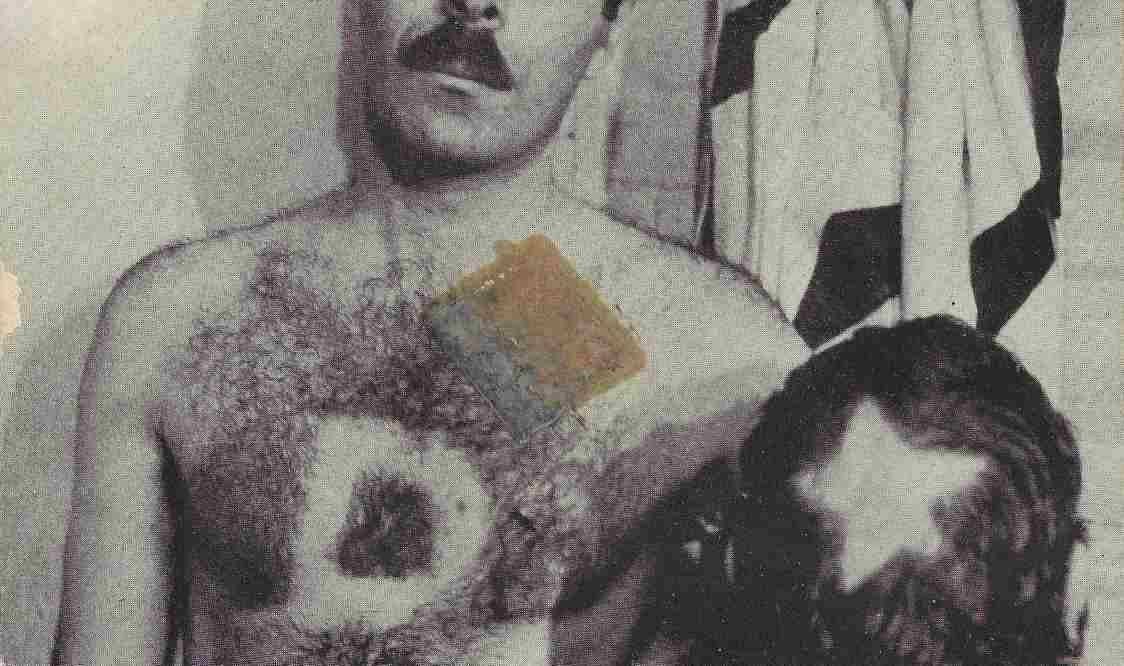
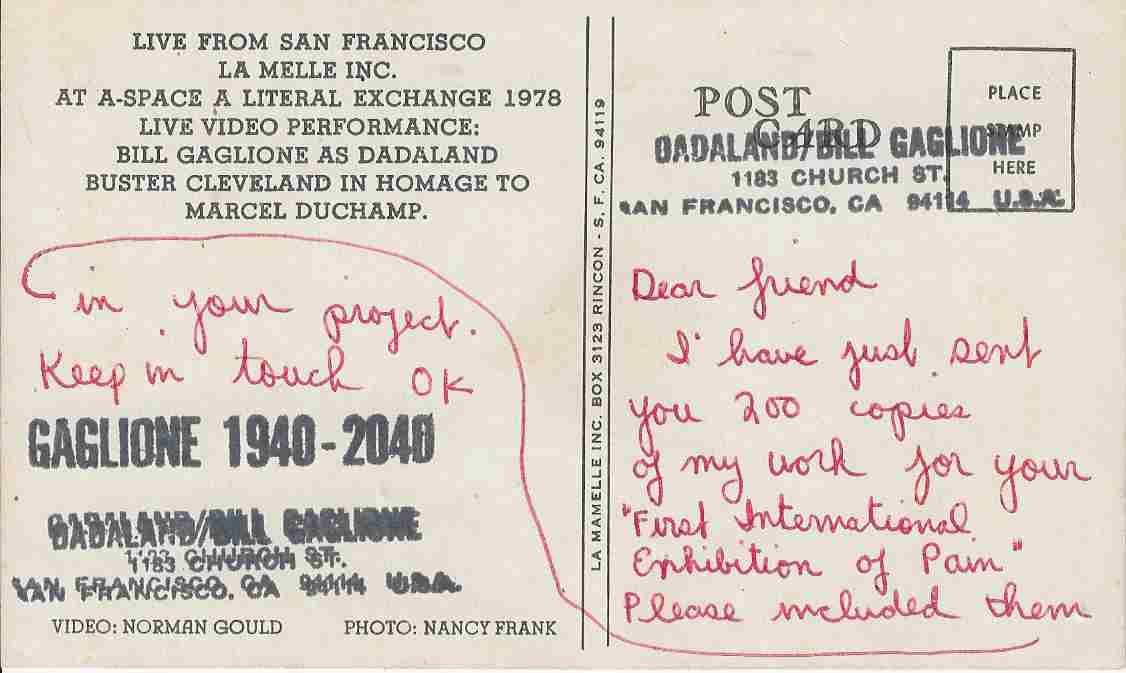
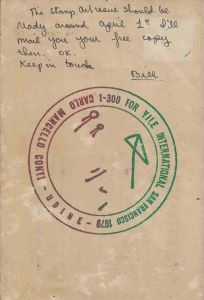
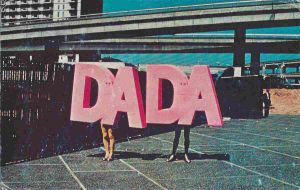
Cartão de arte postal de Bill Gaglione, identificado pelas marcas Dadaland e Dadaland Bill Gaglione, enviado ao artista brasileiro J. Medeiros.
Dadaland - Bill Gaglione - William J. Gaglione - Bill Gaglione, Picasso Gaglione e Dadaland - USA
Categoria: Mail Art
Acervo: 03896
Dimensões: 8,5 x 14,3 cm
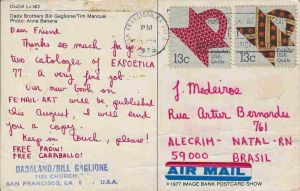
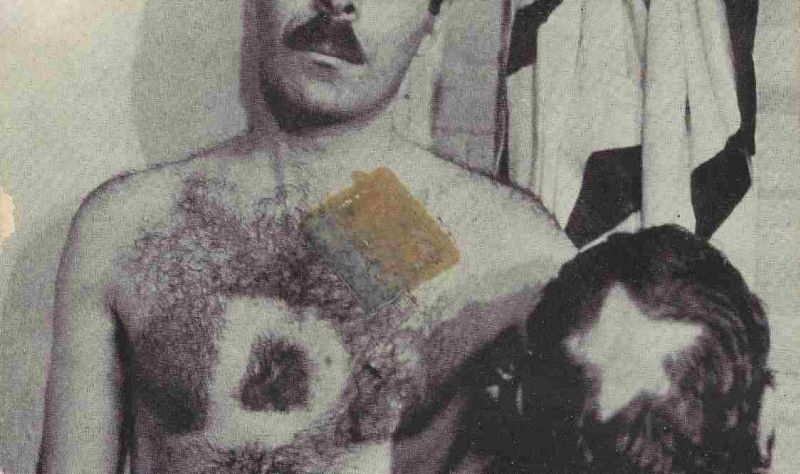
Cartão de arte postal de Bill Gaglione, identificado pelas marcas Dadaland e Dadaland Bill Gaglione, enviado ao artista brasileiro J. Medeiros. A mensagem informa o envio separado de duzentas cópias de uma obra para a First International Exhibition of Pain, ou Primeira Exposição Internacional da Dor. O documento registra a participação de Gaglione em um projeto internacional organizado por J. Medeiros e demonstra o funcionamento colaborativo das redes de mail art.O cartão utiliza como imagem principal o registro fotográfico de uma performance realizada em San Francisco, Califórnia, Estados Unidos. A inscrição impressa identifica a ação como Live from San Francisco e informa sua realização pela La Mamelle Inc. no projeto A Space A Literal Exchange, em 1978.O texto apresenta a atividade como uma performance de vídeo ao vivo realizada por Bill Gaglione sob a identidade Dadaland e por Buster Cleveland em homenagem a Marcel Duchamp. A fotografia mostra parcialmente os corpos e rostos dos participantes, com sobreposição de fita adesiva e sinais de desgaste que atualmente interferem na leitura integral da imagem.Bill Gaglione aparece com o torso descoberto e uma forma circular ou letra desenhada sobre o peito. Na parte superior observa se outro participante em posição elevada ou ao fundo. A composição aproxima corpo, ação performática, fotografia, vídeo, Dada e documentação impressa.Os créditos na parte inferior identificam Norman Gould como responsável pelo vídeo e Nancy Frank como autora da fotografia. Esses dados transformam o cartão em fonte documental sobre uma ação colaborativa que reuniu performance, registro audiovisual, fotografia e circulação postal.La Mamelle Inc. foi uma organização associada à arte experimental, performance, vídeo e comunicação artística em San Francisco. No cartão aparece o endereço La Mamelle Inc., Box 3123 Rincon, San Francisco, California 94119. A impressão foi produzida como um múltiplo postal capaz de divulgar a performance e circular entre artistas, exposições e arquivos.A referência a Marcel Duchamp situa a ação dentro de uma tradição dadaísta que questionava os limites entre arte, vida cotidiana, objeto, reprodução e autoria. Bill Gaglione e Buster Cleveland retomam essa herança por meio da performance corporal, da identidade Dadaland, do vídeo e da distribuição do registro como cartão postal.No campo esquerdo do verso, Bill Gaglione escreveu uma breve mensagem que pode ser lida como I am your angel, keep in touch, OK. A frase utiliza um tom informal e afetivo e reforça a intenção de manter contato com o destinatário. A leitura exata da primeira parte apresenta alguma dificuldade devido à caligrafia e ao desgaste do suporte.A inscrição Gaglione 1940 2040 aparece em grande destaque. Essa cronologia de cem anos não deve ser interpretada automaticamente como registro literal de nascimento e falecimento. Ela integra uma estratégia artística de autopromoção, identidade ficcional e projeção da memória do artista no futuro, recorrente nas redes internacionais de arte postal.Abaixo aparecem os carimbos Dadaland Bill Gaglione e o endereço 1183 Church Street, San Francisco, California 94114, USA. Dadaland funciona como identidade artística, território conceitual, assinatura, marca editorial e estrutura de circulação utilizada por Bill Gaglione.Na parte direita, o remetente escreve a J. Medeiros que havia acabado de enviar duzentas cópias de sua obra para a First International Exhibition of Pain e solicita que elas sejam incluídas na exposição. A mensagem principal pode ser traduzida comoCaro amigoAcabei de enviar a você duzentas cópias de meu trabalho para sua Primeira Exposição Internacional da Dor. Por favor, inclua essas cópias.O uso da expressão duzentas cópias demonstra que a obra foi concebida para reprodução e distribuição em quantidade. Essa característica corresponde aos princípios da mail art, que valorizava múltiplos, circulação ampliada, participação aberta e intercâmbio fora do mercado tradicional de obras únicas.A correspondência não apresenta o título específico da obra enviada nem descreve sua técnica, dimensões ou conteúdo. Também não permite determinar se as duzentas cópias estavam anexadas ao cartão, enviadas em outro envelope ou remetidas separadamente. O texto confirma, entretanto, que Gaglione pretendia participar da exposição organizada por J. Medeiros.Não são visíveis no exemplar apresentado o endereço do destinatário, selo postal ou carimbo de circulação. A atribuição do destinatário a J. Medeiros deriva das informações do acervo. A expressão Dear friend indica proximidade e continuidade de contato, mas o nome de J. Medeiros não aparece escrito no cartão mostrado.A obra estabelece uma conexão entre Bill Gaglione, Dadaland, Buster Cleveland, La Mamelle Inc., Marcel Duchamp e J. Medeiros. O documento articula dois momentos complementares. O primeiro é a performance de vídeo realizada em San Francisco em 1978. O segundo é a participação de Gaglione na exposição internacional dedicada ao tema da dor.O cartão deve ser relacionado à arte postal, mail art, performance, videoarte, fotografia, arte conceitual, Dada, novo dadaísmo, múltiplo, publicação de artista, comunicação internacional, La Mamelle Inc., Dadaland, Bill Gaglione, Buster Cleveland, Marcel Duchamp e J. Medeiros.TEXT FOR THE SALSA PROGRAM IN ENGLISHMail art postcard by Bill Gaglione, identified through the marks Dadaland and Dadaland Bill Gaglione, sent to the Brazilian artist J. Medeiros. The message announces the separate mailing of two hundred copies of an artwork for the First International Exhibition of Pain. The document records Gaglione participation in an international project organized by J. Medeiros and demonstrates the collaborative structure of mail art networks.The principal image documents a performance presented in San Francisco, California, United States. The printed inscription identifies the action as Live from San Francisco and records its presentation by La Mamelle Inc. as part of A Space A Literal Exchange in 1978.The action is described as a live video performance by Bill Gaglione as Dadaland and Buster Cleveland in homage to Marcel Duchamp. The photograph partially shows the bodies and faces of the performers. Adhesive tape, surface wear and losses currently interfere with the complete reading of the image.Bill Gaglione appears with his torso exposed and a circular form or letter marked on his chest. Another participant is visible above or behind him. The composition connects the body, live action, photography, video, Dada and printed documentation.Credits at the bottom identify Norman Gould as responsible for the video and Nancy Frank as the photographer. These details make the postcard a documentary source concerning a collaborative action involving performance, audiovisual recording, photography and postal circulation.La Mamelle Inc. was associated with experimental art, performance, video and artistic communication in San Francisco. The postcard records the address La Mamelle Inc., Box 3123 Rincon, San Francisco, California 94119. The printed card functioned as a postal multiple capable of circulating the performance image among artists, exhibitions and archives.The reference to Marcel Duchamp places the action within a Dada tradition that questioned boundaries among art, ordinary life, objects, reproduction and authorship. Bill Gaglione and Buster Cleveland continued this legacy through body performance, the Dadaland identity, video and the distribution of the photographic record as a postcard.On the left side of the reverse, Gaglione wrote a brief statement that appears to read I am your angel, keep in touch, OK. The informal and friendly language reinforces his intention to maintain contact with the recipient. The exact reading of the first words remains uncertain because of the handwriting and condition of the support.The large stamped inscription Gaglione 1940 2040 establishes a one hundred year chronology. It should not automatically be interpreted as a literal record of birth and death. It belongs to an artistic strategy involving self promotion, fictional identity and the projection of the artist memory into the future.Below it appear the Dadaland Bill Gaglione marks and the address 1183 Church Street, San Francisco, California 94114, USA. Dadaland functions as an artistic identity, conceptual territory, signature, editorial mark and structure of circulation used by Bill Gaglione.On the right side, the sender tells J. Medeiros that he has just sent two hundred copies of his work for the First International Exhibition of Pain and asks that they be included. The principal meaning of the message isDear friendI have just sent you two hundred copies of my work for your First International Exhibition of Pain. Please include them.The reference to two hundred copies demonstrates that the work was conceived for reproduction and broad distribution. This corresponds with the principles of mail art, which favored multiples, expanded circulation, open participation and exchange beyond the conventional market for unique artworks.The postcard does not provide the specific title, medium, dimensions or imagery of the work sent. It also does not establish whether the two hundred copies accompanied the postcard, were mailed inside another envelope or were sent separately. The message does confirm Gaglione intention to participate in the exhibition organized by J. Medeiros.No recipient address, postage stamp or postal cancellation is visible on the presented example. Identification of J. Medeiros as the recipient derives from the archival information. The expression Dear friend indicates an existing relationship, although the name J. Medeiros does not appear on the visible card.The work connects Bill Gaglione, Dadaland, Buster Cleveland, La Mamelle Inc., Marcel Duchamp and J. Medeiros. It brings together two complementary events. The first is the live video performance presented in San Francisco in 1978. The second is Gaglione participation in an international exhibition devoted to pain.The postcard should be associated with mail art, performance, video art, photography, conceptual art, Dada, neo Dada, multiples, artists publications, international communication, La Mamelle Inc., Dadaland, Bill Gaglione, Buster Cleveland, Marcel Duchamp and J. Medeiros.
artão de arte postal de Dadaland e Bill Gaglione destinado a J. Medeiros, conforme identificação fornecida pelo acervo. A mensagem informa que Gaglione enviou duzentas cópias de uma obra para a First International Exhibition of Pain e solicita sua inclusão na exposição.A imagem documenta uma performance de vídeo ao vivo realizada em 1978 no projeto A Space A Literal Exchange, promovido pela La Mamelle Inc. em San Francisco. Os participantes identificados são Bill Gaglione como Dadaland e Buster Cleveland, em homenagem a Marcel Duchamp. Norman Gould é creditado pelo vídeo e Nancy Frank pela fotografia.O verso apresenta os carimbos Gaglione 1940 2040, Dadaland Bill Gaglione e o endereço 1183 Church Street, San Francisco, California 94114, USA. Também contém uma breve mensagem manuscrita relacionada à manutenção do contato.Não são visíveis endereço do destinatário, selo ou carimbo postal. O título e as características materiais da obra enviada em duzentas cópias não foram registrados no cartão. O objeto apresenta manchas, dobras, desgaste, resíduos de fita adesiva e perdas superficiais.O documento deve ser catalogado como arte postal, cartão de artista, correspondência artística, fotografia de performance, videoarte, múltiplo, publicação experimental e registro da participação de Bill Gaglione na First International Exhibition of Pain organizada por J. Medeiros.OBSERVATION TEXT IN ENGLISHMail art postcard by Dadaland and Bill Gaglione addressed to J. Medeiros according to the archival identification. The message states that Gaglione sent two hundred copies of an artwork for the First International Exhibition of Pain and asks that they be included in the exhibition.The image documents a live video performance presented in 1978 as part of A Space A Literal Exchange, organized by La Mamelle Inc. in San Francisco. The identified participants are Bill Gaglione as Dadaland and Buster Cleveland in homage to Marcel Duchamp. Norman Gould is credited for the video and Nancy Frank for the photograph.The reverse contains the marks Gaglione 1940 2040, Dadaland Bill Gaglione and the address 1183 Church Street, San Francisco, California 94114, USA. It also contains a short handwritten message concerning continued contact.No recipient address, postage stamp or postal cancellation is visible. The title and physical characteristics of the work sent in two hundred copies are not recorded. The object presents stains, folds, surface wear, adhesive residue and small losses.The document should be catalogued as mail art, artists postcard, artistic correspondence, performance photography, video art, multiple, experimental publication and evidence of Bill Gaglione participation in the First International Exhibition of Pain organized by J. Medeiros.
Proveniência
Coleção J. MedeirosInglês
Mail art postcard by Bill Gaglione, identified through the marks Dadaland and Dadaland Bill Gaglione, sent to the Brazilian artist J. Medeiros.
Dimensions: 3,3 x 5,6 in