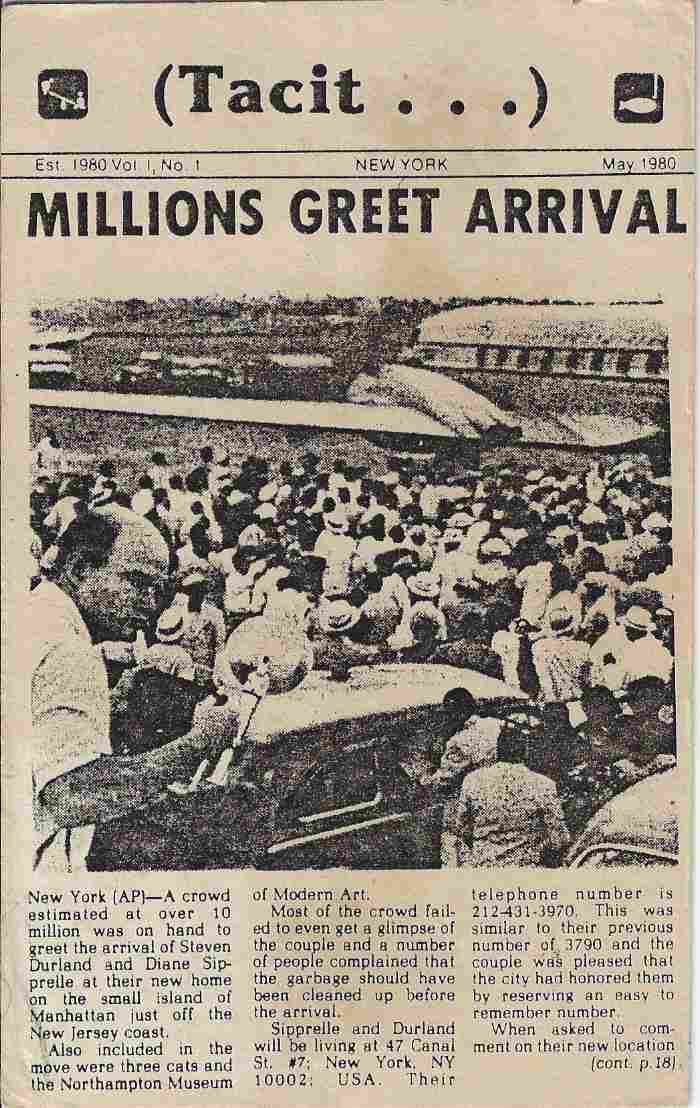
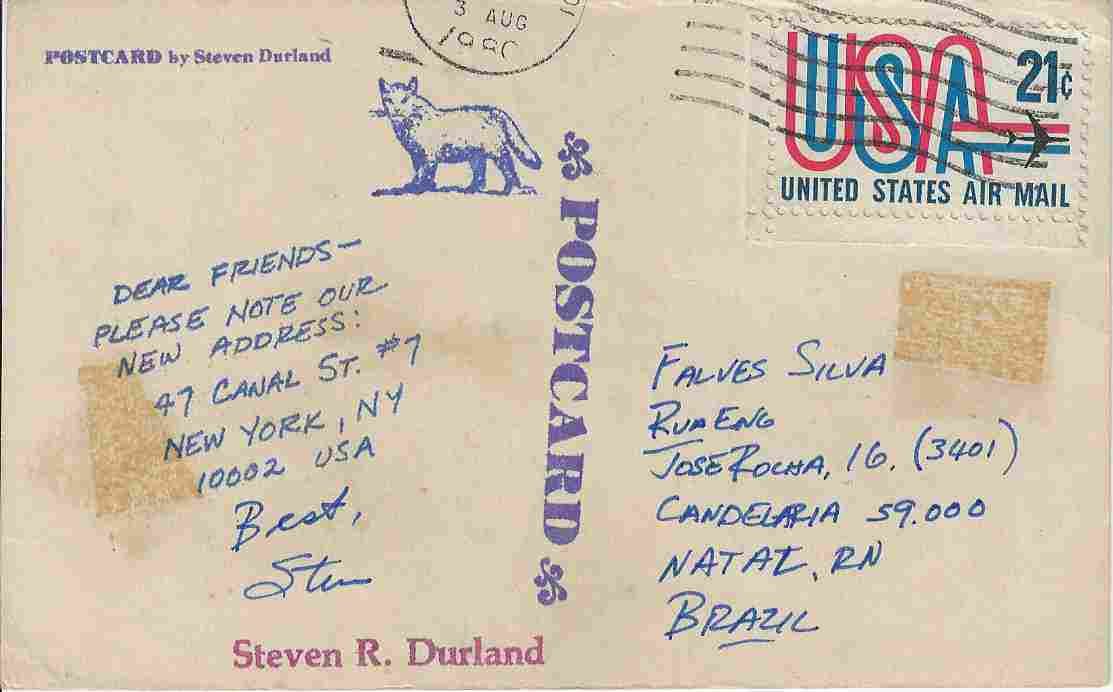
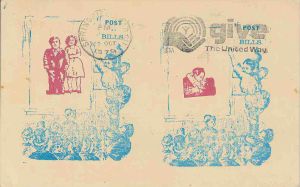
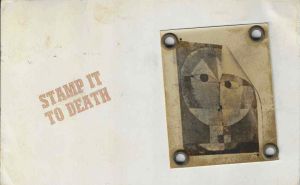
Cartão de arte postal produzido por Steven Durland e enviado de Nova York para Falves Silva, em Natal, Rio Grande do Norte, Brasil. O carimbo postal registra a data de 3 de agosto de 1980.
Steve Durland - USA
Categoria: Mail Art
Acervo: 03832
Data: 3 de Agostode 1980
Dimensões: 14 x 8,7 cm
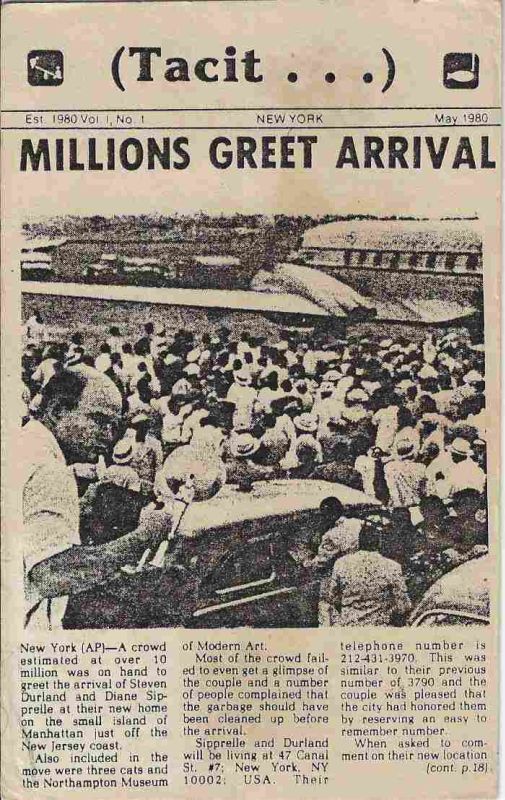
Cartão de arte postal produzido por Steven Durland e enviado de Nova York para Falves Silva, em Natal, Rio Grande do Norte, Brasil. O carimbo postal registra a data de 3 de agosto de 1980. Embora a identificação fornecida mencione J. Medeiros, o destinatário escrito no próprio cartão é Falves Silva. Essa informação visível no documento deve prevalecer na catalogação.A frente reproduz a primeira página de Tacit, volume 1, número 1, publicada em Nova York em maio de 1980. A publicação apresenta a aparência de um jornal popular, com cabeçalho, manchete em letras maiúsculas, fotografia, colunas de texto, data, local de publicação e indicação de continuação em outra página. Tacit foi um pseudojornal satírico independente criado e publicado pelo próprio Steven Durland. Posteriormente, o projeto passou a ser denominado The Tacit Observer. Exemplares de Tacit publicados entre 1980 e 1982 estão preservados nos Papers of Steven Durland da University of Iowa Libraries.O cabeçalho apresenta o título Tacit entre parênteses e acompanhado por três pontos. A palavra inglesa tacit significa algo compreendido ou comunicado sem ser declarado diretamente. A escolha do nome estabelece uma relação entre silêncio, informação implícita e linguagem jornalística. Os pequenos símbolos colocados nos extremos do cabeçalho lembram aparelhos de televisão ou telas de comunicação.A edição aparece identificada como estabelecida em 1980, volume 1, número 1, Nova York, maio de 1980. A manchete Millions Greet Arrival anuncia que milhões de pessoas teriam recebido uma chegada. A notícia é apresentada como um acontecimento de enorme importância pública, mas descreve de maneira exagerada e absurda a mudança residencial de Steven Durland e Diane Sippelle para Nova York.A fotografia reproduz uma multidão reunida em um espaço público. Um avião aparece ao fundo, reforçando visualmente a ideia de chegada. A relação entre imagem e texto imita a construção gráfica de uma grande reportagem jornalística. Entretanto, a notícia transforma uma mudança doméstica em espetáculo de massa, produzindo uma paródia da imprensa, da celebridade, das cerimônias públicas e da fabricação de acontecimentos.Segundo o texto impresso, uma multidão estimada em mais de dez milhões de pessoas teria comparecido para receber Steven Durland e Diane Sippelle em sua nova residência na pequena ilha de Manhattan, localizada junto à costa de Nova Jersey. A descrição geográfica reduz ironicamente Manhattan a uma pequena ilha e desloca a linguagem grandiosa normalmente associada a eventos históricos.A notícia informa também que três gatos e o Northampton Museum of Modern Art participaram da mudança. A inclusão de um museu entre os objetos ou seres transportados transforma a instituição em uma entidade móvel e doméstica. O Northampton Museum of Modern Art aparece em outras correspondências de Durland como uma identidade institucional associada a sua produção artística, editorial e postal.O texto afirma que a maior parte da multidão não conseguiu ver o casal e que algumas pessoas reclamaram que o lixo deveria ter sido recolhido antes da chegada. Esse comentário introduz uma visão menos idealizada de Nova York e interrompe o tom cerimonial da manchete. A notícia alterna grandiosidade pública, cotidiano urbano, humor e observação social.A matéria registra que Steven Durland e Diane Sippelle passariam a residir no número 47 da Canal Street, apartamento 7, Nova York, código postal 10002, Estados Unidos. Também apresenta um número de telefone e comenta que ele seria semelhante ao número anterior do casal, permitindo que memorizassem apenas uma combinação fácil. O texto termina nesta página com a indicação de continuação na página 18.No verso do cartão, Steven Durland escreveu uma mensagem direta aos destinatários, tratados coletivamente como amigos. Ele solicita que anotem seu novo endereço em Nova York e registra o número 47 da Canal Street, apartamento 7, Nova York, código postal 10002, Estados Unidos. A mensagem termina com uma saudação e a assinatura abreviada Steve.A inscrição impressa Postcard by Steven Durland identifica claramente a autoria do cartão. Também aparecem um pequeno carimbo azul com a figura de um gato, a palavra Postcard aplicada verticalmente, o selo oficial norte americano de correio aéreo no valor de vinte e um centavos, marcas de cancelamento e o endereço manuscrito de Falves Silva.O destinatário foi registrado como Falves Silva, Rua Engenheiro José Rocha, número 16, Candelária, código postal 59000, Natal, Rio Grande do Norte, Brasil. A correspondência comunica uma mudança de endereço e demonstra que Falves Silva integrava a lista de artistas, amigos e correspondentes que Steven Durland desejava manter informados após sua transferência para Nova York.A peça possui dupla função. Como correspondência, informa o novo endereço do remetente. Como obra de arte postal, distribui um fragmento de Tacit e transforma uma notícia satírica em cartão circulante. O objeto conecta publicação independente, jornal fictício, humor conceitual, apropriação da linguagem jornalística, autobiografia e comunicação internacional.Tacit tornou se um dos principais veículos da escrita satírica de Steven Durland. Sua estrutura imitava o jornalismo para inventar acontecimentos, exagerar fatos cotidianos e questionar a autoridade das notícias impressas. Posteriormente, Linda Frye Burnham convidou Durland a incorporar Tacit como seção recorrente de High Performance, publicação na qual ele desenvolveria uma extensa atuação editorial.O cartão documenta a mudança de Steven Durland para Nova York em 1980 e a continuidade de seu contato com Falves Silva. A correspondência também estabelece uma relação entre a rede internacional de arte postal e os circuitos brasileiros de poesia visual, publicação experimental e Poema Processo.Steven Durland não integrou formalmente o Poema Processo. Sua relação com esse contexto ocorre pela correspondência com Falves Silva, pela circulação em publicações internacionais e pelo compartilhamento de estratégias como poesia visual, humor, montagem gráfica, comunicação postal e produção editorial independente.TEXT FOR THE SALSA PROGRAM IN ENGLISHMail art postcard produced by Steven Durland and sent from New York to Falves Silva in Natal, Rio Grande do Norte, Brazil. The postal cancellation records the date 3 August 1980. Although the supplied identification mentions J. Medeiros, the recipient written on the postcard itself is Falves Silva. The information visible on the document should therefore prevail in cataloguing.The front reproduces the first page of Tacit, volume 1, number 1, published in New York in May 1980. The publication adopts the appearance of a popular newspaper, with a masthead, capitalized headline, photograph, text columns, date, place of publication and an indication that the story continues on another page. Tacit was an independently published satirical pseudo newspaper created by Steven Durland. The project was later renamed The Tacit Observer. Issues of Tacit published between 1980 and 1982 are preserved in the Papers of Steven Durland at the University of Iowa Libraries.The masthead presents the name Tacit inside parentheses and followed by three dots. The word tacit refers to something understood or communicated without being directly stated. The title therefore creates a relationship among silence, implicit information and journalistic language. The small symbols at both ends of the masthead resemble television sets or communication screens.The issue is identified as established in 1980, volume 1, number 1, New York, May 1980. The headline Millions Greet Arrival announces that millions of people welcomed an arrival. The event is presented as a matter of enormous public importance, but the story describes the residential move of Steven Durland and Diane Sippelle to New York in an exaggerated and absurd manner.The photograph shows a large crowd assembled in a public space. An airplane appears in the background, visually reinforcing the idea of arrival. The relationship between image and text imitates the graphic construction of a major newspaper report. The story, however, transforms an ordinary domestic move into a mass spectacle and creates a parody of the press, celebrity culture, public ceremonies and the manufacture of news events.According to the printed text, a crowd estimated at more than ten million people was present to greet Steven Durland and Diane Sippelle upon their arrival at their new home on the small island of Manhattan, located off the New Jersey coast. This geographical description humorously reduces Manhattan to a small island and displaces the grand language normally associated with historical events.The article also states that three cats and the Northampton Museum of Modern Art were included in the move. The placement of a museum among the beings or objects being transported converts the institution into a mobile and domestic entity. The Northampton Museum of Modern Art appears in other correspondence by Durland as an institutional identity connected with his artistic, editorial and postal practice.The text reports that most of the crowd failed to see the couple and that some people complained that the garbage should have been removed before their arrival. This comment introduces a less idealized view of New York and disrupts the ceremonial tone of the headline. The article moves between public grandeur, urban daily life, humor and social observation.The report records that Steven Durland and Diane Sippelle would live at 47 Canal Street, apartment 7, New York, postal code 10002, United States. It also provides a telephone number and observes that it was similar to their previous number, allowing the couple to memorize only an easy combination. The text ends on this page with an indication that it continues on page 18.On the reverse, Steven Durland wrote a direct message to the recipients, addressing them collectively as friends. He asks them to record his new address in New York and gives 47 Canal Street, apartment 7, New York, postal code 10002, United States. The message ends with a greeting and the abbreviated signature Steve.The printed statement Postcard by Steven Durland clearly identifies the authorship of the card. The reverse also contains a small blue stamp depicting a cat, the word Postcard applied vertically, an official twenty one cent United States air mail stamp, cancellation marks and the handwritten address of Falves Silva.The recipient is recorded as Falves Silva at Rua Engenheiro José Rocha, number 16, Candelária, postal code 59000, Natal, Rio Grande do Norte, Brazil. The correspondence communicates a change of address and demonstrates that Falves Silva belonged to the group of artists, friends and correspondents whom Steven Durland wished to keep informed following his move to New York.The work has a double function. As correspondence, it communicates the new address of the sender. As mail art, it distributes a fragment of Tacit and converts a satirical news story into a circulating postcard. The object connects independent publishing, fictional journalism, conceptual humor, appropriation of newspaper language, autobiography and international communication.Tacit became one of the principal vehicles for Steven Durland
s satirical writing. Its structure imitated journalism in order to invent events, exaggerate ordinary facts and question the authority of printed news. Linda Frye Burnham later invited Durland to develop Tacit as a recurring section in High Performance, the publication in which he would establish an extensive editorial career.The card documents Steven Durland
s move to New York in 1980 and the continuation of his contact with Falves Silva. The correspondence also establishes a relationship between the international mail art network and Brazilian circuits of visual poetry, experimental publishing and the Process Poem Movement.Steven Durland was not a formal member of the Process Poem Movement. His relationship with this context developed through correspondence with Falves Silva, circulation in international publications and the use of shared strategies involving visual poetry, humor, graphic montage, postal communication and independent editorial production.
TEXT FOR THE SALSA PROGRAM IN ENGLISHMail art postcard produced by Steven Durland and sent from New York to Falves Silva in Natal, Rio Grande do Norte, Brazil. The postal cancellation records the date 3 August 1980. Although the supplied identification mentions J. Medeiros, the recipient written on the postcard itself is Falves Silva. The information visible on the document should therefore prevail in cataloguing.The front reproduces the first page of Tacit, volume 1, number 1, published in New York in May 1980. The publication adopts the appearance of a popular newspaper, with a masthead, capitalized headline, photograph, text columns, date, place of publication and an indication that the story continues on another page. Tacit was an independently published satirical pseudo newspaper created by Steven Durland. The project was later renamed The Tacit Observer. Issues of Tacit published between 1980 and 1982 are preserved in the Papers of Steven Durland at the University of Iowa Libraries.The masthead presents the name Tacit inside parentheses and followed by three dots. The word tacit refers to something understood or communicated without being directly stated. The title therefore creates a relationship among silence, implicit information and journalistic language. The small symbols at both ends of the masthead resemble television sets or communication screens.The issue is identified as established in 1980, volume 1, number 1, New York, May 1980. The headline Millions Greet Arrival announces that millions of people welcomed an arrival. The event is presented as a matter of enormous public importance, but the story describes the residential move of Steven Durland and Diane Sippelle to New York in an exaggerated and absurd manner.The photograph shows a large crowd assembled in a public space. An airplane appears in the background, visually reinforcing the idea of arrival. The relationship between image and text imitates the graphic construction of a major newspaper report. The story, however, transforms an ordinary domestic move into a mass spectacle and creates a parody of the press, celebrity culture, public ceremonies and the manufacture of news events.According to the printed text, a crowd estimated at more than ten million people was present to greet Steven Durland and Diane Sippelle upon their arrival at their new home on the small island of Manhattan, located off the New Jersey coast. This geographical description humorously reduces Manhattan to a small island and displaces the grand language normally associated with historical events.The article also states that three cats and the Northampton Museum of Modern Art were included in the move. The placement of a museum among the beings or objects being transported converts the institution into a mobile and domestic entity. The Northampton Museum of Modern Art appears in other correspondence by Durland as an institutional identity connected with his artistic, editorial and postal practice.The text reports that most of the crowd failed to see the couple and that some people complained that the garbage should have been removed before their arrival. This comment introduces a less idealized view of New York and disrupts the ceremonial tone of the headline. The article moves between public grandeur, urban daily life, humor and social observation.The report records that Steven Durland and Diane Sippelle would live at 47 Canal Street, apartment 7, New York, postal code 10002, United States. It also provides a telephone number and observes that it was similar to their previous number, allowing the couple to memorize only an easy combination. The text ends on this page with an indication that it continues on page 18.On the reverse, Steven Durland wrote a direct message to the recipients, addressing them collectively as friends. He asks them to record his new address in New York and gives 47 Canal Street, apartment 7, New York, postal code 10002, United States. The message ends with a greeting and the abbreviated signature Steve.The printed statement Postcard by Steven Durland clearly identifies the authorship of the card. The reverse also contains a small blue stamp depicting a cat, the word Postcard applied vertically, an official twenty one cent United States air mail stamp, cancellation marks and the handwritten address of Falves Silva.The recipient is recorded as Falves Silva at Rua Engenheiro José Rocha, number 16, Candelária, postal code 59000, Natal, Rio Grande do Norte, Brazil. The correspondence communicates a change of address and demonstrates that Falves Silva belonged to the group of artists, friends and correspondents whom Steven Durland wished to keep informed following his move to New York.The work has a double function. As correspondence, it communicates the new address of the sender. As mail art, it distributes a fragment of Tacit and converts a satirical news story into a circulating postcard. The object connects independent publishing, fictional journalism, conceptual humor, appropriation of newspaper language, autobiography and international communication.Tacit became one of the principal vehicles for Steven Durland
s satirical writing. Its structure imitated journalism in order to invent events, exaggerate ordinary facts and question the authority of printed news. Linda Frye Burnham later invited Durland to develop Tacit as a recurring section in High Performance, the publication in which he would establish an extensive editorial career.The card documents Steven Durland
s move to New York in 1980 and the continuation of his contact with Falves Silva. The correspondence also establishes a relationship between the international mail art network and Brazilian circuits of visual poetry, experimental publishing and the Process Poem Movement.Steven Durland was not a formal member of the Process Poem Movement. His relationship with this context developed through correspondence with Falves Silva, circulation in international publications and the use of shared strategies involving visual poetry, humor, graphic montage, postal communication and independent editorial production.TEXTO DE OBSERVAÇÃO EM PORTUGUÊSCartão original de arte postal produzido por Steven Durland e enviado para Falves Silva. O carimbo postal apresenta a data de 3 de agosto de 1980. A localidade encontra se parcialmente cortada, mas a mensagem registra o novo endereço do remetente em Nova York.Embora a identificação inicial mencione J. Medeiros, o destinatário visível no cartão é Falves Silva. O endereço manuscrito aparece como Rua Engenheiro José Rocha, número 16, Candelária, código postal 59000, Natal, Rio Grande do Norte, Brasil. O registro deve ser corrigido para Falves Silva na ficha catalográfica.A frente reproduz a primeira página de Tacit, volume 1, número 1, Nova York, maio de 1980. O título da manchete é Millions Greet Arrival. A publicação é identificada como um pseudojornal satírico independente de Steven Durland. Tacit foi posteriormente denominado The Tacit Observer.A notícia apresenta como acontecimento público a chegada de Steven Durland e Diane Sippelle a uma nova residência em Manhattan. A matéria menciona uma multidão estimada em mais de dez milhões de pessoas, três gatos, o Northampton Museum of Modern Art e o endereço 47 Canal Street, apartamento 7, Nova York, código postal 10002.O sobrenome da companheira de Durland parece estar impresso como Sippelle. A leitura deve ser mantida com cautela, pois a reprodução possui baixa definição em algumas áreas.A notícia apresenta um número de telefone, aparentemente 212 431 3970. Como alguns algarismos estão pouco definidos na reprodução, recomenda se confirmar o número por meio de exemplar original de Tacit ou fonte arquivística antes de incorporá lo como dado definitivo.A matéria termina com indicação de continuação na página 18. Apenas a primeira página está presente no cartão. Não é possível reconstruir o restante do texto a partir das imagens fornecidas.O verso contém a inscrição Postcard by Steven Durland, carimbo com figura de gato, palavra Postcard, mensagem manuscrita, endereço de Falves Silva, selo oficial de correio aéreo e marcas postais.A mensagem comunica o novo endereço de Steven Durland no número 47 da Canal Street, apartamento 7, Nova York, código postal 10002, Estados Unidos. Ela termina com a assinatura abreviada Steve.O selo postal oficial apresenta o valor de vinte e um centavos e a identificação United States Air Mail. As marcas de cancelamento atravessam o selo e comprovam a circulação efetiva do cartão.Há dois fragmentos retangulares de material adesivo ou papel envelhecido no verso. Sua função original não pode ser determinada somente pela imagem. Eles podem corresponder a resíduos de etiquetas, fixações ou intervenções anteriores.O cartão apresenta amarelecimento, manchas, abrasões, desgaste nas bordas, pequenas dobras, perdas superficiais e alterações cromáticas. Essas características integram a trajetória material da peça e testemunham sua circulação entre Nova York e Natal.A peça deve ser catalogada como cartão de arte postal, correspondência artística, publicação de artista, pseudojornal, sátira, colagem editorial, texto jornalístico ficcional, poesia visual e documento de mudança de endereço.Para indexação, recomenda se relacionar o documento aos termos Steven Durland, Steve Durland, Steven R. Durland, Falves Silva, Diane Sippelle, Tacit, The Tacit Observer, Millions Greet Arrival, volume 1, número 1, maio de 1980, 3 de agosto de 1980, Northampton Museum of Modern Art, 47 Canal Street, Nova York, Manhattan, Natal, Rio Grande do Norte, arte postal, mail art, correspondência artística, pseudojornal, publicação independente, sátira jornalística, humor conceitual, poesia visual, High Performance e Poema Processo.OBSERVATION TEXT IN ENGLISHOriginal mail art postcard produced by Steven Durland and sent to Falves Silva. The postal cancellation bears the date 3 August 1980. The place name is partially cropped, but the handwritten message records the new address of the sender in New York.Although the initial identification mentions J. Medeiros, the recipient visible on the card is Falves Silva. The handwritten address appears as Rua Engenheiro José Rocha, number 16, Candelária, postal code 59000, Natal, Rio Grande do Norte, Brazil. The catalogue record should therefore identify Falves Silva as the recipient.The front reproduces the first page of Tacit, volume 1, number 1, New York, May 1980. The headline is Millions Greet Arrival. The publication is identified as an independently published satirical pseudo newspaper by Steven Durland. Tacit was later renamed The Tacit Observer.The story presents the arrival of Steven Durland and Diane Sippelle at a new home in Manhattan as a major public event. It mentions a crowd estimated at more than ten million people, three cats, the Northampton Museum of Modern Art and the address 47 Canal Street, apartment 7, New York, postal code 10002.The surname of Durland
s companion appears to be printed as Sippelle. This reading should be retained cautiously because some areas of the reproduction have limited definition.The report includes a telephone number that appears to be 212 431 3970. Since some digits are not completely clear, the number should be verified against an original issue of Tacit or an archival source before being entered as definitive information.The article ends with an indication that it continues on page 18. Only the first page is reproduced on the postcard. The remainder of the text cannot be reconstructed from the supplied images.The reverse contains the statement Postcard by Steven Durland, a rubber stamp depicting a cat, the word Postcard, a handwritten message, the address of Falves Silva, official air mail postage and postal markings.The message communicates Steven Durland
s new address at 47 Canal Street, apartment 7, New York, postal code 10002, United States. It ends with the abbreviated signature Steve.The official postage stamp has a value of twenty one cents and carries the identification United States Air Mail. Cancellation marks cross the stamp and confirm the actual postal circulation of the card.Two rectangular fragments of aged adhesive material or paper are present on the reverse. Their original function cannot be established from the image alone. They may be residues of labels, attachments or earlier interventions.The postcard shows yellowing, stains, abrasions, worn edges, minor folds, surface losses and color changes. These characteristics form part of the material history of the work and testify to its circulation between New York and Natal.The work should be catalogued as a mail art postcard, artistic correspondence, artists publication, pseudo newspaper, satire, editorial collage, fictional journalistic text, visual poetry and change of address document.For indexing purposes, the document should be associated with Steven Durland, Steve Durland, Steven R. Durland, Falves Silva, Diane Sippelle, Tacit, The Tacit Observer, Millions Greet Arrival, volume 1, number 1, May 1980, 3 August 1980, Northampton Museum of Modern Art, 47 Canal Street, New York, Manhattan, Natal, Rio Grande do Norte, mail art, artistic correspondence, pseudo newspaper, independent publishing, journalistic satire, conceptual humor, visual poetry, High Performance and the Process Poem Movement.
Proveniência
Coleção Falves SilvaInglês
Mail art postcard produced by Steven Durland and sent from New York to Falves Silva in Natal, Rio Grande do Norte, Brazil. The postal cancellation records the date 3 August 1980.
Dimensions: 5,5 x 3,4 in