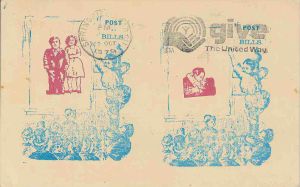
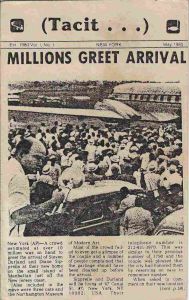
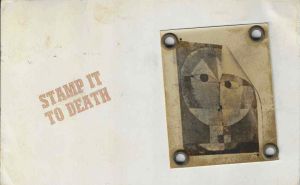
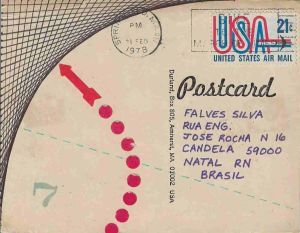
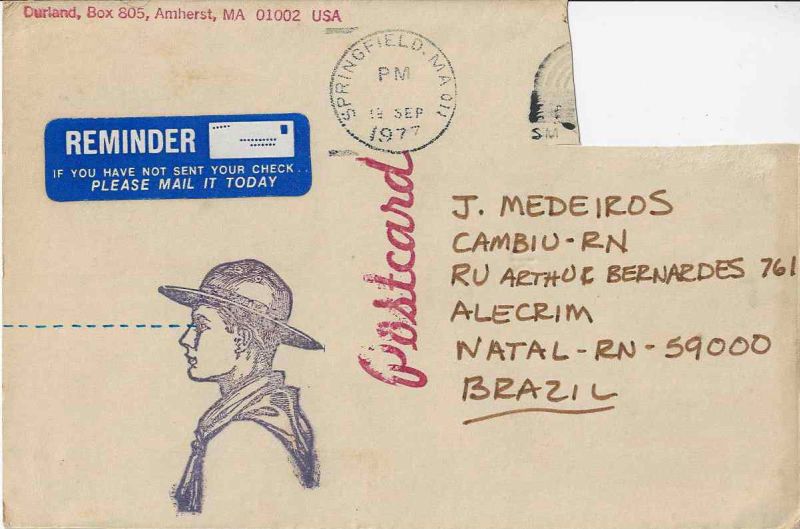
Cartão postal enviado pelo artista norte americano Steve Durland para J. Medeiros, em Natal, Rio Grande do Norte, Brasil. O carimbo postal registra o envio em 19 de setembro de 1977 a partir de Springfield, Massachusetts, Estados Unidos.
Steve Durland - USA
Categoria: Mail Art
Acervo: 03827
Data: 19 de Setembro de 1977
Dimensões: 10 x 15,2 cm
Cartão postal enviado pelo artista norte americano Steve Durland para J. Medeiros, em Natal, Rio Grande do Norte, Brasil. O carimbo postal registra o envio em 19 de setembro de 1977 a partir de Springfield, Massachusetts, Estados Unidos. O documento integra o período inicial da atuação de Durland nas redes internacionais de arte postal, correspondência artística e publicações experimentais.Na margem superior aparece a identificação do remetente como Durland, caixa postal 805, Amherst, Massachusetts, código postal 01002, Estados Unidos. Esse endereço situa o artista em Amherst durante 1977, período relacionado à sua formação e às suas primeiras experiências com cerâmica, escultura, performance e arte por correspondência.O destinatário foi identificado como J. Medeiros. O endereço manuscrito registra Rua Arthur Bernardes, número 761, Alecrim, Natal, Rio Grande do Norte, código postal 59000, Brasil. Entre o nome e o endereço aparece uma inscrição que parece corresponder a Cambio RN. A leitura não é totalmente segura devido à grafia manuscrita e deve ser preservada como informação a confirmar.A superfície do cartão combina desenho, escrita manual, impressão tipográfica, etiqueta comercial e marcas do sistema postal. Na parte inferior esquerda aparece o desenho de perfil de uma figura masculina usando chapéu de abas largas e roupa semelhante a um traje histórico ou uniforme. A origem exata do personagem não está indicada no documento. O desenho introduz uma dimensão narrativa e transforma o cartão em composição visual, não apenas em suporte de endereçamento.Ao lado do endereço aparece verticalmente a palavra Postcard, impressa em vermelho. A palavra atua simultaneamente como identificação do suporte e elemento de poesia visual, pois sua disposição vertical interfere na organização gráfica da superfície.Na parte superior esquerda foi aplicada uma etiqueta azul com a palavra Reminder e uma mensagem comercial solicitando o envio imediato de um cheque ainda não remetido. A frase pode ser traduzida como lembrete para que o pagamento seja enviado pelo correio naquele mesmo dia. Retirada de seu contexto administrativo original, a etiqueta adquire caráter irônico e conceitual. Ela transforma uma cobrança financeira padronizada em componente de uma correspondência artística internacional.O pequeno desenho de envelope presente na etiqueta reforça a relação entre mensagem, correio e circulação. A apropriação de material comercial demonstra como artistas da rede postal utilizavam adesivos, formulários, carimbos, fragmentos gráficos e impressos cotidianos para produzir novos significados.Uma linha horizontal azul atravessa parte da composição e parece relacionar visualmente a figura desenhada ao campo postal. O carimbo circular de Springfield atravessa a área superior, registrando materialmente o percurso do cartão pelo sistema de correios dos Estados Unidos. Parte do selo postal encontra se encoberta por uma área branca no canto superior direito, impedindo a identificação completa de sua imagem e valor.O cartão documenta uma conexão direta entre Steve Durland e J. Medeiros em 1977. A correspondência situa o destinatário brasileiro dentro de uma rede internacional que aproximava artistas, poetas, editores e organizadores por meio de cartões, envelopes, calendários, revistas e projetos coletivos.A peça também deve ser relacionada à presença de Steve Durland no Mail Art Calendar 1977 da IM Press e à sua atuação em projetos internacionais de correspondence art durante a mesma década. Não há evidência visível de uma mensagem pessoal extensa, mas a própria seleção e combinação de materiais funcionam como conteúdo artístico.O documento possui importância para a história da arte postal no Brasil porque comprova a circulação de materiais entre Massachusetts e Natal em 1977. Ele registra uma relação entre o circuito experimental norte americano e artistas ou agentes culturais do Rio Grande do Norte, região diretamente relacionada ao desenvolvimento do Poema Processo, da poesia visual e de outras práticas de vanguarda.Steve Durland não deve ser identificado como integrante formal do Poema Processo. Sua relação com esse contexto ocorre por meio da rede internacional de arte postal e da correspondência com participantes do ambiente artístico de Natal. O cartão constitui uma evidência material dessa aproximação e amplia a compreensão das conexões internacionais estabelecidas no Nordeste brasileiro durante a década de 1970.TEXT FOR THE SALSA PROGRAM IN ENGLISHPostcard sent by the American artist Steve Durland to J. Medeiros in Natal, Rio Grande do Norte, Brazil. The postal cancellation records that the card was mailed on 19 September 1977 from Springfield, Massachusetts, United States. The document belongs to the early period of Durland
s participation in international networks of mail art, artistic correspondence and experimental publishing.The upper margin identifies the sender as Durland at Post Office Box 805, Amherst, Massachusetts, postal code 01002, United States. This address places the artist in Amherst during 1977, a period connected with his education and his early experiments in ceramics, sculpture, performance and correspondence art.The recipient is identified as J. Medeiros. The handwritten address records Rua Arthur Bernardes, number 761, Alecrim, Natal, Rio Grande do Norte, postal code 59000, Brazil. Between the recipient
s name and the street address is an inscription that appears to read Cambio RN. The reading is not entirely certain because of the handwriting and should be preserved as information requiring confirmation.The surface combines drawing, handwriting, printed typography, a commercial label and postal markings. In the lower left area is a profile drawing of a male figure wearing a broad brimmed hat and clothing resembling a historical costume or uniform. The precise identity and source of the character are not indicated on the document. The drawing introduces a narrative dimension and transforms the postcard into a visual composition rather than merely an addressed postal support.The word Postcard is printed vertically in red beside the address. It functions both as an identification of the medium and as an element of visual poetry because its vertical arrangement intervenes in the graphic organization of the surface.A blue commercial label was applied in the upper left area. It contains the word Reminder and a message requesting that an outstanding check be mailed immediately. Removed from its original administrative context, the label acquires an ironic and conceptual character. A standardized financial demand becomes part of an international artistic correspondence.The small envelope image printed on the label reinforces the relationship among message, postal circulation and communication. The appropriation of commercial material demonstrates how mail artists used stickers, forms, rubber stamps, graphic fragments and ordinary printed matter to produce new meanings.A blue horizontal line crosses part of the composition and appears to connect the drawn figure visually with the postal field. The circular Springfield cancellation crosses the upper area and materially records the movement of the card through the United States postal system. Part of the postage stamp is covered by a white area in the upper right corner, preventing complete identification of its image and denomination.The postcard documents a direct connection between Steve Durland and J. Medeiros in 1977. The correspondence places the Brazilian recipient within an international network that connected artists, poets, editors and organizers through postcards, envelopes, calendars, magazines and collective projects.The work should also be connected with Steve Durland
s inclusion in the IM Press Mail Art Calendar 1977 and with his organization of international correspondence art projects during the same decade. No extended personal message is visible, but the selection and combination of materials themselves function as artistic content.The document is important to the history of mail art in Brazil because it confirms the circulation of material between Massachusetts and Natal in 1977. It records a relationship between the experimental art network of the United States and artists or cultural agents in Rio Grande do Norte, a region directly connected with the development of the Process Poem Movement, visual poetry and other avant garde practices.Steve Durland should not be identified as a formal member of the Process Poem Movement. His relationship with this context developed through the international mail art network and through correspondence with participants in the artistic environment of Natal. The postcard is material evidence of this connection and expands the understanding of international relationships established in northeastern Brazil during the 1970s.
TEXTO DE OBSERVAÇÃO EM PORTUGUÊSCartão postal original enviado por Steve Durland para J. Medeiros. O carimbo postal visível registra Springfield, Massachusetts, e a data de 19 de setembro de 1977.O nome completo Steve Durland não aparece integralmente na linha superior. A identificação visível corresponde a Durland, seguido do endereço caixa postal 805, Amherst, Massachusetts, código postal 01002, Estados Unidos. A atribuição a Steve Durland é sustentada pelas informações fornecidas e pela correspondência entre o sobrenome, a cidade e o período de atuação do artista.O destinatário aparece como J. Medeiros. O endereço é legível como Rua Arthur Bernardes, número 761, Alecrim, Natal, Rio Grande do Norte, código postal 59000, Brasil. A inscrição localizada abaixo do nome parece corresponder a Cambio RN, mas sua leitura permanece incerta.A peça apresenta desenho de uma figura masculina de perfil, palavra Postcard impressa verticalmente, linha azul, etiqueta comercial de lembrete, endereçamento manuscrito, selo postal parcialmente visível e marcas de cancelamento.O texto da etiqueta azul informa que, caso o cheque ainda não tenha sido enviado, ele deve ser colocado no correio naquele dia. A etiqueta parece proceder de material comercial ou administrativo apropriado pelo remetente. Não é possível determinar apenas pela imagem se ela foi aplicada por Steve Durland especificamente como intervenção artística ou se já integrava o suporte reutilizado. Sua presença, entretanto, participa da composição recebida por J. Medeiros.A identidade da figura desenhada não pode ser confirmada. Ela deve ser descrita como perfil masculino usando chapéu de abas largas, sem atribuição a personagem histórico específico.A área branca no canto superior direito encobre parte do selo ou da superfície original. Não é possível determinar pela imagem se corresponde a etiqueta posterior, ocultação deliberada ou alteração digital realizada durante a reprodução do documento. Por essa razão, o selo postal não deve ser identificado sem documentação complementar.O cartão apresenta amarelecimento, manchas, abrasões, pequenas dobras, desgaste nas bordas e marcas de manuseio. Essas características integram sua história material e testemunham sua circulação efetiva entre os Estados Unidos e o Brasil.O documento deve ser catalogado como cartão postal de arte, correspondência artística, arte postal, desenho sobre papel, apropriação de material comercial, composição tipográfica e registro da relação entre Steve Durland e J. Medeiros.Para indexação, a peça deve ser relacionada aos termos Steven Durland, Steve Durland, J. Medeiros, Amherst, Springfield, Massachusetts, Natal, Rio Grande do Norte, Alecrim, Rua Arthur Bernardes, arte postal, mail art, correspondence art, cartão de artista, desenho, etiqueta comercial, Reminder, Postcard, poesia visual, IM Press, Mail Art Calendar 1977 e redes internacionais de artistas.OBSERVATION TEXT IN ENGLISHOriginal postcard sent by Steve Durland to J. Medeiros. The visible postal cancellation records Springfield, Massachusetts, and the date 19 September 1977.The complete name Steve Durland does not appear in the upper line. The visible identification consists of Durland followed by the address at Post Office Box 805, Amherst, Massachusetts, postal code 01002, United States. Attribution to Steve Durland is supported by the information supplied and by the correspondence among the surname, location and documented period of the artist
s activity.The recipient is identified as J. Medeiros. The address can be read as Rua Arthur Bernardes, number 761, Alecrim, Natal, Rio Grande do Norte, postal code 59000, Brazil. The inscription beneath the name appears to read Cambio RN, but the reading remains uncertain.The work contains a profile drawing of a male figure, the word Postcard printed vertically, a blue line, a commercial reminder label, handwritten addressing, a partially visible postage stamp and postal cancellation marks.The blue label states that an outstanding check should be mailed that day. It appears to derive from appropriated commercial or administrative material. The image alone does not establish whether Steve Durland applied it specifically as an artistic intervention or whether it was already part of a reused support. Its presence nevertheless forms part of the composition received by J. Medeiros.The identity of the drawn figure cannot be confirmed. It should be described as a male profile wearing a broad brimmed hat, without attribution to a specific historical character.A white area in the upper right corner covers part of the postage stamp or original surface. The image does not establish whether this is a later label, deliberate concealment or a digital alteration made during reproduction. The postage stamp should therefore not be identified without additional documentation.The postcard shows yellowing, stains, abrasions, minor folds, worn edges and evidence of handling. These characteristics form part of its material history and testify to its actual circulation between the United States and Brazil.The document should be catalogued as an artists postcard, artistic correspondence, mail art, drawing on paper, appropriation of commercial material, typographic composition and a record of the relationship between Steve Durland and J. Medeiros.For indexing purposes, the work should be associated with Steven Durland, Steve Durland, J. Medeiros, Amherst, Springfield, Massachusetts, Natal, Rio Grande do Norte, Alecrim, Rua Arthur Bernardes, mail art, correspondence art, artists postcard, drawing, commercial label, Reminder, Postcard, visual poetry, IM Press, Mail Art Calendar 1977 and international artists networks.
Proveniência
Coleção J. MedeirosInglês
ostcard sent by the American artist Steve Durland to J. Medeiros in Natal, Rio Grande do Norte, Brazil. The postal cancellation records that the card was mailed on 19 September 1977 from Springfield, Massachusetts, United States.
Dimensions: 3,9 x 6 in