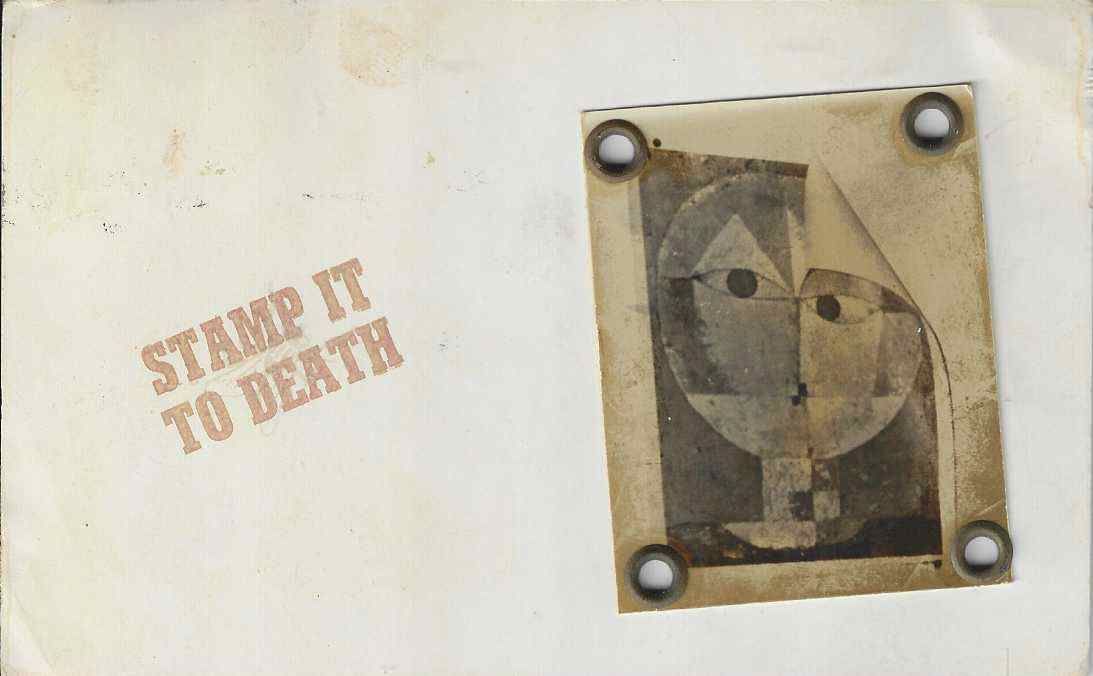
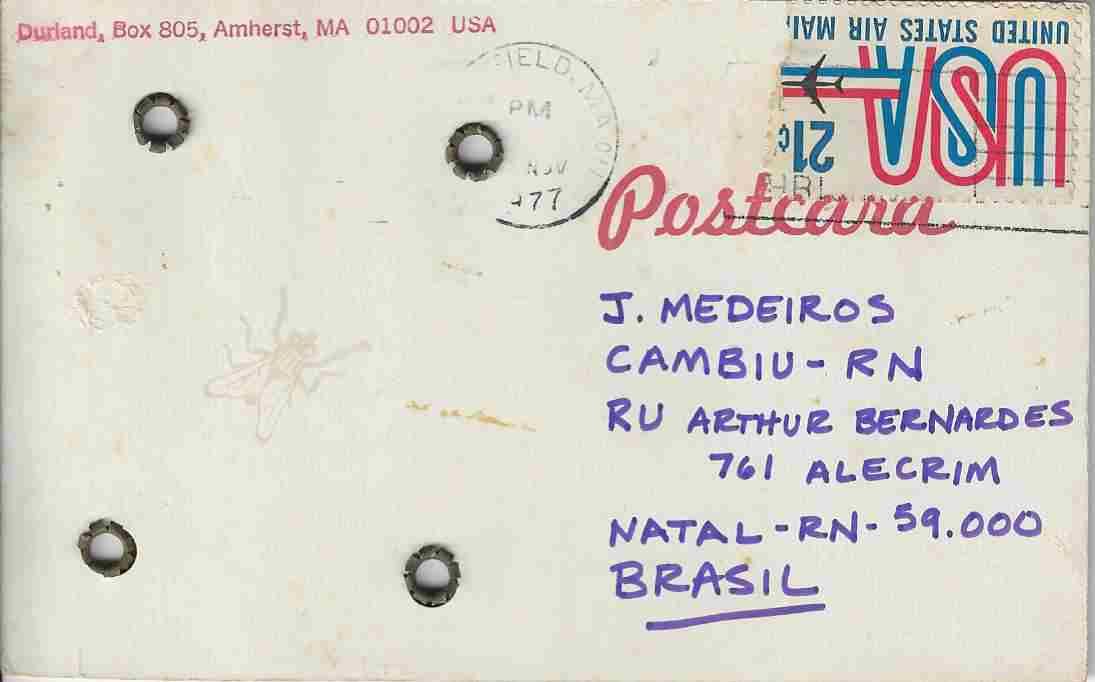
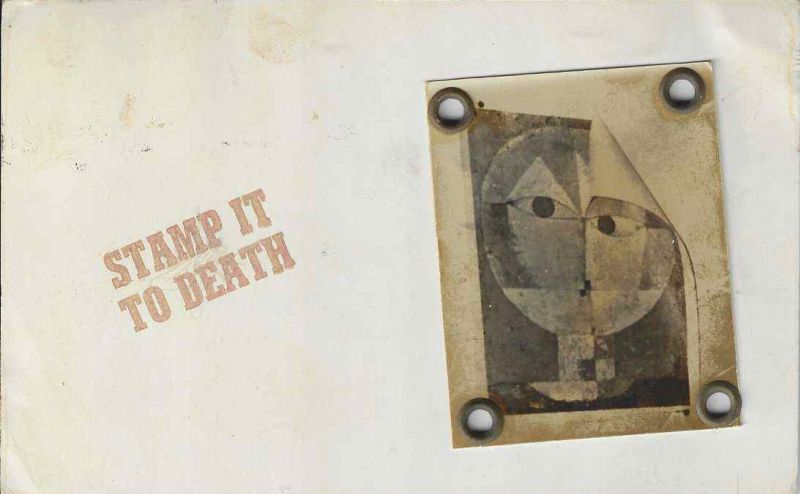
Cartão de arte postal produzido por Steve Durland e enviado para J. Medeiros, em Natal, Rio Grande do Norte, Brasil, em novembro de 1977. A peça apresenta o título Stamp It to Death
Steve Durland - USA
Categoria: Mail Art
Acervo: 03828
Data: Novembro de 1977
Dimensões: 8,6 x 13,8 cm
Cartão de arte postal produzido por Steve Durland e enviado para J. Medeiros, em Natal, Rio Grande do Norte, Brasil, em novembro de 1977. A peça apresenta o título Stamp It to Death e integra a atuação inicial de Durland nas redes internacionais de arte postal, correspondência artística, publicação experimental e intercâmbio entre artistas.A frente do cartão possui composição de grande economia visual. Sobre uma base de papel claro, Steve Durland aplicou o título Stamp It to Death em letras maiúsculas inclinadas, impressas em tonalidade avermelhada. A expressão pode ser compreendida como uma ordem para carimbar algo repetidamente até sua destruição, seu esgotamento ou sua transformação. O título relaciona humor, violência simbólica, reprodução mecânica e procedimentos próprios do sistema postal.Na região direita encontra se uma pequena imagem impressa fixada ao cartão por quatro ilhoses metálicos, um em cada canto. A reprodução apresenta uma figura de aparência felina ou um rosto construído por formas geométricas, com planos sobrepostos, olhos circulares, linhas retas e uma estrutura próxima da colagem cubista. A origem exata da imagem não aparece identificada no documento e não deve ser atribuída a artista ou obra específica sem comprovação adicional.Os quatro ilhoses ultrapassam o papel e permanecem visíveis no verso. Esse procedimento transforma o cartão em objeto tridimensional e evidencia sua construção material. A imagem não está apenas colada ou impressa sobre a superfície. Ela foi presa mecanicamente ao suporte, aproximando a obra da assemblage, da colagem objetual e da escultura em pequena escala.A combinação entre o título Stamp It to Death e os ilhoses produz uma ambiguidade entre carimbar, perfurar, fixar e danificar. Em inglês, a palavra stamp pode designar tanto o ato de carimbar quanto o selo postal. Dentro de uma obra enviada pelo correio, o título também pode ser interpretado como comentário sobre o excesso de marcas, selos, cancelamentos e intervenções que transformam o objeto durante sua circulação.O verso registra o remetente como Durland, caixa postal 805, Amherst, Massachusetts, código postal 01002, Estados Unidos. Esse endereço situa Steve Durland em Amherst durante 1977 e coincide com o período de sua participação ativa na rede internacional de correspondence art.O destinatário foi identificado como J. Medeiros. O endereço manuscrito registra Rua Arthur Bernardes, número 761, Alecrim, Natal, Rio Grande do Norte, código postal 59000, Brasil. Entre o nome e o endereço aparece a inscrição Cambiu RN, cuja leitura permanece parcialmente incerta devido à grafia manual.A palavra Postcard aparece impressa em vermelho na área superior do verso. Um selo postal norte americano de correio aéreo, com valor de vinte e um centavos, foi aplicado de cabeça para baixo no canto superior direito. A inversão pode ter sido intencional e integra visualmente a linguagem experimental do cartão, embora o documento não permita confirmar se essa posição resultou de decisão artística ou de aplicação casual.O carimbo postal circular registra Springfield, Massachusetts, e o mês de novembro de 1977. O dia exato não pode ser lido com segurança na imagem. As marcas de cancelamento atravessam o selo e confirmam que o cartão circulou efetivamente pelo sistema postal entre os Estados Unidos e o Brasil.Os quatro orifícios metálicos visíveis no verso comprovam que os ilhoses foram inseridos através de toda a espessura do cartão. Eles criam pequenas áreas de vazio e tornam a estrutura física da obra perceptível em ambos os lados. Essa característica diferencia a peça de um cartão postal convencional e reforça seu caráter de objeto artístico.O cartão documenta uma relação direta entre Steve Durland e J. Medeiros em 1977. A correspondência situa o destinatário brasileiro dentro de uma rede internacional que aproximava artistas, poetas, editores e organizadores por meio de cartões, envelopes, calendários, revistas e projetos coletivos.Stamp It to Death deve ser compreendido simultaneamente como cartão postal, obra de arte postal, assemblage, colagem, objeto perfurado, composição tipográfica e documento histórico. Sua importância está no uso combinado de imagem apropriada, texto, metal, perfuração, selo e circulação postal para questionar os limites entre reprodução, destruição, comunicação e transformação material.A peça também possui relevância para o estudo das conexões entre a arte postal internacional e o ambiente experimental de Natal durante a década de 1970. Steve Durland não integrou formalmente o Poema Processo, mas sua correspondência com J. Medeiros e sua circulação em publicações e projetos internacionais aproximam sua produção dos campos da poesia visual, da arte conceitual, da publicação de artista e das redes compartilhadas por participantes do movimento brasileiro.EXT FOR THE SALSA PROGRAM IN ENGLISHMail art postcard produced by Steve Durland and sent to J. Medeiros in Natal, Rio Grande do Norte, Brazil, in November 1977. The work bears the title Stamp It to Death and belongs to the early period of Durland
s participation in international networks of mail art, artistic correspondence, experimental publishing and exchange among artists.The front presents a visually restrained composition. On a light paper support, Steve Durland applied the title Stamp It to Death in slanted capital letters printed in a reddish tone. The phrase can be understood as an instruction to stamp something repeatedly until it is destroyed, exhausted or transformed. The title combines humor, symbolic violence, mechanical reproduction and procedures associated with the postal system.A small printed image is attached to the right side of the card with four metal eyelets, one at each corner. The reproduction shows a feline looking figure or a face constructed from geometric forms, overlapping planes, circular eyes, straight lines and a structure related to Cubist collage. The precise source of the image is not identified on the document and should not be attributed to a particular artist or work without additional evidence.The four eyelets pass through the paper and remain visible on the reverse. This procedure transforms the postcard into a three dimensional object and exposes its material construction. The image is not merely glued or printed onto the surface. It has been mechanically fastened to the support, connecting the work with assemblage, object based collage and small scale sculpture.The combination of the title Stamp It to Death and the metal eyelets produces an ambiguity among stamping, perforating, fastening and damaging. In English, the word stamp can refer both to the action of applying an impression and to a postage stamp. Within an artwork sent through the mail, the title may also function as a comment on the accumulation of marks, stamps, cancellations and interventions that transform an object during circulation.The reverse identifies the sender as Durland at Post Office Box 805, Amherst, Massachusetts, postal code 01002, United States. This address places Steve Durland in Amherst in 1977 and corresponds with the period of his active participation in the international correspondence art network.The recipient is identified as J. Medeiros. The handwritten address records Rua Arthur Bernardes, number 761, Alecrim, Natal, Rio Grande do Norte, postal code 59000, Brazil. An inscription between the name and the street address appears to read Cambiu RN, although the handwriting does not allow complete certainty.The word Postcard is printed in red in the upper area of the reverse. A twenty one cent United States air mail stamp was applied upside down in the upper right corner. The inversion may have been intentional and visually contributes to the experimental language of the card, although the document does not establish whether the position resulted from an artistic decision or casual placement.The circular postal cancellation records Springfield, Massachusetts, and the month of November 1977. The precise day cannot be read securely from the image. Cancellation marks cross the stamp and confirm that the card circulated through the postal system between the United States and Brazil.The four metal openings visible on the reverse demonstrate that the eyelets were inserted through the entire thickness of the card. They create small areas of empty space and make the physical structure of the work visible from both sides. This feature distinguishes the piece from an ordinary postcard and reinforces its character as an art object.The card documents a direct relationship between Steve Durland and J. Medeiros in 1977. The correspondence places the Brazilian recipient within an international network that connected artists, poets, editors and organizers through postcards, envelopes, calendars, magazines and collective projects.Stamp It to Death should be understood simultaneously as a postcard, mail art work, assemblage, collage, perforated object, typographic composition and historical document. Its importance lies in the combined use of appropriated imagery, text, metal, perforation, postage and postal circulation to question the boundaries among reproduction, destruction, communication and material transformation.The work is also relevant to the study of connections between international mail art and the experimental artistic environment of Natal during the 1970s. Steve Durland was not a formal member of the Process Poem Movement, but his correspondence with J. Medeiros and his circulation through international publications and projects connect his production with visual poetry, conceptual art, artists publications and networks shared by participants in the Brazilian movement.
TEXTO DE OBSERVAÇÃO EM PORTUGUÊSCartão original de arte postal produzido por Steve Durland e enviado para J. Medeiros em novembro de 1977. O objeto apresenta o título Stamp It to Death na frente e combina papel, impressão, imagem apropriada e quatro ilhoses metálicos.A imagem fixada na região direita apresenta uma figura geométrica de aparência felina ou antropomórfica. A fonte original da reprodução não está indicada. Não é possível confirmar se se trata de obra conhecida, ilustração editorial ou imagem produzida pelo próprio remetente.Os quatro ilhoses atravessam integralmente o suporte e aparecem no verso como perfurações circulares com bordas metálicas. A presença desses elementos deve ser registrada como parte constitutiva da obra e não como dano posterior.O remetente aparece como Durland, caixa postal 805, Amherst, Massachusetts, código postal 01002, Estados Unidos. A atribuição a Steve Durland é sustentada pelo sobrenome, pelo endereço e pelo período documentado de atividade do artista.O destinatário foi registrado como J. Medeiros, Rua Arthur Bernardes, número 761, Alecrim, Natal, Rio Grande do Norte, código postal 59000, Brasil. A inscrição Cambiu RN permanece de leitura incerta e deve ser transcrita com cautela.O selo postal oficial é um selo de correio aéreo dos Estados Unidos com valor de vinte e um centavos. Ele foi aplicado invertido. O carimbo postal indica Springfield, Massachusetts, e novembro de 1977. O dia exato permanece ilegível.O título Stamp It to Death pode ser relacionado ao carimbo, ao selo postal, à repetição e à destruição simbólica, mas essa interpretação deve ser compreendida como leitura crítica da obra e não como explicação escrita pelo artista.A superfície apresenta amarelecimento, manchas, pequenas abrasões, marcas de manuseio e desgaste nas bordas. A imagem aplicada apresenta alterações cromáticas e sinais de envelhecimento. Esses elementos integram a história material do cartão e testemunham sua circulação postal.A peça deve ser catalogada como cartão de arte postal, correspondência artística, assemblage, colagem, objeto perfurado, imagem apropriada, composição tipográfica e obra sobre papel.Para indexação, recomenda se relacionar o documento aos termos Steven Durland, Steve Durland, J. Medeiros, Stamp It to Death, Amherst, Springfield, Massachusetts, Natal, Rio Grande do Norte, Alecrim, Rua Arthur Bernardes, arte postal, mail art, correspondence art, assemblage, colagem, ilhós metálico, cartão de artista, poesia visual, arte conceitual e rede internacional de artistas.OBSERVATION TEXT IN ENGLISHOriginal mail art postcard produced by Steve Durland and sent to J. Medeiros in November 1977. The object bears the title Stamp It to Death on the front and combines paper, printing, appropriated imagery and four metal eyelets.The image attached to the right side presents a geometric figure with feline or anthropomorphic characteristics. The original source of the reproduction is not identified. It cannot be confirmed whether it represents a known artwork, an editorial illustration or an image produced by the sender.The four eyelets pass completely through the support and appear on the reverse as circular openings with metal borders. These elements should be recorded as constitutive parts of the artwork rather than later damage.The sender is identified as Durland at Post Office Box 805, Amherst, Massachusetts, postal code 01002, United States. Attribution to Steve Durland is supported by the surname, address and documented period of the artist
s activity.The recipient is recorded as J. Medeiros at Rua Arthur Bernardes, number 761, Alecrim, Natal, Rio Grande do Norte, postal code 59000, Brazil. The inscription Cambiu RN remains uncertain and should be transcribed cautiously.The official postage is a twenty one cent United States air mail stamp. It was applied upside down. The postal cancellation identifies Springfield, Massachusetts, and November 1977. The precise day remains illegible.The title Stamp It to Death may be related to rubber stamping, postage, repetition and symbolic destruction, but this should be understood as a critical interpretation of the work rather than an explanation written by the artist.The surface shows yellowing, stains, minor abrasions, handling marks and worn edges. The attached image displays color changes and evidence of aging. These features form part of the material history of the postcard and testify to its postal circulation.The work should be catalogued as a mail art postcard, artistic correspondence, assemblage, collage, perforated object, appropriated image, typographic composition and work on paper.For indexing purposes, the document should be associated with Steven Durland, Steve Durland, J. Medeiros, Stamp It to Death, Amherst, Springfield, Massachusetts, Natal, Rio Grande do Norte, Alecrim, Rua Arthur Bernardes, mail art, correspondence art, assemblage, collage, metal eyelets, artists postcard, visual poetry, conceptual art and the international artists network.
Proveniência
ColeçãoJ. MedeirosInglês
Mail art postcard produced by Steve Durland and sent to J. Medeiros in Natal, Rio Grande do Norte, Brazil, in November 1977. The work bears the title Stamp It to Death
Dimensions: 3,4 x 5,4 in