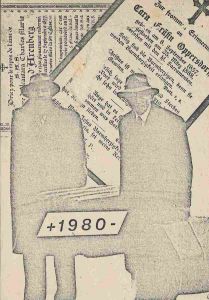
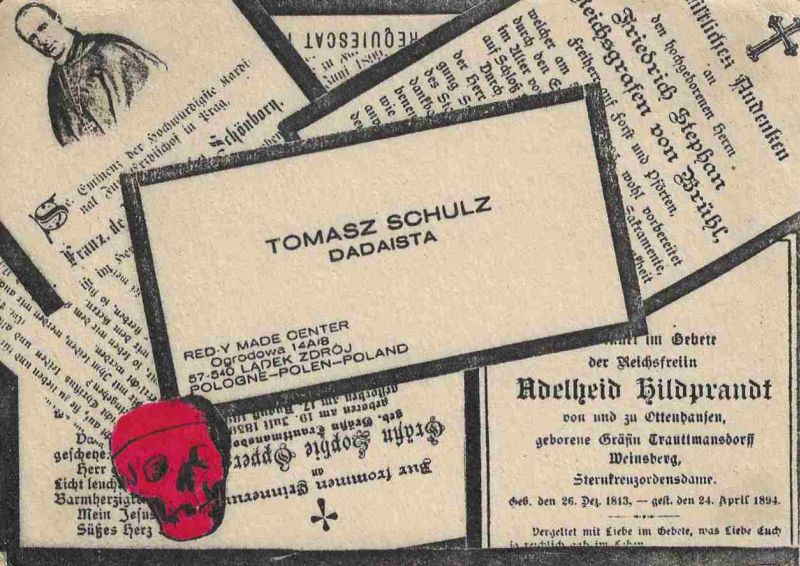
Cartão de arte postal de Tomasz Schulz destinado a Falves Silva e relacionado ao projeto Red Art. A grafia impressa no próprio documento é Tomasz Schulz, embora o nome também possa aparecer em registros secundários como Tomasz Schultz.
Tomasz Schulsz - Polonia
Categoria: Mail Art
Acervo: 03705
Data: 1970s
Dimensões: 11,4 x 15,9 cm
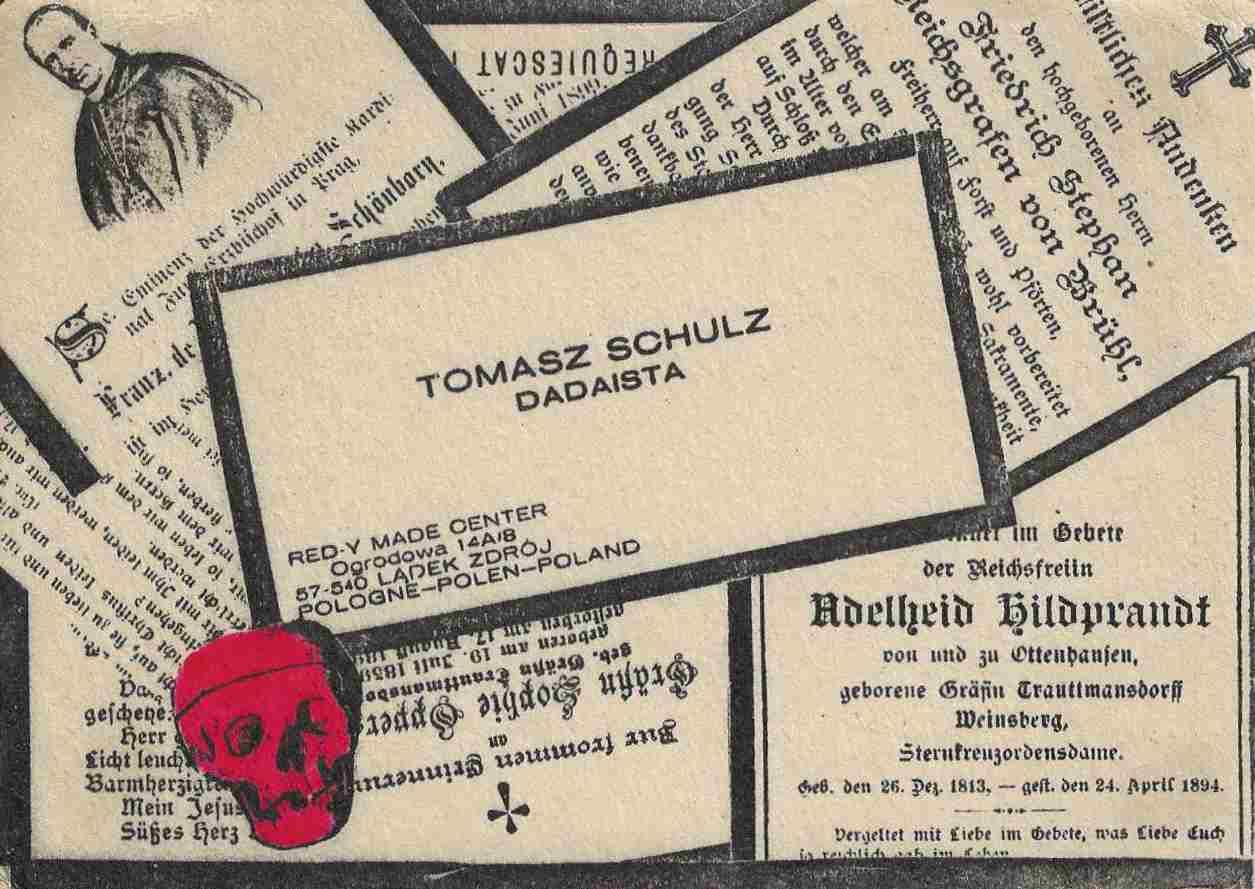
Cartão de arte postal de Tomasz Schulz destinado a Falves Silva e relacionado ao projeto Red Art. A grafia impressa no próprio documento é Tomasz Schulz, embora o nome também possa aparecer em registros secundários como Tomasz Schultz. Para fins de catalogação, deve ser priorizada a forma Tomasz Schulz, documentada diretamente na peça.O cartão reúne colagem, apropriação de material impresso, tipografia, desenho, intervenção cromática, escrita manuscrita e comunicação postal. A composição apresenta referências explícitas ao dadaísmo e integra o circuito internacional da Mail Art, no qual cartões, mensagens, imagens apropriadas, endereços e instruções circulavam entre artistas de diferentes países.Na frente, uma moldura retangular preta ocupa a região central e contém a identificação Tomasz Schulz Dadaista. A palavra Dadaista define diretamente a posição artística assumida pelo autor e relaciona a peça à tradição do Dada, à colagem, à apropriação de impressos, ao antiautoritarismo cultural, à associação livre de imagens e à transformação de documentos cotidianos em matéria artística.Na parte inferior do retângulo aparece a identificação Red V Made Center, seguida de um endereço em L
dek Zdrój, Polônia. A leitura possível é Ogrodowa 1A barra 8, 57 540 L
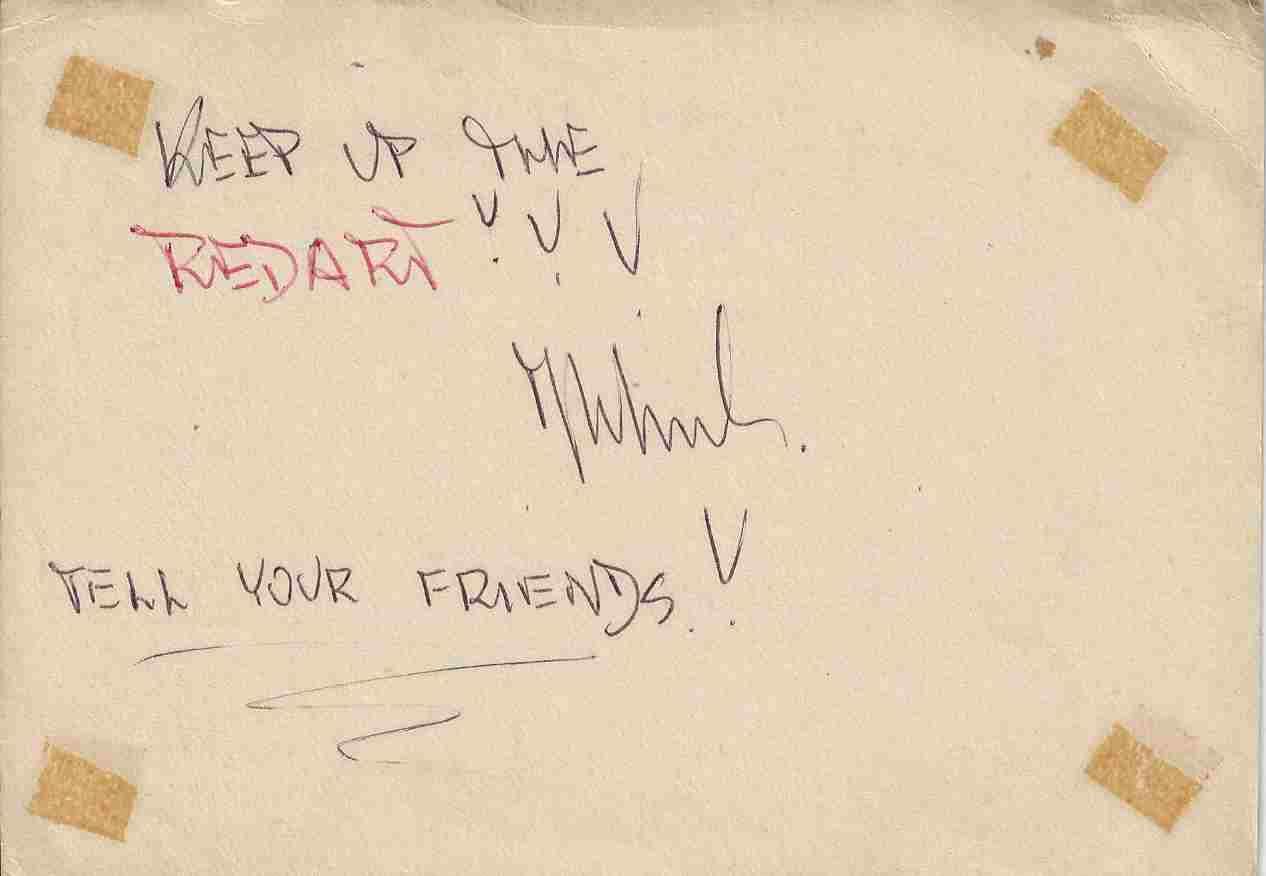
dek Zdrój, Poland. O nome do país aparece em várias línguas, como Polonia, Polen e Poland, estratégia que amplia a compreensão internacional do endereço e favorece sua utilização dentro da rede mundial de arte postal.A expressão Red V Made Center parece funcionar como nome de projeto, centro alternativo, identidade de circulação ou estrutura artística criada por Tomasz Schulz. A letra V também reaparece na mensagem manuscrita do verso, podendo atuar como sinal gráfico, marca de identificação ou elemento vinculado ao projeto Red Art. O documento não fornece explicação suficiente para determinar com segurança o significado completo dessa denominação.O fundo da composição é formado por fragmentos de antigos impressos em língua alemã. Os recortes parecem reproduzir textos religiosos, comunicados funerários, registros de falecimento e anúncios memorialísticos. Entre os fragmentos observam se tipografia gótica, pequenas cruzes, nomes próprios, datas, títulos e uma figura masculina reproduzida em preto e branco.Um dos fragmentos apresenta o nome Adelheid Hildebrandt e informações biográficas ou funerárias, incluindo datas do século XIX. A apropriação desses documentos desloca registros associados à morte, à religião, à memória familiar e ao luto para o campo da colagem experimental.Os impressos foram recortados, girados e sobrepostos em diferentes direções. Algumas palavras aparecem invertidas ou parcialmente ocultas pela moldura central. Esse procedimento impede a leitura linear dos textos originais e transforma a linguagem verbal em textura visual. A composição aproxima a obra das experiências dadaístas com jornais, anúncios, documentos tipográficos e materiais encontrados.Na região inferior esquerda foi aplicada uma caveira em vermelho intenso. A imagem contrasta com os textos históricos em preto e branco e funciona como centro cromático da obra. A caveira estabelece uma relação direta com os documentos funerários do fundo e reforça temas como morte, memória, violência, transitoriedade, sobrevivência da imagem e permanência do arquivo.A coloração vermelha também relaciona a caveira ao título Red Art. O vermelho pode sugerir vida, sangue, conflito, urgência, resistência, revolução ou perigo. Contudo, como o cartão não apresenta um texto conceitual explicativo, essas associações devem ser tratadas como possibilidades interpretativas e não como intenções definitivamente comprovadas.No verso, Tomasz Schulz escreveu em inglês a mensagem Keep up the Red Art, seguida por vários sinais semelhantes à letra V. A expressão pode ser traduzida como Continue com a Red Art ou Mantenha viva a Red Art. A frase apresenta caráter de incentivo e sugere que Red Art não era apenas o título desta peça, mas uma proposta, campanha, rede ou prática artística que deveria ser continuada pelos destinatários.Na parte inferior do verso aparece a frase Tell your friends, acompanhada novamente por um sinal semelhante à letra V. A mensagem solicita que Falves Silva transmitisse a proposta a seus amigos, demonstrando uma estratégia de expansão da rede por meio do contato pessoal. O destinatário não deveria somente receber o cartão, mas também divulgar sua mensagem e estimular novas conexões.Entre as duas frases encontra se uma assinatura gestual de leitura parcialmente incerta, atribuída a Tomasz Schulz. A escrita rápida e os sinais repetidos funcionam visualmente como desenho e reforçam a integração entre mensagem, gesto gráfico e identidade artística.O verso não apresenta endereço do destinatário, selo ou carimbo postal nas imagens disponíveis. É possível que o cartão tenha sido remetido dentro de um envelope ou acompanhado por outra embalagem postal. Essa possibilidade não pode ser confirmada sem o exame do conjunto original. Também não foi localizada uma data na peça apresentada.A relação com Falves Silva é indicada pela identificação fornecida para o documento e por sua preservação no arquivo do artista. Falves Silva, participante histórico do Poema Processo e agente ativo das redes de poesia experimental e arte postal, manteve correspondência com artistas do Brasil, da América Latina, da Europa, dos Estados Unidos e da Ásia.O pedido para continuar a Red Art e informar os amigos mostra que Falves Silva era compreendido como participante e multiplicador de uma rede. Sua posição no circuito de Natal permitia que mensagens recebidas internacionalmente fossem retransmitidas a outros artistas, poetas, editores e produtores independentes.A peça estabelece uma conexão entre a produção experimental polonesa e o ambiente artístico brasileiro ligado a Falves Silva. Não há informação suficiente no cartão para afirmar que Tomasz Schulz tenha participado formalmente do Poema Processo. Sua relação com esse contexto ocorre por meio do intercâmbio com Falves Silva e da circulação de uma obra baseada em participação, comunicação, apropriação, montagem, reprodução e expansão coletiva.A utilização de documentos antigos em língua alemã também introduz questões relacionadas à memória europeia. Textos funerários e religiosos de outra época são reorganizados por um artista polonês e enviados a um artista brasileiro. O deslocamento geográfico e histórico converte o material impresso em uma estrutura internacional de memória, morte, linguagem e comunicação.O cartão pode ser situado nos campos da Mail Art, arte postal, arte correio, dadaísmo, neodadaísmo, colagem, poesia visual, arte conceitual, arte de rede e publicação de artista. Seu funcionamento não se limita à imagem frontal. A mensagem do verso, a solicitação de divulgação e a relação com o destinatário integram a própria obra.O valor histórico da peça reside em sua condição de documento internacional da rede de Falves Silva e na formulação participativa de Red Art. O cartão registra Tomasz Schulz, L
dek Zdrój, Polônia, Falves Silva, o dadaísmo, a apropriação de impressos funerários, a caveira vermelha e o comando para continuar e divulgar a proposta artística.TEXT FOR THE SALSA PROGRAM IN ENGLISHMail art postcard by Tomasz Schulz addressed to Falves Silva and associated with the Red Art project. The spelling printed on the object is Tomasz Schulz, although the name may appear in secondary records as Tomasz Schultz. For cataloguing purposes, Tomasz Schulz should be adopted as the primary form because it is directly documented on the postcard.The object combines collage, appropriation of printed material, typography, drawing, chromatic intervention, handwriting and artistic communication. It contains explicit references to Dadaism and belongs to the international Mail Art network through which postcards, messages, appropriated images, addresses and instructions circulated among artists in different countries.The front contains a central rectangular black frame bearing the identification Tomasz Schulz Dadaista. The term Dadaista directly defines the artistic position adopted by the author and connects the object with Dada, collage, printed appropriation, cultural dissent, free association and the transformation of ordinary documents into artistic material.The lower part of the central rectangle contains the designation Red V Made Center, followed by an address in L
dek Zdrój, Poland. A possible reading is Ogrodowa 1A slash 8, 57 540 L
dek Zdrój, Poland. The country is identified through several linguistic forms, including Polonia, Polen and Poland, facilitating international understanding and postal communication.Red V Made Center appears to function as the name of a project, alternative center, circulation identity or artistic structure created by Tomasz Schulz. The letter V also appears repeatedly in the handwritten message on the reverse and may operate as a graphic sign, personal mark or element associated with Red Art. The postcard does not provide enough information to establish the complete meaning of this designation.The background consists of fragments from old German language printed documents. These pieces appear to reproduce religious texts, funeral notices, death records and memorial announcements. Gothic typography, crosses, names, dates, headings and a small black and white portrait of a man can be observed throughout the composition.One fragment includes the name Adelheid Hildebrandt and biographical or funeral information containing nineteenth century dates. By appropriating these records, Schulz transfers documents associated with death, religion, family memory and mourning into an experimental collage.The printed fragments were cut, rotated and overlapped in multiple directions. Several words appear upside down or partly concealed by the central frame. This procedure interrupts linear reading and transforms verbal language into visual texture. The composition relates directly to Dada experiments using newspapers, advertisements, typographic documents and found material.A bright red skull appears in the lower left area. It contrasts with the historical black and white documents and becomes the main chromatic focus of the composition. The skull establishes a direct relationship with the funeral material in the background and reinforces themes of death, memory, violence, transience, survival of the image and permanence of the archive.The red color also connects the skull with the designation Red Art. Red may evoke life, blood, conflict, urgency, resistance, revolution or danger. Since the postcard contains no explanatory conceptual statement, these associations should remain interpretative possibilities rather than confirmed intentions.On the reverse, Tomasz Schulz wrote the English message Keep up the Red Art, followed by several signs resembling the letter V. The statement encourages the recipient to continue or sustain Red Art and suggests that Red Art was not merely the title of an individual object but a proposal, campaign, network or artistic practice intended to be maintained by its participants.The lower section contains the instruction Tell your friends, again followed by a sign resembling the letter V. Schulz asks Falves Silva to communicate the proposal to other people, revealing a strategy of network expansion through personal contact. The recipient was not expected only to receive the postcard but also to transmit its message and create further connections.A gestural signature appears between the two sentences and is attributed to Tomasz Schulz, although its exact reading is uncertain. The rapid handwriting and repeated signs function visually as drawing and reinforce the integration of message, graphic gesture and artistic identity.The reverse does not contain the address of the recipient, postage or a postal cancellation in the available images. The object may have been mailed inside an envelope or another postal container, but this cannot be confirmed without examining the original group of materials. No date has been located on the postcard.Its relationship with Falves Silva is established by the identification supplied for the document and by its preservation within the artist archive. Falves Silva was a historical participant in the Process Poem Movement and an active agent in networks of experimental poetry and correspondence art, maintaining exchanges with artists in Brazil, Latin America, Europe, the United States and Asia.The instruction to sustain Red Art and inform friends shows that Falves Silva was understood as both a participant and a multiplier within the network. His position in Natal enabled internationally received messages to be transmitted to other artists, poets, editors and independent cultural producers.The object connects Polish experimental production with the Brazilian artistic environment associated with Falves Silva. The postcard provides no evidence that Tomasz Schulz formally participated in the Process Poem Movement. His relationship with that context is established through his exchange with Falves Silva and through the circulation of a work based on participation, communication, appropriation, montage, reproduction and collective expansion.The use of historical German language documents also introduces questions concerning European memory. Funeral and religious texts from an earlier period were reorganized by a Polish artist and transmitted to a Brazilian artist. This geographical and historical displacement transforms the printed material into an international structure of memory, death, language and communication.The postcard belongs to the fields of Mail Art, correspondence art, Dadaism, Neo Dada, collage, visual poetry, conceptual art, network art and artists publications. Its function is not limited to the image on the front. The handwritten message, the instruction to circulate the project and the relationship with the recipient are integral components of the artwork.Its historical value lies in its status as an international document from the network of Falves Silva and in the participatory formulation of Red Art. The postcard records Tomasz Schulz, L
dek Zdrój, Poland, Falves Silva, Dadaism, the appropriation of funeral printing, the red skull and the instruction to continue and distribute the artistic proposition.
Cartão original de arte postal de Tomasz Schulz destinado a Falves Silva e relacionado ao projeto Red Art. A grafia Tomasz Schulz encontra se impressa na frente e deve ser adotada como forma principal de catalogação. A composição apresenta fragmentos de impressos antigos em língua alemã, aparentemente relacionados a registros funerários, religiosos e memorialísticos, organizados por recorte, rotação e sobreposição. No centro aparece uma moldura preta com as inscrições Tomasz Schulz, Dadaista e Red V Made Center, acompanhadas de endereço em Ogrodowa 1A barra 8, 57 540 L
dek Zdrój, Polônia. Na região inferior esquerda aparece uma caveira vermelha. O verso contém as mensagens manuscritas Keep up the Red Art e Tell your friends, sinais semelhantes à letra V e assinatura gestual atribuída ao artista. A peça apresentada não contém data, endereço de Falves Silva, selo ou carimbo postal visível. É possível que tenha circulado dentro de envelope, mas essa hipótese depende de confirmação documental. O cartão apresenta manchas, vincos, abrasões, desgaste nas bordas, alterações cromáticas e quatro fragmentos de fita adesiva no verso, provavelmente relacionados a montagem ou armazenamento anterior. A obra documenta a conexão entre Tomasz Schulz, a produção experimental polonesa, Falves Silva, a Mail Art internacional e as práticas de comunicação associadas à poesia visual e ao ambiente do Poema Processo.OBSERVATION TEXT IN ENGLISHOriginal mail art postcard by Tomasz Schulz addressed to Falves Silva and associated with Red Art. The spelling Tomasz Schulz is printed on the front and should be adopted as the primary cataloguing form. The composition contains fragments of historical German language printed documents apparently connected with funeral, religious and memorial records, arranged through cutting, rotation and superimposition. A black central frame contains the inscriptions Tomasz Schulz, Dadaista and Red V Made Center, followed by an address at Ogrodowa 1A slash 8, 57 540 L
dek Zdrój, Poland. A red skull appears in the lower left area. The reverse contains the handwritten messages Keep up the Red Art and Tell your friends, repeated signs resembling the letter V and a gestural signature attributed to the artist. No date, address for Falves Silva, postage stamp or postal cancellation is visible on the object. It may have circulated inside an envelope, but this possibility requires documentary confirmation. The postcard shows staining, folds, abrasions, edge wear, chromatic alteration and four adhesive tape fragments on the reverse, probably associated with earlier mounting or storage. The object documents a connection among Tomasz Schulz, Polish experimental art, Falves Silva, international Mail Art and communication practices associated with visual poetry and the environment of the Process Poem Movement.
Proveniência
Coleção Falves SilvaInglês
Mail art postcard by Tomasz Schulz addressed to Falves Silva and associated with the Red Art project. The spelling printed on the object is Tomasz Schulz, although the name may appear in secondary records as Tomasz Schultz.
Dimensions: 4,5 x 6,3 in