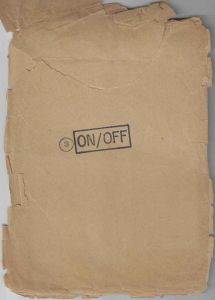
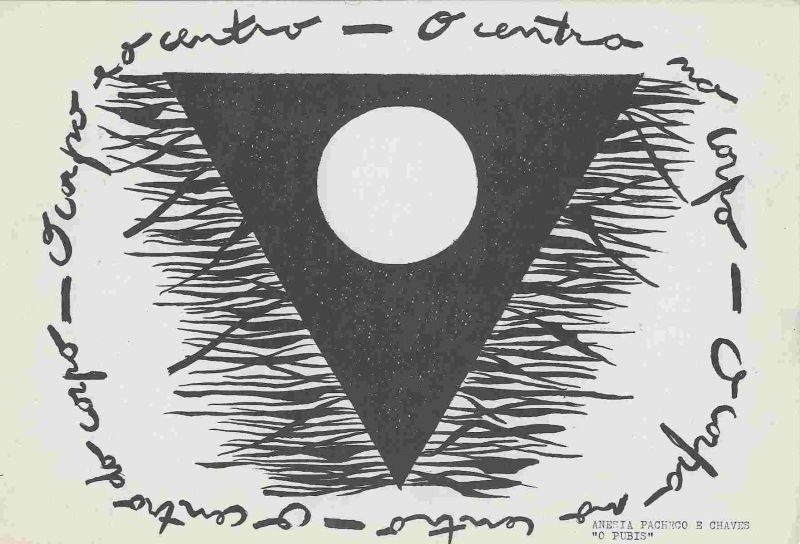
Obra de Anésia Pacheco e Chaves intitulada O Púbis, integrante do projeto coletivo On Off Envelope número 3.
Projeto On / Off - Julio Plaza e Regina Silveira
Categoria: Mail Art
Acervo: 03687
Data: 1974
Dimensões: 15,5 x 23 cm
Obra de Anésia Pacheco e Chaves intitulada O Púbis, integrante do projeto coletivo On Off Envelope número 3. A composição articula formas geométricas, escrita gestual e referências simbólicas ao corpo humano, aproximando desenho, poesia visual, arte conceitual e experimentação gráfica.No centro da imagem encontra se uma grande forma triangular escura, orientada para baixo, com um círculo branco inserido em sua parte superior. O triângulo pode ser associado visualmente à região púbica e à representação esquemática do corpo feminino, enquanto o círculo estabelece um ponto de concentração, vazio ou abertura dentro da área negra. A relação entre essas duas formas produz um contraste intenso entre cheio e vazio, positivo e negativo, interior e exterior.Ao redor do triângulo aparecem linhas rápidas, sobrepostas e irregulares, formando uma textura que parece irradiar das bordas da figura central. Esses traços sugerem pelos, vibrações, energia, movimento ou uma zona de transição entre o corpo representado e o espaço da página. A imagem combina a precisão das formas geométricas com a instabilidade do gesto manual, criando uma tensão entre ordem e espontaneidade.Nas margens da composição, uma inscrição manuscrita se desenvolve de maneira circular e fragmentada. A expressão O centro parece repetir se em diferentes posições e orientações, acompanhando o perímetro da imagem. Essa escrita não funciona apenas como legenda. Ela integra o campo visual e conduz o olhar ao redor da obra, reforçando a ideia de centro, deslocamento e movimento circular. O centro geométrico e o centro corporal tornam se, assim, conceitos complementares.A identificação impressa na margem inferior registra ANESIA PACHECO E CHAVES e o título O PÚBIS. A presença simultânea do texto manuscrito e da identificação tipográfica evidencia dois modos distintos de comunicação. Um é corporal, gestual e subjetivo. O outro é editorial, documental e classificatório.O trabalho investiga a representação do corpo feminino por meio de sinais reduzidos, evitando a descrição anatômica direta. A região púbica é transformada em estrutura visual, signo e campo de reflexão sobre sexualidade, identidade, centralidade e percepção. A obra pode ser compreendida no contexto das práticas experimentais brasileiras dos anos 1970, período em que artistas passaram a explorar o corpo, a linguagem, a reprodução gráfica e a circulação de trabalhos em envelopes e publicações coletivas.Como parte de On Off Envelope número 3, O Púbis participa de uma estrutura editorial baseada na reunião e circulação de obras avulsas. Nesse contexto, o trabalho de Anésia Pacheco e Chaves aproxima arte e comunicação e transforma a folha impressa em espaço de experiência conceitual e poética. A obra estabelece relações com a poesia visual, a arte postal, a publicação de artista, o desenho experimental, a arte feminista e as investigações sobre o corpo realizadas no Brasil durante a década de 1970.Text for the Salsa Program in EnglishWork by Anésia Pacheco e Chaves entitled O Púbis, The Pubis, included in the collective project On Off Envelope number 3. The composition combines geometric forms, gestural handwriting and symbolic references to the human body, bringing together drawing, visual poetry, conceptual art and graphic experimentation.At the center of the image is a large dark triangular form pointing downward, with a white circle placed in its upper section. The triangle may be visually associated with the pubic region and with a schematic representation of the female body, while the circle establishes a point of concentration, emptiness or opening within the black area. The relationship between these two forms produces a strong contrast between fullness and absence, positive and negative space, interior and exterior.Around the triangle, rapid, overlapping and irregular lines create a texture that appears to radiate from the central shape. These marks may suggest hair, vibration, energy, movement or a transitional area between the represented body and the surrounding page. The image combines the precision of geometry with the instability of the handmade gesture, creating tension between order and spontaneity.A handwritten inscription develops around the margins in a circular and fragmented manner. The expression O centro, The center, appears to be repeated in different positions and orientations along the perimeter of the image. The writing does not function only as a caption. It becomes part of the visual field and guides the viewer around the composition, reinforcing ideas of centrality, displacement and circular movement. The geometric center and the bodily center are presented as related concepts.The printed identification along the lower margin records ANESIA PACHECO E CHAVES and the title O PÚBIS. The simultaneous presence of handwritten language and typographic identification reveals two distinct modes of communication. One is bodily, gestural and subjective. The other is editorial, documentary and classificatory.The work investigates the representation of the female body through reduced signs, avoiding direct anatomical description. The pubic region is transformed into a visual structure, a symbol and a field of reflection on sexuality, identity, centrality and perception. The work can be understood within the context of Brazilian experimental practices of the 1970s, when artists increasingly explored the body, language, graphic reproduction and the circulation of artworks through envelopes and collective publications.As part of On Off Envelope number 3, O Púbis participates in an editorial structure based on the assembly and circulation of individual printed sheets. Within this context, the work of Anésia Pacheco e Chaves connects art and communication and transforms the printed page into a space of conceptual and poetic experience. The work relates to visual poetry, mail art, artists publications, experimental drawing, feminist art and investigations of the body developed in Brazil during the 1970s.
Folha avulsa de Anésia Pacheco e Chaves pertencente ao projeto coletivo On Off Envelope número 3. A identificação impressa na margem inferior apresenta o nome da artista e o título O Púbis. A composição é formada por um triângulo negro invertido com um círculo branco em seu interior, cercado por linhas gestuais e inscrições manuscritas distribuídas nas margens. A expressão O centro parece repetir se ao redor da imagem em diferentes orientações. O trabalho utiliza formas geométricas e referências corporais para investigar a região púbica como centro simbólico, visual e conceitual. A obra deve ser relacionada ao conjunto original de folhas e ao envelope da publicação On Off número 3. Recomenda se preservar no cadastro a grafia do título e do nome da artista conforme aparecem impressos no exemplar.Observation Text in EnglishLoose sheet by Anésia Pacheco e Chaves belonging to the collective project On Off Envelope number 3. The printed identification along the lower margin presents the name of the artist and the title O Púbis, The Pubis. The composition consists of an inverted black triangle containing a white circle, surrounded by gestural lines and handwritten inscriptions distributed along the margins. The expression O centro, The center, appears to be repeated around the image in different orientations. The work uses geometric forms and bodily references to investigate the pubic region as a symbolic, visual and conceptual center. The item should be associated with the original group of sheets and the envelope of On Off number 3. The spelling of the title and the artist name should be preserved according to the printed inscription on the work.
Proveniência
Coleção Poema ProcessoInglês
Work by Anésia Pacheco e Chaves entitled O Púbis, The Pubis, included in the collective project On Off Envelope number 3.
Dimensions: 6,1 x 9,1 in