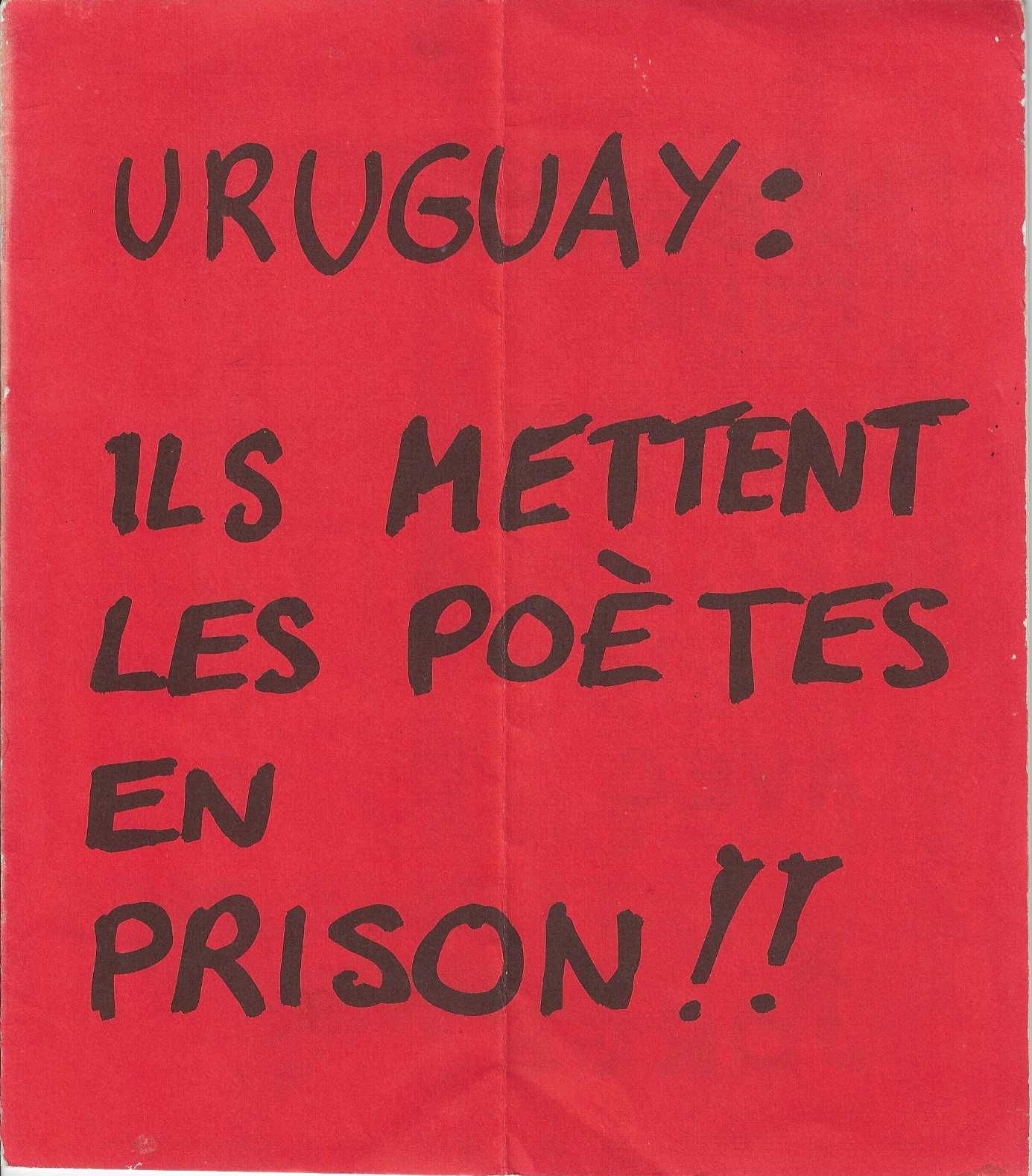
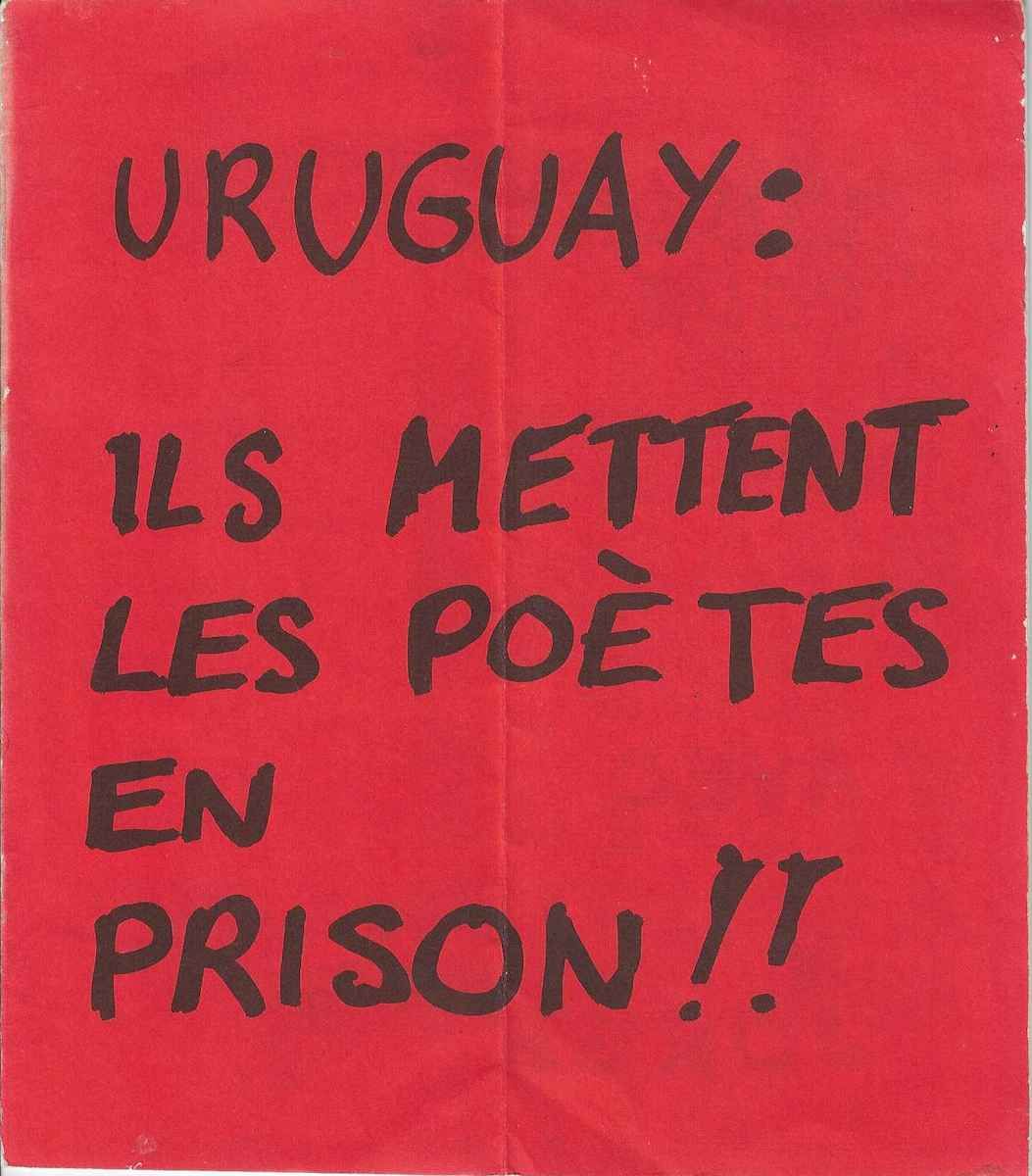
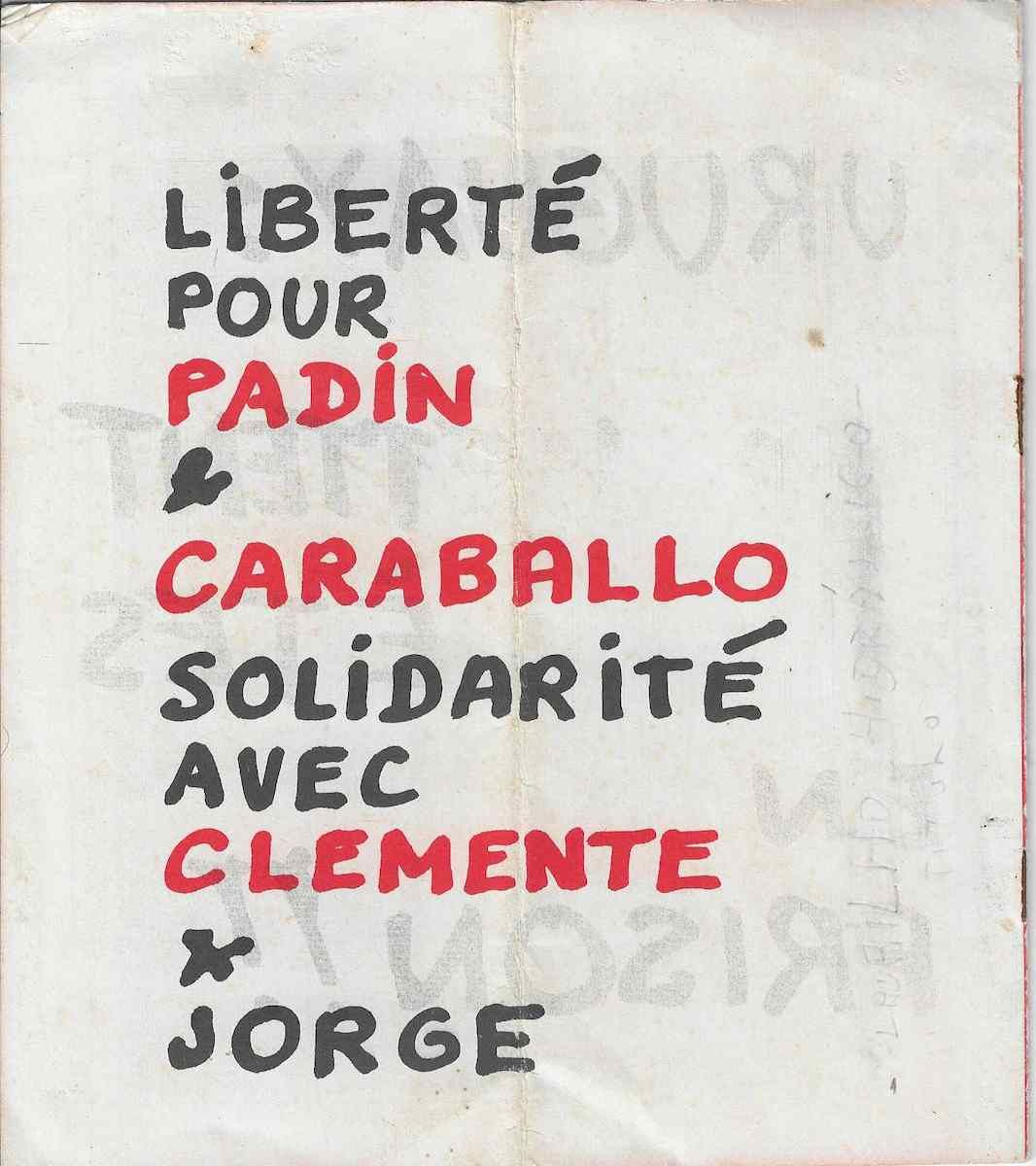
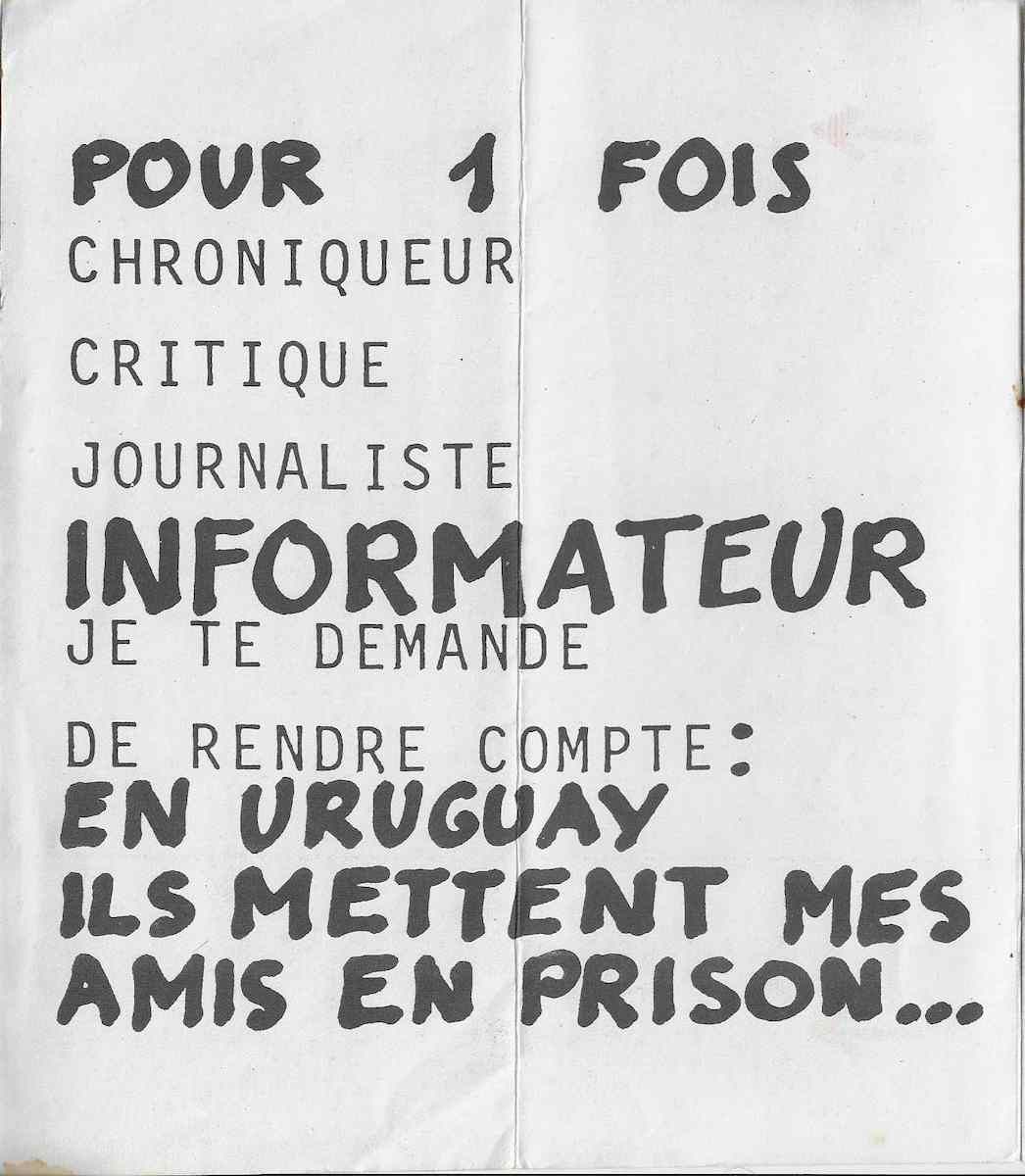
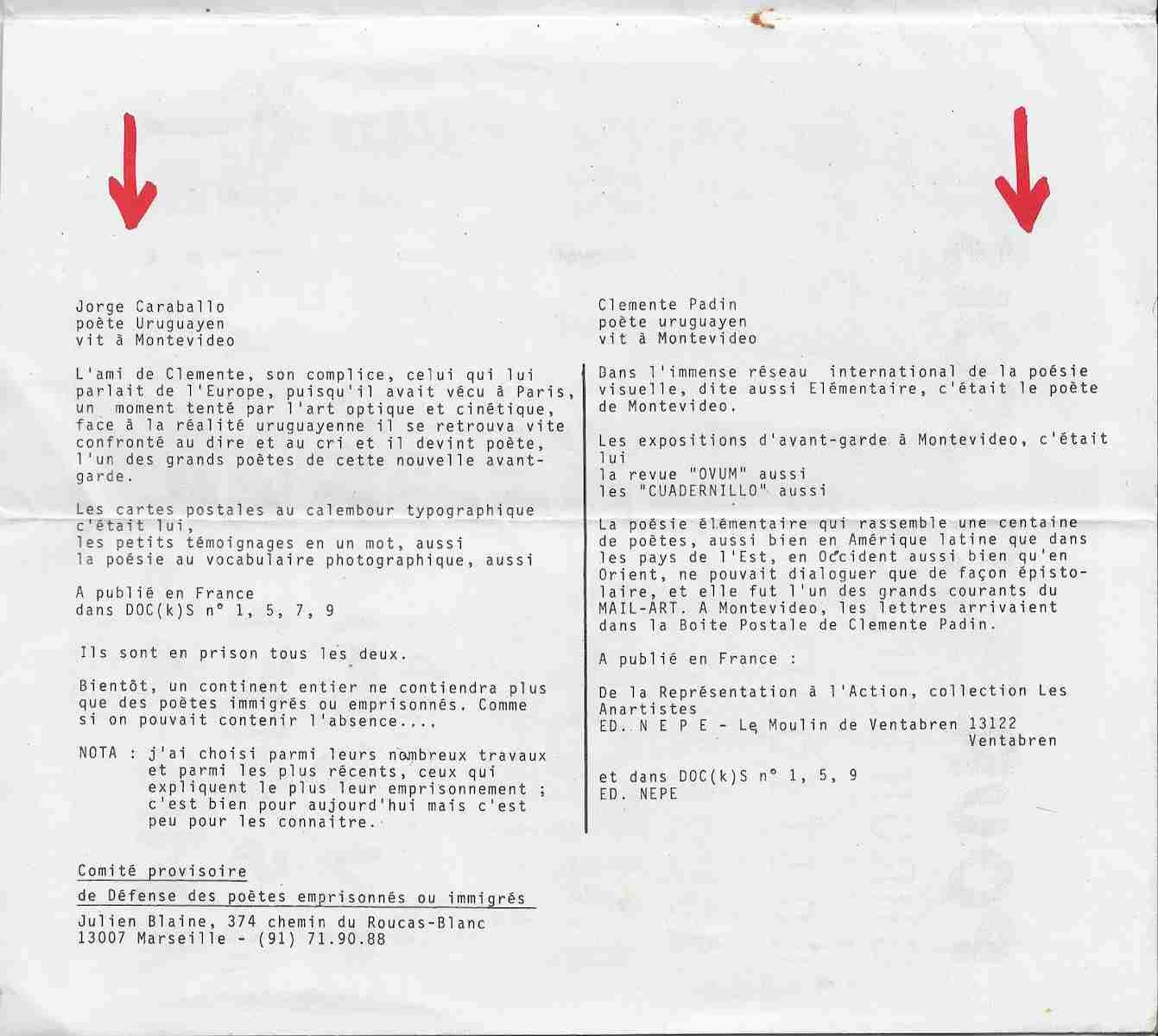
Livro de artista, publicação militante e documento de solidariedade internacional organizado pelo poeta, artista e editor francês Julien Blaine em defesa dos artistas uruguaios Clemente Padín e Jorge Caraballo, presos pela ditadura civil militar do Uruguai.
Clemente Padín
Categoria: Mail Art
Acervo: 03516
Data: 1977
Dimensões: 20 x 17,5 cm
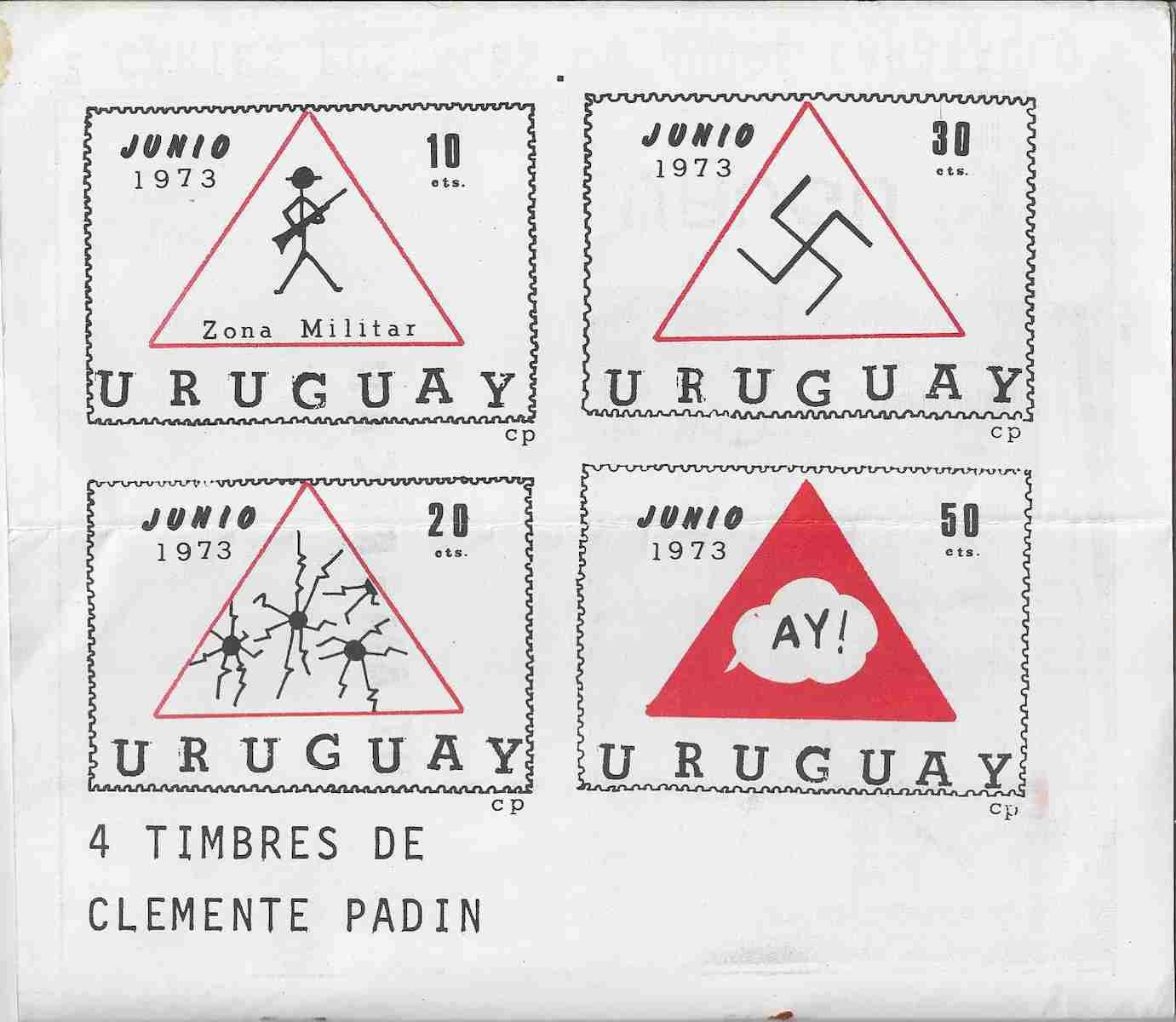
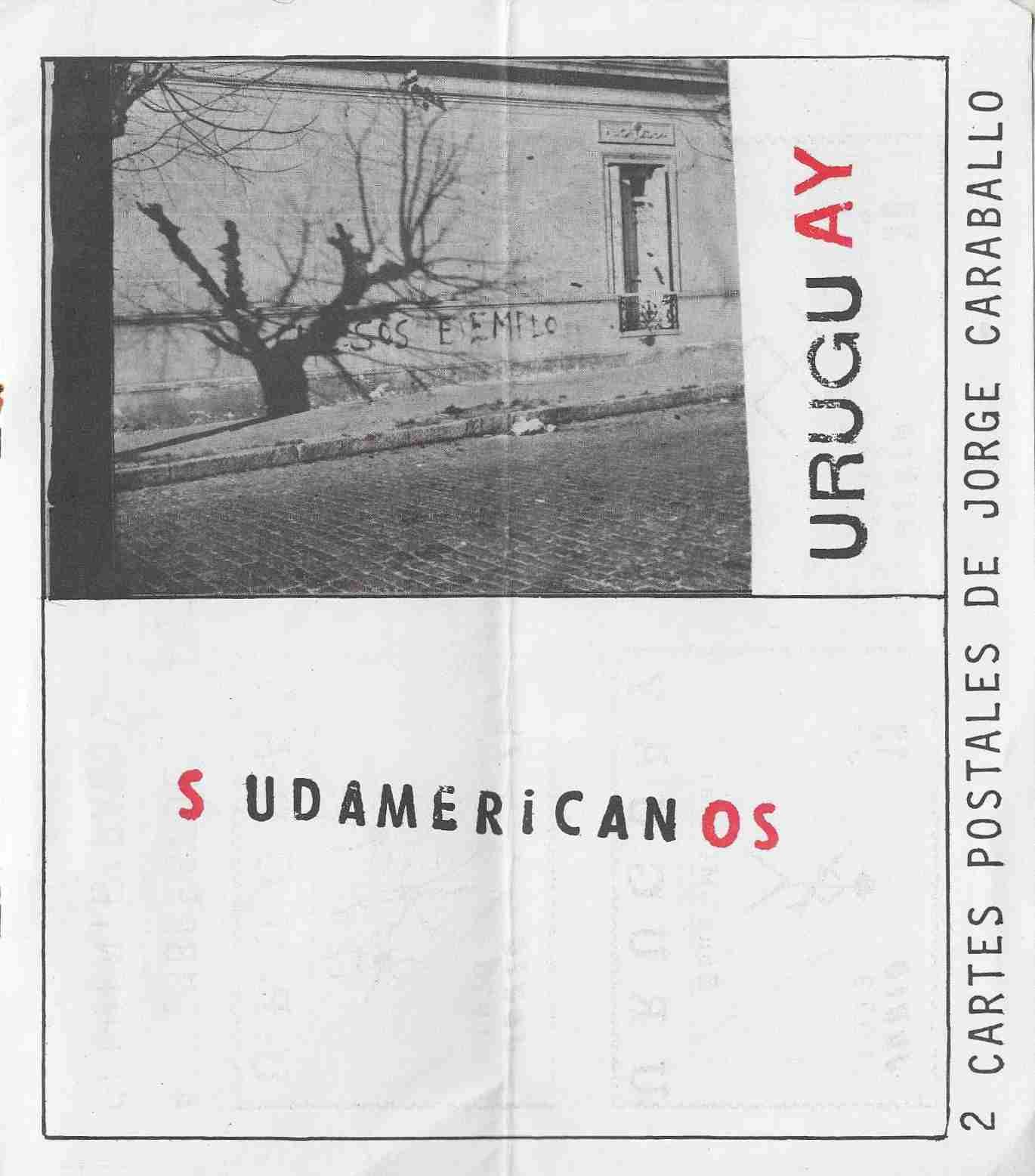
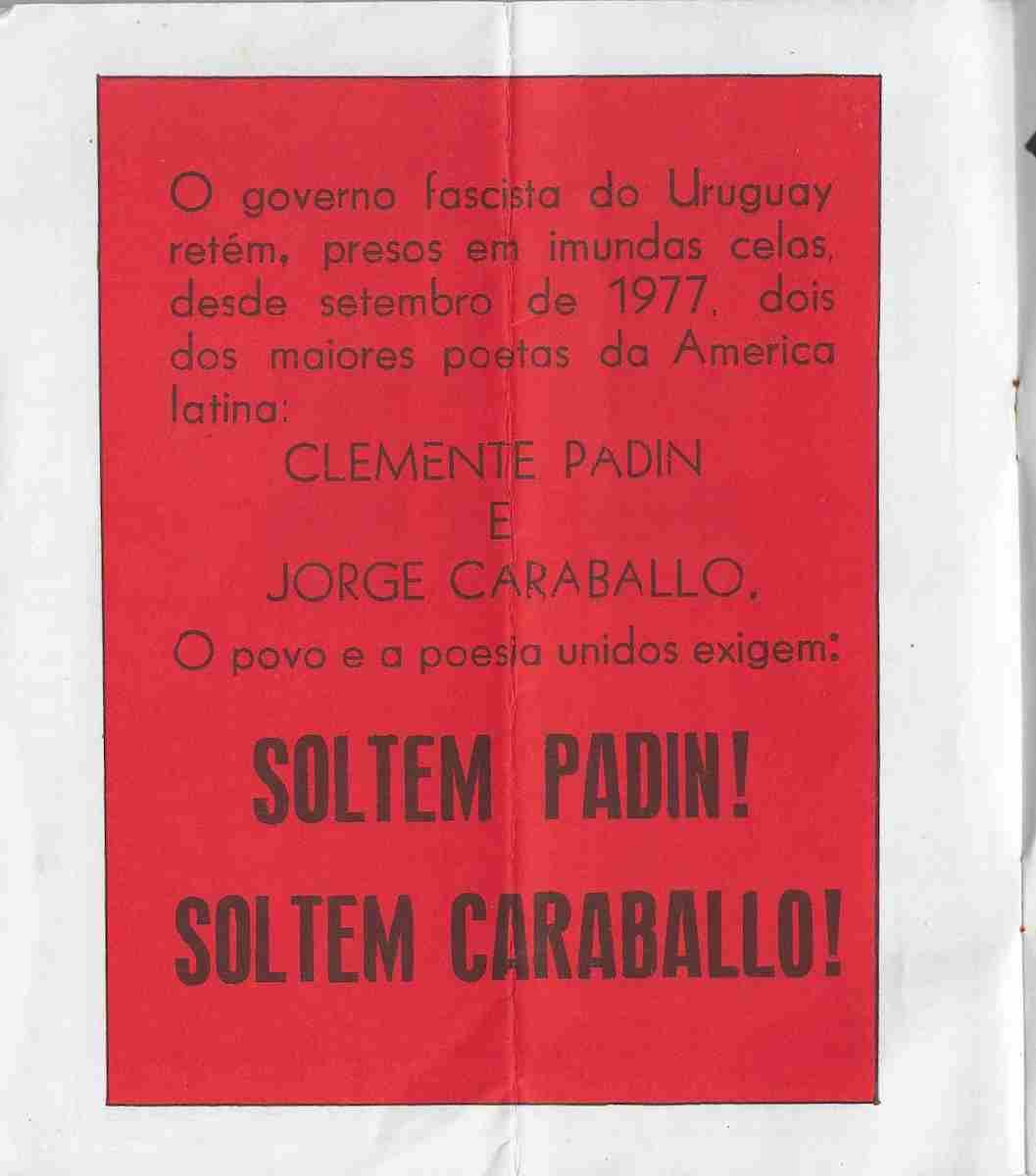
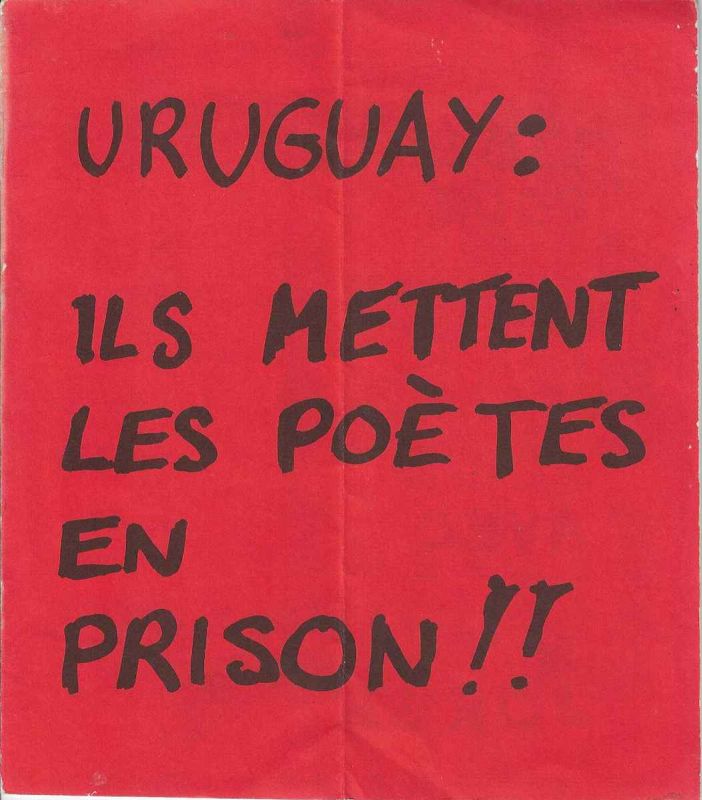
Texto para o programa Salsa em português: Livro de artista, publicação militante e documento de solidariedade internacional organizado pelo poeta, artista e editor francês Julien Blaine em defesa dos artistas uruguaios Clemente Padín e Jorge Caraballo, presos pela ditadura civil militar do Uruguai. A capa, impressa sobre fundo vermelho com letras pretas manuscritas, apresenta a palavra Uruguay e a frase em francês Ils mettent les poètes en prison, traduzida como Eles colocam os poetas na prisão. As páginas internas combinam textos datilografados, intervenções caligráficas, tipografia ampliada, impressão em preto e vermelho, poesia visual, documentos biográficos e reproduções de obras postais de Padín e Caraballo. Uma página anuncia Liberté pour Padín et Caraballo, Solidarité avec Clemente et Jorge, estabelecendo o livro como instrumento de denúncia política e mobilização cultural. Outra composição solicita que cronistas, críticos, jornalistas e agentes de informação prestem contas sobre a situação uruguaia, declarando que no Uruguai eles colocam meus amigos na prisão. O núcleo documental da publicação apresenta informações biográficas sobre os dois artistas. Jorge Caraballo é identificado como poeta uruguaio residente em Montevidéu, amigo e colaborador de Clemente Padín, participante das redes artísticas europeias, com passagem por Paris e aproximação inicial com a arte óptica e cinética. O texto afirma que Caraballo confrontou a realidade uruguaia, tornou se poeta e integrou a nova vanguarda, trabalhando com cartões postais, calendário tipográfico, testemunhos verbais, poesia fotográfica e poesia de vocabulário. Também registra sua publicação na França nas edições de DOC(K)S números 1, 5, 7 e 9. Clemente Padín é apresentado como poeta uruguaio residente em Montevidéu, integrante da extensa rede internacional de poesia visual, chamada no documento de poesia elementar, organizador de exposições de vanguarda em Montevidéu e responsável pelas revistas OVUM e Los Huevos del Plata, nome que no documento parece aparecer de maneira abreviada ou com leitura gráfica parcialmente imprecisa. O texto destaca que a poesia elementar reunia aproximadamente uma centena de poetas da América Latina, Europa Oriental, Europa Ocidental e Oriente e que sua comunicação ocorria principalmente por correspondência, constituindo uma das grandes correntes da Mail Art. A caixa postal de Clemente Padín em Montevidéu é descrita como ponto de chegada de cartas provenientes da rede internacional. A publicação informa ainda que Padín publicou na França o volume De la Représentation à l Action, na coleção Les Anartistes, pelas Éditions NEPE, associadas ao endereço Le Moulin de Ventabren, 13122 Ventabren, e que participou de DOC(K)S números 1, 5 e 9. O texto afirma que ambos estavam presos e adverte sobre o crescimento do exílio, da imigração forçada e do encarceramento de poetas. Julien Blaine explica que selecionou entre os numerosos trabalhos dos dois artistas aqueles que melhor esclareciam as razões de sua prisão, embora reconhecesse que esse conjunto ainda fosse insuficiente para apresentar integralmente suas trajetórias. A publicação identifica o Comité provisoire de Défense des poètes emprisonnés ou immigrés, Comitê Provisório de Defesa dos Poetas Presos ou Imigrados, sob responsabilidade de Julien Blaine, com endereço na época em 374 chemin du Roucas Blanc, 13007 Marseille, França, e telefone 91 71 90 88. Entre as obras reproduzidas estão quatro selos de artista de Clemente Padín, identificados como 4 timbres de Clemente Padín, datados de junho de 1973. Os selos simulam emissões postais do Uruguai e apresentam os valores de 10, 20, 30 e 50 centésimos. As imagens incluem a inscrição Zona Militar com figura armada, um símbolo associado ao fascismo, formas humanas atingidas por linhas de violência e um balão com a interjeição Ay. O conjunto utiliza a linguagem gráfica da filatelia para denunciar militarização, autoritarismo, violência estatal, repressão e sofrimento social. Também aparecem duas cartas postais de Jorge Caraballo. Uma delas apresenta fotografia urbana em preto e branco, a palavra Uruguay com destaque gráfico em preto e vermelho e o termo Sudamericanos, no qual as letras iniciais e finais em vermelho enquadram visualmente a palavra. A outra página reproduz cartaz em fundo vermelho com texto em português denunciando que o governo fascista do Uruguai mantinha Clemente Padín e Jorge Caraballo presos em celas imundas desde setembro de 1977, qualificando os dois como importantes poetas da América Latina e concluindo com os apelos Soltem Padín e Soltem Caraballo. A presença desse texto em português demonstra a circulação da campanha de solidariedade no Brasil e nas redes latino americanas de poesia experimental e arte postal. A publicação constitui testemunho histórico da articulação entre poesia visual, arte postal, livro de artista, ativismo político, comunicação alternativa e defesa dos direitos humanos durante as ditaduras do Cone Sul. Documento fundamental para pesquisas sobre Julien Blaine, Clemente Padín, Jorge Caraballo, DOC(K)S, Éditions NEPE, OVUM, poesia elementar, poesia visual francesa, vanguarda uruguaia, arte postal latino americana, repressão política no Uruguai, ditaduras sul americanas, liberdade de expressão e redes internacionais de solidariedade artística. Texto de observação em português: Publicação sem data de edição claramente visível nas páginas examinadas. A referência à prisão de Clemente Padín e Jorge Caraballo desde setembro de 1977 permite situar sua produção durante ou após esse período, provavelmente no contexto imediato da campanha internacional desenvolvida entre 1977 e 1979. O nome do organizador e responsável pelo comitê aparece como Julien Blaine. O exemplar apresenta dobras centrais, marcas de manuseio, pequenas manchas, oxidação localizada, desgaste nas bordas e transferência parcial da impressão entre páginas. A capa e parte das páginas parecem ter sido produzidas por processos gráficos de baixo custo, possivelmente reprodução mimeográfica, serigráfica, tipográfica ou fotomecânica, característica das publicações independentes e militantes do período. Os textos estão principalmente em francês, com presença de espanhol e português, evidenciando a dimensão internacional da campanha. A publicação reúne material autoral, reprodução documental, textos de denúncia, informações biográficas e obras de Clemente Padín e Jorge Caraballo. A atribuição do título pode ser registrada como Ils mettent les poètes en prison, Liberté pour Padín et Caraballo, Solidarité avec Clemente et Jorge. Recomenda se indexar também as variantes Ils mettent les poetes en prison, Liberté pour Padin et Caraballo, Solidarité avec Clement et Jorge, Freedom for Padín and Caraballo, Liberdade para Padín e Caraballo, Soltem Padín e Soltem Caraballo. Text for the Salsa program in English: Artist book, activist publication and document of international solidarity organized by the French poet, artist and editor Julien Blaine in defense of the Uruguayan artists Clemente Padín and Jorge Caraballo, imprisoned by the civil military dictatorship of Uruguay. The cover, printed on a red background with black handwritten letters, presents the word Uruguay and the French statement Ils mettent les poètes en prison, meaning They put poets in prison. The internal pages combine typewritten texts, calligraphic interventions, enlarged typography, black and red printing, visual poetry, biographical documents and reproductions of postal works by Padín and Caraballo. One page announces Liberté pour Padín et Caraballo, Solidarité avec Clemente et Jorge, establishing the book as an instrument of political denunciation and cultural mobilization. Another composition asks chroniclers, critics, journalists and information agents to report on the Uruguayan situation, declaring that in Uruguay they put my friends in prison. The documentary core of the publication presents biographical information about both artists. Jorge Caraballo is identified as a Uruguayan poet living in Montevideo, a friend and collaborator of Clemente Padín, a participant in European artistic networks, with experience in Paris and an early engagement with optical and kinetic art. The text states that Caraballo confronted the Uruguayan reality, became a poet and joined the new avant garde, working with postcards, typographic calendars, verbal testimonies, photographic poetry and vocabulary based poetry. It also records his publication in France in DOC(K)S issues 1, 5, 7 and 9. Clemente Padín is presented as a Uruguayan poet living in Montevideo, a participant in the extensive international network of visual poetry, described in the document as elementary poetry, an organizer of avant garde exhibitions in Montevideo and the editor of OVUM and Los Huevos del Plata, whose title appears in the document in an abbreviated or graphically unclear form. The text explains that elementary poetry brought together approximately one hundred poets from Latin America, Eastern Europe, Western Europe and the East and that their communication occurred mainly through correspondence, forming one of the major currents of Mail Art. Clemente Padín postal box in Montevideo is described as a destination for letters arriving from the international network. The publication also states that Padín published in France the volume De la Représentation à l Action in the Les Anartistes collection through Éditions NEPE, associated with Le Moulin de Ventabren, 13122 Ventabren, and that he appeared in DOC(K)S issues 1, 5 and 9. The text declares that both artists were in prison and warns about the increasing exile, forced migration and imprisonment of poets. Julien Blaine explains that he selected from their numerous works those that best clarified the reasons for their imprisonment, while acknowledging that the selection remained insufficient to present their complete artistic trajectories. The publication identifies the Comité provisoire de Défense des poètes emprisonnés ou immigrés, the Provisional Committee for the Defense of Imprisoned or Immigrant Poets, under the responsibility of Julien Blaine, whose address at the time was 374 chemin du Roucas Blanc, 13007 Marseille, France, with telephone number 91 71 90 88. Among the reproduced works are four artist stamps by Clemente Padín, identified as 4 timbres de Clemente Padín and dated June 1973. The stamps imitate Uruguayan postal issues and display values of 10, 20, 30 and 50 centésimos. Their images include the words Zona Militar with an armed figure, a symbol associated with fascism, human forms struck by lines of violence and a speech balloon containing the exclamation Ay. The group uses the visual language of philately to denounce militarization, authoritarianism, state violence, repression and social suffering. The publication also includes two postcards by Jorge Caraballo. One presents a black and white urban photograph, the word Uruguay highlighted in black and red and the term Sudamericanos, with its first and final letters printed in red. Another page reproduces a poster on a red background with a Portuguese text denouncing that the fascist government of Uruguay had held Clemente Padín and Jorge Caraballo in filthy prison cells since September 1977, describing them as two major Latin American poets and concluding with the demands Soltem Padín and Soltem Caraballo. The Portuguese language text demonstrates the circulation of the solidarity campaign in Brazil and throughout Latin American networks of experimental poetry and mail art. The publication is a historical record of the relationship between visual poetry, mail art, artist books, political activism, alternative communication and human rights advocacy during the dictatorships of the Southern Cone. It is a fundamental document for research on Julien Blaine, Clemente Padín, Jorge Caraballo, DOC(K)S, Éditions NEPE, OVUM, elementary poetry, French visual poetry, the Uruguayan avant garde, Latin American mail art, political repression in Uruguay, South American dictatorships, freedom of expression and international networks of artistic solidarity. Observation text in English: Publication without a clearly visible edition date in the examined pages. The statement that Clemente Padín and Jorge Caraballo had been imprisoned since September 1977 places its production during or after that period, probably within the immediate international campaign developed between 1977 and 1979. Julien Blaine is identified as the organizer and person responsible for the committee. The copy presents central folds, handling marks, small stains, localized oxidation, edge wear and partial transfer of printing between pages. The cover and some internal pages appear to have been produced through inexpensive graphic processes, possibly mimeographic, screen printing, typographic or photomechanical reproduction, characteristic of independent and activist publications of the period. The texts are mainly in French, with Spanish and Portuguese content, demonstrating the international dimension of the campaign. The publication combines original material, documentary reproduction, protest texts, biographical information and works by Clemente Padín and Jorge Caraballo. The catalog title may be recorded as Ils mettent les poètes en prison, Liberté pour Padín et Caraballo, Solidarité avec Clemente et Jorge. Recommended indexing variants include Ils mettent les poetes en prison, Liberté pour Padin et Caraballo, Solidarité avec Clement et Jorge, Freedom for Padín and Caraballo, Liberdade para Padín e Caraballo, Soltem Padín and Soltem Caraballo.
Texto para o programa Salsa em português: Livro de artista, publicação militante e documento de solidariedade internacional organizado pelo poeta, artista e editor francês Julien Blaine em defesa dos artistas uruguaios Clemente Padín e Jorge Caraballo, presos pela ditadura civil militar do Uruguai. A capa, impressa sobre fundo vermelho com letras pretas manuscritas, apresenta a palavra Uruguay e a frase em francês Ils mettent les poètes en prison, traduzida como Eles colocam os poetas na prisão. As páginas internas combinam textos datilografados, intervenções caligráficas, tipografia ampliada, impressão em preto e vermelho, poesia visual, documentos biográficos e reproduções de obras postais de Padín e Caraballo. Uma página anuncia Liberté pour Padín et Caraballo, Solidarité avec Clemente et Jorge, estabelecendo o livro como instrumento de denúncia política e mobilização cultural. Outra composição solicita que cronistas, críticos, jornalistas e agentes de informação prestem contas sobre a situação uruguaia, declarando que no Uruguai eles colocam meus amigos na prisão. O núcleo documental da publicação apresenta informações biográficas sobre os dois artistas. Jorge Caraballo é identificado como poeta uruguaio residente em Montevidéu, amigo e colaborador de Clemente Padín, participante das redes artísticas europeias, com passagem por Paris e aproximação inicial com a arte óptica e cinética. O texto afirma que Caraballo confrontou a realidade uruguaia, tornou se poeta e integrou a nova vanguarda, trabalhando com cartões postais, calendário tipográfico, testemunhos verbais, poesia fotográfica e poesia de vocabulário. Também registra sua publicação na França nas edições de DOC(K)S números 1, 5, 7 e 9. Clemente Padín é apresentado como poeta uruguaio residente em Montevidéu, integrante da extensa rede internacional de poesia visual, chamada no documento de poesia elementar, organizador de exposições de vanguarda em Montevidéu e responsável pelas revistas OVUM e Los Huevos del Plata, nome que no documento parece aparecer de maneira abreviada ou com leitura gráfica parcialmente imprecisa. O texto destaca que a poesia elementar reunia aproximadamente uma centena de poetas da América Latina, Europa Oriental, Europa Ocidental e Oriente e que sua comunicação ocorria principalmente por correspondência, constituindo uma das grandes correntes da Mail Art. A caixa postal de Clemente Padín em Montevidéu é descrita como ponto de chegada de cartas provenientes da rede internacional. A publicação informa ainda que Padín publicou na França o volume De la Représentation à l Action, na coleção Les Anartistes, pelas Éditions NEPE, associadas ao endereço Le Moulin de Ventabren, 13122 Ventabren, e que participou de DOC(K)S números 1, 5 e 9. O texto afirma que ambos estavam presos e adverte sobre o crescimento do exílio, da imigração forçada e do encarceramento de poetas. Julien Blaine explica que selecionou entre os numerosos trabalhos dos dois artistas aqueles que melhor esclareciam as razões de sua prisão, embora reconhecesse que esse conjunto ainda fosse insuficiente para apresentar integralmente suas trajetórias. A publicação identifica o Comité provisoire de Défense des poètes emprisonnés ou immigrés, Comitê Provisório de Defesa dos Poetas Presos ou Imigrados, sob responsabilidade de Julien Blaine, com endereço na época em 374 chemin du Roucas Blanc, 13007 Marseille, França, e telefone 91 71 90 88. Entre as obras reproduzidas estão quatro selos de artista de Clemente Padín, identificados como 4 timbres de Clemente Padín, datados de junho de 1973. Os selos simulam emissões postais do Uruguai e apresentam os valores de 10, 20, 30 e 50 centésimos. As imagens incluem a inscrição Zona Militar com figura armada, um símbolo associado ao fascismo, formas humanas atingidas por linhas de violência e um balão com a interjeição Ay. O conjunto utiliza a linguagem gráfica da filatelia para denunciar militarização, autoritarismo, violência estatal, repressão e sofrimento social. Também aparecem duas cartas postais de Jorge Caraballo. Uma delas apresenta fotografia urbana em preto e branco, a palavra Uruguay com destaque gráfico em preto e vermelho e o termo Sudamericanos, no qual as letras iniciais e finais em vermelho enquadram visualmente a palavra. A outra página reproduz cartaz em fundo vermelho com texto em português denunciando que o governo fascista do Uruguai mantinha Clemente Padín e Jorge Caraballo presos em celas imundas desde setembro de 1977, qualificando os dois como importantes poetas da América Latina e concluindo com os apelos Soltem Padín e Soltem Caraballo. A presença desse texto em português demonstra a circulação da campanha de solidariedade no Brasil e nas redes latino americanas de poesia experimental e arte postal. A publicação constitui testemunho histórico da articulação entre poesia visual, arte postal, livro de artista, ativismo político, comunicação alternativa e defesa dos direitos humanos durante as ditaduras do Cone Sul. Documento fundamental para pesquisas sobre Julien Blaine, Clemente Padín, Jorge Caraballo, DOC(K)S, Éditions NEPE, OVUM, poesia elementar, poesia visual francesa, vanguarda uruguaia, arte postal latino americana, repressão política no Uruguai, ditaduras sul americanas, liberdade de expressão e redes internacionais de solidariedade artística. Texto de observação em português: Publicação sem data de edição claramente visível nas páginas examinadas. A referência à prisão de Clemente Padín e Jorge Caraballo desde setembro de 1977 permite situar sua produção durante ou após esse período, provavelmente no contexto imediato da campanha internacional desenvolvida entre 1977 e 1979. O nome do organizador e responsável pelo comitê aparece como Julien Blaine. O exemplar apresenta dobras centrais, marcas de manuseio, pequenas manchas, oxidação localizada, desgaste nas bordas e transferência parcial da impressão entre páginas. A capa e parte das páginas parecem ter sido produzidas por processos gráficos de baixo custo, possivelmente reprodução mimeográfica, serigráfica, tipográfica ou fotomecânica, característica das publicações independentes e militantes do período. Os textos estão principalmente em francês, com presença de espanhol e português, evidenciando a dimensão internacional da campanha. A publicação reúne material autoral, reprodução documental, textos de denúncia, informações biográficas e obras de Clemente Padín e Jorge Caraballo. A atribuição do título pode ser registrada como Ils mettent les poètes en prison, Liberté pour Padín et Caraballo, Solidarité avec Clemente et Jorge. Recomenda se indexar também as variantes Ils mettent les poetes en prison, Liberté pour Padin et Caraballo, Solidarité avec Clement et Jorge, Freedom for Padín and Caraballo, Liberdade para Padín e Caraballo, Soltem Padín e Soltem Caraballo. Text for the Salsa program in English: Artist book, activist publication and document of international solidarity organized by the French poet, artist and editor Julien Blaine in defense of the Uruguayan artists Clemente Padín and Jorge Caraballo, imprisoned by the civil military dictatorship of Uruguay. The cover, printed on a red background with black handwritten letters, presents the word Uruguay and the French statement Ils mettent les poètes en prison, meaning They put poets in prison. The internal pages combine typewritten texts, calligraphic interventions, enlarged typography, black and red printing, visual poetry, biographical documents and reproductions of postal works by Padín and Caraballo. One page announces Liberté pour Padín et Caraballo, Solidarité avec Clemente et Jorge, establishing the book as an instrument of political denunciation and cultural mobilization. Another composition asks chroniclers, critics, journalists and information agents to report on the Uruguayan situation, declaring that in Uruguay they put my friends in prison. The documentary core of the publication presents biographical information about both artists. Jorge Caraballo is identified as a Uruguayan poet living in Montevideo, a friend and collaborator of Clemente Padín, a participant in European artistic networks, with experience in Paris and an early engagement with optical and kinetic art. The text states that Caraballo confronted the Uruguayan reality, became a poet and joined the new avant garde, working with postcards, typographic calendars, verbal testimonies, photographic poetry and vocabulary based poetry. It also records his publication in France in DOC(K)S issues 1, 5, 7 and 9. Clemente Padín is presented as a Uruguayan poet living in Montevideo, a participant in the extensive international network of visual poetry, described in the document as elementary poetry, an organizer of avant garde exhibitions in Montevideo and the editor of OVUM and Los Huevos del Plata, whose title appears in the document in an abbreviated or graphically unclear form. The text explains that elementary poetry brought together approximately one hundred poets from Latin America, Eastern Europe, Western Europe and the East and that their communication occurred mainly through correspondence, forming one of the major currents of Mail Art. Clemente Padín postal box in Montevideo is described as a destination for letters arriving from the international network. The publication also states that Padín published in France the volume De la Représentation à l Action in the Les Anartistes collection through Éditions NEPE, associated with Le Moulin de Ventabren, 13122 Ventabren, and that he appeared in DOC(K)S issues 1, 5 and 9. The text declares that both artists were in prison and warns about the increasing exile, forced migration and imprisonment of poets. Julien Blaine explains that he selected from their numerous works those that best clarified the reasons for their imprisonment, while acknowledging that the selection remained insufficient to present their complete artistic trajectories. The publication identifies the Comité provisoire de Défense des poètes emprisonnés ou immigrés, the Provisional Committee for the Defense of Imprisoned or Immigrant Poets, under the responsibility of Julien Blaine, whose address at the time was 374 chemin du Roucas Blanc, 13007 Marseille, France, with telephone number 91 71 90 88. Among the reproduced works are four artist stamps by Clemente Padín, identified as 4 timbres de Clemente Padín and dated June 1973. The stamps imitate Uruguayan postal issues and display values of 10, 20, 30 and 50 centésimos. Their images include the words Zona Militar with an armed figure, a symbol associated with fascism, human forms struck by lines of violence and a speech balloon containing the exclamation Ay. The group uses the visual language of philately to denounce militarization, authoritarianism, state violence, repression and social suffering. The publication also includes two postcards by Jorge Caraballo. One presents a black and white urban photograph, the word Uruguay highlighted in black and red and the term Sudamericanos, with its first and final letters printed in red. Another page reproduces a poster on a red background with a Portuguese text denouncing that the fascist government of Uruguay had held Clemente Padín and Jorge Caraballo in filthy prison cells since September 1977, describing them as two major Latin American poets and concluding with the demands Soltem Padín and Soltem Caraballo. The Portuguese language text demonstrates the circulation of the solidarity campaign in Brazil and throughout Latin American networks of experimental poetry and mail art. The publication is a historical record of the relationship between visual poetry, mail art, artist books, political activism, alternative communication and human rights advocacy during the dictatorships of the Southern Cone. It is a fundamental document for research on Julien Blaine, Clemente Padín, Jorge Caraballo, DOC(K)S, Éditions NEPE, OVUM, elementary poetry, French visual poetry, the Uruguayan avant garde, Latin American mail art, political repression in Uruguay, South American dictatorships, freedom of expression and international networks of artistic solidarity. Observation text in English: Publication without a clearly visible edition date in the examined pages. The statement that Clemente Padín and Jorge Caraballo had been imprisoned since September 1977 places its production during or after that period, probably within the immediate international campaign developed between 1977 and 1979. Julien Blaine is identified as the organizer and person responsible for the committee. The copy presents central folds, handling marks, small stains, localized oxidation, edge wear and partial transfer of printing between pages. The cover and some internal pages appear to have been produced through inexpensive graphic processes, possibly mimeographic, screen printing, typographic or photomechanical reproduction, characteristic of independent and activist publications of the period. The texts are mainly in French, with Spanish and Portuguese content, demonstrating the international dimension of the campaign. The publication combines original material, documentary reproduction, protest texts, biographical information and works by Clemente Padín and Jorge Caraballo. The catalog title may be recorded as Ils mettent les poètes en prison, Liberté pour Padín et Caraballo, Solidarité avec Clemente et Jorge. Recommended indexing variants include Ils mettent les poetes en prison, Liberté pour Padin et Caraballo, Solidarité avec Clement et Jorge, Freedom for Padín and Caraballo, Liberdade para Padín e Caraballo, Soltem Padín and Soltem Caraballo.
Inglês
Publication without a clearly visible edition date in the examined pages. The statement that Clemente Padín and Jorge Caraballo had been imprisoned since September 1977 places its production during or after that period, probably within the immediate international campaign developed between 1977 and 1979. Julien Blaine is identified as the organizer and person responsible for the committee.
Dimensions: 7,9 x 6,9 in