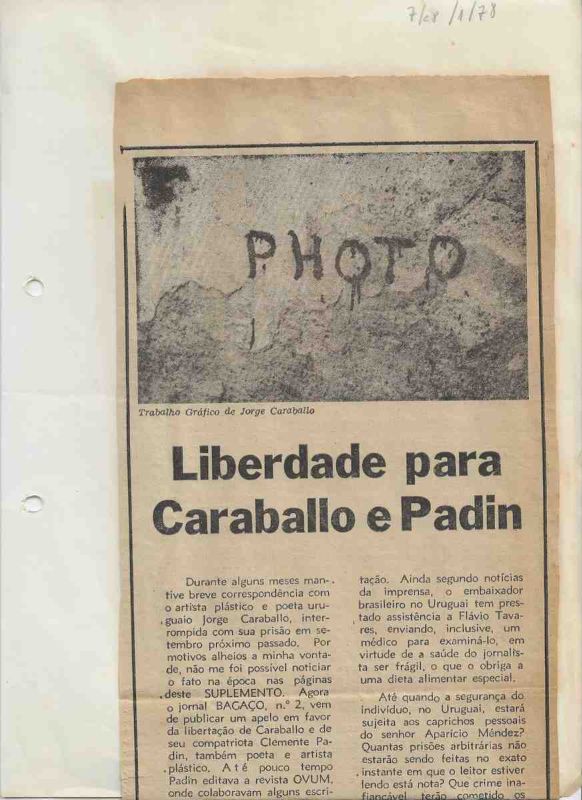
Liberdade para Caraballo e Padín é uma matéria publicada no Suplemento da Tribuna entre 7 e 8 de janeiro de 1978, preservada como recorte de jornal colado em folha original de arquivo.
Clemente Padín
Categoria: Mail Art
Acervo: 03510
Data: 7 a 8 de Janeiro de 1978
Dimensões: 30 x 21,5 cm
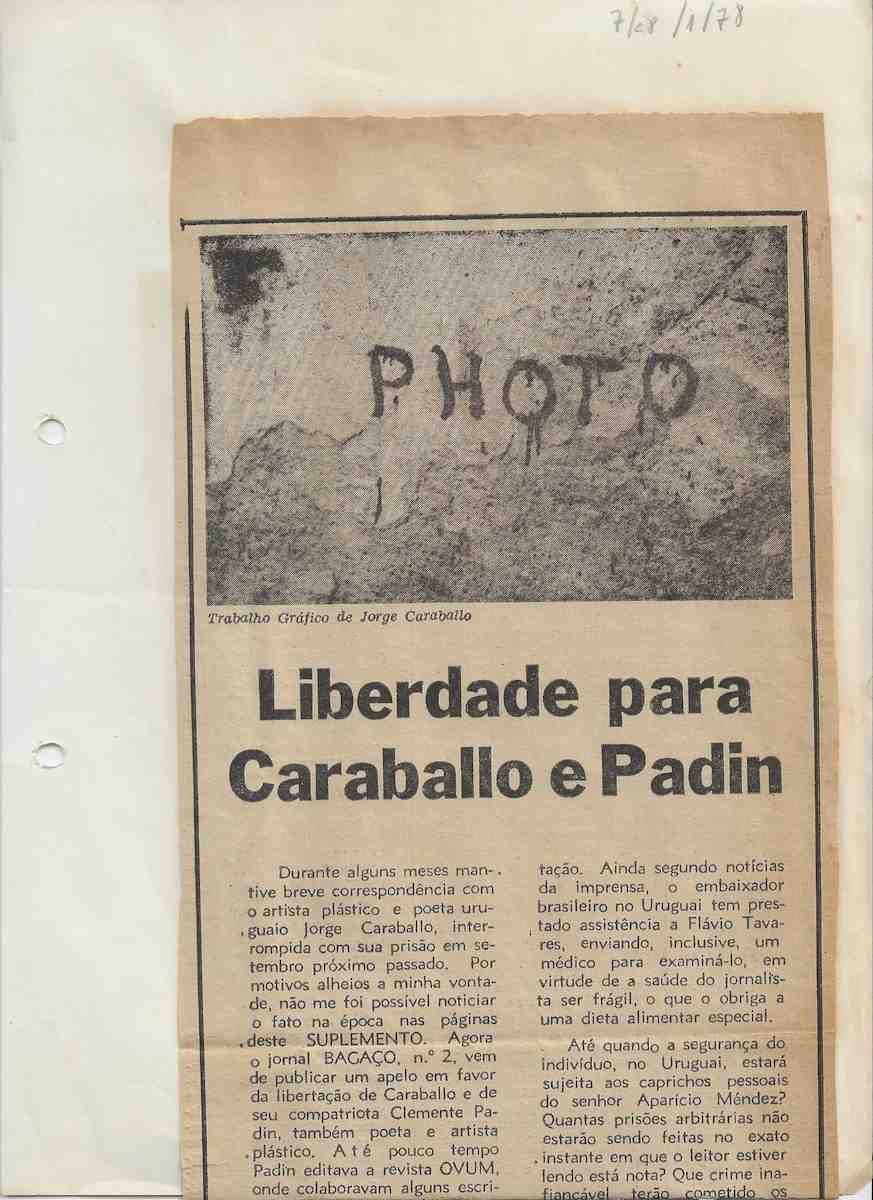
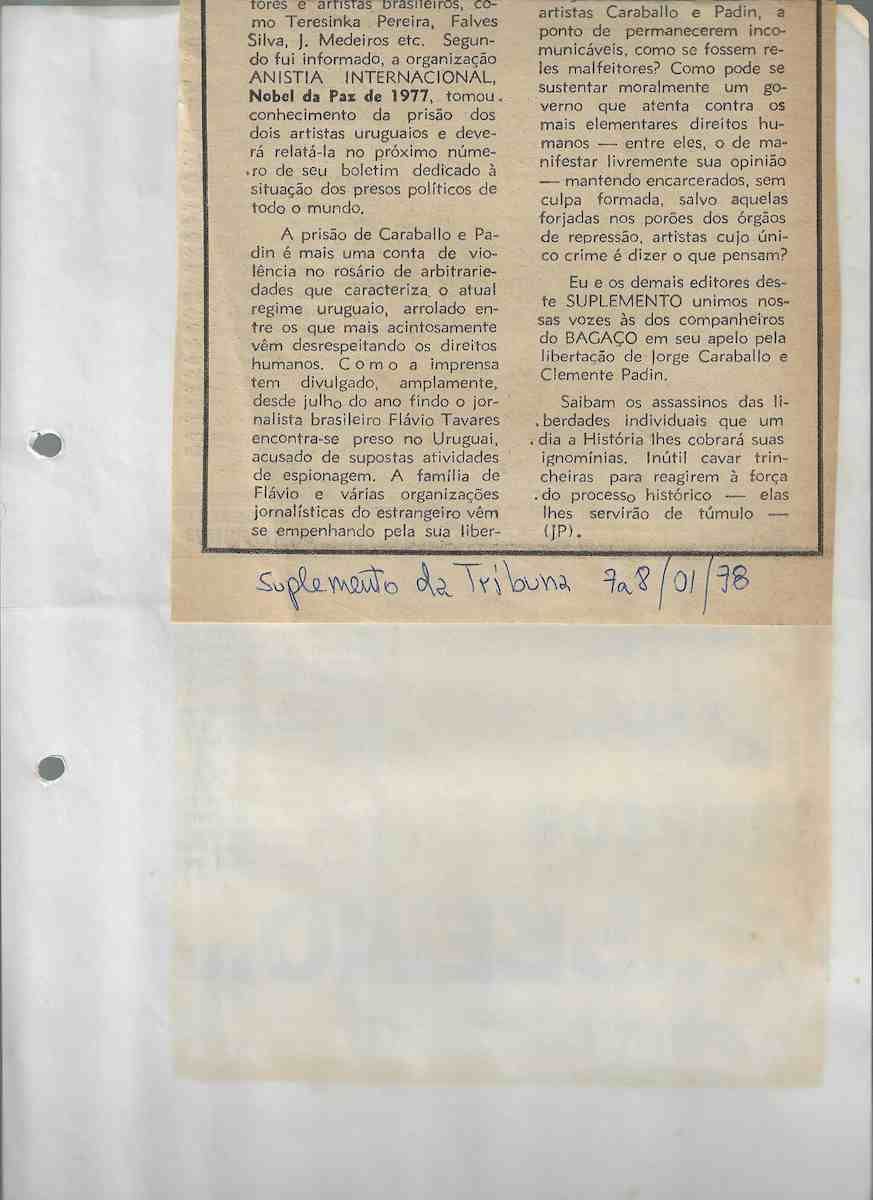
Liberdade para Caraballo e Padín é uma matéria publicada no Suplemento da Tribuna entre 7 e 8 de janeiro de 1978, preservada como recorte de jornal colado em folha original de arquivo. O texto constitui um documento histórico de denúncia e solidariedade internacional em favor dos artistas e poetas uruguaios Jorge Caraballo e Clemente Padín, presos durante a ditadura uruguaia. A matéria é ilustrada por um trabalho gráfico de Jorge Caraballo com a palavra PHOTO inscrita sobre uma parede deteriorada e apresenta um apelo direto pela libertação dos dois artistas. O autor informa que manteve breve correspondência com Jorge Caraballo até setembro do ano anterior, quando o contato foi interrompido em razão de sua prisão. O texto também recorda que Clemente Padín havia dirigido a revista OVUM, publicação experimental na qual colaboraram escritores e artistas brasileiros como Teresinka Pereira, Falves Silva e J. Medeiros. Segundo a matéria, a organização Anistia Internacional, vencedora do Prêmio Nobel da Paz de 1977, tomou conhecimento da prisão dos dois artistas uruguaios e preparava um relato sobre a situação dos presos políticos no país. O artigo situa a detenção de Caraballo e Padín no contexto mais amplo da violência e das arbitrariedades praticadas pelo regime uruguaio, caracterizado pela repressão aos direitos humanos, pela perseguição política e pelo encarceramento de intelectuais, jornalistas e artistas. Também menciona a prisão no Uruguai do jornalista brasileiro Flávio Tavares, acusado de supostas atividades de espionagem, e registra a mobilização de sua família e de organizações jornalísticas estrangeiras por sua libertação. A matéria informa ainda que Flávio Tavares teria recebido assistência do embaixador brasileiro no Uruguai e que sua saúde frágil exigia alimentação especial e acompanhamento médico. O texto questiona a insegurança individual diante de um sistema de prisões arbitrárias e denuncia a tentativa de silenciar artistas cujo único crime seria expressar livremente suas opiniões. Ao final, o Suplemento da Tribuna associa sua voz ao apelo do jornal Bagaço e pede a libertação de Jorge Caraballo e Clemente Padín. O recorte constitui fonte fundamental para o estudo da repressão política à arte e à poesia experimental na América Latina, da atuação de Padín e Caraballo, das redes de solidariedade entre Brasil e Uruguai, da história da arte postal, da poesia visual e da resistência cultural durante as ditaduras do Cone Sul.TEXT FOR THE SALSA PROGRAM IN ENGLISHLiberdade para Caraballo e Padín is an article published in Suplemento da Tribuna between 7 and 8 January 1978 and preserved as a newspaper clipping mounted on an original archival sheet. The text is a historical document of denunciation and international solidarity in support of the Uruguayan artists and poets Jorge Caraballo and Clemente Padín, who were imprisoned during the Uruguayan dictatorship. The article is illustrated with a graphic work by Jorge Caraballo showing the word PHOTO written on a deteriorated wall and presents a direct appeal for the release of both artists. The author states that he maintained brief correspondence with Jorge Caraballo until September of the previous year, when communication was interrupted because of Caraballo
s imprisonment. The text also recalls that Clemente Padín had directed the experimental magazine OVUM, which included contributions by Brazilian writers and artists such as Teresinka Pereira, Falves Silva and J. Medeiros. According to the article, Amnesty International, recipient of the 1977 Nobel Peace Prize, became aware of the imprisonment of the two Uruguayan artists and was preparing a report concerning the condition of political prisoners in the country. The article places the detention of Caraballo and Padín within the broader context of violence and arbitrary measures practiced by the Uruguayan regime, characterized by repression of human rights, political persecution and the imprisonment of intellectuals, journalists and artists. It also mentions the imprisonment in Uruguay of the Brazilian journalist Flávio Tavares, accused of alleged espionage activities, and records the efforts of his family and foreign journalistic organizations to secure his release. The text further reports that Flávio Tavares had received assistance from the Brazilian ambassador in Uruguay and that his fragile health required special food and medical examination. The article questions the lack of personal security under a system of arbitrary imprisonment and denounces the attempt to silence artists whose only crime was to express their opinions freely. In its conclusion, Suplemento da Tribuna joins the appeal made by the newspaper Bagaço and calls for the release of Jorge Caraballo and Clemente Padín. The clipping is a major source for the study of political repression against art and experimental poetry in Latin America, the activities of Padín and Caraballo, solidarity networks between Brazil and Uruguay, the history of mail art, visual poetry and cultural resistance during the dictatorships of the Southern Cone.
Recorte de jornal colado em folha original de arquivo com a matéria Liberdade para Caraballo e Padín, publicada no Suplemento da Tribuna entre 7 e 8 de janeiro de 1978. A data aparece manuscrita na margem superior e novamente na parte inferior da folha. O artigo reproduz um trabalho gráfico de Jorge Caraballo com a palavra PHOTO e apresenta texto de solidariedade aos artistas Jorge Caraballo e Clemente Padín, presos no Uruguai. A matéria menciona a interrupção da correspondência com Caraballo em setembro do ano anterior, a atuação de Padín na revista OVUM, a colaboração de Teresinka Pereira, Falves Silva e J. Medeiros e o interesse da Anistia Internacional pela situação dos presos políticos uruguaios. Também registra a prisão do jornalista brasileiro Flávio Tavares e denuncia a repressão política, a censura, as detenções arbitrárias e a violação da liberdade de expressão durante a ditadura uruguaia. A assinatura final aparece pelas iniciais JP, cuja identificação completa não pode ser confirmada apenas pelas imagens apresentadas. O suporte possui perfurações laterais para arquivamento, marcas de cola, amarelecimento, manchas, dobras, ondulações, pequenas perdas e sinais de envelhecimento. Recomenda se conservar o recorte associado à folha de arquivo original, pois as anotações manuscritas e o modo de montagem fazem parte de sua história documental. Termos recomendados para indexação incluem Clemente Padín, Jorge Caraballo, Liberdade para Caraballo e Padín, Suplemento da Tribuna, 7 de janeiro de 1978, 8 de janeiro de 1978, ditadura uruguaia, presos políticos, liberdade de expressão, Anistia Internacional, Flávio Tavares, OVUM, Teresinka Pereira, Falves Silva, J. Medeiros, arte postal, poesia visual, poesia experimental, direitos humanos, repressão política, Brasil, Uruguai e solidariedade internacional.OBSERVATION TEXT IN ENGLISHNewspaper clipping mounted on an original archival sheet containing the article Liberdade para Caraballo e Padín, published in Suplemento da Tribuna between 7 and 8 January 1978. The date is handwritten along the upper margin and again below the clipping. The article reproduces a graphic work by Jorge Caraballo featuring the word PHOTO and presents a text of solidarity with Jorge Caraballo and Clemente Padín, who were imprisoned in Uruguay. The article mentions the interruption of correspondence with Caraballo in September of the previous year, Padín
s role in the magazine OVUM, the participation of Teresinka Pereira, Falves Silva and J. Medeiros and the interest of Amnesty International in the situation of Uruguayan political prisoners. It also records the imprisonment of the Brazilian journalist Flávio Tavares and denounces political repression, censorship, arbitrary detention and violations of freedom of expression during the Uruguayan dictatorship. The final signature appears as the initials JP, whose full identity cannot be confirmed from the supplied images alone. The support has lateral filing perforations, adhesive marks, yellowing, stains, folds, surface undulations, minor losses and signs of aging. The clipping should remain associated with its original archival sheet because the handwritten notes and mounting method form part of its documentary history. Recommended indexing terms include Clemente Padín, Jorge Caraballo, Liberdade para Caraballo e Padín, Suplemento da Tribuna, 7 January 1978, 8 January 1978, Uruguayan dictatorship, political prisoners, freedom of expression, Amnesty International, Flávio Tavares, OVUM, Teresinka Pereira, Falves Silva, J. Medeiros, mail art, visual poetry, experimental poetry, human rights, political repression, Brazil, Uruguay and international solidarity.
Proveniência
Coleção Poema ProcessoInglês
Liberdade para Caraballo e Padín is an article published in Suplemento da Tribuna between 7 and 8 January 1978 and preserved as a newspaper clipping mounted on an original archival sheet.
Dimensions: 11,8 x 8,5 in