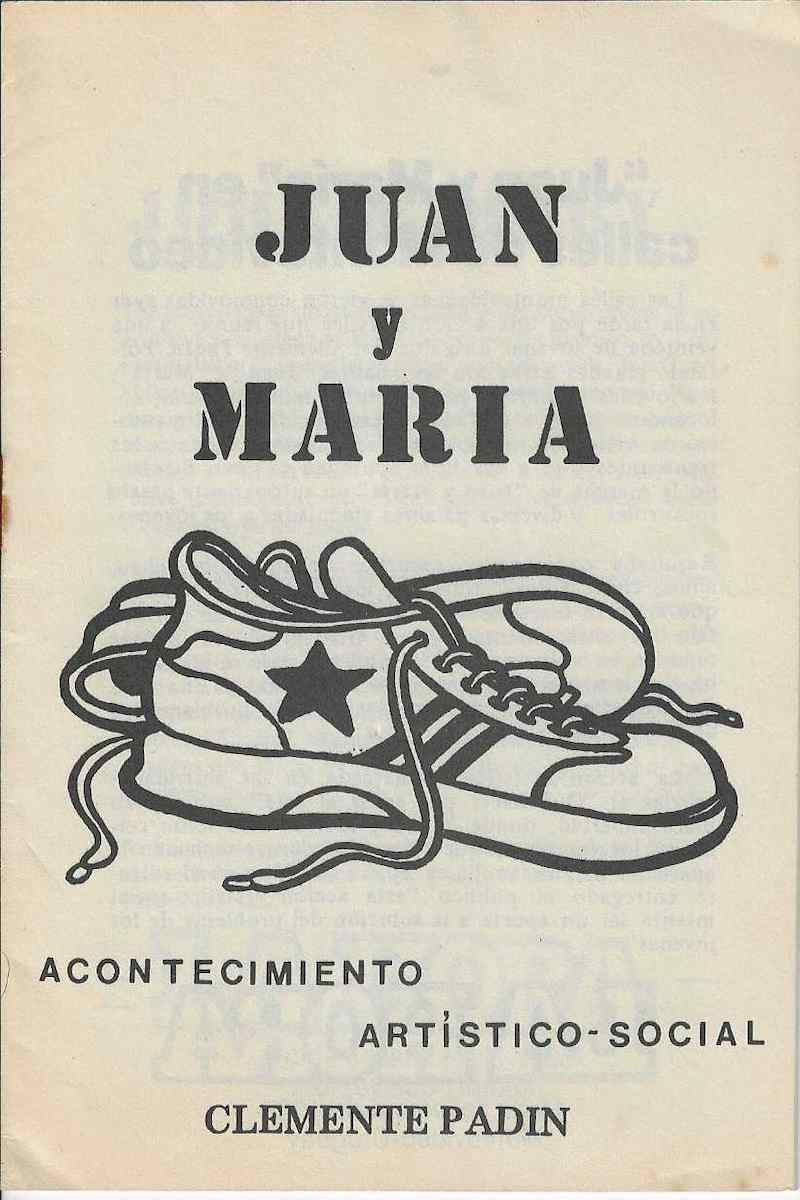
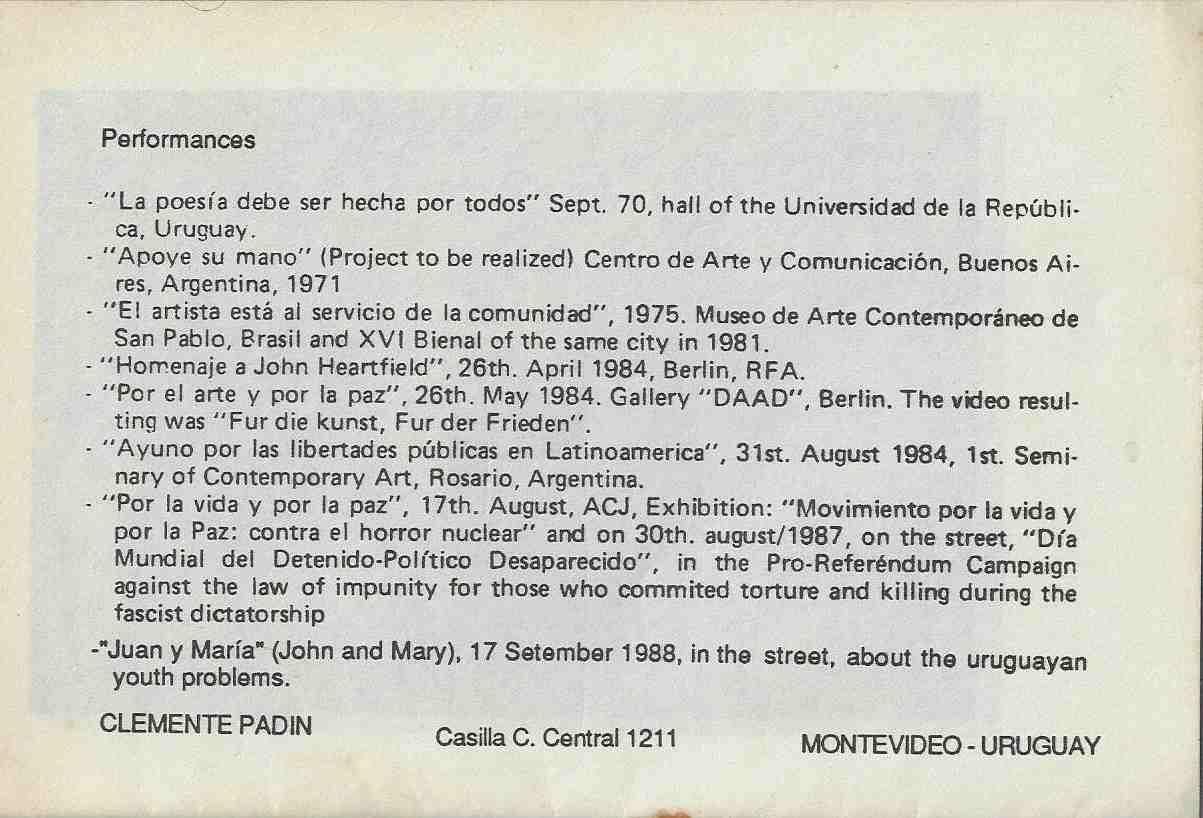
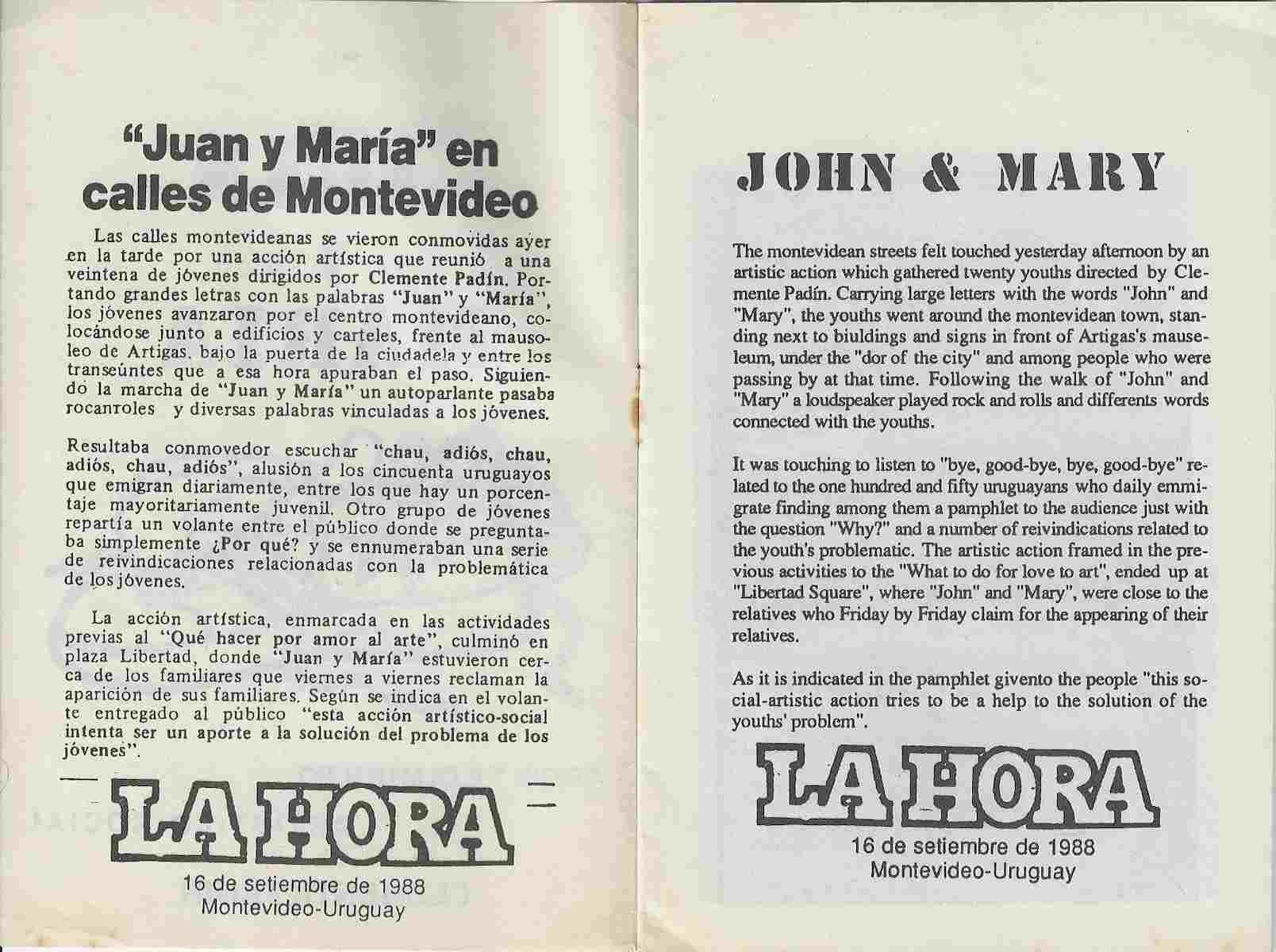
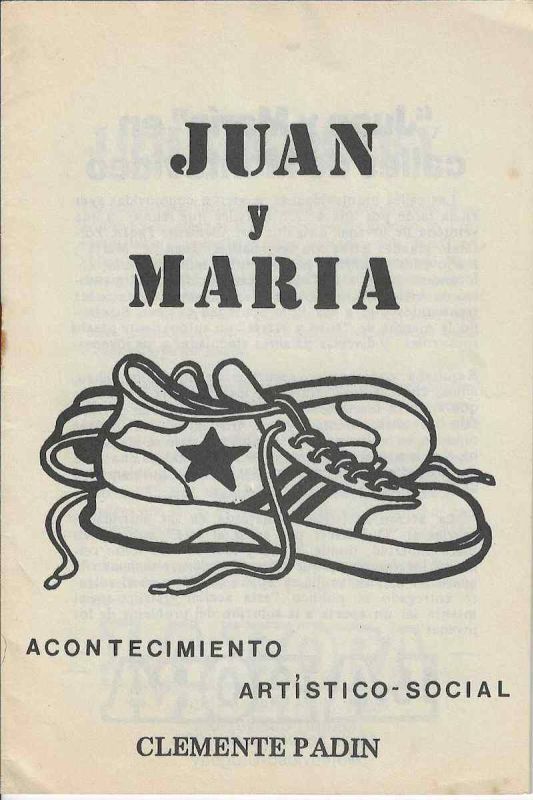
Livro de artista e publicação documental de Clemente Padin intitulada Juan y Maria, acontecimento artistico social, Montevidéu, Uruguai, 1988.
Clemente Padín
Categoria: Livro de Artista
Acervo: 03442
Data: 1988
Dimensões: 15,5 x 10,5 cm
Texto principal em portuguêsLivro de artista e publicação documental de Clemente Padin intitulada Juan y Maria, acontecimento artistico social, Montevidéu, Uruguai, 1988. A capa apresenta o título Juan y Maria em letras grandes, desenho de dois tênis e a identificação Clemente Padin. O verso registra uma lista de performances de Padin, incluindo La poesia debe ser hecha por todos, realizada em setembro de 1970 no hall da Universidad de la Republica no Uruguai, Apoye su mano, projeto para o Centro de Arte y Comunicacion de Buenos Aires em 1971, El artista esta al servicio de la comunidad, realizado em 1975 no Museu de Arte Contemporanea de Sao Paulo e apresentado também na XVI Bienal de Sao Paulo em 1981, Homenaje a John Heartfield, realizado em Berlim em 1984, Por el arte y por la paz, realizado na galeria DAAD em Berlim em 1984, Ayuno por las libertades publicas en Latinoamerica, realizado em Rosario, Argentina, em 1984, Por la vida y por la paz, realizado em 1984 e 1987 em campanhas contra o horror nuclear e contra a lei de impunidade no Uruguai, e Juan y Maria, ação de rua sobre os problemas da juventude uruguaia. A publicação inclui recorte do jornal La Hora, Montevidéu, 16 de setembro de 1988, com texto em espanhol e versão em inglês sob o título John and Mary. O relato informa que as ruas de Montevidéu foram mobilizadas por uma ação artística dirigida por Clemente Padin, reunindo cerca de vinte jovens que carregavam grandes letras formando as palavras Juan e Maria, caminhando pelo centro da cidade, junto a edifícios, cartazes, ao Museu de Artigas, à porta da cidadela e entre transeuntes. Durante a marcha, um alto falante tocava rock and roll e palavras ligadas à juventude. O texto destaca a emissão sonora de despedida, associada aos muitos uruguaios que emigravam diariamente, em sua maioria jovens, e menciona distribuição de panfleto ao público com a pergunta Por que e reivindicações ligadas à problemática juvenil. A ação culminou na Plaza Libertad, próxima aos familiares que todas as sextas feiras reclamavam o aparecimento de seus parentes desaparecidos. A publicação documenta a prática de Padin como arte de ação, arte postal expandida, poesia visual, intervenção urbana, performance social, crítica política, direitos humanos, juventude, migração, desaparecidos políticos e resistência cultural no Uruguai pós ditadura.Main text in EnglishArtist book and documentary publication by Clemente Padin titled Juan y Maria, social artistic event, Montevideo, Uruguay, 1988. The cover presents the title Juan y Maria in large letters, a drawing of two sneakers and the identification Clemente Padin. The back records a list of Padin performances, including La poesia debe ser hecha por todos, carried out in September 1970 at the hall of the Universidad de la Republica in Uruguay, Apoye su mano, a project for the Centro de Arte y Comunicacion in Buenos Aires in 1971, El artista esta al servicio de la comunidad, carried out in 1975 at the Museum of Contemporary Art of Sao Paulo and also presented at the Sixteenth Sao Paulo Biennial in 1981, Homenaje a John Heartfield, carried out in Berlin in 1984, Por el arte y por la paz, carried out at the DAAD Gallery in Berlin in 1984, Ayuno por las libertades publicas en Latinoamerica, carried out in Rosario, Argentina, in 1984, Por la vida y por la paz, carried out in 1984 and 1987 in campaigns against nuclear horror and against the impunity law in Uruguay, and Juan y Maria, a street action about the problems of Uruguayan youth. The publication includes a clipping from the newspaper La Hora, Montevideo, September 16, 1988, with a Spanish text and an English version under the title John and Mary. The report states that the streets of Montevideo were moved by an artistic action directed by Clemente Padin, gathering about twenty young people carrying large letters forming the words Juan and Maria, walking through the city center, next to buildings, signs, the Artigas Museum, the city gate and among passersby. During the walk, a loudspeaker played rock and roll and words connected with youth. The text highlights a sound sequence of farewell, associated with the many Uruguayans who emigrated daily, mostly young people, and mentions the distribution of a pamphlet to the public with the question Why and claims related to youth problems. The action culminated in Plaza Libertad, close to relatives who every Friday demanded the appearance of their disappeared family members. The publication documents Padin practice as action art, expanded mail art, visual poetry, urban intervention, social performance, political criticism, human rights, youth, migration, political disappearances and cultural resistance in post dictatorship Uruguay.
Texto de observação em portuguêsPublicação em papel, com capa impressa em preto e branco, manchas de tempo, marcas de manuseio e páginas internas com texto datilografado ou reproduzido. O conjunto apresenta alto valor documental por registrar uma ação pública de Clemente Padin voltada aos problemas da juventude uruguaia no contexto de redemocratização, memória dos desaparecidos e crise social. A imagem dos tênis na capa funciona como síntese visual da marcha urbana e da presença dos jovens no espaço público. O verso organiza a publicação dentro da trajetória performática de Padin entre 1970 e 1988, conectando Juan y Maria a ações anteriores sobre participação coletiva, comunidade, paz, liberdade pública, desaparecidos políticos, referendo contra a impunidade e crítica social latino americana. O recorte de La Hora confirma a recepção pública da ação em Montevidéu e descreve o percurso, os participantes, os cartazes, a sonorização, a pergunta Por que, a referência à emigração juvenil e a aproximação simbólica com os familiares dos desaparecidos na Plaza Libertad. A peça deve ser indexada com Clemente Padin, Juan y Maria, John and Mary, acontecimento artistico social, Montevidéu 1988, La Hora, Plaza Libertad, juventude uruguaia, desaparecidos políticos, emigração, arte de ação, performance latino americana, poesia visual, arte postal, intervenção urbana, direitos humanos, pós ditadura uruguaia e redes experimentais da América Latina.Observation text in EnglishPaper publication with black and white printed cover, age stains, handling marks and inner pages with typed or reproduced text. The set has high documentary value because it records a public action by Clemente Padin focused on the problems of Uruguayan youth in the context of redemocratization, memory of the disappeared and social crisis. The sneakers image on the cover works as a visual synthesis of the urban walk and the presence of young people in public space. The back places the publication within Padin performance trajectory between 1970 and 1988, connecting Juan y Maria to earlier actions on collective participation, community, peace, public freedoms, political disappearances, the referendum against impunity and Latin American social criticism. The La Hora clipping confirms the public reception of the action in Montevideo and describes the route, the participants, the signs, the sound system, the question Why, the reference to youth emigration and the symbolic proximity to the relatives of the disappeared in Plaza Libertad. The piece should be indexed with Clemente Padin, Juan y Maria, John and Mary, social artistic event, Montevideo 1988, La Hora, Plaza Libertad, Uruguayan youth, political disappearances, emigration, action art, Latin American performance, visual poetry, mail art, urban intervention, human rights, post dictatorship Uruguay and experimental networks of Latin America.
Proveniência
Coleção Poema ProcessoInglês
Artist book and documentary publication by Clemente Padin titled Juan y Maria, social artistic event, Montevideo, Uruguay, 1988.
Dimensions: 6,1 x 4,1 in