Matriz
Neide Sá
Categoria: Poema Processo
Acervo: 05027
Data: 1967
Dimensões: 19 x 23 cm
TEXTO SALSA PORTUGUÊS
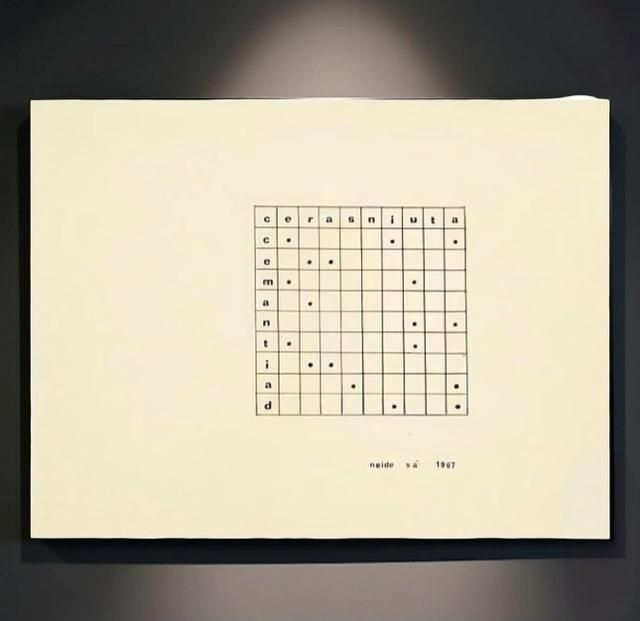
Matriz, obra realizada em 1967 pela artista brasileira Neide Sá, é um poema visual vinculado às experiências inaugurais do movimento Poema Processo. Executada em nanquim e letraset sobre papel vegetal, apresenta uma composição geométrica organizada como uma matriz quadriculada, na qual letras minúsculas, pontos e espaços vazios constituem um sistema de relações gráficas. A obra investiga a transformação da linguagem escrita em estrutura visual, substituindo a organização convencional de palavras e versos por uma composição baseada em posições, correspondências e possibilidades de leitura.
A estrutura central de Matriz é formada por uma grade de linhas horizontais e verticais que delimitam pequenas células regulares. Letras aparecem distribuídas na primeira linha e na primeira coluna, enquanto pontos pretos ocupam posições selecionadas no interior do quadro. A organização permite relacionar os signos dispostos nos dois eixos da matriz, sugerindo um procedimento de correspondência entre caracteres, posições e marcações gráficas.
O título Matriz reforça a importância do princípio estrutural da obra. Em vez de apresentar um poema organizado por uma sequência verbal contínua, Neide Sá constrói uma superfície de relações na qual a leitura pode ocorrer por cruzamentos, deslocamentos e associações entre elementos. Os pontos funcionam como unidades de marcação, enquanto as células vazias participam da composição ao estabelecer intervalos e diferenças entre as posições assinaladas.
Criada em 1967, Matriz pertence ao contexto de formação do movimento Poema Processo, iniciado naquele ano no Brasil. Neide Sá integrou o movimento, que propôs novas possibilidades de construção poética por meio de estruturas visuais, códigos, sequências e procedimentos capazes de ultrapassar a dependência da palavra escrita. A investigação do processo de organização dos signos tornou-se um dos aspectos centrais dessas experiências.
A composição estabelece relações entre poesia experimental, geometria, linguagem e comunicação visual. A estrutura quadriculada remete a sistemas de classificação e organização de informações, mas sua utilização poética desloca essas referências para uma experiência de leitura em que a posição dos elementos se torna tão relevante quanto sua identidade gráfica.
O uso do papel vegetal acrescenta uma característica material à obra, associada à transparência do suporte. A matriz ocupa uma área relativamente pequena da folha, deixando amplas regiões vazias ao redor da composição. Essa distribuição evidencia a autonomia do sistema gráfico e destaca a relação entre a estrutura central e o espaço disponível.
Matriz constitui um exemplo das investigações de Neide Sá sobre a construção de linguagens poéticas não lineares. Produzida no ano inaugural do Poema Processo, a obra documenta a pesquisa da artista sobre a utilização de códigos, relações espaciais e unidades gráficas como componentes de uma experiência poética que aproxima escrita, desenho e percepção visual.
TEXTO SALSA INGLÊS
Matriz, created in 1967 by Brazilian artist Neide Sá, is a visual poem associated with the formative experiments of the Poema Processo movement. Executed in ink and Letraset on tracing paper, the work presents a geometric composition organized as a grid in which lowercase letters, dots, and empty spaces constitute a system of graphic relationships. The composition investigates the transformation of written language into visual structure, replacing the conventional organization of words and verses with an arrangement based on positions, correspondences, and possibilities of reading.
The central structure of Matriz consists of a grid of horizontal and vertical lines defining small, regular cells. Letters appear along the first row and first column, while black dots occupy selected positions within the grid. This organization allows relationships to be established between the signs arranged along the two axes, suggesting a procedure of correspondence between characters, positions, and graphic markings.
The title Matriz emphasizes the structural principle underlying the work. Rather than presenting a poem organized through a continuous verbal sequence, Neide Sá constructs a field of relationships in which reading may occur through intersections, movements, and associations between elements. The dots function as marking units, while the empty cells contribute to the composition by establishing intervals and distinctions between marked positions.
Created in 1967, Matriz belongs to the historical context surrounding the formation of Poema Processo, a movement established in Brazil that year. Neide Sá participated in this movement, which proposed new approaches to poetic construction through visual structures, codes, sequences, and procedures extending beyond dependence on written language. The investigation of the processes through which signs are organized became a central aspect of these experiments.
The composition establishes relationships between experimental poetry, geometry, language, and visual communication. Its grid structure recalls systems of classification and information organization, but its poetic application transforms these references into a reading experience in which the position of individual elements becomes as significant as their graphic identity.
The use of tracing paper introduces a material characteristic associated with the transparency of the support. The matrix occupies a relatively small area of the sheet, leaving broad empty regions around the composition. This distribution emphasizes the autonomy of the graphic system and highlights the relationship between the central structure and the surrounding space.
Matriz exemplifies Neide Sá's investigations into the construction of nonlinear poetic languages. Produced during the inaugural year of Poema Processo, the work documents the artist's exploration of codes, spatial relationships, and graphic units as components of a poetic experience connecting writing, drawing, and visual perception.
TEXTO DE OBSERVAÇÃO PORTUGUÊS
Matriz, obra de Neide Sá datada de 1967, é realizada em nanquim e letraset sobre papel vegetal. A reprodução apresenta uma folha retangular em orientação horizontal, com uma matriz quadriculada de pequenas dimensões posicionada aproximadamente na região central, ligeiramente acima do eixo horizontal do suporte.
A composição é constituída por linhas horizontais e verticais finas, que formam uma estrutura regular de células quadrangulares. Na primeira linha e na primeira coluna aparecem sequências de letras minúsculas, enquanto pontos escuros são distribuídos em posições específicas no interior do quadro. A relação entre esses elementos estabelece uma organização gráfica baseada em correspondências espaciais.
Os pontos apresentam dimensões semelhantes e ocupam células determinadas, formando uma distribuição descontínua. A presença de espaços vazios entre as marcações contribui para a diferenciação das posições e para a percepção dos intervalos dentro da estrutura. A matriz permite observar relações entre os dois eixos, embora a documentação disponível não apresente instruções que determinem uma única sequência ou regra de leitura.
Abaixo da composição gráfica, na região inferior direita da matriz, encontra-se a identificação Neide Sá acompanhada da data 1967. A inscrição estabelece a autoria e a referência cronológica da obra. A reprodução não permite determinar com segurança o procedimento utilizado para aplicar essa identificação ao suporte.
O papel vegetal, informado como suporte, relaciona-se às possibilidades materiais de transparência e sobreposição, características relevantes para a compreensão das experiências gráficas da artista. Entretanto, não há elementos suficientes para afirmar que esta peça tenha sido originalmente concebida para utilização com outras folhas ou composições sobrepostas.
O título Matriz identifica a obra e corresponde à sua organização visual. A estrutura quadriculada aproxima a composição de sistemas de ordenação e codificação, enquanto a utilização de letras e pontos estabelece relações com as investigações do Poema Processo sobre linguagens poéticas construídas por procedimentos gráficos.
Não foram informadas dimensões, número de inventário, tiragem, proveniência específica, localização atual ou participação da obra em exposições determinadas. A reprodução disponível apresenta somente a frente da peça e não permite avaliar o verso, a existência de inscrições adicionais ou seu estado de conservação completo.
TEXTO DE OBSERVAÇÃO INGLÊS
Matriz, a work by Neide Sá dated 1967, is executed in ink and Letraset on tracing paper. The reproduction shows a horizontally oriented rectangular sheet with a small grid positioned approximately in the central region, slightly above the horizontal midpoint of the support.
The composition consists of thin horizontal and vertical lines forming a regular structure of quadrangular cells. Sequences of lowercase letters appear along the first row and first column, while dark dots are distributed in specific positions within the grid. Relationships between these elements establish a graphic organization based on spatial correspondences.
The dots are similar in size and occupy selected cells, creating a discontinuous distribution. Empty spaces between the markings contribute to the differentiation of positions and to the perception of intervals within the structure. The matrix allows relationships between the two axes to be examined, although the available documentation provides no instructions establishing a single reading sequence or rule.
Below the graphic composition, near the lower right area of the matrix, the name Neide Sá appears together with the date 1967. This inscription establishes authorship and the chronological reference of the work. The reproduction does not allow the technique used to apply this identification to be determined with certainty.
Tracing paper, identified as the support, is associated with material possibilities of transparency and superimposition, characteristics relevant to understanding the artist's graphic experiments. However, there is insufficient evidence to establish that this particular work was originally intended to be used with additional overlapping sheets or compositions.
The title Matriz identifies the work and corresponds to its visual organization. The grid structure recalls systems of ordering and coding, while the use of letters and dots establishes relationships with Poema Processo investigations into poetic languages constructed through graphic procedures.
No dimensions, inventory number, edition details, specific provenance, current location, or confirmed exhibition history have been supplied. The available reproduction shows only the front of the work and does not permit examination of the reverse, identification of additional inscriptions, or a complete assessment of its physical condition.
Proveniência
Coleção Poema Processo
Inglês
Matrix
Dimensions: 7,5 x 9,1 in