Ephemera nº 5, 1978
Revista Ephemera - Amsterdã - Ulises Carrión, Aart van Barneveld e Salvador Flores
Categoria: Revista
Acervo: 04936
Data: Março de 1978
Dimensões: 32 x 23 cm
TEXTO SALSA PORTUGUÊS
Ephemera nº 5, publicada em Amsterdã em março de 1978 pela Other Books and So, integra a revista internacional Ephemera, editada por Ulises Carrión, Aart van Barneveld e Salvador Flores e dedicada à Mail Art, arte postal, trabalhos efêmeros, publicações de artista e redes alternativas de comunicação artística. O número possui dez páginas, formato de aproximadamente 32 × 23 cm e impressão offset em preto e branco, incorporando também materiais gráficos e elementos aplicados à composição editorial.
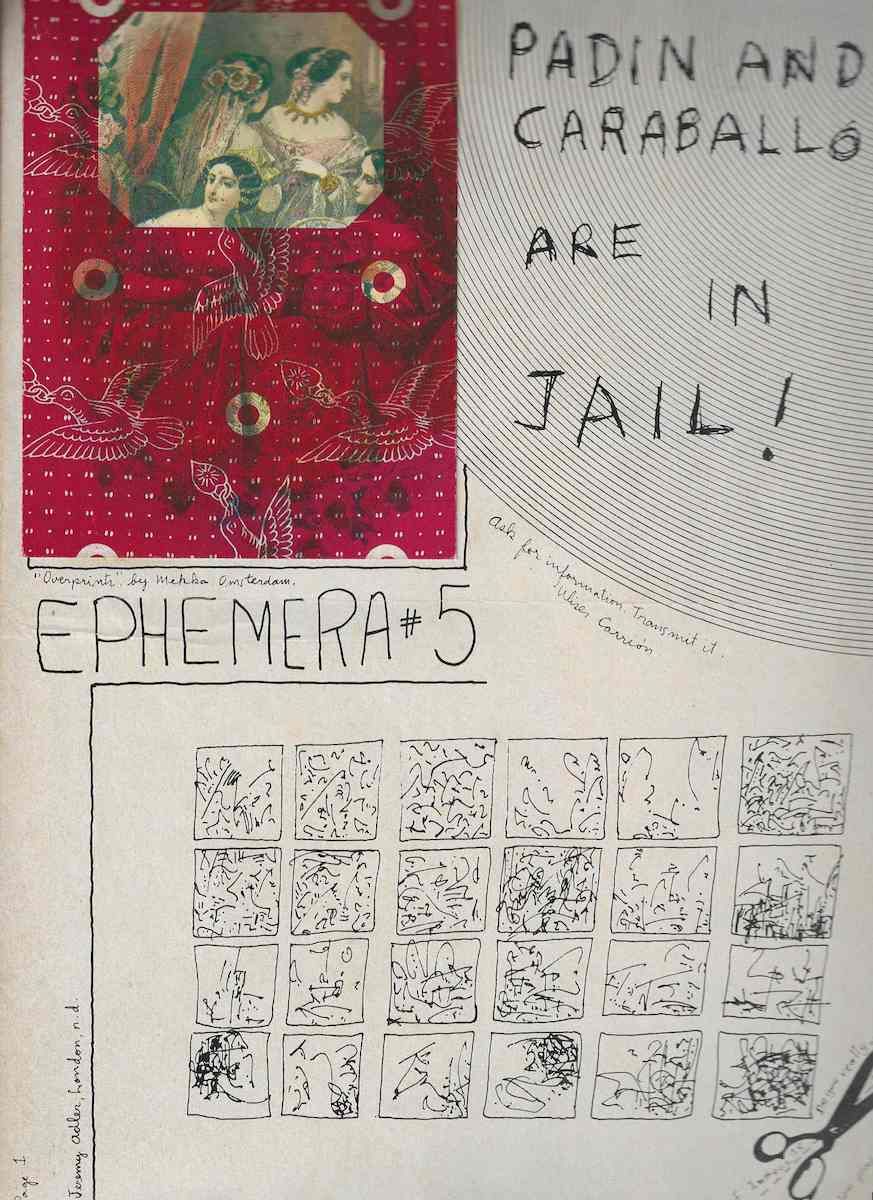
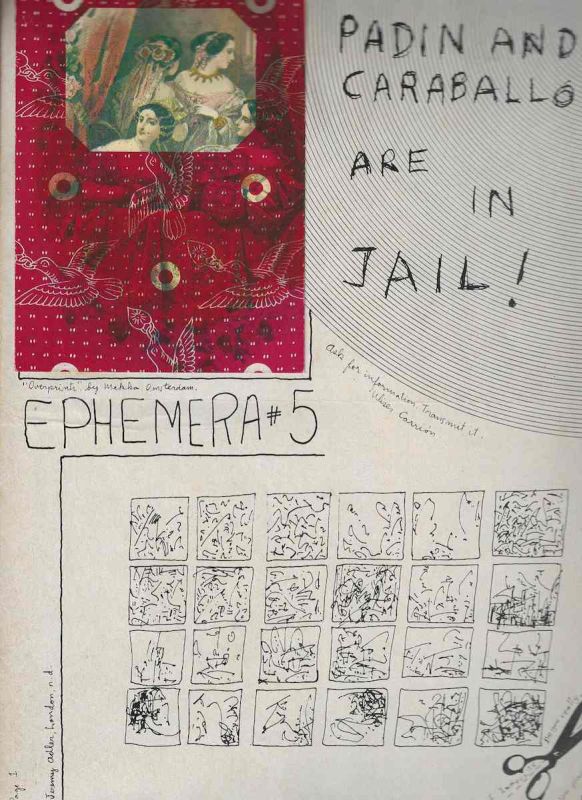
A capa apresenta em destaque manuscrito EPHEMERA #5 e, ocupando grande parte da região superior direita, a mensagem PADIN AND CARABALLO ARE IN JAIL. A inscrição refere se aos artistas uruguaios Clemente Padín e Jorge Caraballo, presos no Uruguai em agosto de 1977. Ulises Carrión utilizou o quinto número de Ephemera como parte da mobilização internacional que circulou informações sobre a prisão dos dois artistas através da rede de Mail Art. Princeton University Library identifica esse número como um dos principais veículos empregados por Carrión na campanha, na qual solicitava aos participantes da rede que buscassem e transmitissem informações sobre a situação de Padín e Caraballo.
A capa transforma essa denúncia política em estrutura gráfica da própria publicação. A mensagem sobre Padín e Caraballo aparece sobre um campo formado por linhas concêntricas, acompanhada da anotação Ask for information. Transmit it e da identificação Ulises Carrión. Dessa maneira, a comunicação postal deixa de ser apenas um meio de distribuição e passa a funcionar como instrumento de mobilização, circulação de informação e solidariedade internacional entre artistas.
O caso de Clemente Padín e Jorge Caraballo constitui um documento significativo para a história da arte postal latino americana. Ambos participaram de redes de poesia experimental, poesia visual e Mail Art e foram detidos durante a ditadura militar uruguaia. A circulação de sua situação através de Ephemera e de outras correspondências internacionais demonstra como a rede postal artística também podia funcionar como sistema descentralizado de informação diante de regimes repressivos e mecanismos de censura.
Outro elemento destacado da capa é uma composição em cores situada na região superior esquerda, formada por imagem figurativa, padrões ornamentais e aves, acompanhada por anotação manuscrita que relaciona o material a Amsterdã. A edição conhecida de Ephemera nº 5 incorpora partes aplicadas e materiais em cor, característica que reforça o caráter de publicação assembling e a utilização de elementos recebidos pela rede postal como componentes físicos da revista.
Na parte inferior da capa aparece uma sequência organizada de pequenos desenhos gestuais distribuídos em módulos quadrangulares. A composição associa repetição, variação gráfica e registro sequencial, enquanto uma imagem de tesoura aparece junto à margem inferior direita. A montagem reúne, assim, denúncia política, desenho, correspondência, imagem impressa, escrita manuscrita e materiais incorporados em uma mesma superfície editorial.
A documentação desta edição registra também a existência de mais de uma versão do número 5. Coleção especializada da série Ephemera identifica duas versões do quinto número associadas à mensagem Padín and Caraballo are in jail, dado relevante para a história editorial e para a comparação de exemplares preservados em diferentes coleções.
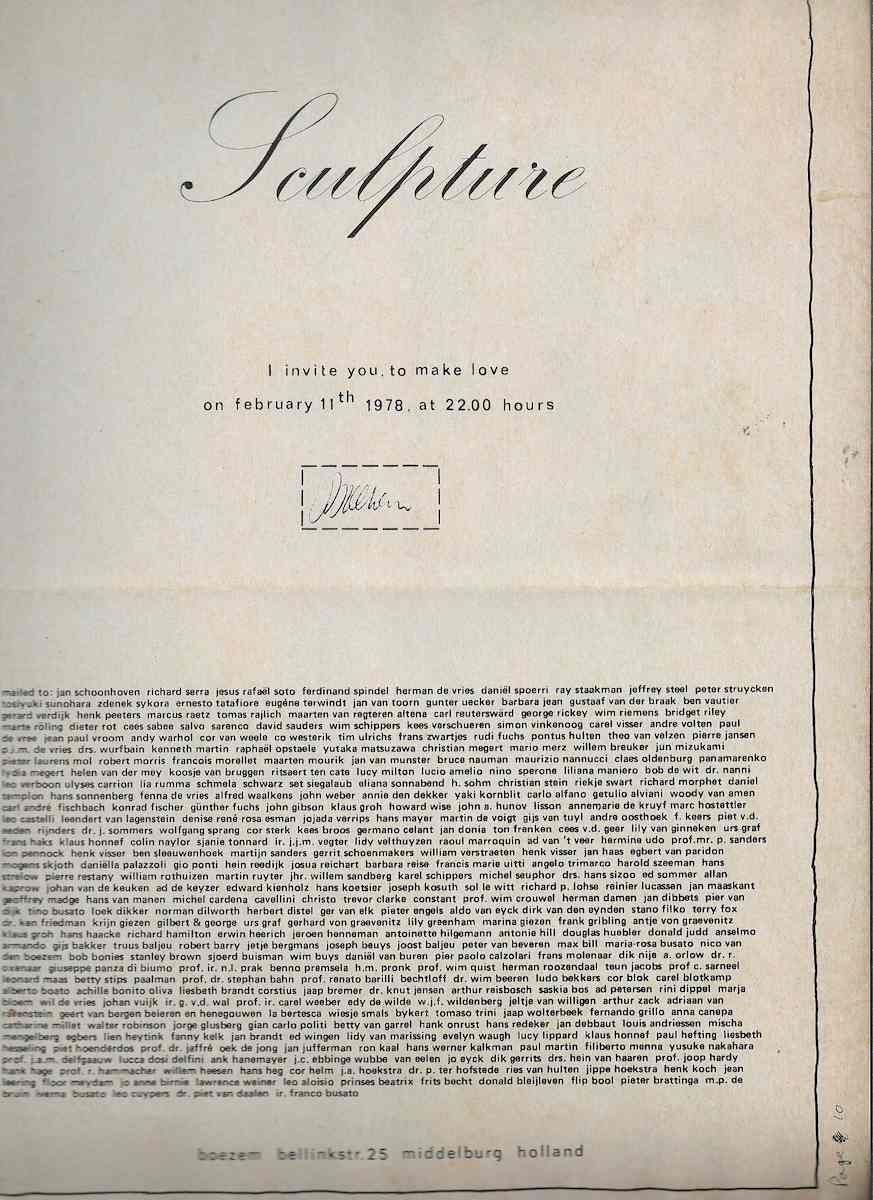
Entre os materiais internos documentados nas imagens encontra se a folha intitulada Sculpture, contendo o texto I invite you to make love on February 11th 1978, at 22.00 hours. A peça apresenta assinatura manuscrita dentro de campo retangular pontilhado e, na parte inferior, extensa relação de destinatários precedida pela indicação mailed to. O endereço impresso ao pé da folha registra Bellinkstr. 25, Middelburg, Holland.
A presença dessa peça dentro de Ephemera evidencia a forma como a revista incorporava proposições, convites, projetos postais e comunicações originalmente concebidas para circular entre numerosos destinatários. O documento relaciona ação, temporalidade, participação e distribuição postal, aspectos recorrentes da arte conceitual e da Mail Art internacional dos anos 1970.
O conjunto de nomes impressos na parte inferior de Sculpture constitui também um registro das redes de circulação artística mobilizadas por esse tipo de projeto. A longa relação de destinatários transforma o documento em um mapa textual de conexões entre artistas, editores, produtores culturais e participantes de diferentes países.
Ephemera nº 5 possui importância particular dentro da série porque explicita a dimensão política que as redes de Mail Art podiam assumir. Ao colocar a prisão de Clemente Padín e Jorge Caraballo no centro de sua capa, Ulises Carrión utilizou a revista não apenas como suporte de obras e documentos, mas como mecanismo internacional de circulação de informação. O periódico registra assim a convergência entre arte postal, poesia experimental, publicação de artista, ativismo cultural, correspondência e redes transnacionais de solidariedade durante a década de 1970.
TEXTO SALSA INGLÊS
Ephemera No 5, published in Amsterdam in March 1978 by Other Books and So, forms part of the international periodical Ephemera, edited by Ulises Carrión, Aart van Barneveld and Salvador Flores and devoted to Mail Art, postal art, ephemeral works, artists publications and alternative artistic communication networks. The issue consists of ten pages measuring approximately 32 × 23 cm and was printed in black and white offset, while also incorporating applied graphic materials and other elements into its editorial composition.
The cover prominently carries the handwritten identification EPHEMERA #5 and, across much of its upper right section, the message PADIN AND CARABALLO ARE IN JAIL. The statement refers to the Uruguayan artists Clemente Padín and Jorge Caraballo, who were arrested in Uruguay in August 1977. Ulises Carrión used the fifth issue of Ephemera as part of the international mobilization that circulated information about their imprisonment through the Mail Art network. Princeton University Library identifies this issue as an important vehicle in Carrións campaign, which encouraged members of the network to obtain and transmit information concerning Padín and Caraballo.
The cover transforms this political denunciation into part of the graphic structure of the publication itself. The statement concerning Padín and Caraballo appears over a field of concentric lines, accompanied by the instruction Ask for information. Transmit it and by the name Ulises Carrión. Postal communication therefore operates not merely as a distribution system but as an instrument for mobilization, information circulation and international solidarity among artists.
The case of Clemente Padín and Jorge Caraballo is a significant document in the history of Latin American postal art. Both artists participated in networks of experimental poetry, visual poetry and Mail Art and were detained during the Uruguayan military dictatorship. The circulation of information concerning their situation through Ephemera and other international correspondence demonstrates how postal art networks could also function as decentralized information systems in the face of censorship and political repression.
Another prominent element on the cover is a color composition in the upper left area, combining figurative imagery, ornamental patterns and birds, accompanied by a handwritten annotation connecting the material with Amsterdam. Documented copies of Ephemera No 5 incorporate applied parts and color elements, reinforcing the character of the magazine as an assembling publication in which materials circulating through the postal network could become physical components of the issue itself.
In the lower portion of the cover is a sequence of small gestural drawings arranged within rectangular modules. The composition combines repetition, graphic variation and sequential notation, while an image of scissors appears along the lower right edge. Political denunciation, drawing, correspondence, printed imagery, handwriting and incorporated materials are thus brought together within the same editorial surface.
Documentation of the series also records more than one version of issue number 5. A specialist record of Ephemera identifies two versions of the fifth issue associated with the Padín and Caraballo are in jail message, an important detail for the editorial history of the magazine and for comparison among copies preserved in different collections.
Among the internal materials visible in the supplied images is a sheet titled Sculpture containing the text I invite you to make love on February 11th 1978, at 22.00 hours. The piece includes a handwritten signature within a dotted rectangular field and, across its lower section, an extensive list of recipients introduced by the words mailed to. The printed address at the bottom records Bellinkstr. 25, Middelburg, Holland.
The inclusion of this piece within Ephemera demonstrates how the magazine incorporated propositions, invitations, postal projects and communications originally designed to circulate among numerous recipients. The document connects action, duration, participation and postal distribution, all recurring concerns within conceptual art and international Mail Art during the 1970s.
The extensive list of names printed at the bottom of Sculpture also records the circulation networks activated by this type of project. The recipients list transforms the document into a textual map of connections among artists, editors, cultural producers and participants from different countries.
Ephemera No 5 holds a particularly significant position within the series because it makes explicit the political dimension that Mail Art networks could assume. By placing the imprisonment of Clemente Padín and Jorge Caraballo at the center of its cover, Ulises Carrión used the magazine not only as a support for artworks and documents but also as an international mechanism for circulating information. The periodical consequently records the convergence of postal art, experimental poetry, artists publishing, cultural activism, correspondence and transnational solidarity networks during the 1970s.
TEXTO DE OBSERVAÇÃO PORTUGUÊS
Exemplar correspondente a Ephemera nº 5, publicado em Amsterdã em março de 1978 por Other Books and So. Fontes especializadas registram Ulises Carrión, Aart van Barneveld e Salvador Flores como editores, dez páginas, dimensão de 32 × 23 cm e impressão offset em preto e branco.
A imagem apresentada corresponde à capa com a identificação manuscrita EPHEMERA #5. Na região superior direita encontra se a inscrição PADIN AND CARABALLO ARE IN JAIL, referente a Clemente Padín e Jorge Caraballo. Próximo à mensagem aparece a anotação Ask for information. Transmit it, seguida da identificação de Ulises Carrión.
A denúncia refere se à prisão dos dois artistas uruguaios em 1977. A campanha internacional conduzida através da rede de Mail Art utilizou Ephemera nº 5 para ampliar a circulação de informações sobre o caso. A documentação da Princeton University Library identifica explicitamente a capa deste número como parte dessa campanha.
Na porção superior esquerda da capa encontra se elemento gráfico colorido aplicado à página, com figuras femininas, padrões ornamentais e representações de aves. Registros bibliográficos de exemplares desta edição indicam presença de partes aplicadas e materiais coloridos, aspecto material relevante para distinguir o exemplar e compreender a construção assembling da revista.
A metade inferior apresenta o título EPHEMERA #5 manuscrito e uma grade composta por pequenos módulos com desenhos gestuais. Uma representação de tesoura aparece junto à margem inferior direita, integrando se visualmente à composição.
A segunda imagem registra uma peça intitulada Sculpture. O texto impresso informa I invite you to make love on February 11th 1978, at 22.00 hours. Existe assinatura manuscrita no interior de um retângulo pontilhado.
A parte inferior de Sculpture contém extensa lista de nomes precedida por mailed to, documentando sua distribuição a numerosos destinatários. Ao pé da folha aparece o endereço Bellinkstr. 25, Middelburg, Holland. A identificação segura do autor da peça não foi estabelecida somente a partir das imagens apresentadas e, por isso, não foi atribuída.
A data de 11 de fevereiro de 1978 impressa em Sculpture corresponde à ação ou proposição contida nesse documento e não à data editorial de Ephemera nº 5. A data bibliográfica do periódico é março de 1978.
Existem registros de duas versões de Ephemera nº 5 relacionadas à campanha Padín and Caraballo are in jail. Esse dado deve ser considerado na comparação entre exemplares e na identificação de eventuais variações materiais ou gráficas da edição.
TEXTO DE OBSERVAÇÃO INGLÊS
Copy of Ephemera No 5, published in Amsterdam in March 1978 by Other Books and So. Specialist bibliographic sources identify Ulises Carrión, Aart van Barneveld and Salvador Flores as editors and record ten pages, dimensions of 32 × 23 cm and black and white offset printing.
The supplied image shows the cover bearing the handwritten identification EPHEMERA #5. In the upper right section is the statement PADIN AND CARABALLO ARE IN JAIL, referring to Clemente Padín and Jorge Caraballo. Close to this statement appears the instruction Ask for information. Transmit it, followed by the identification of Ulises Carrión.
The statement concerns the imprisonment of the two Uruguayan artists in 1977. The international campaign conducted through the Mail Art network used Ephemera No 5 to expand the circulation of information concerning the case. Princeton University Library documentation explicitly identifies the cover of this issue as part of that campaign.
The upper left area of the cover contains a color graphic element applied to the page, combining female figures, ornamental patterns and images of birds. Bibliographic descriptions of surviving copies record attached parts and color elements in this issue, an important material characteristic for identifying the copy and understanding the assembling structure of the publication.
The lower half includes the handwritten title EPHEMERA #5 and a grid composed of small modules containing gestural drawings. A representation of scissors appears near the lower right edge and forms part of the overall visual composition.
The second supplied image documents a piece titled Sculpture. Its printed text states I invite you to make love on February 11th 1978, at 22.00 hours. A handwritten signature appears inside a dotted rectangular field.
The lower section of Sculpture contains an extensive list of names introduced by mailed to, documenting distribution to numerous recipients. The address Bellinkstr. 25, Middelburg, Holland appears at the bottom. The authorship of this piece cannot be securely established from the supplied images alone and has therefore not been assigned.
The date February 11th 1978 printed on Sculpture refers to the action or proposition contained in that document and should not be confused with the editorial date of Ephemera No 5. The bibliographic publication date of the periodical is March 1978.
Records indicate the existence of two versions of Ephemera No 5 associated with the Padín and Caraballo are in jail campaign. This information should be considered when comparing surviving copies and identifying possible material or graphic variations within the issue.
Inglês
Ephemera nº 5, 1978
Dimensions: 12,6 x 9,1 in