O Por Que do Happening nas Escadarias do Teatro Municipal
1a Exposição Nacional de Poema Processo - A 1a Grande Exposição do Movimento
Categoria: Poema Processo
Acervo: 04704
Data: 1967
Dimensões: 27,7 x 22 cm
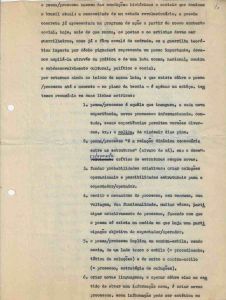
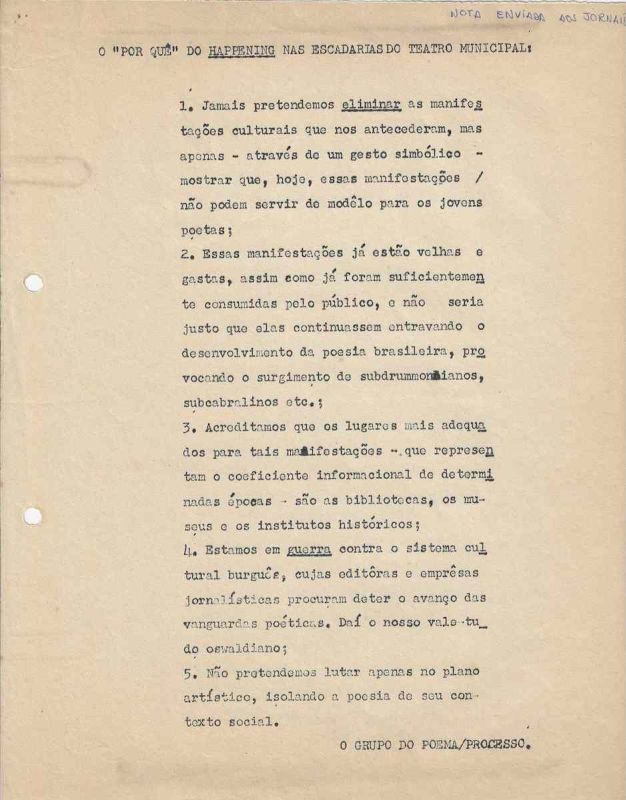
O Por Que do Happening nas Escadarias do Teatro Municipal é um texto datiloscrito do Grupo do Poema Processo que apresenta uma justificativa programática para o happening realizado ou planejado para as escadarias do Teatro Municipal. Na margem superior direita há uma anotação manuscrita indicando que se trata de uma nota enviada aos jornais, o que identifica o documento também como material de divulgação e posicionamento público do grupo.
O texto é organizado em cinco pontos e explicita argumentos do Grupo do Poema Processo contra modelos culturais anteriores que, segundo os autores, já não poderiam servir de referência aos jovens poetas. O primeiro ponto afirma que o grupo não pretendia eliminar manifestações culturais antecedentes, mas realizar um gesto simbólico que demonstrasse que essas manifestações não deveriam continuar funcionando como modelo para a nova geração.
No segundo ponto, o documento caracteriza essas manifestações como velhas, gastas e já suficientemente consumidas pelo público. O grupo argumenta que sua permanência como referência poderia dificultar o desenvolvimento da poesia brasileira e provocar o surgimento de formas imitativas ou derivadas, mencionadas no texto por termos críticos como subdrummondianos e subcabralinos.
O terceiro ponto afirma que bibliotecas, museus e institutos históricos seriam os lugares adequados para manifestações culturais representativas de determinadas épocas. A formulação estabelece uma distinção entre preservação histórica e continuidade como modelo ativo para a criação contemporânea.
O quarto ponto declara uma posição de confronto com o sistema cultural vigente. O Grupo do Poema Processo afirma estar em guerra contra o sistema cultural burguês e acusa editoras e empresas jornalísticas de tentarem impedir o avanço das vanguardas poéticas. O documento utiliza a expressão valo tudo oswaldiano para caracterizar essa atitude de enfrentamento, estabelecendo uma referência direta à tradição de ruptura associada a Oswald de Andrade.
No quinto e último ponto, o grupo afirma que sua luta não se restringia ao plano artístico e que a poesia não deveria ser isolada de seu contexto social. Essa declaração aproxima explicitamente a prática do Poema Processo de uma concepção de poesia vinculada às transformações sociais, culturais e comunicacionais de seu tempo.
Assinado coletivamente como O Grupo do Poema Processo, o documento constitui uma fonte primária para a compreensão das posições teóricas, culturais e públicas do movimento, especialmente no contexto do happening nas escadarias do Teatro Municipal e da defesa de uma ruptura com modelos literários considerados superados.
TEXTO SALSA INGLÊS
Why the Happening on the Steps of the Municipal Theatre is a typewritten text issued by the Poema Processo Group presenting a programmatic justification for the happening held or planned for the steps of the Municipal Theatre. A handwritten note in the upper right margin indicates that the document was sent to newspapers, identifying it also as material intended for public communication and dissemination of the group?s position.
The text is organized into five points and sets out the arguments of the Poema Processo Group against earlier cultural models which, according to the authors, could no longer serve as references for young poets. The first point states that the group did not intend to eliminate previous cultural manifestations, but rather to perform a symbolic gesture demonstrating that such manifestations should no longer function as models for a new generation.
In the second point, the document characterizes these manifestations as old, worn out and already sufficiently consumed by the public. The group argues that their continued dominance as models could hinder the development of Brazilian poetry and generate derivative or imitative forms, referred to in the document through critical terms such as subdrummondianos and subcabralinos.
The third point states that libraries, museums and historical institutes are the appropriate places for cultural manifestations representing particular historical periods. This formulation establishes a distinction between historical preservation and the continued use of those manifestations as active models for contemporary artistic creation.
The fourth point declares an openly confrontational position toward the existing cultural system. The Poema Processo Group states that it is at war with the bourgeois cultural system and accuses publishing houses and journalistic companies of attempting to restrict the advance of poetic avant gardes. The document uses the expression Oswaldian anything goes to characterize this attitude of confrontation, establishing a direct reference to the tradition of rupture associated with Oswald de Andrade.
In the fifth and final point, the group states that its struggle was not limited to the artistic field and that poetry should not be isolated from its social context. This declaration explicitly associates the practice of Poema Processo with a conception of poetry connected to the social, cultural and communicational transformations of its time.
Collectively signed as The Poema Processo Group, the document is a primary source for understanding the theoretical, cultural and public positions of the movement, particularly in relation to the happening on the steps of the Municipal Theatre and its defense of a break with literary models considered obsolete.
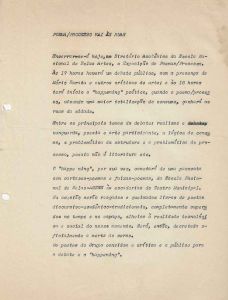
O documento é uma folha datilografada com o título O POR QUE DO HAPPENING NAS ESCADARIAS DO TEATRO MUNICIPAL na parte superior. Na margem superior direita existe a anotação manuscrita Nota enviada aos jornais, informação relevante para identificar sua provável função como comunicado ou nota de imprensa do Grupo do Poema Processo.
O texto apresenta cinco itens numerados. No primeiro, o grupo afirma que não pretendia eliminar manifestações culturais anteriores, mas demonstrar simbolicamente que elas não poderiam continuar servindo de modelo aos jovens poetas.
No segundo item aparecem referências críticas a formas derivativas da poesia brasileira, com os termos subdrummondianos e subcabralinos. Esses vocábulos são importantes porque indicam uma crítica direta à repetição de modelos poéticos anteriores e devem ser preservados como terminologia documental do próprio texto.
O terceiro item cita bibliotecas, museus e institutos históricos como espaços destinados à conservação de manifestações representativas de épocas determinadas. O quarto declara guerra ao sistema cultural burguês e acusa editoras e empresas jornalísticas de tentar deter o avanço das vanguardas poéticas. Nesse mesmo trecho aparece a expressão valo tudo oswaldiano, cuja grafia foi preservada conforme a leitura visível do documento.
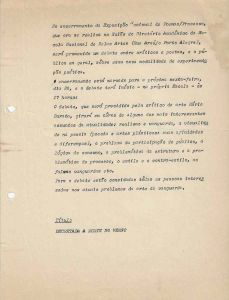
O quinto item afirma que a luta do grupo não se restringia ao plano artístico e que a poesia não deveria ser isolada de seu contexto social. Na parte inferior, o documento é encerrado com a identificação coletiva O GRUPO DO POEMA/PROCESSO.
A imagem apresenta duas perfurações circulares na margem esquerda, marcas de dobra e sinais de envelhecimento do papel. Não há data visível na folha. Embora o conteúdo dialogue diretamente com os documentos anteriormente relacionados ao happening do Poema Processo nas escadarias do Teatro Municipal, não é documentalmente seguro atribuir a este exemplar a data de 26 de dezembro de 1967 sem evidência adicional. Por isso, o campo Data permanece como não identificado, em conformidade com a regra de não transformar hipótese em fato.
TEXTO DE OBSERVAÇÃO INGLÊS
The document is a typewritten sheet bearing the title O POR QUE DO HAPPENING NAS ESCADARIAS DO TEATRO MUNICIPAL at the top. In the upper right margin there is a handwritten note stating that it was a note sent to newspapers, an important indication of its probable function as a press statement or public communication issued by the Poema Processo Group.
The text is structured in five numbered sections. In the first, the group states that it did not intend to eliminate previous cultural manifestations, but rather to symbolically demonstrate that they could no longer serve as models for young poets.
The second section contains critical references to derivative forms of Brazilian poetry through the terms subdrummondianos and subcabralinos. These terms are significant because they indicate a direct critique of the repetition of earlier poetic models and should be preserved as part of the historical terminology of the document.
The third section refers to libraries, museums and historical institutes as appropriate spaces for preserving cultural manifestations representative of particular periods. The fourth declares war against the bourgeois cultural system and accuses publishing houses and journalistic companies of attempting to halt the advance of poetic avant gardes. The same section includes the expression valo tudo oswaldiano, preserved according to the visible wording of the document.
The fifth section states that the group?s struggle was not restricted to the artistic field and that poetry should not be isolated from its social context. At the bottom of the sheet, the document is collectively signed O GRUPO DO POEMA/PROCESSO.
The image shows two circular perforations along the left margin, fold marks and signs of paper aging. No date is visible on the sheet. Although its content clearly relates to other documents concerning the Poema Processo happening on the steps of the Municipal Theatre, there is not enough evidence in this document alone to assign it the date December 26, 1967 with certainty. The date therefore remains unidentified.
Proveniência
Coleção Poema ProcessoInglês
Why the Happening on the Steps of the Municipal Theatre
Dimensions: 10,9 x 8,7 in