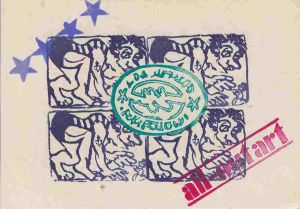
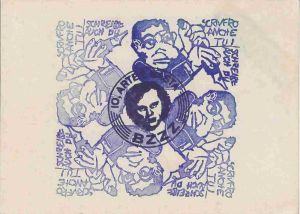
Cartão postal artístico de Henryk Bzdok enviado da Polônia ao artista brasileiro Falves Silva, em Natal, Rio Grande do Norte, com data manuscrita de 8 de junho de 1977
Henryk Bzdok -BZZZ ART IN CONTACT, BZZZ AS ART, Art in contact e BZZZ - Polonia
Categoria: Mail Art
Acervo: 04453
Data: 8 de Junho de 1977
Dimensões: 10,5 x 14,8 cm
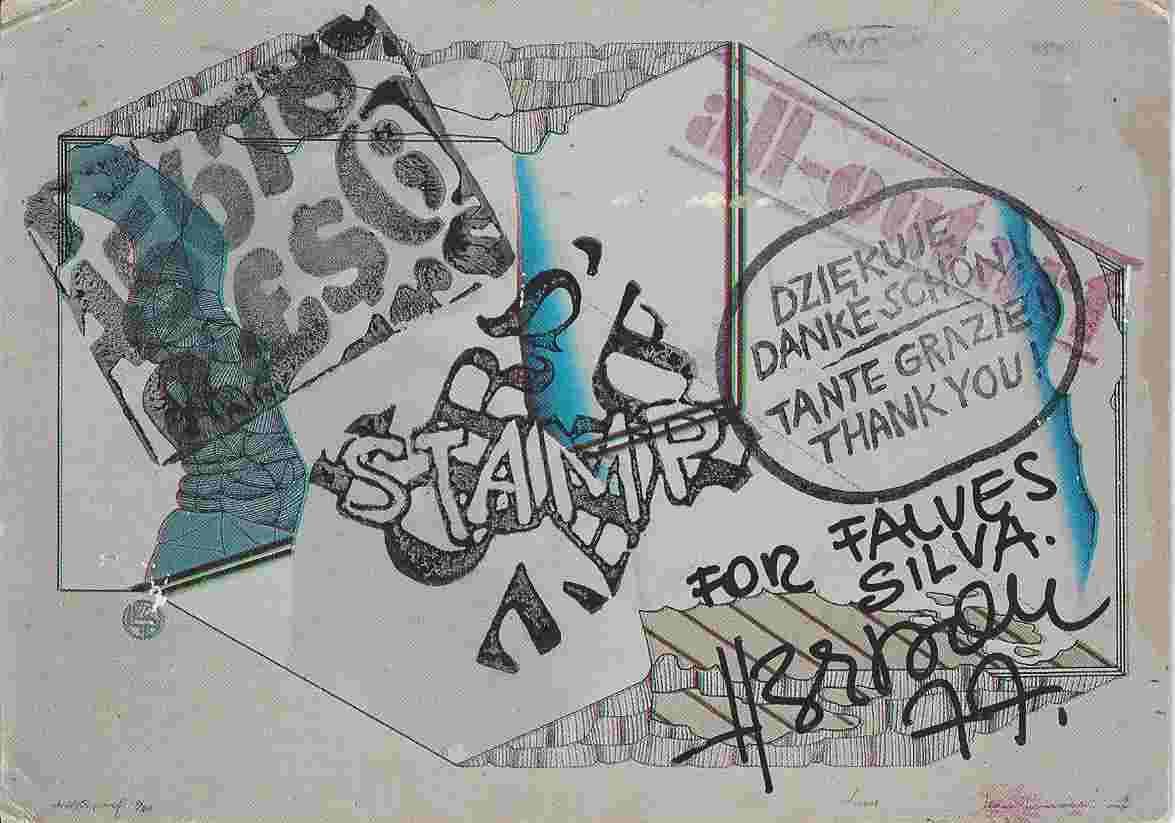
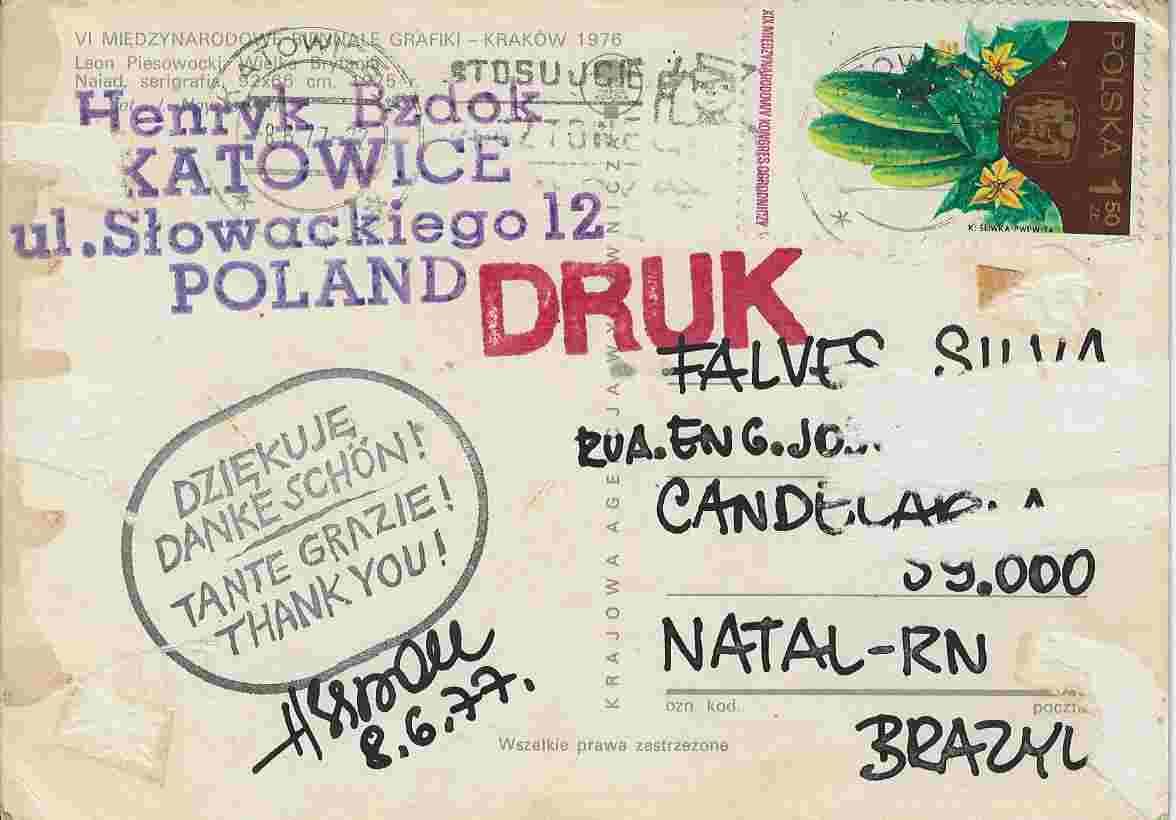
Texto Salsa em portuguêsCartão postal artístico de Henryk Bzdok enviado da Polônia ao artista brasileiro Falves Silva, em Natal, Rio Grande do Norte, com data manuscrita de 8 de junho de 1977. O documento constitui um exemplo significativo da arte postal internacional dos anos 1970 e registra uma conexão direta entre a rede polonesa de mail art e a produção experimental brasileira vinculada a Falves Silva, poesia visual e ao ambiente do Poema Processo.Henryk Bzdok, nascido em 1937, é artista gráfico polonês formado na área de artes gráficas da Academia de Belas Artes de Cracóvia. Sua atuação profissional incluiu design gráfico, cartaz, ilustração, desenho satírico, gráfica editorial e posteriormente arte postal e rubber stamp art. A partir de meados da década de 1970 tornou se ativo nas redes internacionais de mail art, sendo particularmente reconhecido pelo uso de carimbos como linguagem artística e por projetos relacionados a BZZZ Art, cartões, mensagens gráficas e circulação de obras por correspondência.O suporte utilizado neste envio possui origem anterior à intervenção de Bzdok. No verso permanece visível material impresso relacionado à VII Mi
dzynarodowe Biennale Grafiki, Kraków 1976, a sétima Bienal Internacional de Gravura de Cracóvia, realizada na Polônia em 1976. Bzdok reutilizou esse cartão como suporte para uma nova obra postal, acrescentando carimbos, escrita manual, desenho e intervenções gráficas. Essa reutilização transforma um impresso institucional em objeto artístico individual e documento de circulação internacional.O endereço do remetente identifica Henryk Bzdok em Katowice, Polônia, na rua S
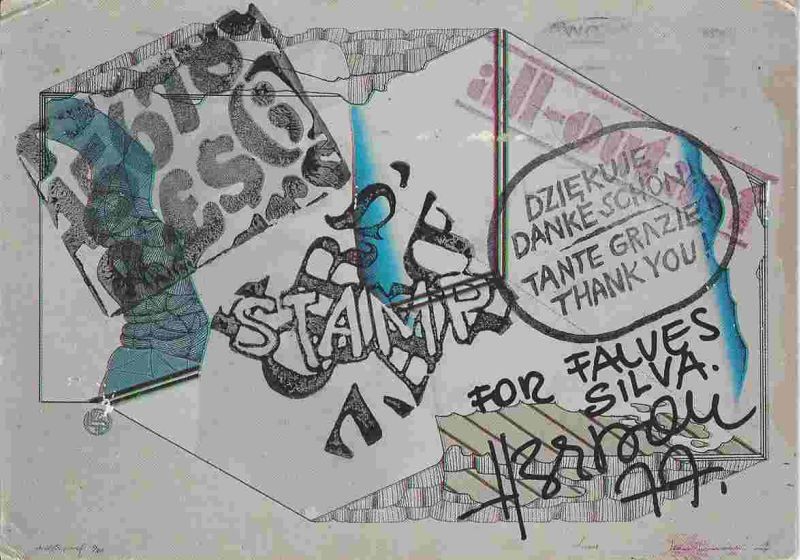
owackiego 12. O destinatário é Falves Silva, em Natal, Rio Grande do Norte, Brasil. A presença dos nomes, endereços, selo postal, inscrições e sinais de circulação confirma materialmente a passagem do cartão pelo sistema de correspondência e reforça sua classificação como mail art.Na face principal, Bzdok constrói uma composição gráfica complexa com desenho linear, impressão, carimbos, manchas, sobreposições e interferências em diferentes tonalidades. A estrutura lembra um espaço tridimensional ou uma caixa aberta, dentro da qual imagens e palavras se acumulam. Áreas em preto, azul, rosa e outras tonalidades atravessam a superfície e convivem com fragmentos gráficos de diferentes origens.No centro da composição aparece uma grande intervenção gráfica com letras e formas sobrepostas. À direita encontra se um balão contendo agradecimentos em diferentes idiomas, incluindo Dzi
kuj
em polonês, Danke Schön em alemão, Tante Grazie em italiano e Thank You em inglês. O uso simultâneo de diferentes línguas transforma a mensagem de agradecimento em signo internacional e corresponde ao caráter transnacional da mail art, construída para circular entre participantes de diferentes países sem depender de uma única língua.Na mesma região aparece a inscrição FOR FALVES SILVA, individualizando a peça e confirmando que a intervenção foi concebida especificamente para o artista brasileiro. Próximo à parte inferior encontra se uma assinatura gestual de Bzdok. O cartão deixa assim de ser apenas um suporte reproduzido e adquire condição de obra postal personalizada.No verso, além das informações originalmente impressas da Bienal Internacional de Gravura de Cracóvia de 1976, aparecem numerosas interferências de Bzdok. O nome Henryk Bzdok e a cidade KATOWICE são destacados por grandes carimbos ou letras em violeta. A palavra DRUK aparece em vermelho. Também permanecem visíveis inscrições, carimbos, elementos gráficos, um selo postal polonês e a escrita manual do endereço de Falves Silva no Brasil.Um grande carimbo circular de agradecimento aparece novamente no verso, repetindo a mensagem multilíngue e funcionando como elemento de identidade gráfica da correspondência. A repetição entre frente e verso demonstra que Bzdok tratou toda a superfície postal como espaço de criação e não apenas a face tradicionalmente destinada à imagem.A correspondência de 1977 possui especial valor porque não representa um contato isolado. Arquivos brasileiros preservam outros trabalhos enviados por Henryk Bzdok a Falves Silva em 1977, 1979 e 1980, incluindo peças identificadas como Peace, Retocado, BZZZ ART IN CONTACT, BZZZ AS ART e Art in contact. Esses registros demonstram continuidade no intercâmbio entre Bzdok e Falves Silva e situam o artista brasileiro dentro da rede internacional de correspondência de Bzdok.A documentação internacional sobre Bzdok confirma sua atividade na mail art durante as décadas de 1970 e 1980 e destaca especialmente seus carimbos de borracha. Fontes históricas registram projetos como BZZZ carts, cartões produzidos com carimbos artesanais, além de um projeto postal de 1977 que convidava o destinatário a acrescentar seu endereço e reenviar o cartão a outro artista. Esse procedimento revela uma concepção de obra baseada em contato, circulação, participação e expansão da rede.O cartão enviado a Falves Silva em 8 de junho de 1977 constitui, portanto, documento primário da história da arte postal entre Polônia e Brasil. A peça articula Henryk Bzdok, Falves Silva, Katowice, Natal, Bienal Internacional de Gravura de Cracóvia, mail art, rubber stamp art, poesia visual, arte gráfica, correspondência de artistas, redes alternativas, BZZZ Art e circulação internacional da arte durante a década de 1970.Salsa text in EnglishPostal artwork by Henryk Bzdok sent from Poland to Brazilian artist Falves Silva in Natal, Rio Grande do Norte, bearing the handwritten date June 8, 1977. The document is a significant example of international mail art during the 1970s and records a direct connection between the Polish mail art network and Brazilian experimental practices associated with Falves Silva, visual poetry and the cultural environment surrounding the Process Poem Movement.Henryk Bzdok, born in 1937, is a Polish graphic artist who studied graphic arts at the Academy of Fine Arts in Kraków. His professional activities included graphic design, poster design, illustration, satirical drawing, editorial graphics and later mail art and rubber stamp art. From the mid 1970s onward he became active within international mail art networks and was particularly recognized for using rubber stamps as an artistic language and for projects associated with BZZZ Art, postcards, graphic messages and the circulation of works through correspondence.The support used for this mailing predates Bzdok's intervention. On the reverse remains printed material connected with the VII Mi
dzynarodowe Biennale Grafiki, Kraków 1976, the seventh International Print Biennale in Kraków, Poland, held in 1976. Bzdok reused this printed card as the support for a new postal artwork, adding stamps, handwriting, drawing and graphic interventions. This reuse transforms an institutional printed object into an individual artwork and a document of international circulation.The sender information identifies Henryk Bzdok in Katowice, Poland, at S
owackiego Street 12. The recipient is Falves Silva in Natal, Rio Grande do Norte, Brazil. The presence of names, addresses, postage, inscriptions and evidence of circulation materially confirms the passage of the card through the postal system and supports its classification as mail art.On the principal side, Bzdok created a complex graphic composition combining linear drawing, printing, rubber stamps, stains, overlays and interventions in several tones. The structure resembles a three dimensional space or open box within which images and words accumulate. Areas of black, blue, pink and other tones cross the surface and coexist with graphic fragments from different sources.At the center is a large graphic intervention formed by overlapping letters and shapes. On the right appears a speech balloon containing words of thanks in several languages, including Dzi
kuj
in Polish, Danke Schön in German, Tante Grazie in Italian and Thank You in English. The simultaneous use of several languages transforms the message of gratitude into an international sign and corresponds to the transnational character of mail art, which circulated among participants from different countries without depending on a single language.The inscription FOR FALVES SILVA appears in the same area, individualizing the piece and confirming that the intervention was conceived specifically for the Brazilian artist. A gestural signature by Bzdok is visible toward the lower portion. The card therefore ceases to function only as a reproduced support and becomes a personalized postal artwork.On the reverse, in addition to the original printed information from the 1976 International Print Biennale in Kraków, numerous interventions by Bzdok are visible. The name Henryk Bzdok and the city KATOWICE are emphasized through large violet stamped or printed letters. The word DRUK appears in red. Additional inscriptions, stamps, graphic marks, Polish postage and the handwritten Brazilian address of Falves Silva remain visible.A large circular stamp containing the multilingual expression of thanks appears again on the reverse, repeating the message from the front and functioning as an element of graphic identity. This repetition between both sides demonstrates that Bzdok treated the entire postal surface as an artistic field rather than limiting the work to the conventional image side of the postcard.The 1977 correspondence is especially significant because it was not an isolated contact. Brazilian archives preserve additional works sent by Henryk Bzdok to Falves Silva in 1977, 1979 and 1980, including pieces catalogued as Peace, Retocado, BZZZ ART IN CONTACT, BZZZ AS ART and Art in contact. These records demonstrate continuity in the exchange between Bzdok and Falves Silva and position the Brazilian artist within Bzdok's international correspondence network.International documentation confirms Bzdok's activity in mail art during the 1970s and 1980s and particularly emphasizes his use of rubber stamps. Historical sources record projects such as BZZZ carts, postcards produced with handmade rubber stamps, as well as a 1977 postal project inviting the recipient to add an address and send the card onward to another artist. This procedure reveals an understanding of art based on contact, circulation, participation and the expansion of the network.The card sent to Falves Silva on June 8, 1977 therefore constitutes a primary document in the history of mail art between Poland and Brazil. The piece connects Henryk Bzdok, Falves Silva, Katowice, Natal, the International Print Biennale in Kraków, mail art, rubber stamp art, visual poetry, graphic art, artists correspondence, alternative networks, BZZZ Art and the international circulation of art during the 1970s.
Texto de observação em portuguêsCartão postal intervencionado por Henryk Bzdok e destinado a Falves Silva, Natal, Rio Grande do Norte, Brasil, com data manuscrita de 8 de junho de 1977. A peça apresenta intervenções em ambas as faces e deve ser considerada simultaneamente obra de mail art, correspondência de artista e documento material de circulação entre Polônia e Brasil.O suporte original corresponde a cartão impresso relacionado à VII Mi
dzynarodowe Biennale Grafiki, Kraków 1976, a sétima Bienal Internacional de Gravura de Cracóvia. Essa informação permanece parcialmente legível na face destinada à correspondência. A reutilização de material gráfico de uma bienal internacional integra a estratégia visual da obra e cria uma sobreposição entre documento institucional e intervenção artística pessoal.Na face principal observa se uma composição construída sobre linhas que sugerem uma estrutura espacial aberta. Sobre esse desenho foram acrescentados fragmentos de imagens, padrões impressos, manchas, letras, grafismos e áreas de tonalidades azul, rosa, preto e outras cores.Um elemento central é a inscrição gráfica formada por grandes letras parcialmente sobrepostas. A composição combina diferentes escalas tipográficas e interfere diretamente sobre as imagens anteriores do cartão.À direita encontra se um grande balão desenhado contendo palavras de agradecimento em vários idiomas. São legíveis Dzi
kuj
, Danke Schön, Tante Grazie e Thank You. A multiplicidade linguística reforça o conceito de comunicação internacional característico da arte postal.Abaixo aparece a inscrição FOR FALVES SILVA, que identifica nominalmente o destinatário dentro da própria composição artística. A presença do nome de Falves Silva sobre a obra demonstra personalização e confirma que o cartão foi transformado especificamente para essa correspondência.Na região inferior direita aparece assinatura gestual atribuível a Henryk Bzdok. A combinação de assinatura, dedicatória, carimbos, escrita e intervenção manual contribui para caracterizar o objeto como peça original de correspondência artística.No verso permanece visível o texto impresso da VII Mi
dzynarodowe Biennale Grafiki, Kraków 1976. Também aparecem impressões e interferências superpostas que dificultam parcialmente a leitura do material original.O nome Henryk Bzdok aparece em grandes caracteres violeta, seguido por KATOWICE. Abaixo é legível o endereço ul. S
owackiego 12, POLAND. Registros históricos de mail art também associam Bzdok ao endereço S
owackiego 12, Katowice, confirmando a identificação do remetente.Em vermelho aparece a palavra DRUK, termo polonês relacionado a material impresso. Na região superior direita está fixado selo postal polonês com motivo vegetal. Existem ainda marcas postais e outros sinais de processamento e circulação.O destinatário foi escrito manualmente em tinta preta. São legíveis Falves Silva, referência a rua em Candelária, o código 59000, Natal, RN e Brazil. Partes intermediárias do endereço encontram se parcialmente encobertas ou de leitura incerta e não devem ser reconstruídas por suposição.Na região inferior esquerda do verso aparece novamente o grande carimbo circular com agradecimentos multilíngues. Abaixo encontra se assinatura e a data manuscrita 8.6.77, correspondente a 8 de junho de 1977.A obra apresenta marcas de envelhecimento, abrasões, pequenas perdas superficiais, manchas, vincos e alterações decorrentes de manuseio e circulação postal. Essas características devem ser preservadas documentalmente, pois fazem parte da trajetória física da peça.A pesquisa externa confirma que Henryk Bzdok nasceu em 1937, estudou na Academia de Belas Artes de Cracóvia e participou ativamente da rede de mail art nas décadas de 1970 e 1980, sendo especialmente associado à rubber stamp art.O intercâmbio com Falves Silva possui continuidade documentada. Existem registros de outras peças de Bzdok destinadas ao artista brasileiro em 1977, 1979 e 1980. Entre os títulos catalogados encontram se Peace, Retocado, BZZZ ART IN CONTACT, BZZZ AS ART e Art in contact.Documento relevante para pesquisas sobre Henryk Bzdok, Falves Silva, BZZZ Art, Katowice, Cracóvia, Polônia, Natal, Rio Grande do Norte, Brasil, mail art, arte postal, rubber stamp art, carimbo de artista, poesia visual, arte gráfica, correspondência internacional, Bienal Internacional de Gravura de Cracóvia e redes alternativas de artistas durante a década de 1970.Observation text in EnglishPostal card intervened by Henryk Bzdok and addressed to Falves Silva in Natal, Rio Grande do Norte, Brazil, bearing the handwritten date June 8, 1977. The piece contains interventions on both sides and should be understood simultaneously as mail art, artists correspondence and material documentation of circulation between Poland and Brazil.The original support is a printed card related to the VII Mi
dzynarodowe Biennale Grafiki, Kraków 1976, the seventh International Print Biennale in Kraków. This information remains partly legible on the correspondence side. The reuse of graphic material from an international biennale forms part of the visual strategy of the piece and creates an overlap between an institutional document and a personal artistic intervention.The principal side contains a composition constructed over lines suggesting an open spatial structure. Fragments of images, printed patterns, stains, letters, graphic marks and areas of blue, pink, black and other tones have been added over this structure.A central element is a graphic inscription formed by large partially overlapping letters. The composition combines different typographic scales and directly interferes with earlier printed imagery on the card.On the right is a large drawn speech balloon containing expressions of thanks in several languages. Dzi
kuj
, Danke Schön, Tante Grazie and Thank You are legible. The multilingual character reinforces the principle of international communication associated with postal art.Below this element appears the inscription FOR FALVES SILVA, identifying the recipient by name within the artistic composition itself. The inclusion of Falves Silva's name confirms the personalized character of the intervention and demonstrates that the card was transformed specifically for this correspondence.A gestural signature attributable to Henryk Bzdok appears in the lower right area. The combination of signature, dedication, rubber stamps, handwriting and manual intervention supports its classification as an original piece of artists correspondence.On the reverse, the printed text related to the VII Mi
dzynarodowe Biennale Grafiki, Kraków 1976 remains visible. Numerous overprinted marks and interventions partially obscure the original information.The name Henryk Bzdok appears in large violet characters followed by KATOWICE. Below it the address ul. S
owackiego 12, POLAND can be read. Historical mail art records also associate Bzdok with S
owackiego 12 in Katowice, confirming the identification of the sender.The word DRUK appears in red, a Polish term related to printed matter. A Polish postage stamp with a botanical motif is attached in the upper right area. Postal cancellations and additional signs of processing and circulation are also visible.The recipient information was handwritten in black ink. Falves Silva, a reference to an address in Candelária, the postal code 59000, Natal, RN and Brazil are legible. Intermediate portions of the address are partly obscured or uncertain and should not be reconstructed through conjecture.The large circular multilingual stamp of thanks appears again in the lower left portion of the reverse. Below it are a signature and the handwritten date 8.6.77, corresponding to June 8, 1977.The piece shows aging, abrasion, minor surface losses, stains, creases and alterations resulting from handling and postal circulation. These characteristics should be preserved as documentary evidence because they form part of the physical history of the object.External research confirms that Henryk Bzdok was born in 1937, studied at the Academy of Fine Arts in Kraków and was active within international mail art networks during the 1970s and 1980s, becoming particularly associated with rubber stamp art.His exchange with Falves Silva has documented continuity. Records identify additional pieces by Bzdok sent to the Brazilian artist in 1977, 1979 and 1980. Catalogued titles include Peace, Retocado, BZZZ ART IN CONTACT, BZZZ AS ART and Art in contact.Document relevant to research on Henryk Bzdok, Falves Silva, BZZZ Art, Katowice, Kraków, Poland, Natal, Rio Grande do Norte, Brazil, mail art, postal art, rubber stamp art, artist stamps, visual poetry, graphic art, international artists correspondence, the International Print Biennale in Kraków and alternative artist networks during the 1970s.
Proveniência
Coleção Falves SilvaInglês
Postal artwork by Henryk Bzdok sent from Poland to Brazilian artist Falves Silva in Natal, Rio Grande do Norte, bearing the handwritten date June 8, 1977.
Dimensions: 4,1 x 5,8 in