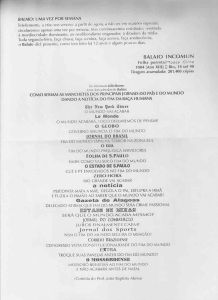
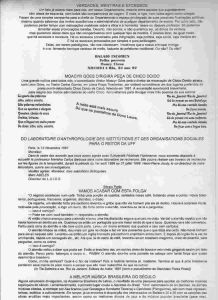
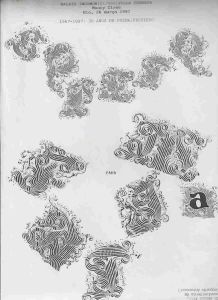
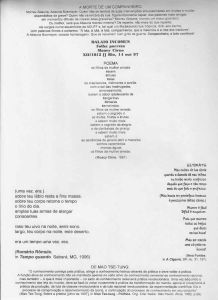
Balaio Incomum, Folha Porreta, X 845, publicação de Moacy Cirne, Rio de Janeiro, 26 de junho de 1996. O documento integra a série comemorativa 1986 1996 Dez anos de Balaio, número 35
Moacy Cirne
Categoria: Categoria: Publicação seriadaSubcategoria: Boletim experimentalClassificação complementar: Poesia visual; Documento editorial; Arte conceitual; Documento de rede
Acervo: 04275
Data: 26 de junho de 1996
Dimensões: 33 x 21,5 cm
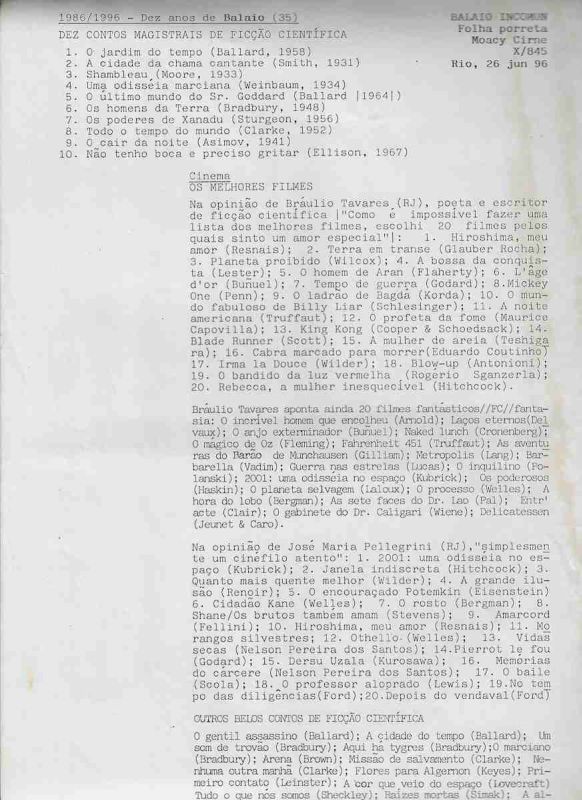
Texto Salsa em portuguêsBalaio Incomum, Folha Porreta, X 845, publicação de Moacy Cirne, Rio de Janeiro, 26 de junho de 1996. O documento integra a série comemorativa 1986 1996 Dez anos de Balaio, número 35, e constitui um registro particularmente importante das relações entre Moacy Cirne, literatura de ficção científica, cinema, cultura popular, crítica cinematográfica e circulação intelectual brasileira nos anos 1990.A abertura apresenta Dez contos magistrais de ficção científica, seleção que estabelece um pequeno cânone pessoal do gênero. A lista reúne O jardim do tempo, de J G Ballard, de 1958, A cidade da chama cantante, de Clark Ashton Smith, de 1931, Shambleau, de C L Moore, de 1933, Uma odisseia marciana, de Stanley G Weinbaum, de 1934, O último mundo do Sr Goddard, de J G Ballard, Os homens da Terra, de Ray Bradbury, de 1948, Os poderes de Xanadu, de Theodore Sturgeon, de 1956, Todo o tempo do mundo, de Arthur C Clarke, de 1952, O cair da noite, de Isaac Asimov, de 1941, e Não tenho boca e preciso gritar, de Harlan Ellison, de 1967.A seleção aproxima diferentes gerações da ficção científica internacional e evidencia o interesse de Moacy Cirne por escritores fundamentais do gênero, entre eles J G Ballard, Clark Ashton Smith, C L Moore, Stanley G Weinbaum, Ray Bradbury, Theodore Sturgeon, Arthur C Clarke, Isaac Asimov e Harlan Ellison. O conjunto inclui narrativas ligadas a especulação científica, mundos alternativos, futuro, espaço, inteligência, catástrofe, humanidade e transformações da experiência moderna.A seção Cinema, intitulada Os melhores filmes, apresenta inicialmente a seleção de Bráulio Tavares, do Rio de Janeiro, identificado como poeta e escritor de ficção científica. O próprio texto observa a dificuldade de escolher apenas vinte filmes pelos quais se tenha um amor especial, mostrando o caráter pessoal e afetivo da enquete cinematográfica promovida por Balaio.A lista de Bráulio Tavares inclui Hiroshima, meu amor, de Alain Resnais, Terra em transe, de Glauber Rocha, Planeta proibido, de Fred M Wilcox, A bossa da conquista, de Richard Lester, O homem de Aran, de Robert Flaherty, A idade do ouro, de Luis Buñuel, Tempo de guerra, de Jean Luc Godard, Mickey One, de Arthur Penn, O ladrão de Bagdá, associado a Alexander Korda, O mundo fabuloso de Billy Liar, de John Schlesinger, A noite americana, de François Truffaut, O profeta da fome, de Maurice Capovilla, King Kong, de Merian C Cooper e Ernest B Schoedsack, Blade Runner, de Ridley Scott, A mulher de areia, de Hiroshi Teshigahara, Cabra marcado para morrer, de Eduardo Coutinho, Irma la Douce, de Billy Wilder, Blow Up, de Michelangelo Antonioni, O bandido da luz vermelha, de Rogério Sganzerla, e Rebecca, a mulher inesquecível, de Alfred Hitchcock.Essa seleção conecta cinema brasileiro, Cinema Novo, cinema marginal, nouvelle vague francesa, surrealismo, documentário, cinema clássico norte americano, cinema japonês e ficção científica. A presença conjunta de Glauber Rocha, Maurice Capovilla, Eduardo Coutinho e Rogério Sganzerla é especialmente relevante para a história do cinema brasileiro e para a dimensão crítica da publicação de Moacy Cirne.Bráulio Tavares acrescenta ainda uma segunda relação com vinte filmes fantásticos e de ficção científica. Entre os títulos legíveis encontram se O incrível homem que encolheu, O anjo exterminador, Naked Lunch, O mágico de Oz, Fahrenheit 451, As aventuras do Barão de Munchausen, Metrópolis, Barbarella, Guerra nas estrelas, O inquilino, 2001 uma odisseia no espaço, Planeta selvagem, A hora do lobo, As sete faces do Dr Lao, Intriga internacional, O gabinete do Dr Caligari e Delicatessen. A seleção amplia as conexões do documento com cineastas como Jack Arnold, Luis Buñuel, David Cronenberg, Victor Fleming, François Truffaut, Terry Gilliam, Fritz Lang, Roger Vadim, George Lucas, Roman Polanski, Stanley Kubrick, Ingmar Bergman, Alfred Hitchcock, Robert Wiene, Jean Pierre Jeunet e Marc Caro.Outra lista cinematográfica é atribuída a José Maria Pellegrini, do Rio de Janeiro, apresentado de maneira bem humorada como um cinéfilo atento. Sua seleção inclui 2001 uma odisseia no espaço, de Stanley Kubrick, Janela indiscreta, de Alfred Hitchcock, Quanto mais quente melhor, de Billy Wilder, A grande ilusão, de Jean Renoir, O encouraçado Potemkin, de Sergei Eisenstein, Cidadão Kane, de Orson Welles, O rosto, de Ingmar Bergman, Shane, também conhecido no Brasil como Os brutos também amam, de George Stevens, Amarcord, de Federico Fellini, Hiroshima, meu amor, de Alain Resnais, Morangos silvestres, de Ingmar Bergman, Othello, de Orson Welles, Vidas secas, de Nelson Pereira dos Santos, Pierrot le fou, de Jean Luc Godard, Dersu Uzala, de Akira Kurosawa, Memórias do cárcere, de Nelson Pereira dos Santos, O baile, de Ettore Scola, O professor aloprado, de Jerry Lewis, No tempo das diligências, de John Ford, e Depois do vendaval, de John Ford.Na parte inferior da folha surge ainda a seção Outros belos contos de ficção científica, ampliando significativamente o repertório literário do documento. Entre os títulos visíveis estão O gentil assassino, de J G Ballard, A cidade do tempo, de Ballard, Um som de trovão, de Ray Bradbury, O marciano, de Bradbury, Arena, de Fredric Brown, Missão de salvamento, de Arthur C Clarke, Nenhuma outra manhã, de Clarke, Flores para Algernon, de Daniel Keyes, Primeiro contato, de Murray Leinster, A cor que veio do espaço, de H P Lovecraft, Tudo o que nos somos, de Robert Sheckley, e Raízes mortas, de Clifford D Simak. A relação continua além da área integralmente visível da reprodução.A presença central da ficção científica neste número é particularmente significativa dentro da trajetória intelectual de Moacy Cirne. Além de sua atuação ligada ao Poema Processo, à poesia experimental, aos quadrinhos e à comunicação, Cirne desenvolveu amplo interesse pelas formas narrativas da cultura de massa e pelos cruzamentos entre literatura, imagem, cinema e experimentação. Balaio Incomum X 845 documenta esse universo de referências e também registra a participação de Bráulio Tavares, escritor brasileiro cuja produção se relaciona diretamente à ficção científica, literatura fantástica, poesia e cultura popular.O número 35 da série Dez anos de Balaio constitui fonte primária relevante para pesquisas sobre Moacy Cirne, Balaio Incomum, Folha Porreta, Bráulio Tavares, José Maria Pellegrini, ficção científica brasileira e internacional, J G Ballard, Ray Bradbury, Arthur C Clarke, Isaac Asimov, Harlan Ellison, Theodore Sturgeon, C L Moore, Stanley G Weinbaum, cinema de ficção científica, cinema fantástico, cinema brasileiro, Cinema Novo, Glauber Rocha, Eduardo Coutinho, Rogério Sganzerla, Nelson Pereira dos Santos, crítica cinematográfica, Poema Processo, poesia experimental, cultura de massa e publicações independentes brasileiras da década de 1990.Salsa text in EnglishBalaio Incomum, Folha Porreta, X 845, a publication by Moacy Cirne, Rio de Janeiro, 26 June 1996. The document belongs to the commemorative series 1986 1996 Ten Years of Balaio, number 35, and is a particularly important record of the connections between Moacy Cirne, science fiction literature, cinema, popular culture, film criticism and Brazilian intellectual networks during the 1990s.The opening section presents Ten masterful science fiction stories, establishing a personal canon of the genre. The list includes The Garden of Time by J G Ballard from 1958, The City of the Singing Flame by Clark Ashton Smith from 1931, Shambleau by C L Moore from 1933, A Martian Odyssey by Stanley G Weinbaum from 1934, The Last World of Mr Goddard by J G Ballard, The Earth Men by Ray Bradbury from 1948, The Powers of Xanadu by Theodore Sturgeon from 1956, All the Time in the World by Arthur C Clarke from 1952, Nightfall by Isaac Asimov from 1941, and I Have No Mouth and I Must Scream by Harlan Ellison from 1967.The selection brings together different generations of international science fiction and demonstrates Moacy Cirne's interest in major writers of the genre, including J G Ballard, Clark Ashton Smith, C L Moore, Stanley G Weinbaum, Ray Bradbury, Theodore Sturgeon, Arthur C Clarke, Isaac Asimov and Harlan Ellison. These narratives address scientific speculation, alternative worlds, the future, space, intelligence, catastrophe, humanity and transformations of modern experience.The Cinema section, entitled The Best Films, first presents the selection of Bráulio Tavares from Rio de Janeiro, identified as a poet and science fiction writer. The text itself notes the difficulty of choosing only twenty films for which one feels a special affection, emphasizing the personal and emotional nature of the film survey conducted by Balaio.Bráulio Tavares selects Hiroshima mon amour by Alain Resnais, Entranced Earth by Glauber Rocha, Forbidden Planet by Fred M Wilcox, The Knack and How to Get It by Richard Lester, Man of Aran by Robert Flaherty, L Age d Or by Luis Buñuel, Les Carabiniers by Jean Luc Godard, Mickey One by Arthur Penn, The Thief of Bagdad associated with Alexander Korda, Billy Liar by John Schlesinger, Day for Night by François Truffaut, O profeta da fome by Maurice Capovilla, King Kong by Merian C Cooper and Ernest B Schoedsack, Blade Runner by Ridley Scott, Woman in the Dunes by Hiroshi Teshigahara, Cabra marcado para morrer by Eduardo Coutinho, Irma la Douce by Billy Wilder, Blow Up by Michelangelo Antonioni, The Red Light Bandit by Rogério Sganzerla, and Rebecca by Alfred Hitchcock.This selection connects Brazilian cinema, Cinema Novo, marginal cinema, the French New Wave, surrealism, documentary film, classical American cinema, Japanese cinema and science fiction. The simultaneous presence of Glauber Rocha, Maurice Capovilla, Eduardo Coutinho and Rogério Sganzerla is especially relevant to the history of Brazilian cinema and to the critical dimension of Moacy Cirne's publication.Bráulio Tavares also provides a second list containing twenty fantasy and science fiction films. Among the clearly visible titles are The Incredible Shrinking Man, The Exterminating Angel, Naked Lunch, The Wizard of Oz, Fahrenheit 451, The Adventures of Baron Munchausen, Metropolis, Barbarella, Star Wars, The Tenant, 2001 A Space Odyssey, Fantastic Planet, Hour of the Wolf, 7 Faces of Dr Lao, North by Northwest, The Cabinet of Dr Caligari and Delicatessen. This selection expands the document's connections with filmmakers including Jack Arnold, Luis Buñuel, David Cronenberg, Victor Fleming, François Truffaut, Terry Gilliam, Fritz Lang, Roger Vadim, George Lucas, Roman Polanski, Stanley Kubrick, Ingmar Bergman, Alfred Hitchcock, Robert Wiene, Jean Pierre Jeunet and Marc Caro.Another cinematic list is attributed to José Maria Pellegrini from Rio de Janeiro, humorously described as an attentive cinephile. His selection includes 2001 A Space Odyssey by Stanley Kubrick, Rear Window by Alfred Hitchcock, Some Like It Hot by Billy Wilder, Grand Illusion by Jean Renoir, Battleship Potemkin by Sergei Eisenstein, Citizen Kane by Orson Welles, The Face by Ingmar Bergman, Shane by George Stevens, Amarcord by Federico Fellini, Hiroshima mon amour by Alain Resnais, Wild Strawberries by Ingmar Bergman, Othello by Orson Welles, Barren Lives by Nelson Pereira dos Santos, Pierrot le fou by Jean Luc Godard, Dersu Uzala by Akira Kurosawa, Memories of Prison by Nelson Pereira dos Santos, The Ball by Ettore Scola, The Nutty Professor by Jerry Lewis, Stagecoach by John Ford, and The Quiet Man by John Ford.The lower portion of the sheet also contains a section entitled Other beautiful science fiction stories, considerably expanding the literary repertoire of the document. Among the visible titles are The Gentle Assassin by J G Ballard, The City of Time by Ballard, A Sound of Thunder by Ray Bradbury, The Martian by Bradbury, Arena by Fredric Brown, Rescue Party by Arthur C Clarke, No Morning After by Clarke, Flowers for Algernon by Daniel Keyes, First Contact by Murray Leinster, The Colour Out of Space by H P Lovecraft, a story by Robert Sheckley listed in Portuguese as Tudo o que nos somos, and Raízes mortas by Clifford D Simak. The list continues beyond the fully visible area of the reproduced page.The central position of science fiction in this issue is particularly significant within Moacy Cirne's intellectual trajectory. In addition to his activities connected with Poema Processo, experimental poetry, comics and communication studies, Cirne maintained a broad interest in the narrative forms of mass culture and in intersections among literature, image, cinema and experimentation. Balaio Incomum X 845 documents this field of references and also records the participation of Bráulio Tavares, a Brazilian writer whose work is directly associated with science fiction, fantastic literature, poetry and popular culture.Number 35 of the Ten Years of Balaio series is an important primary source for research on Moacy Cirne, Balaio Incomum, Folha Porreta, Bráulio Tavares, José Maria Pellegrini, Brazilian and international science fiction, J G Ballard, Ray Bradbury, Arthur C Clarke, Isaac Asimov, Harlan Ellison, Theodore Sturgeon, C L Moore, Stanley G Weinbaum, science fiction cinema, fantasy cinema, Brazilian cinema, Cinema Novo, Glauber Rocha, Eduardo Coutinho, Rogério Sganzerla, Nelson Pereira dos Santos, film criticism, Poema Processo, experimental poetry, mass culture and Brazilian independent publishing in the 1990s.
Texto de observação em portuguêsDocumento original datilografado de Balaio Incomum, identificado também como Folha Porreta, número X 845, de Moacy Cirne, datado no Rio de Janeiro em 26 de junho de 1996. O cabeçalho registra 1986 1996 Dez anos de Balaio 35, situando o exemplar dentro da sequência comemorativa dos dez anos da publicação.O documento apresenta forte concentração temática em ficção científica e cinema. A primeira seção, Dez contos magistrais de ficção científica, registra dez narrativas consideradas fundamentais e permite identificar J G Ballard, Clark Ashton Smith, C L Moore, Stanley G Weinbaum, Ray Bradbury, Theodore Sturgeon, Arthur C Clarke, Isaac Asimov e Harlan Ellison. As datas indicadas junto aos títulos contribuem para a identificação histórica das obras e abrangem narrativas publicadas entre as décadas de 1930 e 1960.A seção Cinema registra inicialmente a participação de Bráulio Tavares, identificado como poeta e escritor de ficção científica. Sua lista de vinte filmes combina cinema brasileiro e internacional e inclui Hiroshima, meu amor, Terra em transe, Planeta proibido, A bossa da conquista, O homem de Aran, A idade do ouro, Tempo de guerra, Mickey One, O ladrão de Bagdá, O mundo fabuloso de Billy Liar, A noite americana, O profeta da fome, King Kong, Blade Runner, A mulher de areia, Cabra marcado para morrer, Irma la Douce, Blow Up, O bandido da luz vermelha e Rebecca, a mulher inesquecível.A presença de Bráulio Tavares constitui um dado relevante para a história das redes culturais reunidas por Moacy Cirne. Literatura fantástica, ficção científica, cinema e cultura popular aparecem interligados, revelando afinidades intelectuais entre os colaboradores de Balaio Incomum.O documento registra ainda uma segunda lista de Bráulio Tavares dedicada especificamente a filmes fantásticos e de ficção científica. Estão visíveis referências a O incrível homem que encolheu, O anjo exterminador, Naked Lunch, O mágico de Oz, Fahrenheit 451, As aventuras do Barão de Munchausen, Metrópolis, Barbarella, Guerra nas estrelas, O inquilino, 2001 uma odisseia no espaço, Planeta selvagem, A hora do lobo, As sete faces do Dr Lao, Intriga internacional, O gabinete do Dr Caligari e Delicatessen. A seleção documenta uma concepção ampla do fantástico que aproxima ficção científica, surrealismo, horror, fantasia e cinema de autor.A segunda participação na enquete Os melhores filmes é de José Maria Pellegrini, do Rio de Janeiro. Sua relação de vinte títulos inclui 2001 uma odisseia no espaço, Janela indiscreta, Quanto mais quente melhor, A grande ilusão, O encouraçado Potemkin, Cidadão Kane, O rosto, Shane, Amarcord, Hiroshima, meu amor, Morangos silvestres, Othello, Vidas secas, Pierrot le fou, Dersu Uzala, Memórias do cárcere, O baile, O professor aloprado, No tempo das diligências e Depois do vendaval.Na parte inferior aparece a seção Outros belos contos de ficção científica. Entre os autores e títulos legíveis estão J G Ballard com O gentil assassino e A cidade do tempo, Ray Bradbury com Um som de trovão e O marciano, Fredric Brown com Arena, Arthur C Clarke com Missão de salvamento e Nenhuma outra manhã, Daniel Keyes com Flores para Algernon, Murray Leinster com Primeiro contato, H P Lovecraft com A cor que veio do espaço, Robert Sheckley e Clifford D Simak. A reprodução termina antes da conclusão integral dessa lista, por isso os títulos não completamente visíveis não devem ser estabelecidos de maneira definitiva sem consulta ao documento original.A folha X 845 é especialmente relevante para compreender o interesse de Moacy Cirne pela ficção científica como campo literário e cinematográfico. Esse interesse dialoga com sua atuação em áreas como Poema Processo, poesia experimental, quadrinhos, comunicação, cultura de massa e crítica cultural, mostrando que Balaio Incomum funcionava como espaço de encontro entre alta cultura, cultura popular e gêneros tradicionalmente associados à indústria cultural.O documento constitui fonte primária para catalogação e pesquisa sobre Moacy Cirne, Balaio Incomum, Folha Porreta, Bráulio Tavares, José Maria Pellegrini, ficção científica, literatura fantástica, cinema fantástico, cinema de ficção científica, J G Ballard, Ray Bradbury, Isaac Asimov, Arthur C Clarke, Harlan Ellison, Theodore Sturgeon, H P Lovecraft, Daniel Keyes, Robert Sheckley, Clifford D Simak, Glauber Rocha, Eduardo Coutinho, Rogério Sganzerla, Nelson Pereira dos Santos, Poema Processo, poesia experimental, quadrinhos, cultura de massa e imprensa independente brasileira.Observation text in EnglishOriginal typewritten document from Balaio Incomum, also identified as Folha Porreta, number X 845, by Moacy Cirne, dated in Rio de Janeiro on 26 June 1996. The heading records 1986 1996 Ten Years of Balaio 35, placing the item within the commemorative sequence marking the first ten years of the publication.The document has a particularly strong thematic concentration on science fiction and cinema. The first section, Ten masterful science fiction stories, records ten narratives considered fundamental and identifies J G Ballard, Clark Ashton Smith, C L Moore, Stanley G Weinbaum, Ray Bradbury, Theodore Sturgeon, Arthur C Clarke, Isaac Asimov and Harlan Ellison. The dates accompanying the titles contribute to the historical identification of the works and cover stories published between the 1930s and the 1960s.The Cinema section initially records the participation of Bráulio Tavares, identified as a poet and science fiction writer. His list of twenty films combines Brazilian and international cinema and includes Hiroshima mon amour, Entranced Earth, Forbidden Planet, The Knack and How to Get It, Man of Aran, L Age d Or, Les Carabiniers, Mickey One, The Thief of Bagdad, Billy Liar, Day for Night, O profeta da fome, King Kong, Blade Runner, Woman in the Dunes, Cabra marcado para morrer, Irma la Douce, Blow Up, The Red Light Bandit and Rebecca.The presence of Bráulio Tavares is an important element in reconstructing the cultural networks brought together by Moacy Cirne. Fantastic literature, science fiction, cinema and popular culture appear interconnected, revealing intellectual affinities among contributors to Balaio Incomum.The document also records a second list by Bráulio Tavares devoted specifically to fantasy and science fiction films. Visible references include The Incredible Shrinking Man, The Exterminating Angel, Naked Lunch, The Wizard of Oz, Fahrenheit 451, The Adventures of Baron Munchausen, Metropolis, Barbarella, Star Wars, The Tenant, 2001 A Space Odyssey, Fantastic Planet, Hour of the Wolf, 7 Faces of Dr Lao, North by Northwest, The Cabinet of Dr Caligari and Delicatessen. The selection documents a broad understanding of the fantastic, connecting science fiction, surrealism, horror, fantasy and auteur cinema.The second contribution to the survey The Best Films comes from José Maria Pellegrini of Rio de Janeiro. His list of twenty titles includes 2001 A Space Odyssey, Rear Window, Some Like It Hot, Grand Illusion, Battleship Potemkin, Citizen Kane, The Face, Shane, Amarcord, Hiroshima mon amour, Wild Strawberries, Othello, Barren Lives, Pierrot le fou, Dersu Uzala, Memories of Prison, The Ball, The Nutty Professor, Stagecoach and The Quiet Man.The lower part contains the section Other beautiful science fiction stories. Among the clearly readable authors and titles are J G Ballard with The Gentle Assassin and A Cidade do Tempo, Ray Bradbury with A Sound of Thunder and The Martian, Fredric Brown with Arena, Arthur C Clarke with Rescue Party and No Morning After, Daniel Keyes with Flowers for Algernon, Murray Leinster with First Contact, H P Lovecraft with The Colour Out of Space, as well as references to Robert Sheckley and Clifford D Simak. The reproduction ends before the complete conclusion of this list, so titles that are not entirely visible should not be definitively established without examining the original document.Issue X 845 is especially important for understanding Moacy Cirne's interest in science fiction as both a literary and cinematic field. This interest intersects with his activities involving Poema Processo, experimental poetry, comics, communication, mass culture and cultural criticism, demonstrating how Balaio Incomum functioned as a meeting point between established culture, popular culture and genres traditionally associated with the cultural industries.The document is a primary source for cataloguing and research on Moacy Cirne, Balaio Incomum, Folha Porreta, Bráulio Tavares, José Maria Pellegrini, science fiction, fantastic literature, fantasy cinema, science fiction cinema, J G Ballard, Ray Bradbury, Isaac Asimov, Arthur C Clarke, Harlan Ellison, Theodore Sturgeon, H P Lovecraft, Daniel Keyes, Robert Sheckley, Clifford D Simak, Glauber Rocha, Eduardo Coutinho, Rogério Sganzerla, Nelson Pereira dos Santos, Poema Processo, experimental poetry, comics, mass culture and Brazilian independent publishing.
Proveniência
Coleção Poema ProcessoInglês
Balaio Incomum, Folha Porreta, X 845, a publication by Moacy Cirne, Rio de Janeiro, 26 June 1996. The document belongs to the commemorative series 1986 1996 Ten Years of Balaio, number 35
Dimensions: 13 x 8,5 in