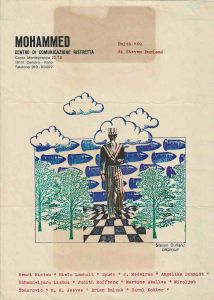
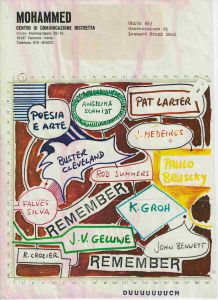
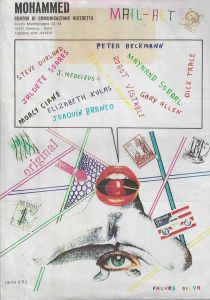
Obra de arte postal de Luis integrada ao circuito de Mohammed, Centro di Comunicazione Ristretta, sediado em Gênova, Itália.
Mohammed - Centro di Comunicazione Ristretta - Plinio Mesciulam - Genova - Italia
Categoria: Mail Art
Acervo: 04253
Dimensões: 29,7 x 21,5 cm
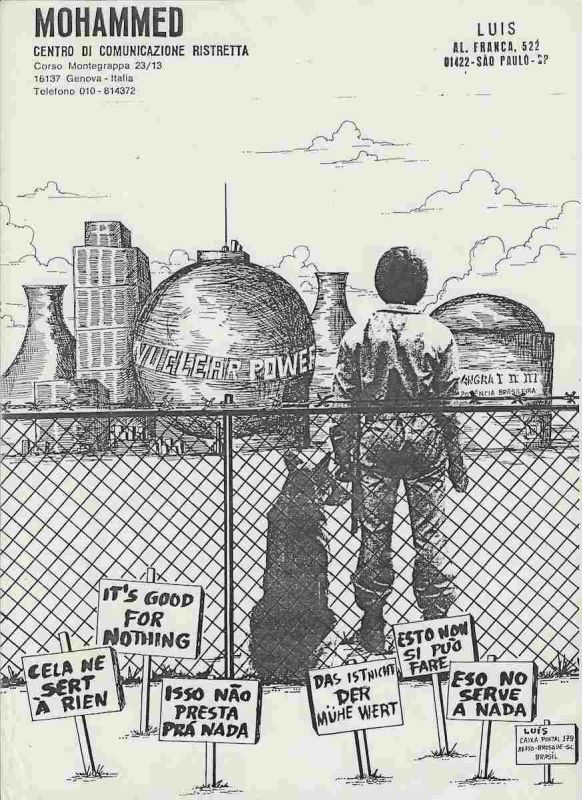
Texto Salsa em portuguêsObra de arte postal de Luis integrada ao circuito de Mohammed, Centro di Comunicazione Ristretta, sediado em Gênova, Itália. A folha apresenta na parte superior esquerda a identificação Mohammed, Centro di Comunicazione Ristretta, seguida do endereço Corso Montegrappa 23/13, 16137 Genova, Italia, e do telefone 010 814372. Na parte superior direita aparece a identificação Luis, Al. Franca, 522, 01422, São Paulo, SP, estabelecendo documentalmente a relação entre o projeto italiano e um participante da rede de mail art localizado em São Paulo, Brasil.Pesquisa em documentação internacional de mail art confirma a existência de um participante identificado como Luis nesse mesmo endereço. A revista Umbrella registrou em 1981 o endereço Luis, Al. Franca 522, 01422, Sao Paulo, SP, Brasil, e informou que Luis já participava da rede de mail art havia bastante tempo, solicitando informações sobre exposições para redistribuí las entre seus contatos e enviando uma pequena publicação informativa de duas páginas. Esse registro independente é particularmente importante porque confirma o endereço visível na obra e demonstra que Luis atuava como agente de circulação de informações dentro da rede internacional de arte postal.A imagem central apresenta uma paisagem de caráter gráfico e narrativo. Uma figura humana vista de costas ocupa o centro da composição diante de uma cerca metálica. Ao fundo aparece uma paisagem industrial ou tecnológica formada por grandes estruturas esféricas, torres e edificações. Sobre uma das grandes esferas pode ser lida a expressão Nuclear Power, introduzindo uma referência direta à energia nuclear e à cultura tecnológica contemporânea.Em outra estrutura ao fundo aparecem inscrições parcialmente legíveis que parecem incluir Angra I II III e referência a potência ou energia brasileira. A imagem permite relacionar visualmente a obra ao debate brasileiro sobre energia nuclear e ao complexo de Angra dos Reis, mas a leitura integral dessa inscrição não é suficientemente nítida para uma transcrição definitiva. Por rigor documental, deve ser preservada apenas a informação claramente visível e evitar completar palavras pouco legíveis por suposição.A parte inferior da composição apresenta uma série de placas com a mesma mensagem expressa em diferentes idiomas. Em inglês aparece It's Good for Nothing. Em português aparece Isso Não Presta Pra Nada. Em alemão aparece Das Ist Nicht Der Mühe Wert, ou formulação muito próxima, cuja leitura deve ser conferida no original. Em italiano aparece Esto Non Si Può Fare, com grafia visível que deve ser transcrita conforme o objeto. Outra placa apresenta a frase Eso No Serve A Nada, em espanhol. Há ainda uma inscrição à esquerda cuja leitura integral é menos segura.Essa multiplicidade linguística constitui um dos elementos conceituais mais importantes da obra. A repetição de uma mensagem negativa em diferentes idiomas transforma a composição em uma comunicação internacional destinada a uma rede transnacional de receptores. O recurso aproxima a peça da poesia visual, da arte conceitual e da própria lógica da mail art, na qual mensagem, tradução, circulação e destinatário fazem parte da estrutura artística.A frase Isso Não Presta Pra Nada estabelece um contraste crítico com a monumental paisagem tecnológica representada ao fundo. A presença de Nuclear Power e das estruturas industriais associada às placas de rejeição permite interpretar a obra como crítica ao desenvolvimento tecnológico, ao poder nuclear e à promessa de progresso. Essa leitura é sustentada pela iconografia da peça, embora deva ser registrada como interpretação curatorial e não como declaração textual conhecida do artista.A figura central observa a paisagem sem que seu rosto seja visível. Essa posição cria uma relação entre indivíduo e infraestrutura tecnológica. A cerca separa a figura do complexo industrial, funcionando visualmente como barreira e limite. A composição pode ser relacionada a temas como vigilância, exclusão, ameaça tecnológica, desenvolvimento industrial e distanciamento entre sociedade e sistemas de poder.A obra também utiliza a própria internacionalidade da rede postal como linguagem. Mensagens em diversos idiomas ampliam a leitura para além do contexto brasileiro. Em vez de limitar a crítica a uma situação local, a composição transforma o problema em questão internacional e o distribui através de uma rede artística igualmente internacional.No canto inferior direito aparece uma segunda identificação de Luis acompanhada de Caixa Postal 429 e referência a São Paulo, Brasil. Parte dos números menores apresenta leitura limitada na reprodução. Esse elemento reforça que a peça contém dados de contato do autor e foi concebida para circular dentro de uma rede postal real.A identidade completa de Luis não pode ser estabelecida com segurança apenas a partir da peça e das fontes consultadas. Uma fonte bibliográfica sobre periódicos de mail art registra o nome Luis Rebouças Torres entre participantes brasileiros, mas os dados localizados nesta pesquisa não são suficientes para demonstrar que o Luis da Alameda Franca 522 seja a mesma pessoa. Portanto, essa identificação não deve ser incorporada ao cadastro como fato confirmado sem documentação adicional.O documento possui forte relevância para a história da mail art brasileira porque demonstra um contato direto entre um participante de São Paulo e o Centro di Comunicazione Ristretta de Gênova. Fontes sobre a arte postal latino americana também registram Mohammed entre os participantes da exposição de arte postal da XVI Bienal de São Paulo, evidenciando a presença institucional dessa rede italiana no circuito brasileiro no início da década de 1980.A peça deve ser compreendida simultaneamente como obra gráfica, arte postal, comunicação de artista, poesia visual, imagem política e documento de rede. A combinação de iconografia nuclear, linguagem multilíngue, endereço postal e estrutura Mohammed materializa uma forma de arte em que conteúdo crítico e circulação internacional são inseparáveis.Para indexação digital, os principais termos associados ao documento são Mohammed, Centro di Comunicazione Ristretta, Luis, Al. Franca 522, Alameda Franca 522, São Paulo, Brasil, Genova, Italia, Plinio Mesciulam, mail art, arte postal, Nuclear Power, Angra, energia nuclear, poesia visual, arte conceitual, comunicação artística, rede internacional, Umbrella, arte postal brasileira e arte experimental dos anos 1980.Salsa text in EnglishMail art work by Luis integrated into the network of Mohammed, Centro di Comunicazione Ristretta, based in Genoa, Italy. The upper left section carries the identification Mohammed, Centro di Comunicazione Ristretta, followed by the address Corso Montegrappa 23/13, 16137 Genova, Italia, and telephone number 010 814372. In the upper right appears the identification Luis, Al. Franca, 522, 01422, São Paulo, SP, establishing a documented relationship between the Italian project and a participant in the mail art network based in São Paulo, Brazil.International mail art documentation confirms the existence of a participant identified as Luis at this same address. In 1981 the magazine Umbrella listed Luis, Al. Franca 522, 01422, Sao Paulo, SP, Brasil, and reported that Luis had been active in the mail art network for a considerable period, requesting information about exhibitions so that he could redistribute notices among his contacts and sending out a small two page newsletter. This independent record is particularly important because it confirms the address visible on the work and demonstrates that Luis acted as an information distributor within the international mail art network.The central image presents a graphic and narrative landscape. A human figure seen from behind occupies the center of the composition before a metal fence. Beyond the fence is an industrial or technological landscape composed of large spherical structures, towers and buildings. One of the large spheres bears the words Nuclear Power, introducing a direct reference to nuclear energy and contemporary technological culture.Another structure in the background contains partially legible inscriptions that appear to include Angra I II III and a reference to Brazilian energy or power. The imagery allows the work to be visually associated with debates surrounding nuclear energy in Brazil and the Angra nuclear complex, but the full inscription is not sufficiently clear for a definitive transcription. For documentary accuracy, only clearly visible information should be retained and uncertain wording should not be completed through conjecture.The lower part of the composition contains a series of signs presenting similar messages in different languages. In English one reads It's Good for Nothing. In Portuguese appears Isso Não Presta Pra Nada. A German sign appears to read Das Ist Nicht Der Mühe Wert or a closely related formulation, which should be checked against the original. An Italian sign reads Esto Non Si Può Fare as visibly printed on the object. Another sign contains Eso No Serve A Nada in Spanish. A further inscription on the left is less securely legible.This multilingual structure is one of the most important conceptual elements of the work. Repetition of a negative statement in different languages transforms the composition into an international communication addressed to a transnational network of recipients. The strategy connects the piece with Visual Poetry, Conceptual Art and the fundamental logic of mail art, in which message, translation, circulation and addressee become part of the artistic structure.The Portuguese phrase Isso Não Presta Pra Nada establishes a critical contrast with the monumental technological landscape in the background. The presence of Nuclear Power and industrial structures alongside signs of rejection allows the work to be interpreted as a critique of technological development, nuclear power and the rhetoric of progress. This interpretation is supported by the visual evidence but should be identified as a curatorial reading rather than as a documented statement by the artist.The central figure observes the landscape without revealing a face. This position creates a relationship between individual and technological infrastructure. The fence separates the figure from the industrial complex and functions visually as a barrier and boundary. The composition can therefore be associated with themes of surveillance, exclusion, technological threat, industrial development and the distance between society and systems of power.The work also uses the international nature of the postal network as an artistic language. Messages in multiple languages expand the composition beyond a specifically Brazilian context. Rather than limiting its critique to a local situation, the image presents the problem as an international issue and distributes it through an equally international artistic network.In the lower right corner appears another identification of Luis together with Caixa Postal 429 and a reference to São Paulo, Brazil. Some of the smaller numerical information cannot be read securely from the available reproduction. This element reinforces the fact that the work incorporates the artist's contact information and was designed to circulate through an actual postal network.The complete identity of Luis cannot be established securely from the object and the sources consulted. A bibliographical source concerning mail art periodicals records the name Luis Rebouças Torres among Brazilian participants, but the evidence located in this research is not sufficient to demonstrate that the Luis at Alameda Franca 522 is the same person. This identification should therefore not be entered as a confirmed fact without additional documentation.The document is highly relevant to the history of Brazilian mail art because it demonstrates direct contact between a São Paulo based participant and the Centro di Comunicazione Ristretta in Genoa. Research on Latin American postal art also records Mohammed among participants in the mail art exhibition of the 16th São Paulo Biennial, demonstrating the institutional presence of this Italian network within the Brazilian circuit at the beginning of the 1980s.The piece should be understood simultaneously as a graphic work, mail art, artists communication, Visual Poetry, political image and network document. Its combination of nuclear iconography, multilingual language, postal address and the Mohammed structure materializes an artistic practice in which critical content and international circulation are inseparable.For digital indexing, principal associated terms include Mohammed, Centro di Comunicazione Ristretta, Luis, Al. Franca 522, Alameda Franca 522, São Paulo, Brazil, Genoa, Italy, Plinio Mesciulam, mail art, Nuclear Power, Angra, nuclear energy, Visual Poetry, Conceptual Art, artistic communication, international network, Umbrella, Brazilian mail art and experimental art of the 1980s.
Texto de observação em portuguêsObra de arte postal identificada com o nome Luis e vinculada a Mohammed, Centro di Comunicazione Ristretta, Gênova, Itália.Na parte superior esquerda aparecem Mohammed e Centro di Comunicazione Ristretta, seguidos do endereço Corso Montegrappa 23/13, 16137 Genova, Italia, e telefone 010 814372.Na parte superior direita encontra se a identificação Luis, Al. Franca, 522, 01422, São Paulo, SP. O endereço é confirmado por documentação publicada na revista internacional de mail art Umbrella em 1981, que registra Luis nesse mesmo endereço e informa sua atuação prolongada na rede postal, incluindo o envio de uma pequena publicação informativa e a redistribuição de notícias sobre exposições.A identidade civil completa de Luis não está estabelecida de modo seguro pelas fontes consultadas. Por esse motivo, o cadastro deve preservar o nome exatamente como aparece na obra, Luis, evitando a atribuição de sobrenome sem comprovação documental.A composição gráfica é predominantemente em preto e branco e representa uma figura humana vista de costas diante de uma cerca metálica. Ao fundo aparece uma paisagem industrial ou tecnológica composta por grandes estruturas esféricas, torres e edificações.Na principal estrutura esférica aparece de maneira claramente legível a expressão Nuclear Power.Outra estrutura ao fundo contém inscrições parcialmente visíveis que parecem fazer referência a Angra I II III e ao contexto brasileiro. A qualidade da reprodução não permite assegurar a leitura completa e uma transcrição definitiva deve ser realizada diretamente a partir do original.A paisagem e a referência a Nuclear Power permitem relacionar iconograficamente a peça ao debate sobre energia nuclear, tecnologia e desenvolvimento. Qualquer identificação específica com uma instalação nuclear brasileira deve permanecer apresentada como interpretação visual enquanto não houver documentação textual complementar.Na parte inferior aparecem diversas placas com frases em idiomas diferentes. Em inglês aparece It's Good for Nothing. Em português aparece Isso Não Presta Pra Nada. Há ainda mensagens em alemão, italiano, espanhol e possivelmente outro idioma.O caráter multilíngue é essencial para a descrição da obra. As mensagens produzem uma comunicação dirigida a receptores internacionais e dialogam diretamente com o funcionamento transnacional da mail art.Uma das placas à esquerda apresenta texto de leitura limitada. A inscrição não deve ser completada por inferência.A figura humana permanece de costas para o observador. A ausência do rosto e a presença da cerca reforçam visualmente uma situação de observação e separação em relação ao ambiente industrial representado.Na parte inferior direita aparece outra identificação de Luis, seguida de Caixa Postal 429 e referência a São Paulo, Brasil. Os demais números pequenos não apresentam definição suficiente para transcrição segura nesta reprodução.O suporte funciona simultaneamente como imagem artística e documento de comunicação. Endereços postais, identificação do Centro di Comunicazione Ristretta, nome do participante e mensagens internacionais são componentes da própria obra.Pesquisa externa demonstra que Luis participava ativamente da rede internacional de mail art e distribuía informações sobre exposições através de uma pequena publicação, informação que amplia significativamente a interpretação documental do objeto.A presença do cabeçalho Mohammed demonstra que a obra foi incorporada ao circuito do Centro di Comunicazione Ristretta de Plinio Mesciulam, uma estrutura internacional de reprodução e circulação de comunicações artísticas sediada em Gênova.Documentação acadêmica sobre arte postal latino americana registra ainda Mohammed entre os participantes da exposição de arte postal da XVI Bienal de São Paulo, evidenciando a circulação do Centro di Comunicazione Ristretta no Brasil.A peça deve ser catalogada como mail art, arte postal, obra gráfica, comunicação de artista, documento de rede e arte conceitual de caráter político e tecnológico.Para indexação, os principais descritores são Mohammed, Centro di Comunicazione Ristretta, Luis, Al. Franca 522, Alameda Franca 522, São Paulo, Brasil, Genova, Italia, Plinio Mesciulam, Nuclear Power, Angra, energia nuclear, mail art, arte postal, arte conceitual, poesia visual, comunicação internacional, Umbrella e redes alternativas de arte dos anos 1980.Observation text in EnglishMail art work identified with the name Luis and associated with Mohammed, Centro di Comunicazione Ristretta, Genoa, Italy.The upper left section contains Mohammed and Centro di Comunicazione Ristretta, followed by the address Corso Montegrappa 23/13, 16137 Genova, Italia, and telephone number 010 814372.In the upper right appears the identification Luis, Al. Franca, 522, 01422, São Paulo, SP. This address is independently confirmed by the international mail art magazine Umbrella in 1981, which records Luis at the same address and describes his longstanding participation in the postal network, including distribution of a small newsletter and circulation of information about exhibitions.The complete civil identity of Luis has not been securely established by the sources consulted. The cataloguing record should therefore preserve the name exactly as it appears on the object, Luis, without assigning a surname that cannot yet be documented.The graphic composition is predominantly black and white and depicts a human figure seen from behind standing before a metal fence. Beyond the fence is an industrial or technological landscape composed of large spherical structures, towers and buildings.The words Nuclear Power are clearly visible on the principal spherical structure.Another structure in the background contains partially visible inscriptions that appear to refer to Angra I II III and a Brazilian context. The quality of the reproduction does not permit a secure complete reading and a definitive transcription should be made directly from the original object.The landscape and the reference to Nuclear Power allow the work to be iconographically associated with debates concerning nuclear energy, technology and development. Any specific identification with a Brazilian nuclear installation should remain an interpretative reading until supported by additional documentary evidence.Several signs containing phrases in different languages appear in the lower section. The English sign reads It's Good for Nothing. The Portuguese sign reads Isso Não Presta Pra Nada. Additional messages appear in German, Italian, Spanish and possibly another language.The multilingual character is essential to the description of the work. These messages establish communication addressed to international recipients and correspond directly with the transnational functioning of mail art.One sign on the left contains wording that cannot be read securely from the available image. It should not be completed through inference.The human figure remains with its back toward the viewer. The absence of a visible face and the presence of the fence reinforce a visual situation of observation and separation in relation to the industrial environment.A second identification of Luis appears in the lower right, followed by Caixa Postal 429 and a reference to São Paulo, Brazil. The remaining smaller numerical information is not sufficiently clear for secure transcription from this reproduction.The sheet functions simultaneously as an artistic image and a communication document. Postal addresses, institutional identification of the Centro di Comunicazione Ristretta, the participant's name and multilingual messages all form part of the work itself.External research demonstrates that Luis was an active participant in the international mail art network and distributed exhibition information through a small newsletter, significantly expanding the documentary interpretation of the object.The Mohammed heading demonstrates that the work was incorporated into the circuit of Plinio Mesciulam's Centro di Comunicazione Ristretta, an international system for reproducing and circulating artistic communications based in Genoa.Academic documentation concerning Latin American postal art also records Mohammed among the participants in the mail art exhibition of the 16th São Paulo Biennial, demonstrating the circulation of the Centro di Comunicazione Ristretta within Brazil.The object should be catalogued as mail art, graphic work, artists communication, network document and conceptual art with political and technological content.For indexing, principal descriptors include Mohammed, Centro di Comunicazione Ristretta, Luis, Al. Franca 522, Alameda Franca 522, São Paulo, Brazil, Genoa, Italy, Plinio Mesciulam, Nuclear Power, Angra, nuclear energy, mail art, Conceptual Art, Visual Poetry, international artistic communication, Umbrella and alternative art networks of the 1980s.
Proveniência
Coleção Poema ProcessoInglês
Mail art work by Luis integrated into the network of Mohammed, Centro di Comunicazione Ristretta, based in Genoa, Italy.
Dimensions: 11,7 x 8,5 in