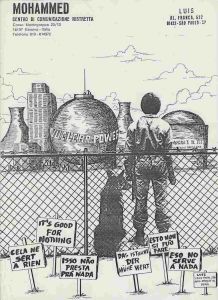
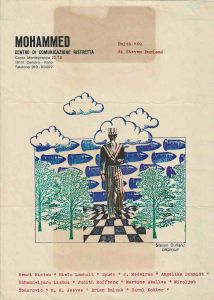
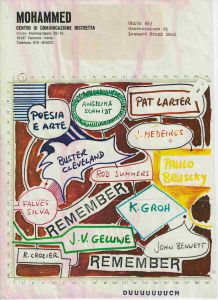
Mohammed, Unità 593, é uma obra de arte postal de Falves Silva integrada ao sistema do Centro di Comunicazione Ristretta, sediado em Gênova, Itália.
Mohammed - Centro di Comunicazione Ristretta - Plinio Mesciulam - Genova - Italia
Categoria: Mail Art
Acervo: 04252
Dimensões: 29,5 x 21 cm
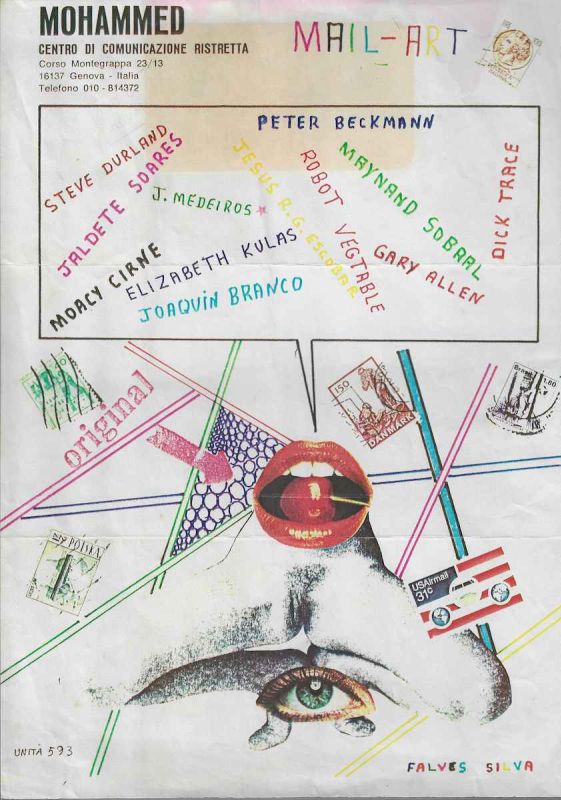
Texto Salsa em portuguêsMohammed, Unità 593, é uma obra de arte postal de Falves Silva integrada ao sistema do Centro di Comunicazione Ristretta, sediado em Gênova, Itália. A folha reúne collage, desenho, reprodução gráfica, selos postais, carimbos, nomes de participantes de uma rede internacional e referências explícitas à mail art. O documento constitui um registro particularmente relevante da presença de Falves Silva e de outros agentes brasileiros nas redes internacionais de comunicação artística articuladas em torno do projeto Mohammed.Na parte superior esquerda aparece a identificação institucional Mohammed, Centro di Comunicazione Ristretta, acompanhada do endereço Corso Montegrappa 23/13, 16137 Genova, Italia, e do telefone 010 814372. Na parte superior direita aparece a inscrição Mail Art construída manualmente com letras de diferentes cores. O uso explícito dessa expressão identifica de maneira direta o campo artístico ao qual a peça se vincula.Na parte inferior esquerda encontra se a identificação Unità 593. A numeração integra a peça ao sistema de unidades do projeto Mohammed, no qual diferentes contribuições artísticas eram incorporadas a uma estrutura de comunicação, reprodução e circulação. Na parte inferior direita aparece o nome Falves Silva, identificando o autor da composição apresentada.A obra está organizada em dois grandes campos visuais. Na parte superior há uma área retangular delimitada por linhas pretas contendo uma série de nomes escritos em diferentes cores e direções. A distribuição irregular dos nomes transforma a lista de contatos em composição gráfica, aproximando diretório postal, cartografia de relações e poesia visual.Entre os nomes claramente identificáveis aparecem Steve Durland, Peter Beckmann, J. Medeiros, Moacy Cirne, Elizabeth Kulas, Joaquin Branco, Mariano Sobral, Gary Allen e Dick Trace. Também são visíveis outros nomes e expressões cuja leitura integral é menos segura a partir da reprodução apresentada. Para uma transcrição diplomática definitiva, esses registros devem ser confrontados com o original.A presença de J. Medeiros é particularmente importante para a reconstrução da circulação brasileira de Mohammed. Seu nome aparece em verde, aproximadamente na região central esquerda do campo nominal, integrado ao conjunto internacional de participantes.Moacy Cirne aparece no lado esquerdo da composição. Sua presença amplia significativamente o interesse histórico da peça para pesquisas sobre poesia experimental brasileira e Poema Processo, pois Cirne foi uma figura central na formulação teórica e na trajetória histórica do movimento.O nome Joaquin Branco também aparece destacado em azul esverdeado. Sua presença reforça a dimensão brasileira da rede registrada pela obra. A composição evidencia portanto um ambiente de comunicação no qual agentes brasileiros aparecem ao lado de participantes de diferentes circuitos internacionais.Steve Durland aparece na região superior esquerda do campo nominal. Sua presença cria uma conexão documental com outras unidades de Mohammed associadas diretamente a Durland, demonstrando a recorrência de determinados artistas dentro da estrutura de comunicação do Centro di Comunicazione Ristretta.Peter Beckmann aparece na parte superior central e Dick Trace na margem direita. Gary Allen está situado no setor direito, enquanto Mariano Sobral aparece em verde em direção diagonal. A diversidade de posições, cores e orientações faz com que os nomes deixem de funcionar apenas como informação textual e passem a constituir elementos plásticos da composição.Na metade inferior da folha encontra se uma collage de forte impacto visual. O elemento central é a reprodução parcial de um rosto humano, com destaque para um olho e para uma boca aberta. Sobre a região da boca aparece uma forma semelhante a projétil, míssil ou objeto pontiagudo, inserida horizontalmente. A associação entre corpo, boca e objeto bélico produz uma imagem de tensão relacionada a comunicação, violência, emissão, censura ou conflito, embora essas possibilidades devam ser entendidas como leituras iconográficas e não como significado textual declarado pelo artista.A imagem do rosto é atravessada por numerosas linhas coloridas em verde, azul, vermelho, amarelo e rosa. Essas linhas criam conexões visuais entre diferentes regiões da composição e podem ser relacionadas formalmente à ideia de rede, trajetória, transmissão e circulação.Diversos selos postais reais ou reproduzidos estão incorporados à collage. São identificáveis referências postais da Dinamarca, Polônia, Brasil e Estados Unidos, incluindo elemento relacionado ao correio aéreo norte americano. Essa reunião de materiais postais de diferentes países reforça a dimensão internacional e transnacional da peça.À esquerda aparece ainda a palavra Original em impressão avermelhada. A presença dessa palavra dentro de uma obra baseada em circulação, cópia, reprodução e arte postal cria uma tensão conceitual entre originalidade e multiplicação, tema particularmente relevante para a mail art e para as práticas gráficas experimentais das décadas de 1970 e 1980.A composição de Falves Silva articula portanto diversos sistemas simultaneamente. Há uma rede de nomes, uma rede de linhas, uma rede postal sugerida pelos selos e uma estrutura institucional fornecida por Mohammed e pelo Centro di Comunicazione Ristretta. O objeto transforma o próprio conceito de rede em linguagem visual.A presença conjunta de Falves Silva, Moacy Cirne, J. Medeiros e Joaquin Branco torna a Unità 593 especialmente importante para pesquisas sobre as conexões entre o ambiente brasileiro da poesia experimental e as redes europeias de arte postal. No caso de Falves Silva e Moacy Cirne, essa relação também aproxima o documento da história do Poema Processo, embora Mohammed como projeto não deva ser classificado como integrante formal do movimento brasileiro.A Unità 593 constitui assim uma fonte primária para compreender como artistas brasileiros participaram de circuitos internacionais baseados em correspondência, reprodução, listas de contatos, circulação postal e comunicação alternativa. A obra não representa apenas uma imagem enviada pelo correio. Ela registra visualmente uma comunidade internacional de comunicação artística.Para catalogação e indexação digital, os principais termos associados ao documento são Mohammed, Unità 593, Falves Silva, Centro di Comunicazione Ristretta, Genova, Italia, Plinio Mesciulam, mail art, arte postal, Poema Processo, poesia experimental, poesia visual, Moacy Cirne, J. Medeiros, Joaquin Branco, Steve Durland, Peter Beckmann, Elizabeth Kulas, Mariano Sobral, Gary Allen, Dick Trace, collage, selos postais, comunicação artística, network art, copy art e redes internacionais de arte experimental.Salsa text in EnglishMohammed, Unità 593, is a mail art work by Falves Silva incorporated into the system of the Centro di Comunicazione Ristretta based in Genoa, Italy. The sheet combines collage, drawing, graphic reproduction, postage stamps, postal marks, names of participants in an international network and an explicit reference to mail art. The document is particularly significant as evidence of the presence of Falves Silva and other Brazilian figures within international artistic communication networks associated with the Mohammed project.In the upper left section appears the institutional identification Mohammed, Centro di Comunicazione Ristretta, accompanied by the address Corso Montegrappa 23/13, 16137 Genova, Italia, and telephone number 010 814372. In the upper right appears the expression Mail Art constructed manually with letters in different colors. The explicit use of this term directly identifies the artistic field to which the work belongs.In the lower left corner is the identification Unità 593. The numbering connects the sheet with the system of units used by Mohammed, through which different artistic contributions were incorporated into a larger structure of communication, reproduction and circulation. In the lower right appears the name Falves Silva, identifying the author of the composition.The work is organized into two principal visual fields. The upper section contains a rectangular area defined by black lines and filled with names written in different colors and directions. Their irregular distribution transforms a list of contacts into a graphic composition combining postal directory, relational map and Visual Poetry.Clearly identifiable names include Steve Durland, Peter Beckmann, J. Medeiros, Moacy Cirne, Elizabeth Kulas, Joaquin Branco, Mariano Sobral, Gary Allen and Dick Trace. Other names and expressions are also visible, although their complete spelling cannot be established securely from the reproduction. A definitive diplomatic transcription should therefore be checked against the original object.The presence of J. Medeiros is particularly significant for reconstructing the Brazilian circulation of Mohammed. His name appears in green approximately in the central left area of the field and is integrated into the larger international group of participants.Moacy Cirne appears on the left side of the composition. His presence substantially increases the historical importance of the document for research on Brazilian experimental poetry and the Process Poem Movement, since Cirne was a central figure in the theoretical formulation and historical development of that movement.The name Joaquin Branco also appears prominently in blue green lettering. His inclusion further reinforces the Brazilian dimension of the network represented in the work. The composition therefore records an environment of communication in which Brazilian figures appear alongside participants from different international circuits.Steve Durland appears in the upper left section of the field of names. His presence establishes a documentary connection with other Mohammed units directly associated with Durland and demonstrates the recurrence of particular artists within the communication structure of the Centro di Comunicazione Ristretta.Peter Beckmann appears near the upper center and Dick Trace along the right margin. Gary Allen occupies the right sector, while Mariano Sobral appears diagonally in green. Variations in position, color and direction transform the names from purely textual information into visual components of the work.The lower half of the sheet contains a visually powerful collage. Its central element is a partial reproduction of a human face with particular emphasis on an eye and an open mouth. Across the mouth appears a form resembling a projectile, missile or pointed object. The association between body, mouth and weapon like form produces an image of tension that may suggest communication, violence, transmission, censorship or conflict. These possibilities should remain identified as iconographic interpretations rather than as meanings explicitly declared by the artist.The face is crossed by numerous colored lines in green, blue, red, yellow and pink. These lines visually connect different areas of the composition and can formally be related to concepts of network, trajectory, transmission and circulation.Several real or reproduced postage stamps are incorporated into the collage. Postal references from Denmark, Poland, Brazil and the United States can be identified, including an element associated with United States airmail. The combination of postal materials from different countries reinforces the international and transnational character of the work.The word Original also appears in reddish printing on the left. Within an artistic practice based on circulation, copying, reproduction and postal distribution, the presence of this word establishes a conceptual tension between originality and multiplication, an important issue within mail art and experimental graphic practices of the 1970s and 1980s.Falves Silva's composition therefore articulates several systems simultaneously. There is a network of names, a network of colored lines, a postal network suggested by the stamps and an institutional framework provided by Mohammed and the Centro di Comunicazione Ristretta. The work transforms the concept of network itself into visual language.The joint presence of Falves Silva, Moacy Cirne, J. Medeiros and Joaquin Branco makes Unità 593 especially important for research into connections between Brazilian experimental poetry and European mail art networks. In the cases of Falves Silva and Moacy Cirne, the document also intersects with the history of the Brazilian Process Poem Movement, although Mohammed as a project should not itself be classified as a formal component of that movement.Unità 593 is therefore a primary source for understanding how Brazilian artists participated in international circuits based on correspondence, reproduction, contact lists, postal circulation and alternative communication. The work is not merely an image distributed through the mail. It visually records an international community of artistic communication.For cataloguing and digital indexing, principal associated terms include Mohammed, Unità 593, Falves Silva, Centro di Comunicazione Ristretta, Genoa, Italy, Plinio Mesciulam, mail art, Process Poem Movement, experimental poetry, Visual Poetry, Moacy Cirne, J. Medeiros, Joaquin Branco, Steve Durland, Peter Beckmann, Elizabeth Kulas, Mariano Sobral, Gary Allen, Dick Trace, collage, postage stamps, artistic communication, network art, copy art and international experimental art networks.
Texto de observação em portuguêsObra de arte postal de Falves Silva identificada como Mohammed, Unità 593, vinculada ao Centro di Comunicazione Ristretta de Gênova, Itália.Na parte superior esquerda encontra se a identificação Mohammed, Centro di Comunicazione Ristretta, seguida do endereço Corso Montegrappa 23/13, 16137 Genova, Italia, e telefone 010 814372.Na região superior direita aparece a inscrição Mail Art composta por letras desenhadas em diferentes cores. Essa informação integra a própria obra e constitui elemento importante para sua classificação documental como arte postal.Na parte inferior esquerda aparece Unità 593. Na parte inferior direita encontra se a assinatura ou identificação Falves Silva. Esses dois elementos devem ser preservados integralmente no registro catalográfico.A composição possui um campo retangular superior com diversos nomes distribuídos em diferentes posições, orientações e cores. A relação nominal funciona simultaneamente como documentação da rede e como elemento visual.Entre os nomes claramente legíveis estão Steve Durland, Peter Beckmann, J. Medeiros, Moacy Cirne, Elizabeth Kulas, Joaquin Branco, Mariano Sobral, Gary Allen e Dick Trace.Outros nomes aparecem na imagem, mas algumas grafias apresentam leitura limitada. Recomenda se confronto com o exemplar original antes da adoção de uma transcrição definitiva desses registros.O nome J. Medeiros aparece em verde na parte central esquerda. Sua presença é particularmente relevante porque estabelece uma conexão direta entre a rede Mohammed e um participante do circuito brasileiro de arte experimental.Moacy Cirne aparece no setor esquerdo e constitui outro elemento documental de grande importância. Sua atuação histórica no Poema Processo amplia a relevância da peça para pesquisas sobre as relações entre poesia experimental brasileira e redes internacionais de arte postal.Joaquin Branco aparece em azul esverdeado na região inferior do campo de nomes. A presença conjunta desses participantes brasileiros oferece evidência visual da inserção do Brasil no circuito internacional representado pela obra.A metade inferior da folha apresenta uma collage composta por fragmento de rosto humano, olho, boca aberta, objeto semelhante a projétil, linhas coloridas e diversos materiais postais.O olho ocupa posição de destaque no centro inferior. A boca encontra se acima e contém um objeto horizontal semelhante a projétil ou míssil. Essa associação pode sugerir temas relacionados a comunicação, violência, linguagem e conflito, porém essa leitura é interpretativa e não deve substituir uma eventual declaração do artista.A composição incorpora selos ou reproduções de selos de diferentes países. São visíveis referências postais da Dinamarca, Polônia, Brasil e Estados Unidos. A combinação desses elementos enfatiza a circulação internacional própria da mail art.Na região direita aparece um elemento relacionado ao correio aéreo norte americano. Na região esquerda superior da collage aparece a palavra Original em impressão avermelhada.Linhas finas em verde, azul, vermelho, rosa e amarelo atravessam a composição em diferentes direções. O efeito pode ser relacionado visualmente a trajetórias, conexões e redes de comunicação.O suporte apresenta marcas de dobra, elemento compatível com sua natureza de material produzido para circulação, manuseio ou envio postal. Essas marcas fazem parte da história material da peça e devem ser registradas em documentação de conservação quando pertinente.A obra articula palavras, nomes próprios, imagem fotográfica ou reproduzida, collage, desenho, selos, elementos postais e identidade institucional de Mohammed. Essa combinação permite classificá la como arte postal, collage, publicação ou comunicação de artista, documento de rede e obra gráfica experimental.A peça apresenta especial interesse para o estudo de Falves Silva porque documenta sua participação direta em uma estrutura internacional de comunicação artística sediada em Gênova e registra visualmente uma rede que incluía brasileiros como J. Medeiros, Moacy Cirne e Joaquin Branco.A presença de Moacy Cirne e Falves Silva aproxima documentalmente a obra do universo histórico do Poema Processo, enquanto a estrutura Mohammed a situa no campo internacional da mail art, copy art, network art e comunicação artística.Para catalogação e indexação digital, os termos prioritários são Mohammed, Unità 593, Falves Silva, Mail Art, Centro di Comunicazione Ristretta, Genova, Italia, Plinio Mesciulam, Moacy Cirne, J. Medeiros, Joaquin Branco, Steve Durland, Peter Beckmann, Elizabeth Kulas, Mariano Sobral, Gary Allen, Dick Trace, Poema Processo, poesia experimental, poesia visual, arte postal, collage, selos postais, copy art, network art e comunicação internacional de artistas.Observation text in EnglishMail art work by Falves Silva identified as Mohammed, Unità 593, associated with the Centro di Comunicazione Ristretta in Genoa, Italy.In the upper left section appears the identification Mohammed, Centro di Comunicazione Ristretta, followed by the address Corso Montegrappa 23/13, 16137 Genova, Italia, and telephone number 010 814372.In the upper right area appears the expression Mail Art composed of letters drawn in different colors. This information forms part of the work itself and is important for its documentary classification as mail art.The lower left section contains the identification Unità 593. The lower right contains the name Falves Silva. Both elements should be preserved in full within the cataloguing record.The composition includes an upper rectangular field containing numerous names distributed in different positions, directions and colors. The list functions simultaneously as documentation of a network and as a visual component.Clearly legible names include Steve Durland, Peter Beckmann, J. Medeiros, Moacy Cirne, Elizabeth Kulas, Joaquin Branco, Mariano Sobral, Gary Allen and Dick Trace.Other names are visible, although some spellings cannot be determined conclusively from the available reproduction. Comparison with the original object is recommended before adopting a definitive transcription.The name J. Medeiros appears in green in the central left area. His presence is especially relevant because it establishes a direct connection between the Mohammed network and a participant in the Brazilian experimental art circuit.Moacy Cirne appears in the left sector and constitutes another element of considerable documentary importance. His historical activity within the Process Poem Movement increases the significance of the work for research into relationships between Brazilian experimental poetry and international mail art networks.Joaquin Branco appears in blue green lettering toward the lower part of the field of names. The joint presence of these Brazilian participants provides visual evidence of Brazil's integration into the international network represented by the work.The lower half of the sheet presents a collage composed of a fragment of a human face, an eye, an open mouth, a projectile like object, colored lines and various postal materials.The eye occupies a prominent position in the lower center. Above it is the mouth containing a horizontal form resembling a projectile or missile. This association may suggest themes involving communication, violence, language and conflict, but such a reading remains interpretative and should not replace any documented statement by the artist.The composition incorporates postage stamps or reproductions of stamps from different countries. Postal references from Denmark, Poland, Brazil and the United States are visible. Their combination emphasizes the international circulation characteristic of mail art.An element associated with United States airmail appears on the right. The word Original appears in reddish printing in the upper left area of the collage.Thin lines in green, blue, red, pink and yellow cross the composition in different directions. Their visual effect can be associated with trajectories, connections and communication networks.The sheet displays folding marks consistent with a material intended for circulation, handling or postal transmission. These marks form part of the material history of the object and should be recorded in conservation documentation when relevant.The work combines words, proper names, photographic or reproduced imagery, collage, drawing, postage stamps, postal elements and the institutional identity of Mohammed. This combination supports its classification as mail art, collage, artists communication, network document and experimental graphic work.The piece is especially significant for the study of Falves Silva because it documents his direct participation in an international artistic communication structure based in Genoa and visually records a network that included Brazilian figures such as J. Medeiros, Moacy Cirne and Joaquin Branco.The presence of Moacy Cirne and Falves Silva connects the work to the historical environment of the Process Poem Movement, while the Mohammed structure situates it within the international fields of mail art, copy art, network art and artistic communication.For cataloguing and digital indexing, priority terms include Mohammed, Unità 593, Falves Silva, Mail Art, Centro di Comunicazione Ristretta, Genoa, Italy, Plinio Mesciulam, Moacy Cirne, J. Medeiros, Joaquin Branco, Steve Durland, Peter Beckmann, Elizabeth Kulas, Mariano Sobral, Gary Allen, Dick Trace, Process Poem Movement, experimental poetry, Visual Poetry, mail art, collage, postage stamps, copy art, network art and international artistic communication.
Proveniência
Coleção Poema ProcessoInglês
Mohammed, Unità 593, is a mail art work by Falves Silva incorporated into the system of the Centro di Comunicazione Ristretta based in Genoa, Italy.
Dimensions: 11,6 x 8,3 in