Mohammed, Unità 869 di Steven Durland, é uma unidade de comunicação artística vinculada ao Centro di Comunicazione Ristretta, sediado em Gênova, Itália, e ao sistema Mohammed desenvolvido por Plinio Mesciulam.
Mohammed - Centro di Comunicazione Ristretta - Plinio Mesciulam - Genova - Italia
Categoria: Mail Art
Acervo: 04250
Dimensões: 29,7 x 21,2 cm
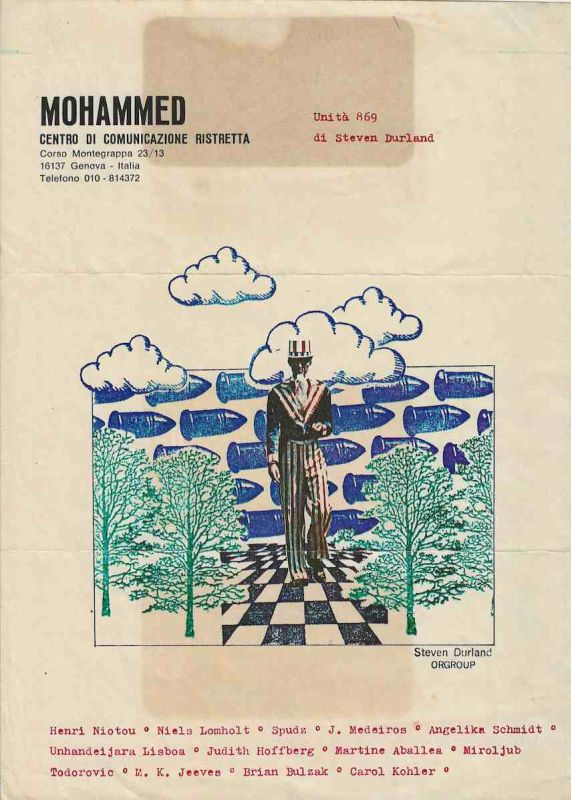
Texto Salsa em portuguêsMohammed, Unità 869 di Steven Durland, é uma unidade de comunicação artística vinculada ao Centro di Comunicazione Ristretta, sediado em Gênova, Itália, e ao sistema Mohammed desenvolvido por Plinio Mesciulam. A peça integra uma estrutura experimental de circulação internacional em que contribuições produzidas por diferentes artistas eram recebidas, identificadas por número de unidade, reproduzidas e redistribuídas dentro de uma rede postal organizada. Arquivos internacionais confirmam a existência de uma Mohammed color photocopy identificada precisamente como Unita 869 e associada a Steven Durland, com documentação datada de 1980.Na parte superior esquerda da folha aparece a identificação Mohammed, Centro di Comunicazione Ristretta, seguida pelo endereço Corso Montegrappa 23/13, 16137 Genova, Italia, e pelo telefone 010 814372. À direita encontra se a inscrição datilografada em vermelho Unità 869 di Steven Durland. Esses elementos inserem a composição simultaneamente no sistema de autoria de Durland e no mecanismo distributivo do projeto Mohammed.A imagem central é assinada Steven Durland ORGROUP. A composição utiliza uma linguagem gráfica próxima da collage e da reprodução impressa, combinando elementos figurativos, símbolos políticos e estruturas visuais de caráter surreal. No centro aparece uma figura semelhante ao Uncle Sam, personagem emblemático da iconografia política dos Estados Unidos, posicionada sobre um piso quadriculado em perspectiva. Ao fundo surgem formas semelhantes a projéteis ou bombas, distribuídas horizontalmente, enquanto árvores e nuvens completam uma paisagem artificial e estranhamente ordenada.A associação entre a figura de Uncle Sam e as formas de armamento permite interpretar a peça como uma construção crítica sobre poder, militarização, nacionalismo e cultura política norte americana. Essa leitura deve ser entendida como interpretação visual da composição, pois o documento apresentado não contém texto explicativo do artista que determine de maneira definitiva seu significado.A assinatura ORGROUP acrescenta outra camada de identificação ao trabalho. Na peça, Steven Durland aparece diretamente associado a esse nome, indicando uma identidade artística ou estrutura de produção utilizada pelo autor no contexto de sua atividade postal. Fontes brasileiras também registram trabalhos de arte correio de Steven Durland circulando no Brasil em 1980, inclusive correspondência dirigida a Falves Silva, demonstrando sua participação efetiva nas redes internacionais de mail art conectadas ao país.Na parte inferior da folha aparece uma sequência de nomes impressa em vermelho. São identificáveis Henri Niotou, Niels Lomholt, Spudz, J. Medeiros, Angelika Schmidt, Unhandejbara Lisboa, Judith Hoffberg, Martine Abdallea, Miroljub Todorovic, N. K. Jeeves, Brian Bulzak e Carol Kohler. A presença dessa relação de participantes ou destinatários é fundamental para compreender o objeto. Em vez de constituir apenas uma imagem autônoma, Unità 869 materializa uma rede concreta de pessoas conectadas por correspondência e reprodução.J. Medeiros aparece nominalmente entre os integrantes dessa lista. Essa presença constitui evidência documental particularmente importante para a história das relações entre o Centro di Comunicazione Ristretta de Gênova, Steven Durland e o circuito brasileiro de arte experimental. A participação de J. Medeiros dentro da própria estrutura impressa da unidade demonstra que o contato não se limitava à recepção ocasional de correspondências, mas estava integrado ao mecanismo organizado de circulação de Mohammed.Também aparecem nomes centrais da história internacional da mail art. Niels Lomholt desenvolveu um arquivo e uma extensa rede de correspondência artística. Judith Hoffberg tornou se uma figura fundamental para a documentação e difusão internacional da mail art através da revista Umbrella. Miroljub Todorovi
esteve ligado à poesia experimental e ao Signalism na antiga Iugoslávia. A reunião desses nomes numa mesma unidade demonstra a amplitude geográfica e interdisciplinar da rede construída pelo sistema Mohammed.A lógica numérica expressa pela designação Unità 869 é igualmente relevante. Mohammed tratava cada comunicação como unidade identificável dentro de um sistema mais amplo. A numeração permitia registrar, ordenar e redistribuir contribuições, transformando procedimentos normalmente associados à administração, arquivo e comunicação em componentes formais de uma obra coletiva e processual.A existência de documentação arquivística independente reforça a identificação do objeto. O arquivo da University of Iowa registra material dirigido a Steven Durland que inclui uma cópia em preto e branco de uma fotocópia colorida Mohammed, Unita 869, datada de 1980. Esse registro confirma tanto a associação entre Durland e a unidade quanto sua circulação dentro da rede internacional.O Joachim Frank Mail Art Archive documenta ainda o Centro di Comunicazione Ristretta de Gênova como participante de redes postais internacionais e preserva unidades numeradas de Mohammed, demonstrando que o uso sistemático de números fazia parte efetiva da metodologia do projeto.Mohammed, Unità 869 di Steven Durland deve portanto ser compreendida simultaneamente como obra gráfica, peça de mail art, unidade de comunicação, documento de rede e publicação distribuída. Seu significado histórico reside tanto na imagem produzida por Steven Durland quanto na infraestrutura de circulação criada pelo Centro di Comunicazione Ristretta. A obra conecta Gênova a uma rede internacional que inclui Europa, América do Norte e Brasil e documenta uma forma de produção artística na qual autoria, reprodução, distribuição, destinatários e arquivo tornam se partes inseparáveis do trabalho.Para indexação e pesquisa digital, os principais termos associados ao documento incluem Mohammed, Unità 869, Steven Durland, Steven Durland ORGROUP, ORGROUP, Plinio Mesciulam, Centro di Comunicazione Ristretta, Genova, Italia, 1980, J. Medeiros, Niels Lomholt, Judith Hoffberg, Miroljub Todorovic, mail art, arte postal, copy art, network art, arte conceitual, comunicação artística, poesia experimental, publicação de artista, redes alternativas e correspondência internacional.Salsa text in EnglishMohammed, Unità 869 di Steven Durland, is an artistic communication unit associated with the Centro di Comunicazione Ristretta in Genoa, Italy, and with the Mohammed system developed by Plinio Mesciulam. The work formed part of an experimental structure of international circulation in which contributions by different artists were received, identified by unit number, reproduced and redistributed through an organized postal network. International archival records confirm the existence of a Mohammed color photocopy specifically identified as Unita 869 and associated with Steven Durland, with documentation dated 1980.In the upper left section of the sheet appears the identification Mohammed, Centro di Comunicazione Ristretta, followed by the address Corso Montegrappa 23/13, 16137 Genova, Italia, and telephone number 010 814372. At the upper right is the red typewritten inscription Unità 869 di Steven Durland. These elements place the composition simultaneously within Durland's authorship and within the distribution mechanism of the Mohammed project.The central image is signed Steven Durland ORGROUP. The composition employs a graphic language related to collage and reproduced imagery, combining figurative elements, political symbols and surreal visual structures. At the center stands a figure resembling Uncle Sam, the emblematic figure of United States political iconography, positioned on a perspectival checkerboard floor. Behind him are repeated forms resembling projectiles or bombs, while trees and clouds construct an artificial and strangely ordered landscape.The association between Uncle Sam and forms of weaponry allows the composition to be interpreted as a critical construction concerning power, militarization, nationalism and United States political culture. This should be understood as a visual interpretation, since the document itself contains no explanatory statement by the artist fixing a definitive meaning.The signature ORGROUP adds another level of identification. In the work, Steven Durland is directly associated with this name, suggesting an artistic identity or production structure used by the artist within his postal activity. Brazilian sources also document mail art by Steven Durland circulating in Brazil in 1980, including correspondence sent to Falves Silva, demonstrating his active participation in international mail art networks connected with Brazil.At the bottom of the sheet appears a sequence of names printed in red. Identifiable names include Henri Niotou, Niels Lomholt, Spudz, J. Medeiros, Angelika Schmidt, Unhandejbara Lisboa, Judith Hoffberg, Martine Abdallea, Miroljub Todorovic, N. K. Jeeves, Brian Bulzak and Carol Kohler. The presence of this list of participants or recipients is fundamental to the meaning of the object. Rather than functioning only as an autonomous image, Unità 869 materializes a concrete network of people connected through correspondence and reproduction.J. Medeiros is explicitly named within this list. His presence constitutes particularly important documentary evidence for the history of relationships linking the Centro di Comunicazione Ristretta in Genoa, Steven Durland and the Brazilian experimental art circuit. The inclusion of J. Medeiros within the printed structure of the unit demonstrates that this relationship extended beyond occasional reception of correspondence and formed part of Mohammed's organized circulation mechanism.Several names associated with the international history of mail art also appear. Niels Lomholt developed an extensive correspondence network and mail art archive. Judith Hoffberg became an important figure in the international documentation and circulation of mail art through the publication Umbrella. Miroljub Todorovi
was associated with experimental poetry and Signalism in the former Yugoslavia. Their presence within a single unit demonstrates the geographical and interdisciplinary reach of the Mohammed network.The numerical logic expressed by the designation Unità 869 is equally significant. Mohammed treated communications as identifiable units within a larger system. Numbering enabled contributions to be recorded, organized and redistributed, transforming procedures normally associated with administration, archives and communication into formal components of a collective and process based artwork.Independent archival documentation reinforces the identification of the object. The University of Iowa records material connected with Steven Durland that includes a black and white copy of a Mohammed color photocopy identified as Unita 869 and dated 1980. This record confirms both the association of Durland with the unit and its circulation within the international network.The Joachim Frank Mail Art Archive also documents the Centro di Comunicazione Ristretta in Genoa as a participant in international postal networks and preserves numbered Mohammed units, demonstrating that systematic numbering formed an effective part of the methodology of the project.Mohammed, Unità 869 di Steven Durland should therefore be understood simultaneously as a graphic work, mail art object, communication unit, network document and distributed artists publication. Its historical significance lies both in the image produced by Steven Durland and in the communication infrastructure established by the Centro di Comunicazione Ristretta. The work connects Genoa with an international network extending across Europe, North America and Brazil and documents an artistic model in which authorship, reproduction, distribution, recipients and archival organization become inseparable components of the work.For digital cataloguing and indexing, principal associated terms include Mohammed, Unità 869, Steven Durland, Steven Durland ORGROUP, ORGROUP, Plinio Mesciulam, Centro di Comunicazione Ristretta, Genoa, Italy, 1980, J. Medeiros, Niels Lomholt, Judith Hoffberg, Miroljub Todorovic, mail art, copy art, network art, conceptual art, artistic communication, experimental poetry, artists publication, alternative networks and international correspondence.
Texto de observação em portuguêsFolha de comunicação artística identificada como Mohammed, Unità 869 di Steven Durland, vinculada ao Centro di Comunicazione Ristretta de Gênova, Itália. Documentação arquivística independente registra uma fotocópia colorida Mohammed identificada como Unita 869 e associada a Steven Durland, datada de 1980.No canto superior esquerdo aparece a identificação impressa Mohammed, Centro di Comunicazione Ristretta, Corso Montegrappa 23/13, 16137 Genova, Italia, telefone 010 814372. À direita encontra se a inscrição datilografada em vermelho Unità 869 di Steven Durland.A parte central contém composição gráfica assinada Steven Durland ORGROUP. A imagem apresenta figura central semelhante ao Uncle Sam, posicionada sobre piso quadriculado em perspectiva. Ao fundo aparecem formas repetidas semelhantes a bombas ou projéteis, árvores e nuvens. A composição combina iconografia política norte americana, paisagem artificial e elementos gráficos de caráter surreal.A associação visual entre Uncle Sam e formas de armamento permite uma leitura relacionada a militarização, poder político, nacionalismo e cultura norte americana. Como não há texto explicativo do artista na peça apresentada, essa interpretação deve permanecer identificada como leitura iconográfica e não como título ou significado documentalmente declarado.A inscrição Steven Durland ORGROUP é parte material da obra e deve ser preservada na catalogação. ORGROUP aparece como identificação associada ao artista dentro da própria composição.Na parte inferior encontra se uma lista de nomes impressa em vermelho. É possível identificar Henri Niotou, Niels Lomholt, Spudz, J. Medeiros, Angelika Schmidt, Unhandejbara Lisboa, Judith Hoffberg, Martine Abdallea, Miroljub Todorovic, N. K. Jeeves, Brian Bulzak e Carol Kohler. Algumas grafias apresentam leitura limitada pela qualidade da reprodução e devem ser conferidas com o original antes de uma transcrição diplomática definitiva.A presença de J. Medeiros na relação de nomes é um dado documental central. Ela demonstra sua integração à rede de circulação desta unidade de Mohammed e estabelece uma conexão direta entre o Centro di Comunicazione Ristretta de Gênova, Steven Durland e o circuito brasileiro de arte postal.A presença de Niels Lomholt, Judith Hoffberg e Miroljub Todorovic amplia a importância documental da peça, pois relaciona a unidade a diferentes núcleos internacionais da mail art, poesia experimental, networking e documentação artística.O número 869 deve ser preservado como elemento fundamental da identificação. As unidades numeradas faziam parte da metodologia documental e distributiva de Mohammed. Arquivos de mail art preservam outras unidades numeradas do Centro di Comunicazione Ristretta, confirmando que essa numeração integrava a estrutura operacional do sistema.O registro da University of Iowa é particularmente importante para a datação da peça. O arquivo descreve uma cópia em preto e branco de uma fotocópia colorida Mohammed, Unita 869, com data de 1980 e associação a Steven Durland.Há também documentação independente de circulação de Steven Durland no Brasil em 1980. A Galeria Superfície registra uma obra de arte correio enviada por Steven Durland a Falves Silva naquele ano, demonstrando que o artista mantinha conexões com participantes brasileiros das redes internacionais de arte postal.A peça deve ser classificada simultaneamente como arte postal, comunicação de artista, obra gráfica, copy art, documento de rede e unidade do sistema Mohammed. A reprodução e a redistribuição são componentes essenciais de sua materialidade histórica.Para catalogação e indexação digital, os principais termos são Mohammed, Unità 869, Steven Durland, Steven Durland ORGROUP, ORGROUP, Centro di Comunicazione Ristretta, Plinio Mesciulam, Genova, Italia, 1980, J. Medeiros, Niels Lomholt, Judith Hoffberg, Miroljub Todorovic, mail art, arte postal, copy art, network art, comunicação artística, correspondência internacional, publicação de artista e redes experimentais dos anos 1980.Observation text in EnglishArtistic communication sheet identified as Mohammed, Unità 869 di Steven Durland, associated with the Centro di Comunicazione Ristretta in Genoa, Italy. Independent archival documentation records a Mohammed color photocopy identified as Unita 869, associated with Steven Durland and dated 1980.In the upper left corner appears the printed identification Mohammed, Centro di Comunicazione Ristretta, Corso Montegrappa 23/13, 16137 Genova, Italia, telephone 010 814372. At the upper right is the red typewritten inscription Unità 869 di Steven Durland.The central section contains a graphic composition signed Steven Durland ORGROUP. The image presents a central figure resembling Uncle Sam positioned on a perspectival checkerboard floor. Behind the figure are repeated forms resembling bombs or projectiles, together with trees and clouds. The composition combines United States political iconography, an artificial landscape and surreal graphic elements.The visual association between Uncle Sam and forms of weaponry permits an interpretation related to militarization, political power, nationalism and United States culture. Because no explanatory text by the artist appears on the object shown, this interpretation should remain identified as an iconographic reading rather than as a documented title or artist declared meaning.The inscription Steven Durland ORGROUP forms a material part of the work and should be preserved in cataloguing. ORGROUP appears as an identification associated with the artist within the composition itself.At the bottom is a list of names printed in red. Identifiable names include Henri Niotou, Niels Lomholt, Spudz, J. Medeiros, Angelika Schmidt, Unhandejbara Lisboa, Judith Hoffberg, Martine Abdallea, Miroljub Todorovic, N. K. Jeeves, Brian Bulzak and Carol Kohler. Some spellings are difficult to establish conclusively from the reproduction and should be checked against the original before a definitive diplomatic transcription.The presence of J. Medeiros within the list is a central documentary fact. It demonstrates his integration into the circulation network of this Mohammed unit and establishes a direct connection among the Centro di Comunicazione Ristretta in Genoa, Steven Durland and the Brazilian mail art circuit.The presence of Niels Lomholt, Judith Hoffberg and Miroljub Todorovic increases the documentary significance of the object because it connects the unit with different international centers of mail art, experimental poetry, networking and artistic documentation.The number 869 should be preserved as a fundamental identifying element. Numbered units formed part of Mohammed's documentary and distributive methodology. Mail art archives preserve other numbered units from the Centro di Comunicazione Ristretta, confirming that systematic numbering was part of the project's operational structure.The University of Iowa record is particularly important for dating the work. The archive describes a black and white copy of a Mohammed color photocopy, Unita 869, dated 1980 and associated with Steven Durland.Independent documentation also confirms the circulation of Steven Durland in Brazil in 1980. Galeria Superfície records a mail art work sent by Steven Durland to Falves Silva that year, demonstrating the artist's connections with Brazilian participants in international postal art networks.The object should be classified simultaneously as mail art, artists correspondence, graphic work, copy art, network document and a unit of the Mohammed system. Reproduction and redistribution constitute essential elements of its historical materiality.For cataloguing and digital indexing, principal terms include Mohammed, Unità 869, Steven Durland, Steven Durland ORGROUP, ORGROUP, Centro di Comunicazione Ristretta, Plinio Mesciulam, Genoa, Italy, 1980, J. Medeiros, Niels Lomholt, Judith Hoffberg, Miroljub Todorovic, mail art, copy art, network art, artistic communication, international correspondence, artists publication and experimental art networks of the 1980s.
Proveniência
Coleção Poema ProcessoInglês
Mohammed, Unità 869 di Steven Durland, is an artistic communication unit associated with the Centro di Comunicazione Ristretta in Genoa, Italy, and with the Mohammed system developed by Plinio Mesciulam.
Dimensions: 11,7 x 8,3 in