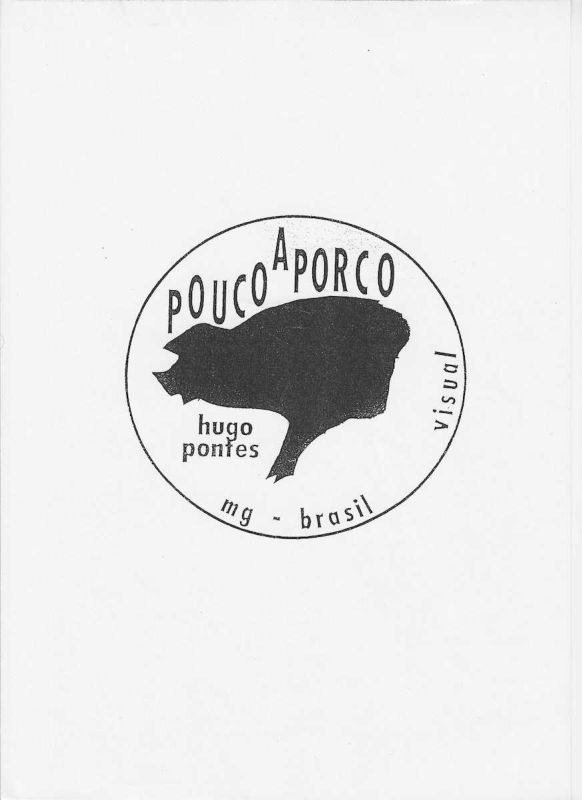
Impressão gráfica de Hugo Pontes intitulada Pouco a Porco, obra de poesia visual e arte gráfica construída pela associação entre linguagem verbal, imagem figurativa e referência territorial.
Hugo Pontes
Categoria: Mail Art
Acervo: 04074
Dimensões: 29,7 x 21 cm
TEXTO PARA O SALSA EM PORTUGUÊSImpressão gráfica de Hugo Pontes intitulada Pouco a Porco, obra de poesia visual e arte gráfica construída pela associação entre linguagem verbal, imagem figurativa e referência territorial. A composição apresenta um círculo central que funciona como campo gráfico e contém a silhueta preta de um porco vista lateralmente. Ao redor e sobre a figura aparecem as inscrições POUCO A PORCO, visual, hugo pontes e mg brasil, identificando o artista e sua vinculação com Minas Gerais e Brasil.O título Pouco a Porco constitui o principal mecanismo poético da obra. A expressão modifica a conhecida construção pouco a pouco pela substituição de uma palavra, criando um jogo fonético e semântico no qual porco interfere diretamente na leitura da frase. A presença da imagem do animal torna o jogo verbal imediatamente visual e transforma uma expressão cotidiana em comentário irônico e crítico.A silhueta do porco ocupa grande parte do campo circular e atua simultaneamente como imagem, símbolo e componente do próprio enunciado. A organização tipográfica acompanha a estrutura circular da composição, fazendo com que palavras e imagem funcionem como uma unidade gráfica. O termo visual impresso lateralmente reforça a vinculação da peça com procedimentos de poesia visual e com uma prática artística baseada na integração entre texto e imagem.Pouco a Porco pode ser compreendida como uma investigação sobre linguagem, alteração de expressões populares, humor, ironia, crítica social e produção de novos significados por meio de pequenas transformações verbais. A proximidade sonora entre pouco e porco é explorada como recurso poético e como dispositivo de comunicação visual.A obra insere se nos campos da poesia visual brasileira, poema visual, poesia experimental, arte conceitual, arte gráfica, comunicação visual, palavra e imagem, jogo verbal, trocadilho visual, humor gráfico e experimentalismo verbo visual. A identificação de Hugo Pontes e de Minas Gerais na própria peça também constitui informação relevante para a documentação da circulação e produção da poesia visual brasileira.SALSA TEXT IN ENGLISHGraphic print by Hugo Pontes entitled Pouco a Porco, a work of visual poetry and graphic art constructed through the association of verbal language, figurative imagery and geographical reference. The composition presents a central circle that functions as a graphic field and contains the black silhouette of a pig shown in profile. Around and over the figure appear the inscriptions POUCO A PORCO, visual, hugo pontes and mg brasil, identifying the artist and his connection with Minas Gerais and Brazil.The title Pouco a Porco constitutes the main poetic mechanism of the work. The expression transforms the familiar Portuguese construction pouco a pouco by replacing one word, creating a phonetic and semantic wordplay in which porco directly interferes with the reading of the phrase. The presence of the animal image makes the verbal operation immediately visual and transforms an everyday expression into an ironic and critical statement.The silhouette of the pig occupies a large part of the circular field and functions simultaneously as image, symbol and component of the verbal statement itself. The typography follows the circular structure of the composition, causing words and image to operate as a single graphic unit. The term visual printed along the side reinforces the connection of the piece with visual poetry and with an artistic practice based on the integration of text and image.Pouco a Porco can be understood as an investigation of language, alteration of popular expressions, humor, irony, social criticism and the creation of new meanings through small verbal transformations. The phonetic proximity between the Portuguese words pouco and porco is explored as both a poetic resource and a device of visual communication.The work belongs to the fields of Brazilian visual poetry, visual poem, experimental poetry, conceptual art, graphic art, visual communication, word and image, wordplay, visual pun, graphic humor and verbal visual experimentation. The identification of Hugo Pontes and Minas Gerais on the piece itself also constitutes important information for documenting the production and circulation of Brazilian visual poetry.
TEXTO DE OBSERVAÇÃO EM PORTUGUÊSImpressão gráfica em preto e branco de Hugo Pontes. A composição apresenta um círculo contendo a silhueta lateral de um porco. Na parte superior do círculo aparece a inscrição POUCO A PORCO. Dentro da área da figura estão impressos os nomes hugo pontes e, na lateral direita, a palavra visual. Na parte inferior do círculo aparece a indicação mg brasil.A obra utiliza a alteração da expressão pouco a pouco para produzir o título Pouco a Porco, estabelecendo um trocadilho baseado na proximidade gráfica e sonora entre as palavras pouco e porco. A imagem do animal completa visualmente o jogo linguístico e faz com que a leitura dependa simultaneamente da palavra e da figura.O formato circular, a tipografia distribuída ao redor da imagem e a silhueta centralizada criam uma composição próxima de um selo, emblema ou marca gráfica. A presença da palavra visual pode ser compreendida como indicação do caráter visual da proposta e reforça sua associação com a poesia visual e com a experimentação entre linguagem escrita e representação gráfica.Para catalogação, pesquisa e indexação digital, a peça pode ser associada aos termos Hugo Pontes, Pouco a Porco, Minas Gerais, Brasil, poesia visual brasileira, poema visual, poesia experimental, arte conceitual, arte gráfica brasileira, porco, silhueta, linguagem visual, palavra e imagem, jogo de palavras, trocadilho, humor, ironia, comunicação visual, tipografia, selo artístico, emblema gráfico e experimentalismo verbo visual.OBSERVATION TEXT IN ENGLISHBlack and white graphic print by Hugo Pontes. The composition presents a circle containing the profile silhouette of a pig. At the top of the circle appears the inscription POUCO A PORCO. Inside the area of the figure are printed the name hugo pontes and, on the right side, the word visual. At the bottom of the circle appears the identification mg brasil.The work alters the Portuguese expression pouco a pouco to produce the title Pouco a Porco, establishing a pun based on the graphic and phonetic proximity between the words pouco and porco. The image of the animal visually completes the linguistic operation and makes the interpretation dependent on both word and image.The circular format, typography distributed around the image and centralized silhouette create a composition resembling a stamp, emblem or graphic mark. The presence of the word visual can be understood as an indication of the visual nature of the proposal and reinforces its association with visual poetry and experimentation between written language and graphic representation.For cataloguing, research and digital indexing, the piece can be associated with Hugo Pontes, Pouco a Porco, Minas Gerais, Brazil, Brazilian visual poetry, visual poem, experimental poetry, conceptual art, Brazilian graphic art, pig, silhouette, visual language, word and image, wordplay, pun, humor, irony, visual communication, typography, artist stamp, graphic emblem and verbal visual experimentation.
Proveniência
Coleção Poema ProcessoInglês
Graphic print by Hugo Pontes entitled Pouco a Porco, a work of visual poetry and graphic art constructed through the association of verbal language, figurative imagery and geographical reference.
Dimensions: 11,7 x 8,3 in