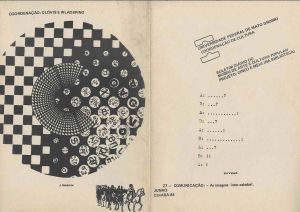
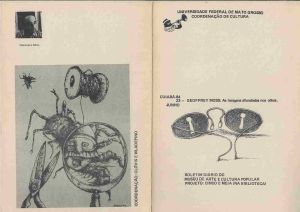
Boletim Diário do Museu de Arte e Cultura Popular da Universidade Federal de Mato Grosso, produzido pela Coordenação de Cultura no âmbito do Projeto Cinco e Meia na Biblioteca, dedicado ao artista chileno Guillermo Deisler em 20 de junho de 1984
Wlademir Dias Pino
Categoria: Poema Processo
Acervo: 03997
Data: 20 de Junho de 1984
Dimensões: 21 x 15,5 cm
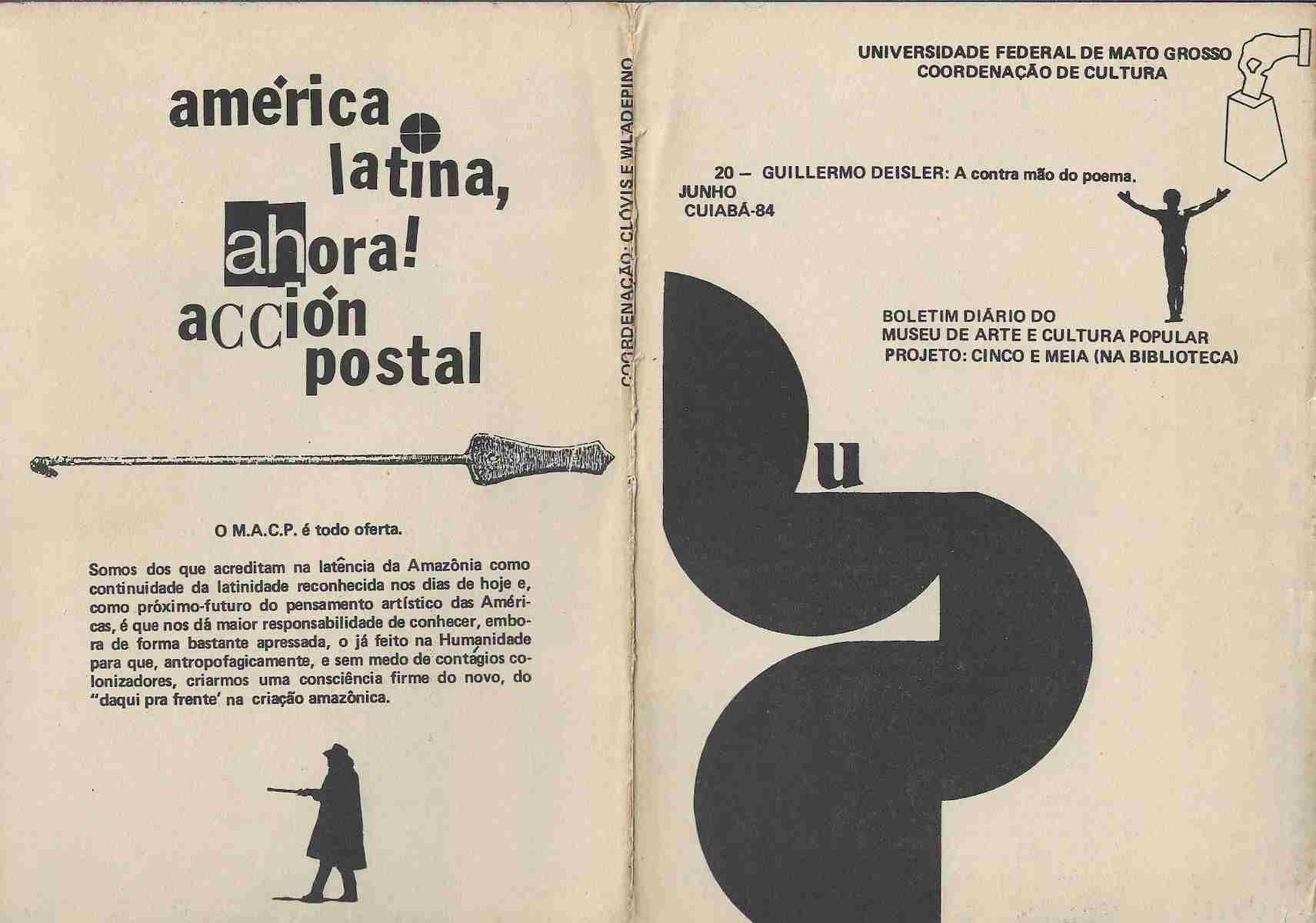
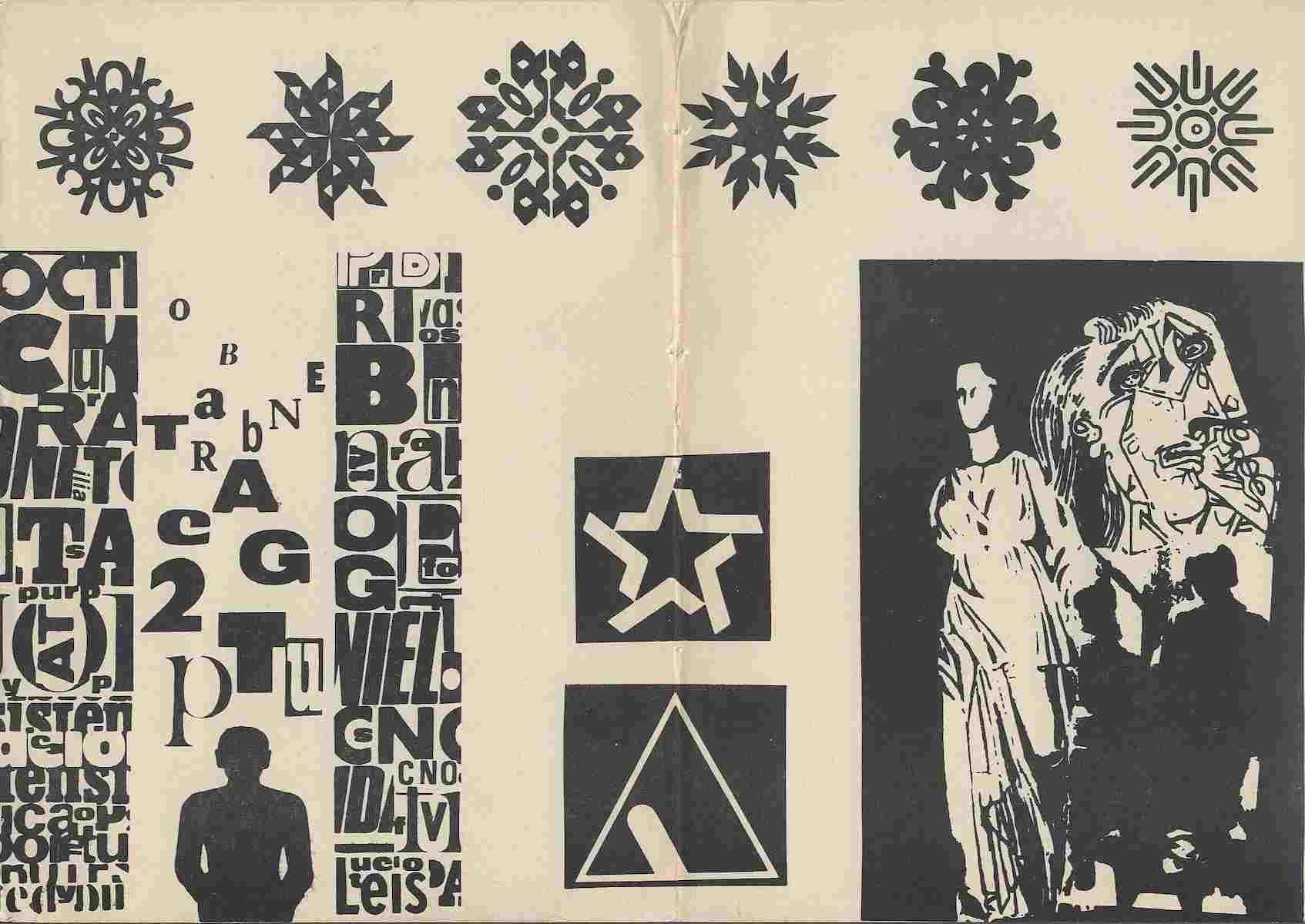
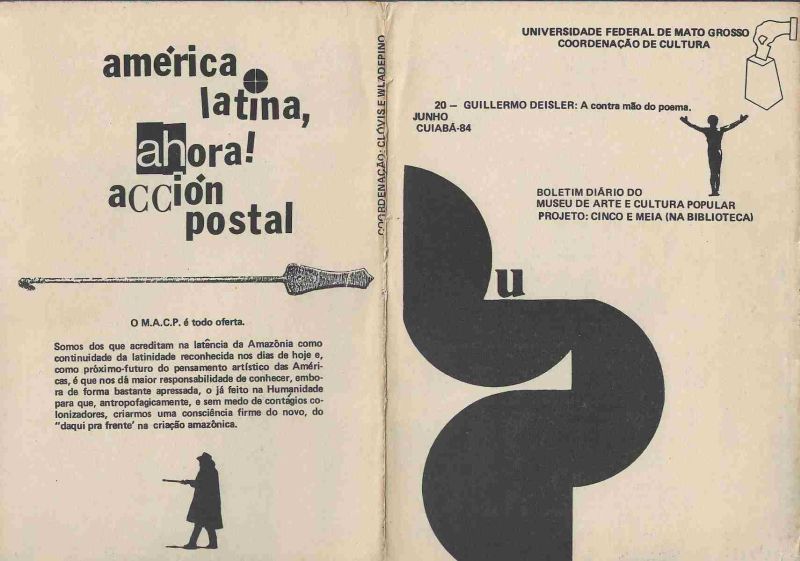
Boletim Diário do Museu de Arte e Cultura Popular da Universidade Federal de Mato Grosso, produzido pela Coordenação de Cultura no âmbito do Projeto Cinco e Meia na Biblioteca, dedicado ao artista chileno Guillermo Deisler em 20 de junho de 1984, em Cuiabá, Mato Grosso. A capa registra a programação 20 Guillermo Deisler: A contra mão do poema e identifica a Universidade Federal de Mato Grosso, a Coordenação de Cultura, o Museu de Arte e Cultura Popular e o Projeto Cinco e Meia na Biblioteca.O documento constitui importante registro da presença de Guillermo Deisler no circuito brasileiro de poesia visual, poesia experimental, arte postal e comunicação artística durante a década de 1980. Deisler foi uma referência latino americana na articulação entre palavra, imagem, impressão, circulação postal e produção gráfica. O boletim evidencia esse universo por meio de uma composição editorial em que tipografia, imagens, sinais, símbolos e estruturas visuais passam a funcionar como elementos de linguagem.A contracapa apresenta a expressão América Latina, ahora, acción postal, associando diretamente a publicação à ideia de ação postal e à circulação artística latino americana. A formulação aproxima o documento das redes internacionais de arte postal e das práticas experimentais que utilizavam correspondência, publicações, cartões, impressos e intercâmbios entre artistas como meios de comunicação e produção artística.Na mesma página aparece um texto institucional do Museu de Arte e Cultura Popular afirmando que o MACP é todo oferta. O texto apresenta uma reflexão sobre a Amazônia, a latinidade e o futuro do pensamento artístico das Américas. O museu declara acreditar na latência da Amazônia como continuidade da latinidade reconhecida no presente e como possibilidade futura para o pensamento artístico americano. Defende ainda a responsabilidade de conhecer o que já havia sido realizado pela humanidade para que, de forma antropofágica e sem medo de contágios colonizadores, fosse criada uma consciência firme do novo e de um daqui para frente na criação amazônica.Essa declaração confere ao boletim relevância que ultrapassa a apresentação individual de Guillermo Deisler. O documento registra uma formulação institucional acerca da cultura amazônica, da América Latina, da circulação de ideias e da construção de uma identidade artística conectada ao contexto continental. A presença da expressão acción postal reforça o vínculo com práticas internacionais de arte correio e com redes de intercâmbio que permitiam a circulação descentralizada da produção artística.As páginas internas são intensamente visuais. A composição reúne estruturas geométricas, signos simétricos, formas semelhantes a símbolos, blocos tipográficos, letras reorganizadas, figuras humanas, uma estrela, uma forma triangular e uma grande imagem figurativa construída em forte contraste entre áreas claras e escuras. O conjunto aproxima poesia visual, design gráfico, tipografia experimental, colagem, reprodução impressa, arte conceitual e comunicação visual.Um dos campos tipográficos apresenta letras de diferentes tamanhos, orientações e famílias gráficas, produzindo uma composição em que a leitura linear é substituída por uma experiência espacial da linguagem. A letra deixa de funcionar apenas como unidade verbal e torna se também matéria visual. Essa transformação da escrita em imagem é fundamental para compreender a poesia experimental e a poesia visual latino americana e estabelece um diálogo conceitual com experiências desenvolvidas no Brasil pelo Poema Processo.O boletim também deve ser compreendido no contexto das atividades culturais coordenadas pela Universidade Federal de Mato Grosso e pelo Museu de Arte e Cultura Popular em Cuiabá. A presença de Wlademir Dias Pino nesse contexto amplia a relevância histórica do documento para os estudos sobre Poema Processo, poesia visual brasileira, poesia experimental, design, comunicação gráfica, cultura mato grossense e conexões entre artistas latino americanos.A edição de 20 de junho de 1984 constitui, portanto, documento importante para pesquisas sobre Guillermo Deisler, Wlademir Dias Pino, Universidade Federal de Mato Grosso, Museu de Arte e Cultura Popular, Projeto Cinco e Meia na Biblioteca, poesia visual, poesia experimental, arte postal, mail art, acción postal, arte conceitual, comunicação gráfica, tipografia experimental, redes de artistas, América Latina, Chile, Brasil, Amazônia, intercâmbio cultural latino americano e circulação internacional da arte durante os anos 1980.Salsa text in EnglishDaily Bulletin of the Museum of Art and Popular Culture of the Federal University of Mato Grosso, produced by the Culture Coordination within the Five Thirty at the Library Project and dedicated to Chilean artist Guillermo Deisler on 20 June 1984 in Cuiabá, Mato Grosso, Brazil. The cover records the program 20 Guillermo Deisler: A contra mão do poema and identifies the Federal University of Mato Grosso, the Culture Coordination, the Museum of Art and Popular Culture and the Five Thirty at the Library Project.The document is an important record of the presence of Guillermo Deisler within Brazilian networks of visual poetry, experimental poetry, mail art and artistic communication during the 1980s. Deisler was an important Latin American figure in the articulation of word, image, print, postal circulation and graphic production. The bulletin reflects this field through an editorial composition in which typography, images, signs, symbols and visual structures operate as elements of language.The back cover presents the expression América Latina, ahora, acción postal, directly associating the publication with postal action and with the circulation of art throughout Latin America. This formulation connects the document to international mail art networks and to experimental practices that used correspondence, publications, postcards, printed matter and exchanges among artists as forms of artistic communication and production.The same page contains an institutional text from the Museum of Art and Popular Culture stating that the MACP is entirely an offering. The text presents a reflection on the Amazon region, Latin identity and the future of artistic thought in the Americas. The museum expresses its belief in the latent potential of the Amazon as a continuation of contemporary Latin identity and as a future possibility for artistic thinking across the Americas. It also stresses the responsibility to understand what humanity had already produced so that, through an anthropophagic process and without fear of colonial contamination, a firm consciousness of the new and of a forward direction in Amazonian creation could emerge.This statement gives the bulletin a significance that extends beyond the individual presentation of Guillermo Deisler. The document records an institutional position concerning Amazonian culture, Latin America, the circulation of ideas and the construction of an artistic identity connected to the continental context. The expression acción postal reinforces its connection with international mail art practices and decentralized exchange networks through which artistic production circulated.The internal pages are strongly visual. Their compositions combine geometric structures, symmetrical signs, symbol like forms, typographic blocks, reorganized letters, human figures, a star, a triangular form and a large figurative image built through strong contrasts between light and dark areas. The ensemble brings together visual poetry, graphic design, experimental typography, collage, printed reproduction, conceptual art and visual communication.One typographic field contains letters of different sizes, orientations and graphic styles, creating a composition in which linear reading is replaced by a spatial experience of language. Letters no longer function only as verbal units and become visual material. This transformation of writing into image is fundamental to understanding Latin American experimental poetry and visual poetry and establishes a conceptual dialogue with experiments developed in Brazil through Poema Processo.The bulletin should also be understood within the context of cultural activities organized by the Federal University of Mato Grosso and the Museum of Art and Popular Culture in Cuiabá. The presence of Wlademir Dias Pino within this context increases the historical relevance of the document for research on Poema Processo, Brazilian visual poetry, experimental poetry, design, graphic communication, cultural production in Mato Grosso and connections among Latin American artists.The 20 June 1984 edition is therefore an important documentary source for research on Guillermo Deisler, Wlademir Dias Pino, the Federal University of Mato Grosso, the Museum of Art and Popular Culture, the Five Thirty at the Library Project, visual poetry, experimental poetry, mail art, acción postal, conceptual art, graphic communication, experimental typography, artist networks, Latin America, Chile, Brazil, the Amazon region, Latin American cultural exchange and the international circulation of art during the 1980s.
Texto de observação em portuguêsDocumento impresso datado de 20 de junho de 1984, Cuiabá, relacionado à Universidade Federal de Mato Grosso, Coordenação de Cultura e Museu de Arte e Cultura Popular, no âmbito do Projeto Cinco e Meia na Biblioteca. A edição é dedicada a Guillermo Deisler e apresenta na capa a identificação A contra mão do poema.O exemplar possui forte caráter gráfico e experimental. A capa combina grandes formas geométricas negras, tipografia e figuras humanas. Nas páginas internas aparecem signos ornamentais e geométricos, composições tipográficas com letras fragmentadas e reorganizadas, estruturas gráficas, uma estrela, uma forma triangular e uma grande composição figurativa. O uso da letra como forma e da página como campo visual aproxima o material da poesia visual, da poesia experimental e das investigações sobre linguagem gráfica desenvolvidas por artistas latino americanos no período.A contracapa possui especial importância documental por apresentar a expressão América Latina, ahora, acción postal. Essa formulação insere explicitamente o boletim no campo da arte postal e das redes de circulação artística latino americanas. Também aparece um texto do MACP dedicado ao papel da Amazônia na formação de um pensamento artístico das Américas. O texto propõe uma consciência do novo baseada no conhecimento da produção cultural anterior, na antropofagia cultural e na resistência aos processos colonizadores.O boletim documenta, assim, uma convergência entre Guillermo Deisler, arte postal, poesia visual, comunicação impressa e pensamento cultural latino americano. Também constitui fonte importante para o estudo das atividades realizadas pela Universidade Federal de Mato Grosso e pelo Museu de Arte e Cultura Popular na década de 1980 e para a compreensão do ambiente intelectual e artístico associado a Wlademir Dias Pino em Cuiabá.O estado físico visível do exemplar apresenta marcas do tempo, vincos, desgaste na dobra central, alterações cromáticas do papel e pequenas irregularidades decorrentes do manuseio e da conservação. Essas características são compatíveis com sua condição de documento impresso histórico e devem ser preservadas como elementos materiais do objeto original.Para fins de catalogação e indexação, os principais termos relacionados ao documento são Guillermo Deisler, Wlademir Dias Pino, Universidade Federal de Mato Grosso, UFMT, Coordenação de Cultura, Museu de Arte e Cultura Popular, MACP, Projeto Cinco e Meia na Biblioteca, Cuiabá, Mato Grosso, 20 de junho de 1984, A contra mão do poema, América Latina, ahora, acción postal, arte postal, mail art, poesia visual, poesia experimental, Poema Processo, comunicação visual, tipografia experimental, arte conceitual, arte latino americana, Chile, Brasil, Amazônia e redes internacionais de artistas.Observation text in EnglishPrinted document dated 20 June 1984 in Cuiabá, connected to the Federal University of Mato Grosso, the Culture Coordination and the Museum of Art and Popular Culture within the Five Thirty at the Library Project. The edition is dedicated to Guillermo Deisler and presents the identification A contra mão do poema on its cover.The publication has a strong graphic and experimental character. The cover combines large black geometric forms, typography and human figures. The internal pages include ornamental and geometric signs, typographic compositions formed from fragmented and reorganized letters, graphic structures, a star, a triangular form and a large figurative composition. The use of letters as visual forms and of the page as a spatial field connects the material with visual poetry, experimental poetry and investigations into graphic language developed by Latin American artists during this period.The back cover is particularly important because it presents the expression América Latina, ahora, acción postal. This formulation explicitly places the bulletin within the field of mail art and Latin American artistic circulation networks. It also contains an institutional text by the MACP addressing the role of the Amazon region in the formation of artistic thought in the Americas. The text proposes a consciousness of the new based on knowledge of previous cultural production, cultural anthropophagy and resistance to colonial processes.The bulletin therefore documents a convergence between Guillermo Deisler, mail art, visual poetry, printed communication and Latin American cultural thought. It is also an important source for the study of activities developed by the Federal University of Mato Grosso and the Museum of Art and Popular Culture during the 1980s and for understanding the intellectual and artistic environment associated with Wlademir Dias Pino in Cuiabá.The visible physical condition of the copy shows signs of age, folds, wear along the central crease, changes in the tone of the paper and small irregularities resulting from handling and preservation. These characteristics are consistent with its status as a historical printed document and should be preserved as material evidence of the original object.For cataloguing and digital indexing, the principal terms associated with the document include Guillermo Deisler, Wlademir Dias Pino, Federal University of Mato Grosso, UFMT, Culture Coordination, Museum of Art and Popular Culture, MACP, Five Thirty at the Library Project, Cuiabá, Mato Grosso, 20 June 1984, A contra mão do poema, América Latina, ahora, acción postal, mail art, visual poetry, experimental poetry, Poema Processo, visual communication, experimental typography, conceptual art, Latin American art, Chile, Brazil, the Amazon region and international artist networks.
Proveniência
Coleção Poema ProcessoInglês
Daily Bulletin of the Museum of Art and Popular Culture of the Federal University of Mato Grosso, produced by the Culture Coordination within the Five Thirty at the Library Project and dedicated to Chilean artist Guillermo Deisler on 20 June 1984
Dimensions: 8,3 x 6,1 in