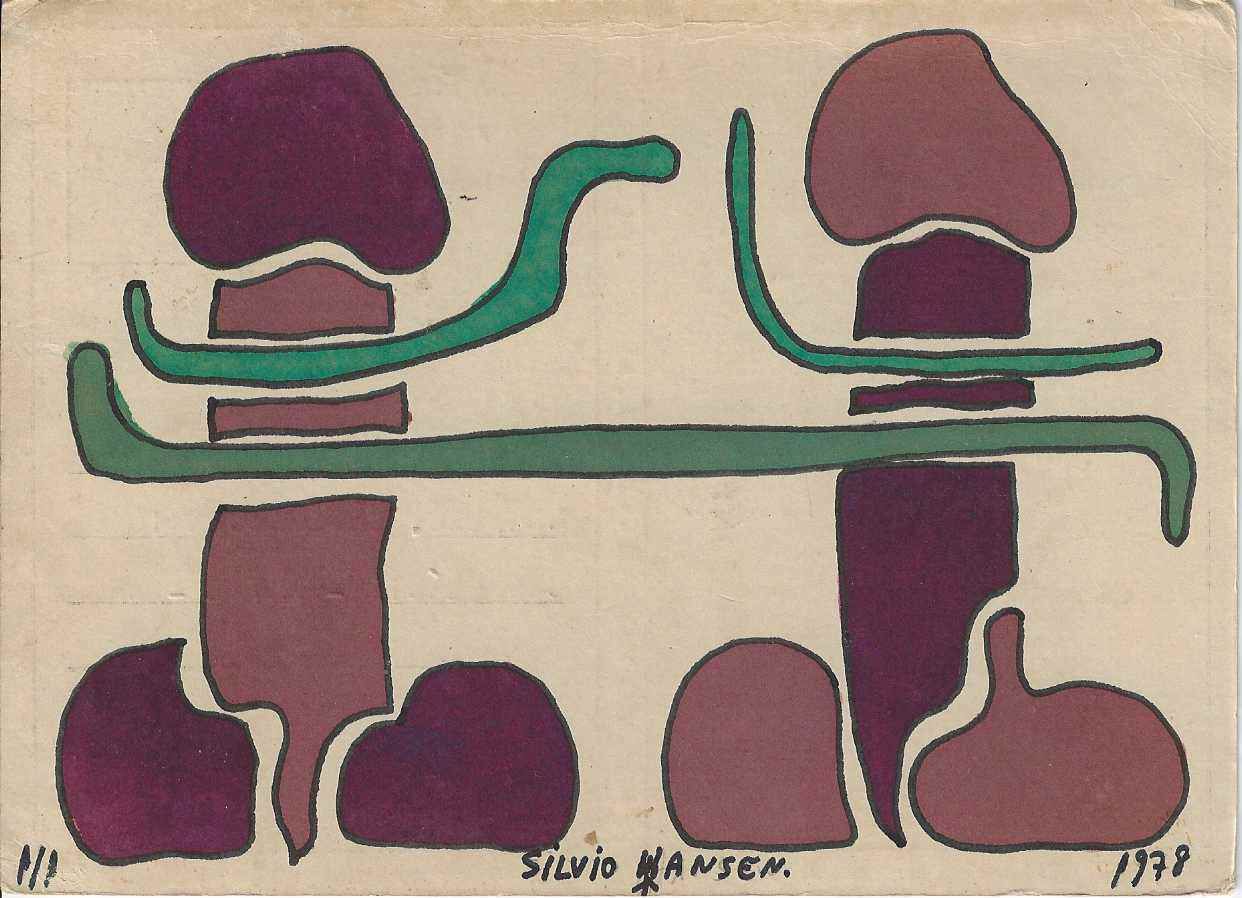
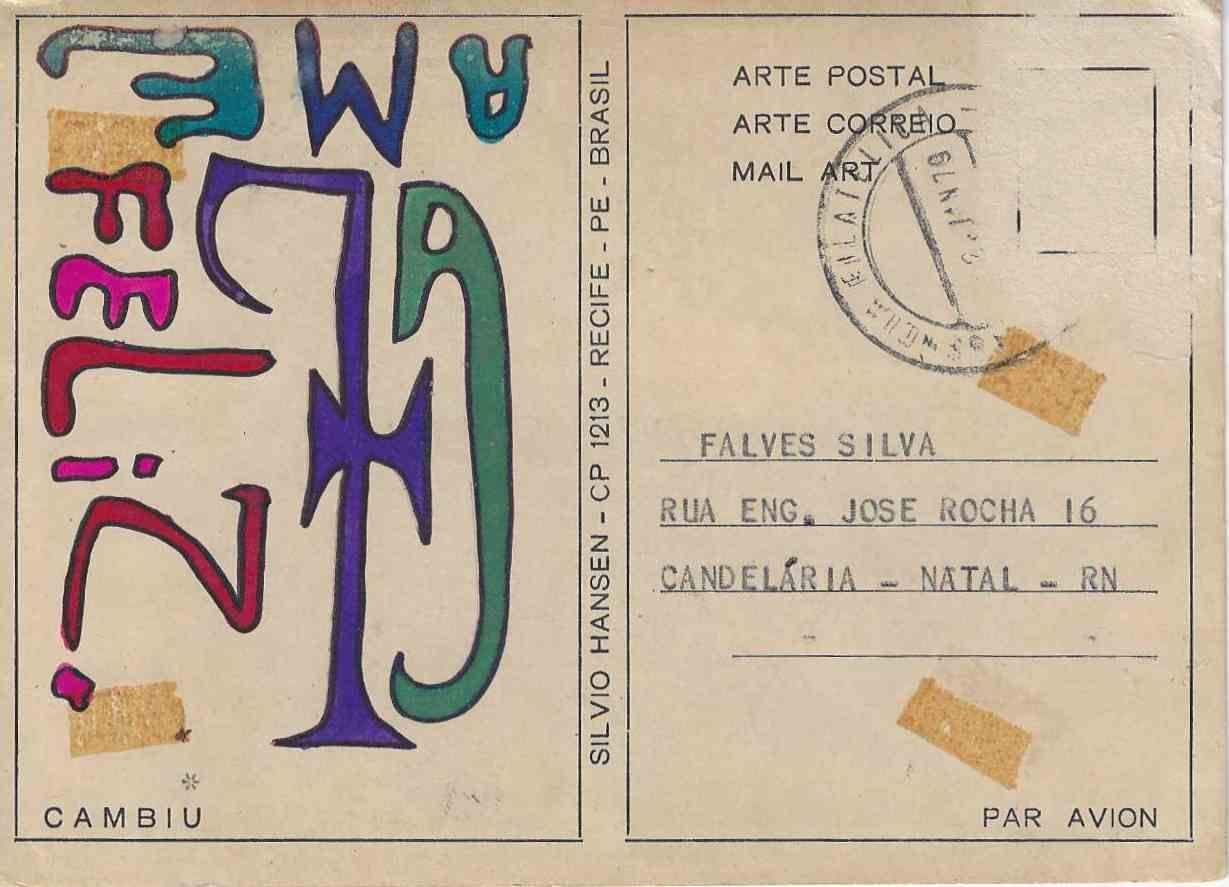
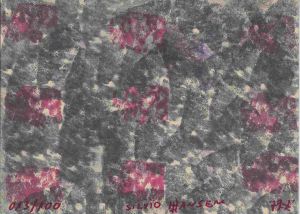
Peça de arte postal pintada à mão por Silvio Hansen e enviada a Falves Silva, em Natal, Rio Grande do Norte, em 1979.
Sílvio Hansen - Silvio Romero Hansen de Barros
Categoria: Mail Art
Acervo: 03700
Data: 1979
Dimensões: 11,4 x 15,7 cm
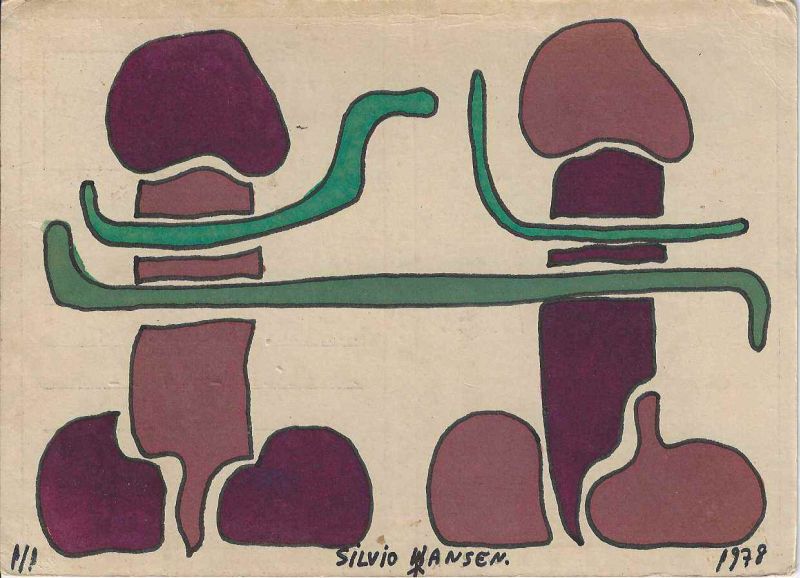
Peça de arte postal pintada à mão por Silvio Hansen e enviada a Falves Silva, em Natal, Rio Grande do Norte, em 1979. O objeto apresenta intervenção manual em toda a superfície, combinando desenho, pintura, caligrafia, sinais gráficos, identificação postal e circulação pelo correio. A obra integra o campo da Mail Art brasileira e documenta a comunicação entre Silvio Hansen, atuante no Recife, Pernambuco, e Falves Silva, artista ligado ao Poema Processo, à poesia experimental, à arte gráfica e às redes internacionais de arte postal.Na face principal, Silvio Hansen constrói uma composição abstrata com formas orgânicas delimitadas por contornos escuros e preenchidas em tons de vinho, vermelho, rosa, verde e roxo. As estruturas ocupam diferentes regiões do suporte e sugerem organismos, sementes, cogumelos, órgãos, recipientes, massas corporais ou sinais inventados. Entretanto, o documento não apresenta título ou explicação que permita atribuir uma representação definitiva às formas.Duas linhas verdes atravessam horizontalmente a região central da composição. A linha superior realiza movimentos curvos e passa entre as duas formas maiores da parte superior. A linha inferior percorre quase toda a largura do trabalho e termina em uma curva descendente na margem direita. Essas linhas conectam os elementos separados, estabelecendo uma rede visual entre as estruturas orgânicas.A organização da imagem baseia se em repetição, correspondência, equilíbrio e variação. Na região superior aparecem duas formas semelhantes, constituídas por grandes massas arredondadas apoiadas sobre segmentos menores. Na parte inferior, outras formas apresentam diferenças de escala e configuração. A composição sugere um sistema de relações entre unidades autônomas, conectadas por linhas contínuas.No centro inferior aparece a assinatura manuscrita Silvio Hansen, acompanhada do ano 1979. Na margem inferior esquerda observa se uma pequena marcação gráfica formada por dois sinais verticais. Esses elementos confirmam a autoria e a datação da intervenção visual.A outra face encontra se dividida em duas áreas retangulares. A área esquerda apresenta nova composição abstrata pintada à mão, formada por letras, sinais, curvas e estruturas gráficas em verde, azul, roxo, vermelho e rosa. Algumas formas lembram caracteres alfabéticos, mas sua disposição altera a leitura convencional e aproxima a escrita de uma linguagem visual autônoma.Entre os sinais é possível reconhecer elementos semelhantes às letras A, M, F, E, L, Z e a um ponto de interrogação. A composição pode sugerir uma palavra fragmentada, uma escrita inventada ou uma reorganização visual de letras, porém não é possível estabelecer uma transcrição segura. No alto da área esquerda aparece uma forma verde semelhante a uma mão, garra ou perfil gráfico. Na parte inferior encontra se a palavra Cambiu, impressa em letras maiúsculas, seguida de pequeno símbolo semelhante a um asterisco.A palavra Cambiu pode constituir título, assinatura secundária, identificação de projeto, expressão inventada ou referência específica empregada pelo artista. O documento não fornece informação complementar capaz de determinar sua função. Por esse motivo, o termo deve ser preservado conforme aparece na peça, sem interpretação definitiva.Uma faixa vertical separa a composição visual da área reservada ao endereço. Nessa faixa encontra se a identificação Silvio Hansen, Caixa Postal 1213, Recife, Pernambuco, Brasil. A informação documenta o endereço utilizado pelo artista para sua participação nas redes de correspondência e confirma a origem da peça na cidade do Recife.Na área postal aparecem as expressões Arte Postal, Arte Correio e Mail Art, impressas em três linhas. A presença simultânea dos termos em português e inglês identifica de maneira direta o campo artístico ao qual o trabalho pertence. Essa autodefinição transforma o próprio sistema postal em tema, meio de produção e estrutura de circulação da obra.A peça foi destinada a Falves Silva, na Rua Engenheiro José Rocha, número 16, Candelária, Natal, Rio Grande do Norte. O nome e o endereço do destinatário foram aplicados por meio de caracteres datilografados ou impressos. Na região inferior direita aparece a indicação Par Avion, termo francês utilizado para correspondência aérea.O carimbo postal circular está parcialmente apagado e sobreposto à área destinada ao selo. A leitura integral da data não é segura na reprodução apresentada. A atribuição ao ano de 1979 é confirmada pela inscrição manuscrita presente na face pintada. Pequenos fragmentos de fita adesiva aparecem em diferentes regiões, provavelmente relacionados à fixação, montagem, exposição, armazenamento ou conservação anterior da obra.A peça possui especial importância por reunir criação visual, comunicação e deslocamento físico. Não se trata apenas de uma pintura aplicada sobre um suporte postal. O endereço, o remetente, os termos Arte Postal, Arte Correio e Mail Art, o carimbo, a postagem e o percurso entre Recife e Natal participam do significado do trabalho.O envio documenta a relação entre Silvio Hansen e Falves Silva e evidencia a circulação da arte experimental entre Pernambuco e Rio Grande do Norte no final da década de 1970. Falves Silva mantinha uma extensa rede de contatos com artistas, poetas, editores e produtores independentes do Brasil e do exterior. A correspondência recebida por ele constitui fonte fundamental para reconstruir a expansão da Mail Art, da poesia visual e das práticas conceituais no Nordeste brasileiro.A obra aproxima pintura manual, desenho abstrato, escrita visual, poesia experimental e comunicação postal. As formas orgânicas e os caracteres transformados demonstram uma pesquisa sobre a passagem entre imagem e linguagem. As letras deixam de funcionar apenas como sinais de leitura e passam a possuir corpo, cor, ritmo, direção e presença espacial.A relação com o Poema Processo ocorre por meio de Falves Silva e do ambiente experimental no qual o documento circulou. A peça não comprova que Silvio Hansen tenha integrado formalmente o movimento Poema Processo. Sua conexão documentada está na correspondência com um de seus participantes históricos e no compartilhamento de procedimentos como visualidade da escrita, criação de códigos, participação, reprodução, circulação e utilização do suporte como parte ativa da obra.O trabalho constitui documento primário da arte postal brasileira em 1979. Sua preservação permite estudar a atuação de Silvio Hansen no Recife, a rede de Falves Silva em Natal, os intercâmbios entre artistas nordestinos e a utilização do correio como sistema alternativo de criação, contato, difusão e arquivo.TEXT FOR THE SALSA PROGRAM IN ENGLISHHand painted postal artwork created by Silvio Hansen and sent to Falves Silva in Natal, Rio Grande do Norte, Brazil, in 1979. The object presents manual intervention across its entire surface through drawing, painting, calligraphy, graphic signs, postal identification and circulation through the mail. The work belongs to the field of Brazilian Mail Art and documents communication between Silvio Hansen, active in Recife, Pernambuco, and Falves Silva, an artist associated with the Process Poem Movement, experimental poetry, graphic art and international postal networks.On the principal side, Silvio Hansen constructed an abstract composition using organic forms outlined in dark pigment and filled with shades of burgundy, red, pink, green and purple. These structures occupy different sections of the surface and may evoke organisms, seeds, mushrooms, organs, containers, bodily masses or invented signs. The document contains no title or explanatory text that would support a definitive identification of the forms.Two green lines cross the central section horizontally. The upper line follows a curved path and passes between the two larger forms in the upper area. The lower line extends across almost the full width of the composition and ends in a descending curve near the right margin. These lines connect otherwise separate elements and establish a visual network among the organic structures.The image is organized through repetition, correspondence, balance and variation. Two related forms appear in the upper section, each composed of a large rounded mass supported by smaller segments. Additional forms in the lower area differ in scale and configuration. The composition suggests a system of relationships among autonomous units connected through continuous lines.The handwritten name Silvio Hansen appears in the lower central area, accompanied by the year 1979. A small graphic notation formed by two vertical signs appears near the lower left margin. These elements confirm the authorship and date of the visual intervention.The other side is divided into two rectangular areas. The left area contains another hand painted abstract composition made from letters, signs, curves and graphic structures in green, blue, purple, red and pink. Several forms resemble alphabetic characters, but their arrangement disrupts conventional reading and transforms writing into an autonomous visual language.Among the signs it is possible to recognize forms resembling the letters A, M, F, E, L and Z, together with a question mark. The composition may suggest a fragmented word, an invented script or a visual reorganization of letters, but a secure transcription cannot be established. A green form resembling a hand, claw or graphic profile appears near the top. The word Cambiu is printed in capital letters at the bottom and is followed by a small symbol similar to an asterisk.Cambiu may be a title, secondary signature, project identification, invented expression or a specific reference employed by the artist. The document provides no additional information capable of determining its function. The term should therefore be preserved exactly as it appears without assigning a definitive interpretation.A vertical strip separates the painted composition from the address area. This strip identifies the sender as Silvio Hansen, Post Office Box 1213, Recife, Pernambuco, Brazil. The information documents the address used by the artist for correspondence and confirms the origin of the object in Recife.The postal section contains the expressions Arte Postal, Arte Correio and Mail Art on three separate lines. Their simultaneous use in Portuguese and English directly identifies the artistic field to which the work belongs. This self designation transforms the postal system into the subject, medium and distribution structure of the artwork.The object was addressed to Falves Silva at Rua Engenheiro José Rocha, number 16, Candelária, Natal, Rio Grande do Norte, Brazil. The name and address of the recipient appear to have been typed or mechanically printed. The designation Par Avion appears in the lower right area and indicates postal circulation by air.The circular postal cancellation is partially faded and overlaps the postage area. Its complete date cannot be read securely from the available reproduction. The attribution to 1979 is confirmed by the handwritten date on the painted side. Small fragments of adhesive tape appear in several areas and may be associated with previous mounting, display, storage or conservation.The object is particularly significant because it combines visual creation, communication and physical movement. It is not merely a painting applied to a postal support. The address, sender identification, the expressions Arte Postal, Arte Correio and Mail Art, the postal cancellation and the journey between Recife and Natal all participate in the meaning of the work.The mailing documents the relationship between Silvio Hansen and Falves Silva and demonstrates the circulation of experimental art between Pernambuco and Rio Grande do Norte during the late 1970s. Falves Silva maintained an extensive network of contacts with artists, poets, editors and independent producers in Brazil and abroad. His correspondence provides an important source for reconstructing the expansion of Mail Art, visual poetry and conceptual practices in northeastern Brazil.The work brings together manual painting, abstract drawing, visual writing, experimental poetry and postal communication. Its organic forms and transformed characters reveal an investigation of the transition between image and language. Letters no longer function only as readable signs but acquire body, color, rhythm, direction and spatial presence.The relationship with the Process Poem Movement is established through Falves Silva and the experimental environment within which the document circulated. The object does not demonstrate that Silvio Hansen formally participated in the Process Poem Movement. The documented connection lies in his correspondence with one of its historical participants and in shared procedures such as the visual treatment of writing, the invention of codes, participation, circulation and the use of the support as an active component of the artwork.The work is a primary document of Brazilian Mail Art in 1979. Its preservation supports research into the activity of Silvio Hansen in Recife, the network maintained by Falves Silva in Natal, exchanges among artists in northeastern Brazil and the use of the postal system as an alternative structure for creation, contact, distribution and archival memory.
Peça postal original pintada à mão por Silvio Hansen e enviada a Falves Silva em 1979. Embora identificada como envelope, a estrutura visível nas imagens apresenta características próximas de cartão ou peça postal plana. A classificação definitiva deve ser confirmada mediante exame físico do objeto. A face principal contém composição abstrata formada por estruturas orgânicas em tons de vinho, rosa, vermelho, verde e roxo, conectadas por linhas horizontais verdes. Na região inferior aparecem a assinatura Silvio Hansen e o ano 1979. A outra face apresenta composição manual com letras e sinais transformados, a palavra Cambiu, a identificação Silvio Hansen, Caixa Postal 1213, Recife, Pernambuco, Brasil, e as expressões Arte Postal, Arte Correio e Mail Art. A peça foi destinada a Falves Silva na Rua Engenheiro José Rocha, número 16, Candelária, Natal, Rio Grande do Norte. Também aparecem a indicação Par Avion e carimbo postal parcialmente ilegível. O documento apresenta marcas de dobra, manchas, abrasões, desgaste nas margens, alterações cromáticas e fragmentos de fita adesiva relacionados a antigos processos de montagem ou armazenamento. O objeto integra a correspondência artística de Falves Silva e documenta a circulação da Mail Art entre Recife e Natal em 1979.OBSERVATION TEXT IN ENGLISHOriginal postal artwork hand painted by Silvio Hansen and sent to Falves Silva in 1979. Although identified as an envelope, the structure visible in the images resembles a postcard or flat postal object. A definitive classification requires physical examination of the original. The principal side contains an abstract composition formed by organic structures in burgundy, pink, red, green and purple, connected by horizontal green lines. The handwritten name Silvio Hansen and the year 1979 appear in the lower area. The other side contains a manually produced composition using transformed letters and signs, the word Cambiu, the identification Silvio Hansen, Post Office Box 1213, Recife, Pernambuco, Brazil, and the expressions Arte Postal, Arte Correio and Mail Art. The object was addressed to Falves Silva at Rua Engenheiro José Rocha, number 16, Candelária, Natal, Rio Grande do Norte, Brazil. It also bears the designation Par Avion and a partially illegible postal cancellation. The document shows fold marks, staining, abrasions, edge wear, chromatic alteration and fragments of adhesive tape associated with earlier mounting or storage. The object belongs to the artistic correspondence of Falves Silva and documents the circulation of Mail Art between Recife and Natal in 1979.
Proveniência
Coleção Falves SilvaInglês
Hand painted postal artwork created by Silvio Hansen and sent to Falves Silva in Natal, Rio Grande do Norte, Brazil, in 1979.
Dimensions: 4,5 x 6,2 in