Réquiem para Yanomami é uma impressão gráfica de Avelino de Araújo realizada em 1995, vinculada à poesia visual, à poesia experimental, à arte conceitual, à arte política e às investigações intersígnicas relacionadas ao campo do Poema Processo.
Avelino de Araújo
Categoria: Poema Processo
Acervo: 00261
Data: 1995
Dimensões: 27,8 x 21,6 cm
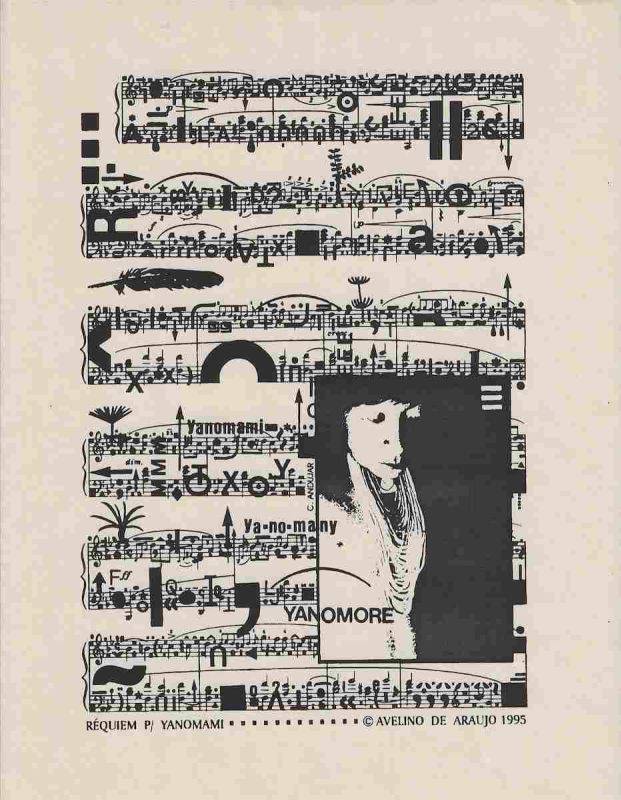
Réquiem para Yanomami é uma impressão gráfica de Avelino de Araújo realizada em 1995, vinculada à poesia visual, à poesia experimental, à arte conceitual, à arte política e às investigações intersígnicas relacionadas ao campo do Poema Processo. A composição apresenta uma estrutura vertical de grande densidade formada por pautas musicais, notas, sinais de dinâmica, pausas, barras, setas, letras, números, palavras fragmentadas, formas geométricas, imagens vegetais e um retrato humano em preto e branco. O título estabelece a obra como um réquiem visual dedicado ao povo Yanomami e associa a linguagem musical do lamento e da memória a uma denúncia sobre violência, desaparecimento, destruição cultural e ameaça à sobrevivência dos povos indígenas. Avelino de Araújo transforma a partitura em campo poético e político. Em lugar de uma música convencional, apresenta uma notação gráfica expandida, marcada por sobreposição, ruído, interrupções, contrastes e fragmentos de informação. As pautas atravessam quase toda a imagem e funcionam como linhas de organização, mas são constantemente invadidas por sinais, figuras e blocos negros. O retrato localizado na região central direita introduz uma presença humana direta e reforça a dimensão documental e memorial da obra. A figura aparece parcialmente integrada a um grande campo escuro, sugerindo apagamento, luto, invisibilidade ou ameaça. Entre os elementos textuais podem ser reconhecidos fragmentos relacionados ao nome Yanomami, incluindo variações tipográficas e fonéticas que aproximam Yanomami de expressões de ausência e desaparecimento. A obra utiliza a repetição do nome como forma de insistência, lembrança e resistência. Pequenas formas vegetais distribuídas entre as pautas podem remeter à floresta, ao território, à vida coletiva e à relação dos Yanomami com o ambiente amazônico. Setas orientadas para cima, formas semelhantes a raízes, folhas e flores, símbolos musicais e elementos gráficos criam uma paisagem simultaneamente sonora, visual e política. Réquiem para Yanomami pode ser compreendido como poema visual, partitura gráfica, memorial, denúncia e homenagem. A obra investiga as relações entre som e silêncio, vida e morte, presença e desaparecimento, floresta e violência, memória e apagamento. Na parte inferior aparece a identificação RÉQUIEM P YANOMAMI, seguida por uma sequência de pontos, pelo símbolo de autoria, pelo nome Avelino de Araújo e pelo ano 1995. Palavras chave para indexação: Avelino de Araújo, Réquiem para Yanomami, Requiem para Yanomami, 1995, impressão gráfica, poesia visual brasileira, poema visual, poesia experimental, arte conceitual, Poema Processo, povo Yanomami, povos indígenas do Brasil, Amazônia, arte indígena e política, direitos indígenas, violência contra povos indígenas, memória, luto, denúncia, floresta amazônica, partitura visual, poesia sonora, notação experimental, arte política, semiótica, intersigno, comunicação visual, arte gráfica brasileira, múltiplo gráfico, arquivo de poesia visual, arte brasileira do século vinte. TEXTO DE OBSERVAÇÃO EM PORTUGUÊS: Impressão gráfica em tinta preta sobre papel claro de tonalidade levemente amarelada. A composição ocupa a região central da folha e apresenta diversas faixas horizontais semelhantes a sistemas de partitura musical. As pautas estão densamente preenchidas por notas, claves, pausas, sinais de dinâmica, números, letras, blocos negros, linhas curvas e formas geométricas. Algumas áreas possuem grande concentração de elementos, reduzindo a legibilidade e criando sensação de ruído visual. Na região central direita encontra se um retrato humano em preto e branco, parcialmente sobreposto por um campo retangular negro. A figura apresenta adornos ou elementos lineares ao redor do pescoço e do tronco. Entre as pautas aparecem pequenas formas semelhantes a plantas, folhas, flores, raízes e setas. São visíveis fragmentos textuais relacionados ao nome Yanomami, distribuídos em diferentes posições e escalas. Na parte inferior encontra se a inscrição RÉQUIEM P YANOMAMI, seguida por uma sequência de pontos, pelo símbolo de autoria, pelo nome AVELINO DE ARAUJO e pelo ano 1995. O suporte apresenta ondulações, vincos, alterações de tonalidade, pequenas manchas e sinais de envelhecimento e manuseio. A peça pode ser classificada como poema visual, impressão de artista, múltiplo gráfico, partitura experimental, obra memorial e documento de crítica política e social, sendo relevante para pesquisas sobre Avelino de Araújo, Poema Processo, poesia visual, povo Yanomami, Amazônia, direitos indígenas, música, semiótica e produção gráfica brasileira.RÉQUIEM P YANOMAMI, followed by a sequence of dots, the authorship symbol, the name Avelino de Araújo and the year 1995. Keywords for indexing: Avelino de Araújo, Requiem for the Yanomami, Réquiem para Yanomami, 1995, graphic print, Brazilian visual poetry, visual poem, experimental poetry, conceptual art, Poema Processo, Yanomami people, Indigenous peoples of Brazil, Amazon, Indigenous rights, violence against Indigenous peoples, memory, mourning, denunciation, Amazon rainforest, visual score, sound poetry, experimental notation, political art, semiotics, intersign, visual communication, Brazilian graphic art, graphic multiple, visual poetry archive, twentieth century Brazilian art.
Requiem for the Yanomami is a graphic print by Avelino de Araújo produced in 1995 and associated with visual poetry, experimental poetry, conceptual art, political art and intersemiotic investigations related to the field of the Poema Processo movement. The composition presents a highly dense vertical structure formed by musical staves, notes, dynamic signs, rests, bars, arrows, letters, numbers, fragmented words, geometric forms, plant images and a black and white human portrait. The title establishes the work as a visual requiem dedicated to the Yanomami people and connects the musical language of mourning and remembrance with a denunciation of violence, disappearance, cultural destruction and threats to the survival of Indigenous peoples. Avelino de Araújo transforms the musical score into a poetic and political field. Instead of presenting conventional music, he creates an expanded graphic notation marked by superimposition, noise, interruption, contrast and fragments of information. The staves cross almost the entire image and function as organizing lines, but they are constantly invaded by signs, figures and black blocks. The portrait located in the central right region introduces a direct human presence and reinforces the documentary and memorial dimension of the work. The figure is partially integrated into a large dark field, suggesting erasure, mourning, invisibility or threat. Textual elements include fragments related to the name Yanomami, with typographic and phonetic variations that connect the name with ideas of absence and disappearance. Repetition of the name functions as insistence, remembrance and resistance. Small plant forms distributed among the staves may refer to the forest, territory, collective life and the relationship of the Yanomami people with the Amazon environment. Upward arrows, forms resembling roots, leaves and flowers, musical symbols and graphic elements create a landscape that is simultaneously sonic, visual and political. Requiem for the Yanomami may be understood as a visual poem, graphic score, memorial, denunciation and tribute. The work investigates relationships between sound and silence, life and death, presence and disappearance, forest and violence, memory and erasure. The lower section contains the identificationOBSERVATION TEXT IN ENGLISH: Graphic print in black ink on light colored paper with a slightly yellowed tone. The composition occupies the central region of the sheet and presents several horizontal bands resembling systems of musical notation. The staves are densely filled with notes, clefs, rests, dynamic signs, numbers, letters, black blocks, curved lines and geometric forms. Some areas contain an intense concentration of elements that reduces legibility and creates a sense of visual noise. A black and white human portrait appears in the central right region and is partially covered by a dark rectangular field. The figure presents ornamental or linear elements around the neck and torso. Small forms resembling plants, leaves, flowers, roots and arrows appear among the staves. Textual fragments connected with the name Yanomami are visible in different positions and scales. The lower section contains the inscription RÉQUIEM P YANOMAMI, followed by a sequence of dots, the authorship symbol, the name AVELINO DE ARAUJO and the year 1995. The support presents undulations, creases, changes in tone, small stains and signs of aging and handling. The piece may be classified as a visual poem, artist print, graphic multiple, experimental score, memorial work and document of political and social criticism, making it relevant to research on Avelino de Araújo, Poema Processo, visual poetry, the Yanomami people, the Amazon, Indigenous rights, music, semiotics and Brazilian graphic production.
Proveniência
Coleção Poema ProcessoInglês
Requiem for the Yanomami is a graphic print by Avelino de Araújo produced in 1995 and associated with visual poetry, experimental poetry, conceptual art, political art and intersemiotic investigations related to the field of the Poema Processo moveme
Dimensions: 10,9 x 8,5 in