Poema Processo, por Álvaro de Sá, Jornal Hoy, Junho de 1969
II Festival de Poesia de Pirapora - II Fespopi - 1969
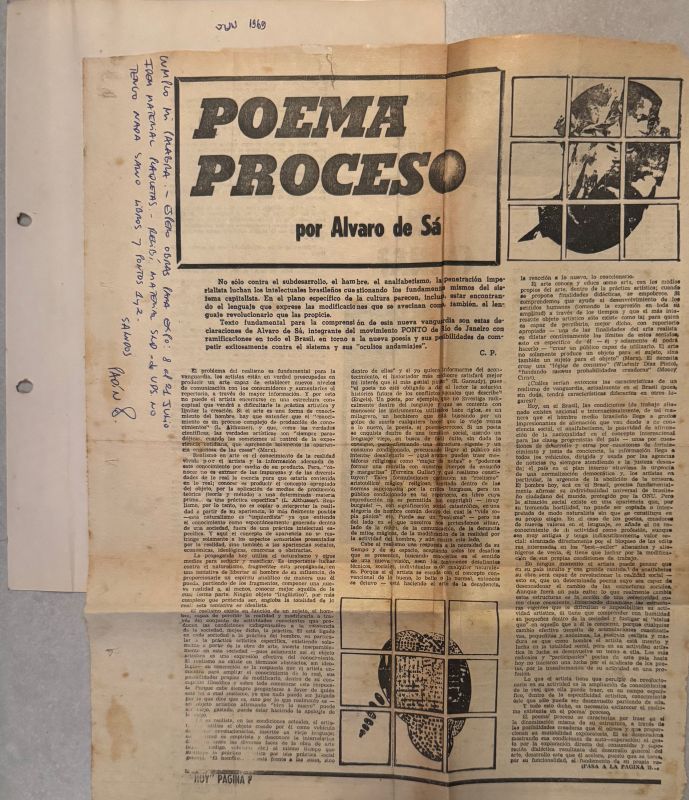
Categoria: Exposição Coletiva Nacional
Acervo: 04829
Data: Junho de 1969
Dimensões: 39 x 49 cm
POEMA PROCESO é uma matéria em língua espanhola de Álvaro de Sá publicada no jornal Hoy em junho de 1969. A página apresenta em grande destaque o título POEMA PROCESO seguido da identificação por Alvaro de Sá e reúne texto teórico, reproduções gráficas e imagens estruturadas em módulos, constituindo documentação contemporânea da circulação internacional das formulações do Poema Processo.
O texto de apresentação situa Álvaro de Sá como integrante do movimento PONTO, do Rio de Janeiro, e informa que suas declarações tratam da nova poesia e de suas possibilidades de atuação diante da realidade brasileira. A introdução menciona problemas como subdesenvolvimento, fome, analfabetismo e penetração imperialista, relacionando a reflexão estética à realidade social e cultural do período.
No desenvolvimento, Álvaro de Sá discute o problema do realismo para a vanguarda e a necessidade de ampliar a comunicação artística. O texto aborda a relação entre arte, informação, sociedade, meios de comunicação e participação do público, recusando uma concepção de arte limitada à reprodução das aparências imediatas.
A reflexão aproxima realismo de vanguarda, comunicação e transformação da linguagem. Álvaro de Sá trata o trabalho artístico como estrutura capaz de produzir informação e modificar a percepção do real. O artigo discute também os limites de uma concepção tradicional de realismo e procura situar a produção de vanguarda dentro das transformações sociais e dos novos processos de comunicação.
O Poema Processo aparece associado a uma linguagem que não depende exclusivamente da palavra. O texto aborda signos, estruturas visuais, participação, informação e a possibilidade de o poema funcionar por diferentes sistemas de comunicação. A produção poética é apresentada como processo aberto à transformação estrutural e à atuação do participante.
A matéria também discute o papel do artista diante da sociedade brasileira, os condicionamentos culturais e econômicos e a necessidade de uma produção capaz de operar criticamente sobre estruturas estabelecidas. O artigo relaciona pesquisa artística, conhecimento, comunicação e participação social dentro de uma concepção experimental da poesia e da arte.
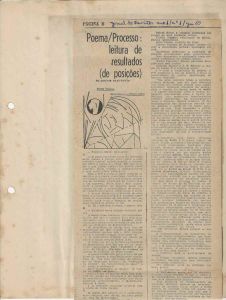
Duas imagens impressas acompanham o texto. Na parte superior direita, uma cabeça humana é dividida por uma grade de nove módulos quadrangulares. Outra imagem semelhante aparece na região inferior da página, novamente fragmentada por uma estrutura reticular. A divisão do retrato em módulos transforma a fotografia em uma estrutura visual passível de recomposição, leitura e operação, aproximando imagem e processo.
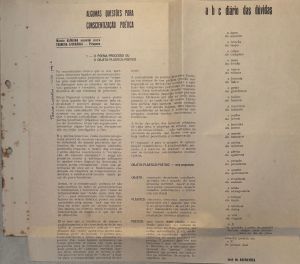
O exemplar possui ainda uma mensagem manuscrita de Clemente Padín na margem esquerda. A anotação registra comunicação pessoal relacionada ao envio ou recebimento de materiais, exposição, publicações e exemplares vinculados à circulação artística entre os participantes. A presença dessa mensagem transforma o recorte não apenas em documento de imprensa sobre Álvaro de Sá, mas também em testemunho material de intercâmbio entre Clemente Padín e a rede ligada ao Poema Processo.
A publicação constitui fonte primária para o estudo de Álvaro de Sá, do Poema Processo e da circulação internacional das vanguardas latino americanas em 1969. O conjunto articula teoria, imagem, publicação periódica e correspondência manuscrita, documentando simultaneamente a difusão pública das ideias do movimento e as relações pessoais utilizadas para circulação de obras, textos e publicações.
TEXTO SALSA INGLÊS
POEMA PROCESO is a Spanish language article by Álvaro de Sá published in the newspaper Hoy in June 1969. The page prominently displays the title POEMA PROCESO followed by the identification por Alvaro de Sá and combines theoretical text, graphic reproductions and images organized into modular structures, providing contemporary documentation of the international circulation of Poema Processo ideas.
The introductory text identifies Álvaro de Sá as a member of the PONTO movement in Rio de Janeiro and states that his declarations concern new poetry and its possibilities of action within Brazilian reality. The introduction mentions underdevelopment, hunger, illiteracy and imperialist penetration, connecting aesthetic reflection with the social and cultural conditions of the period.
In the main text, Álvaro de Sá discusses the problem of realism for the avant garde and the need to expand artistic communication. The article addresses relationships among art, information, society, mass communication and audience participation, rejecting a conception of art restricted to the reproduction of immediate appearances.
The discussion connects avant garde realism, communication and the transformation of language. Álvaro de Sá treats artistic work as a structure capable of producing information and modifying the perception of reality. The article also discusses the limitations of traditional realism and seeks to place avant garde production within social transformations and new processes of communication.
Poema Processo is associated with a language that does not depend exclusively on words. The article discusses signs, visual structures, participation, information and the possibility of the poem operating through different systems of communication. Poetic production is presented as a process open to structural transformation and participant action.
The article also examines the role of the artist within Brazilian society, cultural and economic conditioning and the need for production capable of critically operating upon established structures. Artistic research, knowledge, communication and social participation are connected within an experimental conception of poetry and art.
Two printed images accompany the article. In the upper right section, a human head is divided by a grid of nine quadrangular modules. A similar image appears in the lower portion of the page, again fragmented by a grid structure. The division of the portrait into modules transforms photography into a visual structure capable of recomposition, reading and operation, connecting image with process.
The copy also bears a handwritten message by Clemente Padín along the left margin. The inscription records personal communication related to the sending or receiving of materials, an exhibition, publications and copies connected with artistic circulation among participants. The presence of this message transforms the clipping from a press document about Álvaro de Sá into material evidence of exchange between Clemente Padín and the network associated with Poema Processo.
The publication is a primary source for research into Álvaro de Sá, Poema Processo and the international circulation of Latin American avant garde practices in 1969. It combines theory, image, periodical publication and handwritten correspondence, documenting both the public dissemination of the movement's ideas and the personal relationships through which works, texts and publications circulated.
Página de jornal identificada pelo usuário como Jornal Hoy, junho de 1969. Na região inferior esquerda aparece a indicação impressa HOY PÁGINA 8. O título principal está grafado em espanhol como POEMA PROCESO, seguido da identificação por Alvaro de Sá.
O texto introdutório impresso identifica Álvaro de Sá como integrante do movimento PONTO do Rio de Janeiro e apresenta suas declarações como reflexão sobre nova poesia, realidade brasileira e transformação cultural. A grafia Alvaro de Sá sem acento corresponde à forma impressa na fonte, enquanto Álvaro de Sá é utilizada na descrição catalográfica para identificação correta do artista.
O artigo é acompanhado por duas reproduções de uma cabeça humana organizada em módulos quadrangulares. A imagem superior apresenta nove campos, alguns contendo fragmentos do rosto e outros vazios. Na parte inferior aparece outra configuração modular da mesma lógica visual, reforçando relações entre fragmentação, estrutura, recomposição e processo.
Na margem esquerda existe mensagem manuscrita assinada Padín, atribuída pelo usuário a Clemente Padín. A leitura visível indica referência a obras para uma exposição entre 8 e 21 de julho, pedido ou comentário sobre materiais, recebimento de material e menção a livros ou publicações Ponto 1 e 2. Algumas palavras da anotação permanecem de leitura incerta e não devem ser normalizadas sem documentação complementar.
A anotação manuscrita demonstra que o exemplar foi utilizado como meio de comunicação e circulação documental, associando o artigo de Álvaro de Sá a uma troca concreta de materiais dentro da rede artística. Esse elemento é relevante para estabelecer relações entre Álvaro de Sá, Clemente Padín, Poema Processo, publicações e circulação internacional de vanguarda em 1969.
Na parte superior da folha de suporte há anotação manuscrita junho 1969. O recorte apresenta duas perfurações de fichário na margem esquerda, marcas de dobra, manchas, amarelecimento, oxidação, pequenos rasgos e desgaste nas bordas. Essas características integram a história material e arquivística do documento.
TEXTO DE OBSERVAÇÃO INGLÊS
Newspaper page identified by the user as Jornal Hoy, June 1969. The printed indication HOY PÁGINA 8 appears in the lower left section. The main title is printed in Spanish as POEMA PROCESO, followed by the identification por Alvaro de Sá.
The printed introductory text identifies Álvaro de Sá as a member of the PONTO movement in Rio de Janeiro and presents his declarations as reflections on new poetry, Brazilian reality and cultural transformation. The form Alvaro de Sá without an accent corresponds to the spelling printed in the source, while Álvaro de Sá is used in the catalog description for correct identification of the artist.
The article is accompanied by two reproductions of a human head organized into quadrangular modules. The upper image consists of nine fields, some containing fragments of the face and others left empty. A second modular configuration appears in the lower portion, reinforcing relationships among fragmentation, structure, recomposition and process.
A handwritten message signed Padín appears along the left margin and is attributed by the user to Clemente Padín. The visible reading includes a reference to works for an exhibition between July 8 and 21, a request or comment concerning materials, acknowledgment of received material and mention of books or publications Ponto 1 and 2. Some words remain uncertain and should not be normalized without additional documentation.
The handwritten inscription demonstrates that the copy also functioned as a medium for documentary and artistic exchange, connecting Álvaro de Sá's article with the circulation of materials through an artistic network. This element is important for establishing relationships among Álvaro de Sá, Clemente Padín, Poema Processo, publications and international avant garde circulation in 1969.
A handwritten notation June 1969 appears on the upper area of the archival support. The clipping shows two binder perforations along the left margin, fold marks, staining, yellowing, oxidation, minor tears and edge wear. These characteristics form part of the material and archival history of the document.
Proveniência
Coleção Poema ProcessoInglês
Poema Processo, by Álvaro de Sá, Hoy Newspaper, June 1969
Dimensions: 15,4 x 19,3 in