Impressão gráfica de Hugo Pontes intitulada Construção, datada de 1978, obra de poesia visual e experimentação tipográfica baseada em variações mínimas de palavras, organização espacial e relações semânticas.
Hugo Pontes
Categoria: Mail Art
Acervo: 04102
Data: 1978
Dimensões: 33 x 21,7 cm
TEXTO SALSA EM PORTUGUÊS
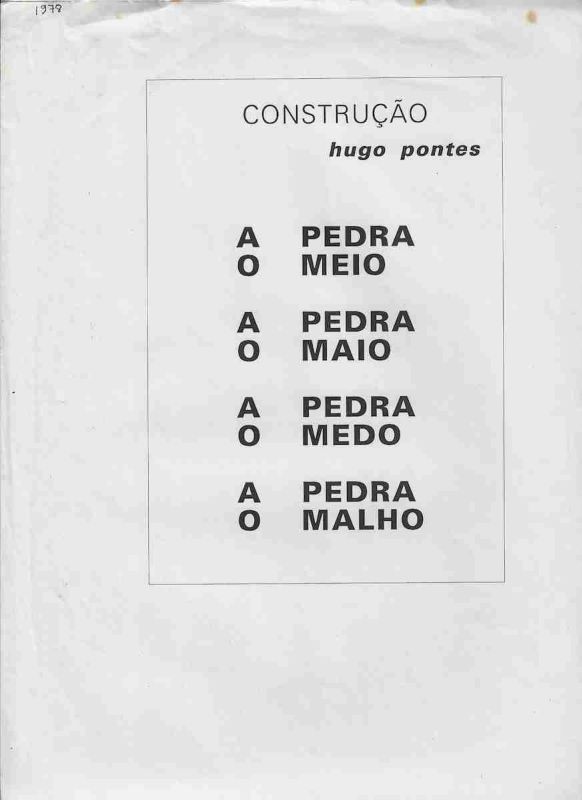
Impressão gráfica de Hugo Pontes intitulada Construção, datada de 1978, obra de poesia visual e experimentação tipográfica baseada em variações mínimas de palavras, organização espacial e relações semânticas. Na parte superior aparece o título CONSTRUÇÃO, seguido da identificação hugo pontes. No corpo do poema, a expressão A PEDRA é repetida quatro vezes e combinada sucessivamente com O MEIO, O MAIO, O MEDO e O MALHO.
A obra explora pequenas alterações fonéticas e gráficas entre MEIO, MAIO, MEDO e MALHO. A repetição de A PEDRA funciona como elemento fixo, enquanto o segundo termo de cada conjunto é modificado, criando uma construção verbal progressiva. O poema trabalha com proximidades sonoras, substituições de letras e deslocamentos de sentido, transformando a linguagem em matéria estrutural.
A relação entre A PEDRA e O MEIO remete imediatamente à ideia de pedra no meio, evocando obstáculo, presença e interrupção. A transformação para O MAIO, O MEDO e O MALHO amplia o campo semântico da composição e produz novas associações entre tempo, emoção, matéria e instrumento. O título Construção reforça a ideia de montagem e fabricação do poema por unidades verbais mínimas.
A disposição vertical e repetitiva cria ritmo visual e permite que cada bloco funcione como módulo independente e simultaneamente como parte de uma estrutura maior. Construção integra a produção experimental de Hugo Pontes relacionada à poesia visual brasileira, poesia concreta, poesia experimental, semiótica, tipografia, jogos de linguagem, repetição, permutação verbal e relações entre palavra, som e forma.
SALSA TEXT IN ENGLISH
Graphic print by Hugo Pontes titled Construção, dated 1978, a work of visual poetry and typographic experimentation based on minimal word variations, spatial organization and semantic relationships. At the top appears the title CONSTRUÇÃO followed by the identification hugo pontes. In the body of the poem, the expression A PEDRA is repeated four times and successively combined with O MEIO, O MAIO, O MEDO and O MALHO.
The work explores small phonetic and graphic changes between MEIO, MAIO, MEDO and MALHO. The repeated phrase A PEDRA functions as a fixed element while the second term in each group changes, creating a progressive verbal construction. The poem uses sound proximity, letter substitution and semantic displacement, transforming language into structural material.
The relationship between A PEDRA and O MEIO immediately evokes the idea of a stone in the middle, suggesting obstacle, presence and interruption. The transformations into O MAIO, O MEDO and O MALHO expand the semantic field of the composition and create new associations between time, emotion, matter and instrument. The title Construção reinforces the idea of assembling and building the poem from minimal verbal units.
The vertical and repetitive arrangement creates visual rhythm and allows each block to function independently while also belonging to a larger structure. Construção belongs to Hugo Pontes experimental production associated with Brazilian visual poetry, concrete poetry, experimental poetry, semiotics, typography, linguistic games, repetition, verbal permutation and relationships between word, sound and form.
TEXTO DE OBSERVAÇÃO EM PORTUGUÊS
Documento gráfico em preto sobre fundo branco de Hugo Pontes identificado pelo título CONSTRUÇÃO e pela inscrição hugo pontes. No canto superior esquerdo da folha aparece uma anotação manuscrita 1978, informação relevante para a datação do exemplar e coerente com a identificação fornecida para a obra.
A composição está contida em uma moldura retangular fina. No interior aparecem quatro blocos verbais organizados verticalmente. Em cada bloco, as letras A e O são posicionadas em uma coluna à esquerda, enquanto PEDRA e a palavra variável aparecem à direita.
A sequência visível é:
A PEDRA
O MEIO
A PEDRA
O MAIO
A PEDRA
O MEDO
A PEDRA
O MALHO
A estrutura trabalha com repetição e variação. A PEDRA permanece constante nos quatro blocos. O segundo termo muda de MEIO para MAIO, MEDO e MALHO. Essa transformação produz uma sequência em que pequenas alterações gráficas desencadeiam mudanças significativas de sentido.
MEIO pode sugerir centro, posição intermediária, ambiente ou condição. MAIO introduz uma referência temporal ao mês. MEDO desloca a leitura para o campo psicológico e emocional. MALHO introduz um objeto ou instrumento de impacto, estabelecendo uma relação potencialmente física com a própria pedra.
A passagem de MEIO para MAIO ocorre pela substituição de uma única vogal. A passagem para MEDO mantém parte da estrutura gráfica anterior, mas altera novamente o significado. MALHO amplia a palavra e introduz nova sonoridade. O poema demonstra como mínimas mudanças na matéria verbal podem reconstruir completamente a leitura.
A repetição da palavra PEDRA é particularmente importante. Pedra pode funcionar como matéria física, obstáculo, elemento construtivo e núcleo simbólico. Em uma obra intitulada Construção, sua presença também pode remeter diretamente ao ato de construir, pois a pedra é um dos materiais fundamentais da arquitetura.
A associação entre PEDRA e MALHO cria ainda uma relação material entre objeto e instrumento. O malho pode atingir ou trabalhar a pedra, enquanto MEIO, MAIO e MEDO operam em campos mais abstratos. Essa progressão amplia a densidade conceitual do poema.
A organização gráfica mantém grande regularidade e utiliza forte economia de elementos. As palavras são separadas em blocos e apresentadas em letras maiúsculas, com espaçamento suficiente para evidenciar as mudanças entre cada combinação. O espaço branco participa da leitura ao distinguir cada estágio da sequência.
O título Construção pode ser entendido tanto em sentido material quanto linguístico. O poema é literalmente construído por repetição, substituição, alinhamento e combinação de palavras. A obra evidencia a linguagem como sistema manipulável, no qual pequenas unidades podem ser reorganizadas para produzir novos sentidos.
A data 1978 deve ser registrada como informação documental importante. A anotação manuscrita visível no alto da folha fornece indicação cronológica do exemplar, embora seja recomendável preservar em catálogo a distinção entre data impressa na obra e anotação manuscrita associada ao documento.
Para indexação digital são especialmente relevantes os termos Hugo Pontes, Construção, Construcao, 1978, A Pedra, O Meio, O Maio, O Medo, O Malho, poesia visual, visual poetry, poesia experimental, concrete poetry, poesia concreta, poema visual, jogo de palavras, wordplay, permutação verbal, semiótica, tipografia experimental, repetição, linguagem, pedra, construção, Poços de Caldas, Minas Gerais, Brasil e poesia visual brasileira.
OBSERVATION TEXT IN ENGLISH
Black graphic document on a white background by Hugo Pontes identified by the title CONSTRUÇÃO and the inscription hugo pontes. At the upper left corner of the sheet appears a handwritten notation 1978, which is relevant to dating the example and is consistent with the identification provided for the work.
The composition is enclosed within a thin rectangular frame. Inside are four verbal blocks arranged vertically. In each block, the letters A and O are positioned in a column on the left, while PEDRA and the variable word appear on the right.
The visible sequence is:
A PEDRA
O MEIO
A PEDRA
O MAIO
A PEDRA
O MEDO
A PEDRA
O MALHO
The structure is based on repetition and variation. A PEDRA remains constant throughout all four blocks. The second term changes from MEIO to MAIO, MEDO and MALHO. This transformation creates a sequence in which small graphic alterations trigger significant changes in meaning.
MEIO can suggest center, intermediate position, environment or condition. MAIO introduces a temporal reference to the month of May. MEDO shifts the reading toward the psychological and emotional field. MALHO introduces an object or striking instrument, establishing a potentially physical relationship with the stone itself.
The transition from MEIO to MAIO occurs through the substitution of a single vowel. The shift to MEDO preserves part of the previous graphic structure but again changes the meaning. MALHO expands the word and introduces a new sound pattern. The poem demonstrates how minimal changes in verbal material can completely reconstruct interpretation.
The repetition of the word PEDRA is particularly important. Stone can function as physical matter, obstacle, building material and symbolic core. In a work titled Construção, its presence may also directly evoke the act of building, since stone is one of the fundamental materials of architecture.
The association between PEDRA and MALHO also creates a material relationship between object and instrument. A mallet can strike or work a stone, while MEIO, MAIO and MEDO operate in more abstract semantic fields. This progression increases the conceptual density of the poem.
The graphic organization maintains strong regularity and uses an economy of elements. The words are separated into blocks and presented in uppercase letters, with enough spacing to emphasize the changes between each combination. White space participates in the reading by distinguishing each stage of the sequence.
The title Construção can be understood in both material and linguistic senses. The poem is literally constructed through repetition, substitution, alignment and combination of words. The work reveals language as a manipulable system in which small units can be reorganized to generate new meanings.
The date 1978 should be recorded as important documentary information. The handwritten notation visible at the top of the sheet provides a chronological indication for this example, although cataloguing should ideally preserve the distinction between a date printed as part of the work and a handwritten notation associated with the document.
For digital indexing, particularly relevant terms include Hugo Pontes, Construção, Construcao, 1978, A Pedra, O Meio, O Maio, O Medo, O Malho, visual poetry, experimental poetry, concrete poetry, visual poem, wordplay, verbal permutation, semiotics, experimental typography, repetition, language, stone, construction, Poços de Caldas, Minas Gerais, Brazil and Brazilian visual poetry.
Proveniência
Coleção Poema ProcessoInglês
Graphic print by Hugo Pontes titled Construção, dated 1978, a work of visual poetry and typographic experimentation based on minimal word variations, spatial organization and semantic relationships.
Dimensions: 13 x 8,5 in