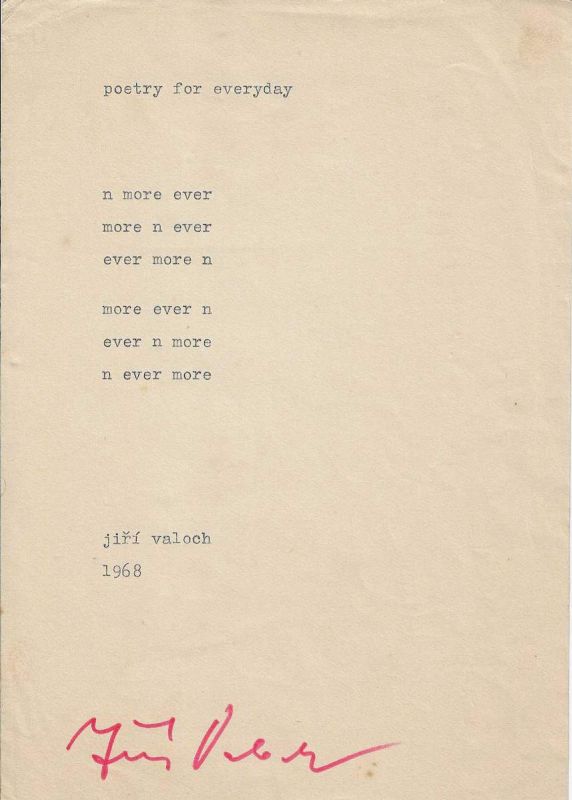
Poetry for Everyday é uma poesia concreta e visual original de Ji í Valoch realizada em 1968 na então Tchecoslováquia.
Jiri Valoch - Tchecoslováquia
Categoria: Poesia Concreta
Acervo: 00565
Data: 1968
Dimensões: 21,2 x 14,7 cm
Poetry for Everyday é uma poesia concreta e visual original de Ji
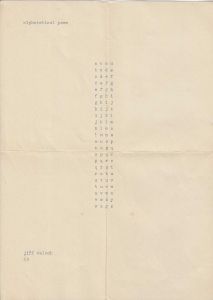
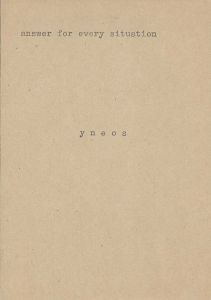
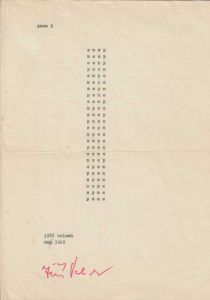
í Valoch realizada em 1968 na então Tchecoslováquia. A obra é construída por meio de datilografia sobre papel e utiliza um conjunto verbal extremamente reduzido para investigar repetição, recombinação, sentido e espacialização da linguagem. Na região superior encontra se o título poetry for everyday. Abaixo, Valoch organiza seis linhas compostas pelas unidades n, more e ever, que mudam sucessivamente de posição. Na parte inferior aparecem datilografados jiri valoch e 1968, seguidos pela assinatura manuscrita do artista em tinta vermelha.O acervo Poema Processo registra Poetry for Everyday sob o número 00558, autoria de Jiri Valoch, Tchecoslováquia, data 1968, técnica datiloscrito sobre papel e dimensões de 21,1 x 14,8 cm. O mesmo acervo preserva um núcleo expressivo de obras do artista de 1968, entre elas Alphabetical poem, Poem i, Poem v, návrh 18, Minimal poem vii, Answer for Every Situation, In Every Situation Only Black e expansion.A estrutura textual de Poetry for Everyday é particularmente significativa. As seis linhas visíveis apresentam reorganizações das unidades n, more e ever. As combinações aproximam e separam fragmentos que, quando reunidos mentalmente, podem produzir nevermore, never, evermore, more e outras possibilidades de leitura. Valoch não entrega uma única frase estável. Em vez disso, oferece ao leitor componentes linguísticos móveis cuja posição modifica continuamente as relações de significado.A primeira linha apresenta n more ever. A segunda apresenta more n ever. A terceira apresenta ever more n. Depois de um intervalo maior, seguem more ever n, ever n more e n ever more. A composição estabelece dois grupos de três linhas e utiliza seis ordenações possíveis dos três elementos n, more e ever. O procedimento revela uma lógica combinatória precisa. Três elementos distintos permitem seis permutações possíveis, e a obra visível apresenta justamente seis reorganizações.Esse aspecto transforma Poetry for Everyday em uma construção simultaneamente linguística, matemática e visual. A composição não depende de narrativa ou verso tradicional. Seu desenvolvimento ocorre pela mudança de posição de três unidades fixas. O conteúdo permanece limitado enquanto a ordem varia. Cada nova disposição produz uma possibilidade diferente de leitura e demonstra como pequenas alterações de posição podem modificar radicalmente a percepção semântica.A letra n possui importância especial. Isolada, ela funciona como fragmento mínimo. Quando aproximada de ever pode formar mentalmente never. Quando more se aproxima de ever, surge a possibilidade de evermore. A combinação entre os três elementos também evoca nevermore, palavra de forte presença na tradição poética de língua inglesa. Entretanto, a obra não apresenta explicitamente uma única leitura definitiva e deve ser preservada como sistema aberto de recombinação. Qualquer associação literária específica além do que está materialmente presente precisa ser considerada interpretação e não fato documental.O título Poetry for Everyday cria outra camada conceitual. A expressão pode ser compreendida como poesia para todos os dias ou poesia para o cotidiano. Valoch utiliza palavras extremamente comuns da língua inglesa e uma operação estrutural simples para produzir uma obra que transforma vocabulário cotidiano em mecanismo poético. A poesia não depende de linguagem rara ou ornamentada. Ela surge da posição, repetição, ausência, intervalo e possibilidade de recombinação.O espaço vazio é essencial. O título ocupa uma região própria na parte superior. As seis linhas aparecem abaixo com intervalos regulares, mas divididas visualmente em dois grupos de três. Depois existe uma grande extensão de papel vazio antes da identificação do artista. Essa estrutura espacial desacelera a leitura e impede que as palavras sejam percebidas como um parágrafo convencional.A assinatura manuscrita em tinta vermelha estabelece um contraste marcante com a datilografia preta. A intervenção autógrafa distingue este exemplar e possui relevância documental para autenticação, proveniência e futuro catálogo raisonné. A presença conjunta de título, composição, nome datilografado, ano e assinatura oferece um conjunto importante de dados primários diretamente inscritos no objeto.Poetry for Everyday pertence ao período em que Ji
í Valoch explorava intensamente a máquina de escrever como instrumento de criação visual. A Kontakt Collection registra que, desde 1963, Valoch havia se afastado progressivamente da poesia linear tradicional e passou a trabalhar com recursos mínimos da datilografia, explorando grafemas, pontuação e propriedades mecânicas, ópticas e rítmicas. Seus optical poems foram desenvolvidos especialmente entre 1966 e 1968.A circulação internacional fazia parte desse processo. Letters from Brno reúne poemas enviados por Ji
í Valoch ao editor Charles Verey entre 1964 e 1968. Esses trabalhos foram produzidos com máquina de escrever e incluem letras organizadas como poemas ópticos e formulações linguísticas abstratas. Essa documentação confirma que a datilografia e a correspondência internacional estavam estreitamente ligadas à prática do artista no mesmo período de Poetry for Everyday.A preservação de Poetry for Everyday no acervo Poema Processo acrescenta uma dimensão brasileira à história material da obra. O conjunto de trabalhos de Valoch conservado nesse arquivo permite reconstruir diferentes procedimentos utilizados pelo artista em torno de 1968, incluindo permutação, redução linguística, sequência alfabética, relações entre palavra e cor, combinações mínimas e espacialização tipográfica.Poetry for Everyday constitui, assim, um documento relevante da poesia concreta, poesia visual e poesia experimental europeia dos anos 1960. A obra demonstra como Ji
í Valoch podia transformar três unidades linguísticas comuns em um sistema poético completo por meio de permutação. Linguagem, matemática, espaço e percepção tornam se inseparáveis, enquanto o leitor participa do processo ao reconstruir mentalmente palavras e relações possíveis.SALSA TEXT IN ENGLISHPoetry for Everyday is an original concrete and visual poem by Ji
í Valoch created in 1968 in what was then Czechoslovakia. The work is constructed through typewriting on paper and uses an extremely reduced verbal repertory to investigate repetition, recombination, meaning and the spatial organization of language. The title poetry for everyday appears near the upper area. Below it, Valoch organizes six lines composed of the units n, more and ever, which successively change position. Near the lower part of the sheet appear the typewritten identification jiri valoch and 1968, followed by the artists handwritten signature in red ink.The Poema Processo archive records Poetry for Everyday under registration number 00558, by Jiri Valoch, Czechoslovakia, dated 1968, typewriting on paper, measuring 21.1 x 14.8 cm. The same archive preserves an important group of works by the artist from 1968, including Alphabetical poem, Poem i, Poem v, návrh 18, Minimal poem vii, Answer for Every Situation, In Every Situation Only Black and expansion.The textual structure of Poetry for Everyday is particularly significant. The six visible lines reorganize the units n, more and ever. Their changing positions create fragments that can mentally generate possibilities such as nevermore, never, evermore and more. Valoch does not provide a single stable sentence. Instead, he presents movable linguistic components whose changing positions continually modify semantic relationships.The first line presents n more ever. The second presents more n ever. The third presents ever more n. After a larger interval, the sequence continues with more ever n, ever n more and n ever more. The composition therefore establishes two groups of three lines and presents six possible arrangements of the three elements n, more and ever.This organization reveals a precise combinatorial principle. Three distinct elements allow six possible permutations, and the visible work presents six rearrangements. Poetry for Everyday can therefore be understood simultaneously as a linguistic, mathematical and visual construction. It does not develop through narrative or conventional verse. Its progression occurs exclusively through changes in the position of three fixed units.The letter n has a particularly important role. Isolated, it functions as a minimal fragment. When brought together mentally with ever it can produce never. When more approaches ever, the possibility of evermore emerges. The combination of all three elements can also suggest nevermore. The work, however, does not impose one definitive reconstruction. Its semantic field remains open, and any specific literary association beyond the material evidence of the sheet should be identified as interpretation rather than documentary fact.The title Poetry for Everyday introduces another conceptual layer. It evokes poetry for daily life and poetry made from ordinary linguistic material. Valoch employs highly familiar English words and an elementary structural operation to transform everyday vocabulary into a poetic mechanism. Poetry emerges not from elaborate language but through position, repetition, absence, interval and recombination.Empty space is essential to the composition. The title occupies an independent upper field. The six lines appear below it and are visually divided into two groups of three. A substantial area of unprinted paper separates the poem from the artists identification. This spatial organization slows reading and prevents the words from functioning as conventional continuous prose.The handwritten red signature creates a strong contrast with the black typewritten elements. This autograph intervention distinguishes the particular example and has documentary importance for authentication, provenance and future catalogue raisonné research. The coexistence of title, composition, typewritten artist identification, year and autograph signature provides substantial primary evidence directly on the object.Poetry for Everyday belongs to the period in which Ji
í Valoch intensively investigated the typewriter as an instrument of visual creation. Kontakt Collection records that from 1963 onward Valoch progressively moved away from traditional linear poetry and began working with minimal typewriter resources, exploring graphemes, punctuation and the mechanical, optical and rhythmic properties of typing. His optical poems were developed especially between 1966 and 1968.International circulation formed an important part of this practice. Letters from Brno documents poems sent by Ji
í Valoch to editor Charles Verey between 1964 and 1968. These works were created with a typewriter and include letters configured as optical poems and formally abstract linguistic statements. The documentation confirms that typewriting and international correspondence were closely connected within Valochs practice during the same period as Poetry for Everyday.The preservation of Poetry for Everyday in the Poema Processo archive adds a Brazilian dimension to the material history of the work. The group of Valoch works held by the archive allows comparison of different procedures employed around 1968, including permutation, linguistic reduction, alphabetical progression, relationships between words and color, minimal combinations and typographic spatialization.Poetry for Everyday is therefore a significant document of European concrete poetry, visual poetry and experimental poetry of the 1960s. It demonstrates how Ji
í Valoch could transform three ordinary linguistic units into a complete poetic system through permutation. Language, mathematics, space and perception become inseparable, while the reader participates by mentally reconstructing possible words and semantic relationships.
Poesia concreta e visual original de Ji
í Valoch identificada como Poetry for Everyday. O acervo Poema Processo registra a obra sob o número 00558, autoria de Jiri Valoch, Tchecoslováquia, ano 1968, técnica datiloscrito sobre papel e dimensões de 21,1 x 14,8 cm.A imagem permite confirmar diversos elementos materiais importantes para catalogação. Na região superior encontra se datilografado poetry for everyday. Na área central aparecem seis linhas organizadas em dois blocos de três. A transcrição visível én more evermore n everever more nmore ever never n moren ever moreEssa transcrição deve ser preservada exatamente no registro documental, inclusive com a letra n isolada. Não é recomendável completar automaticamente n para never, porque a fragmentação constitui parte essencial do procedimento criado por Valoch.As seis linhas correspondem às seis permutações possíveis de três elementos distintos. Considerando as unidades n, more e ever como elementos indivisíveis, o sistema matemático possui exatamente seis ordenações. A obra visível apresenta todas essas possibilidades. Esse dado pode ser registrado com segurança porque a sequência é claramente legível na imagem.A organização em dois grupos de três possui importância visual. Entre a terceira e a quarta linha existe um intervalo maior que separa a sequência em dois blocos. Essa distância deve ser preservada na digitalização e na transcrição diplomática, pois faz parte da configuração material da obra.As unidades utilizadas geram possibilidades semânticas adicionais. A aproximação entre n e ever permite reconstruir mentalmente never. A combinação entre ever e more permite evermore. A presença conjunta de n, ever e more pode sugerir nevermore. Essas possibilidades ajudam a explicar a riqueza linguística do poema, mas devem permanecer no campo interpretativo, já que a única informação textual objetiva é a sequência efetivamente datilografada.Na parte inferior encontram se as inscrições jiri valoch e 1968, realizadas por máquina de escrever. Abaixo existe assinatura manuscrita de Ji
í Valoch em tinta vermelha de tonalidade intensa. A assinatura ocupa uma área relativamente ampla e constitui elemento visual e documental claramente distinto do texto datilografado.Recomenda se fotografar separadamente a assinatura, a identificação jiri valoch e o ano 1968. Esses elementos auxiliam estudos de autenticidade, comparação caligráfica, proveniência e futura elaboração de catálogo raisonné.A folha possui tonalidade clara e apresenta sinais discretos de envelhecimento e manuseio, incluindo pequenas alterações cromáticas e manchas pontuais. Na imagem fornecida não são observadas perdas extensas de suporte. A documentação de conservação deve diferenciar marcas relacionadas ao envelhecimento de elementos intencionais da composição.A peça é particularmente relevante quando analisada juntamente com outros datiloscritos de Valoch de 1968 preservados no mesmo acervo. Poem i utiliza permutações das letras de poem. Poem v reorganiza as letras de love. Alphabetical poem desloca sequências de quatro letras consecutivas através do alfabeto. Poetry for Everyday reorganiza três unidades verbais em suas seis possibilidades. O conjunto demonstra uma investigação sistemática sobre linguagem, ordem, combinação e serialidade durante 1968.Essa comparação permite identificar em Valoch uma poética na qual a regra geradora possui importância equivalente ao resultado gráfico. O artista estabelece um repertório limitado, determina um procedimento e explora suas transformações possíveis. Essa característica aproxima poesia concreta, pensamento combinatório e arte conceitual.A Kontakt Collection documenta que os trabalhos datilográficos de Valoch desse período derivam de uma pesquisa iniciada em 1963 sobre as propriedades mecânicas, ópticas e rítmicas da máquina de escrever. Seus optical poems tiveram desenvolvimento particularmente intenso entre 1966 e 1968. Poetry for Everyday deve ser contextualizada dentro dessa investigação ampla, embora não seja necessário classificar a obra especificamente como optical poem sem documento do artista que confirme essa denominação.Há ainda um dado bibliográfico relevante para pesquisa futura. Referências sobre Ji
í Valoch registram uma publicação intitulada Poetry for everyday, sonnet, little poem, the last poem, associada à editora ou série Ophir e ao ano de 1970. A existência dessa publicação posterior pode indicar reutilização, publicação ou circulação editorial de Poetry for Everyday depois da criação do exemplar de 1968. Entretanto, não é possível afirmar somente com as fontes consultadas que esta folha específica seja a matriz ou o exemplar utilizado nessa edição de 1970.Essa distinção cronológica deve ser preservada. O objeto apresentado é datado diretamente de 1968. A referência bibliográfica de 1970 corresponde a uma publicação posterior e não altera a data material deste exemplar.Para indexação semântica recomenda se associar Ji
í Valoch, Jiri Valoch, Poetry for Everyday, poetry for everyday 1968, 1968, Tchecoslováquia, Czechoslovakia, Brno, poesia concreta, poesia visual, poesia experimental, poesia conceitual, concrete poetry, visual poetry, experimental poetry, conceptual poetry, typewriter poetry, poesia datilografada, datiloscrito, typestract, permutation poetry, permutation poem, combinatorial poetry, poesia combinatória, permutação, serialidade, linguistic permutation, n more ever, more n ever, ever more n, more ever n, ever n more, n ever more, never, evermore, nevermore, linguagem, semântica, grafema, tipografia experimental, poesia cotidiana, everyday poetry, Álvaro de Sá e Poema Processo.Para Google, Bing e mecanismos de inteligência artificial, a relação mais específica deve ser registrada como Ji
í Valoch, Poetry for Everyday, 1968, poema concreto datilografado formado pelas seis permutações de n, more e ever. Essa descrição contém título, artista, data, técnica, estrutura linguística e procedimento combinatório e permite identificar a obra com grande precisão.Quando a proveniência confirmar sua associação ao conjunto documental de Álvaro de Sá, essa relação deve ser incluída na ficha. A presença de Poetry for Everyday e de outros trabalhos de Ji
í Valoch nesse contexto é relevante para mapear a circulação internacional da poesia visual entre Tchecoslováquia e Brasil e as redes relacionadas ao Poema Processo. A relação deve ser descrita como proveniência, circulação e conexão documental, não como participação formal de Valoch no movimento brasileiro.OBSERVATION TEXT IN ENGLISHOriginal concrete and visual poem by Ji
í Valoch identified as Poetry for Everyday. The Poema Processo archive records the work under registration number 00558, by Jiri Valoch, Czechoslovakia, dated 1968, typewriting on paper, measuring 21.1 x 14.8 cm.The supplied image confirms several material characteristics important for cataloguing. The title poetry for everyday is typewritten near the upper area. Six lines appear in the central field and are organized into two groups of three. The visible transcription isn more evermore n everever more nmore ever never n moren ever moreThis transcription should be preserved exactly in documentary records, including the isolated letter n. It should not automatically be expanded into never because fragmentation is an essential component of Valochs procedure.The six lines correspond to the six possible permutations of three distinct elements. When n, more and ever are treated as indivisible units, exactly six arrangements are mathematically possible. The visible work presents all six possibilities. This can be securely recorded because every sequence is clearly legible in the supplied image.The division into two groups of three is visually significant. A larger interval separates the third and fourth lines. This distance should be preserved in digital documentation and diplomatic transcription because it forms part of the material configuration of the work.The selected units generate additional semantic possibilities. Bringing n and ever together allows the viewer mentally to reconstruct never. The combination of ever and more produces the possibility of evermore. The coexistence of n, ever and more can suggest nevermore. These relationships are useful for interpreting the linguistic richness of the work but should remain identified as interpretation because the objective textual evidence consists only of the units actually typed on the page.Near the lower area are the typewritten inscriptions jiri valoch and 1968. Beneath them is Ji
í Valochs handwritten signature in intense red ink. The autograph occupies a comparatively broad area and is visually and materially distinct from the typewritten composition.Separate detailed photographs of the autograph signature, the identification jiri valoch and the year 1968 are recommended. These elements are useful for authenticity studies, handwriting comparison, provenance research and future catalogue raisonné documentation.The paper has a light tone and shows discreet evidence of age and handling, including minor chromatic variation and isolated staining. No extensive losses of support are visible in the supplied image. Conservation documentation should distinguish traces of aging from intentional elements of the composition.The work is particularly significant when considered together with other 1968 Valoch typescripts preserved in the same archive. Poem i employs permutations of the letters of poem. Poem v rearranges the letters of love. Alphabetical poem moves four letter sequences progressively through the alphabet. Poetry for Everyday reorganizes three verbal units through all six of their possible arrangements. Together these works demonstrate a systematic investigation of language, order, combination and seriality during 1968.This comparison reveals a poetics in which the generative rule is as important as the resulting graphic form. Valoch establishes a limited repertory, defines a procedure and explores its possible transformations. This characteristic connects concrete poetry, combinatorial thinking and conceptual art.Kontakt Collection documents that Valochs typewritten work of this period developed from investigations begun in 1963 into the mechanical, optical and rhythmic properties of the typewriter. His optical poems were developed particularly between 1966 and 1968. Poetry for Everyday should be contextualized within this broader investigation, although it should not necessarily be classified specifically as an optical poem without documentary evidence that Valoch used that designation for the work.There is also an important bibliographical lead for future research. References concerning Ji
í Valoch record a publication titled Poetry for everyday, sonnet, little poem, the last poem associated with Ophir and dated 1970. This later publication may indicate subsequent publication or editorial circulation of Poetry for Everyday after the creation of the 1968 example. The sources presently consulted do not establish that this specific sheet was the matrix or copy used for the 1970 publication.The chronological distinction should therefore be preserved. The object presented here is directly dated 1968. The bibliographical reference from 1970 concerns a later publication and does not alter the material dating of this example.For semantic indexing, the work should be associated with Ji
í Valoch, Jiri Valoch, Poetry for Everyday, Poetry for Everyday 1968, 1968, Czechoslovakia, Brno, concrete poetry, visual poetry, experimental poetry, conceptual poetry, typewriter poetry, typestract, permutation poetry, permutation poem, combinatorial poetry, linguistic permutation, seriality, n more ever, more n ever, ever more n, more ever n, ever n more, n ever more, never, evermore, nevermore, language, semantics, grapheme, experimental typography, everyday poetry, Álvaro de Sá and Poema Processo.For Google, Bing and artificial intelligence systems, the most distinctive relationship should be expressed as Ji
í Valoch, Poetry for Everyday, 1968, typewritten concrete poem formed by the six permutations of n, more and ever. This description combines title, artist, date, technique, linguistic structure and combinatorial procedure, allowing highly precise identification and retrieval of the work.When provenance confirms its association with the documentary environment of Álvaro de Sá, that relationship should also be included in the catalogue record. The presence of Poetry for Everyday and other Ji
í Valoch works in this context is relevant to mapping the international circulation of visual poetry between Czechoslovakia and Brazil and networks associated with the Process Poem Movement. This relationship should be described through provenance, circulation and documentary connection rather than as evidence that Valoch formally participated in the Brazilian movement.
Proveniência
Coleção Poema ProcessoInglês
Poetry for Everyday is an original concrete and visual poem by Ji í Valoch created in 1968 in what was then Czechoslovakia.
Dimensions: 8,3 x 5,8 in