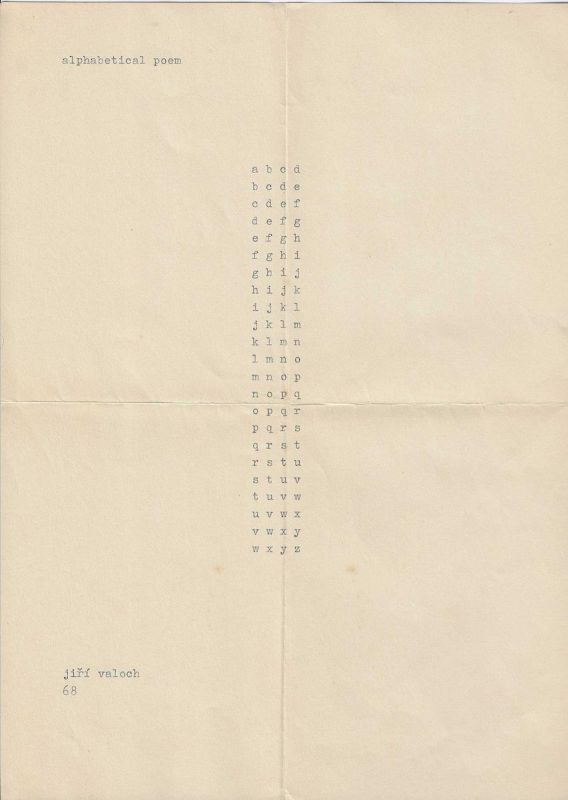
Alphabetical poem é uma poesia concreta e visual original de Ji í Valoch realizada em 1968 na então Tchecoslováquia. A obra utiliza a máquina de escrever como instrumento de construção poética, gráfica e sistemática.
Jiri Valoch - Tchecoslováquia
Categoria: Poesia Concreta
Acervo: 00555
Data: 1968
Dimensões: 29,7 x 21,1 cm
Texto para o Salsa em portuguêsAlphabetical poem é uma poesia concreta e visual original de Ji
í Valoch realizada em 1968 na então Tchecoslováquia. A obra utiliza a máquina de escrever como instrumento de construção poética, gráfica e sistemática. Na região superior esquerda da folha aparece o título alphabetical poem. Próximo ao eixo vertical central encontra se uma coluna formada por sequências sucessivas de quatro letras minúsculas do alfabeto latino. Na região inferior esquerda aparecem datilografados jiri valoch e 68, identificando autor e ano. A peça pertence ao período central das experiências de Valoch com poesia concreta, poesia visual, poesia experimental, estruturas seriais e exploração das possibilidades ópticas e mecânicas da datilografia.O acervo Poema Processo registra Alphabetical poem sob o número 00555, autoria de Jiri Valoch, Tchecoslováquia, ano de 1968, técnica datiloscrito sobre papel e dimensões de 29,7 x 21,3 cm. O registro confirma que se trata de uma obra datilográfica do mesmo núcleo cronológico de Poem i, Poem v, návrh 18, Poetry for Everyday e Minimal poem vii, também preservados no conjunto de obras de Valoch.A estrutura de Alphabetical poem obedece a uma regra precisa e facilmente verificável. A primeira linha contém a b c d. A linha seguinte começa uma letra adiante e apresenta b c d e. O procedimento continua sucessivamente com c d e f, d e f g, e f g h e assim por diante até chegar a w x y z. Cada linha possui quatro caracteres consecutivos e cada nova linha desloca a sequência uma posição para a frente no alfabeto.O poema é, portanto, formado por vinte e três linhas de quatro letras. O sistema percorre todo o alfabeto de a a z por meio de uma espécie de janela móvel de quatro caracteres. Nenhuma frase convencional é construída. A ordem alfabética, normalmente utilizada apenas como sistema de classificação da linguagem, transforma se no próprio conteúdo e na regra geradora do poema.Essa operação cria uma correspondência entre leitura, sequência e movimento. Embora as letras estejam fixas sobre o papel, a passagem de uma linha para a seguinte produz a impressão de deslocamento contínuo. Um caractere desaparece pela esquerda enquanto um novo caractere entra pela direita. A estrutura permanece formalmente idêntica, mas seu conteúdo se modifica gradualmente. O poema pode ser lido tanto verticalmente como processo quanto horizontalmente como sucessões de quatro unidades alfabéticas.A repetição é controlada por uma regra simples. Cada letra participa de diferentes agrupamentos conforme sua posição no alfabeto. As letras centrais aparecem em mais sequências do que as localizadas nas extremidades, porque podem ocupar diferentes posições dentro dos grupos de quatro. O resultado transforma o alfabeto em matéria serial e evidencia que Valoch não utiliza as letras primordialmente para formar palavras, mas como elementos discretos capazes de constituir um sistema visual.A palavra alphabetical presente no título desempenha uma função metalinguística. O poema anuncia o próprio princípio de construção e, em seguida, demonstra esse princípio visualmente. Título, regra e resultado tornam se inseparáveis. A obra fala sobre o alfabeto ao mesmo tempo em que é construída exclusivamente por sua progressão. Dessa maneira, Alphabetical poem aproxima poesia concreta, pensamento conceitual, serialidade e organização sistemática da linguagem.O amplo espaço vazio ao redor da coluna central é igualmente importante. A sequência ocupa uma área muito pequena em relação à dimensão total da folha. O vazio isola o sistema, desacelera a observação e torna perceptível cada alteração mínima entre uma linha e outra. A página deixa de ser simplesmente um suporte para texto e passa a funcionar como campo espacial organizado.Alphabetical poem foi produzido em um momento decisivo da trajetória de Ji
í Valoch. A Kontakt Collection registra que, a partir de 1963, o artista se afastou da escrita poética linear e passou a explorar poemas assêmicos e estruturas baseadas em recursos mínimos da máquina de escrever, incluindo grafemas, pontuação, ritmo e propriedades ópticas. Seus optical poems desenvolveram se particularmente entre 1966 e 1968.Nesse contexto, Alphabetical poem representa uma variação importante. Em vez de produzir principalmente texturas ópticas pela sobreposição de sinais, a obra estabelece uma regra linguística perfeitamente reconhecível e transforma sua execução sistemática em acontecimento visual. O procedimento antecipa a proximidade crescente entre poesia e pensamento conceitual na trajetória de Valoch.A circulação postal também constitui parte relevante do contexto dessa produção. A Kontakt Collection documenta em Letters from Brno poemas enviados por Ji
í Valoch ao editor Charles Verey entre 1964 e 1968. Esses materiais foram produzidos com máquina de escrever e incluem letras configuradas como poemas ópticos e formulações linguísticas abstratas. Essa documentação demonstra que a produção datilográfica de Valoch circulava internacionalmente precisamente no período de criação de Alphabetical poem.A preservação de Alphabetical poem no acervo Poema Processo possui importância para o estudo das relações internacionais da poesia experimental. A obra está conservada ao lado de um conjunto expressivo de trabalhos de Valoch de 1967, 1968 e anos próximos, permitindo comparar diferentes procedimentos de redução, permutação, sequência, espaço, linguagem e datilografia. A presença desses trabalhos em um acervo brasileiro ligado à história do Poema Processo contribui para reconstruir as redes internacionais que aproximaram a produção experimental da Tchecoslováquia das pesquisas realizadas na América Latina e no Brasil.Alphabetical poem deve ser compreendido como uma obra em que alfabeto, regra, sequência e espaço tornam se matéria poética. Valoch elimina praticamente toda narrativa e reduz a composição a um procedimento inteligível. A poesia surge da transformação gradual de um sistema conhecido, fazendo com que o observador perceba o alfabeto não apenas como instrumento da escrita, mas como estrutura visual, temporal e conceitual.Salsa text in EnglishAlphabetical poem is an original concrete and visual poem by Ji
í Valoch created in 1968 in what was then Czechoslovakia. The work uses the typewriter as an instrument of poetic, graphic and systematic construction. The title alphabetical poem appears in the upper left area of the sheet. Near the central vertical axis is a column composed of successive sequences of four lowercase letters from the Latin alphabet. Near the lower left are the typewritten inscriptions jiri valoch and 68, identifying the artist and year. The work belongs to a central period of the experiments of Valoch with concrete poetry, visual poetry, experimental poetry, serial structures and the optical and mechanical possibilities of typewriting.The Poema Processo archive records Alphabetical poem under registration number 00555, by Jiri Valoch, Czechoslovakia, dated 1968, executed as typewriting on paper and measuring 29.7 x 21.3 cm. The catalogue places it within the same chronological group as Poem i, Poem v, návrh 18, Poetry for Everyday and Minimal poem vii, also preserved among the works of Valoch.The structure of Alphabetical poem follows a precise and directly verifiable rule. The first line contains a b c d. The following line begins one position later and contains b c d e. The process continues with c d e f, d e f g, e f g h and successive groups until reaching w x y z. Each line contains four consecutive characters and each new line advances the sequence by one position through the alphabet.The poem therefore consists of twenty three lines containing four letters each. The system moves through the complete alphabet from a to z by means of a moving window of four characters. No conventional sentence is produced. Alphabetical order, normally used merely as a system for organizing language, becomes both the content and the generative rule of the poem.This operation establishes a relationship between reading, sequence and movement. Although the letters remain physically fixed on the paper, movement from one line to the next creates the perception of continuous displacement. One character disappears from the left while another enters from the right. The formal structure remains constant while its contents change gradually. The poem can be perceived vertically as a process and horizontally as successive groups of four alphabetical units.Repetition is governed by a simple rule. Individual letters participate in different groups according to their position within the alphabet. Characters located toward the center appear in more sequences than those at the extremes because they can occupy several positions within groups of four. The alphabet is transformed into serial material, demonstrating that Valoch is not primarily using letters to construct words but as discrete elements capable of generating a visual system.The word alphabetical in the title performs a metalinguistic function. The poem announces its own principle of construction and then visually executes that principle. Title, rule and result become inseparable. The work addresses the alphabet while simultaneously being constructed entirely through its progression. Alphabetical poem consequently connects concrete poetry, conceptual thinking, seriality and systematic organization of language.The extensive empty space surrounding the central column is equally significant. The sequence occupies only a small portion of the total sheet. Empty space isolates the system, slows perception and makes each minimal alteration between successive lines visible. The page becomes not simply a surface carrying text but an organized spatial field.Alphabetical poem was produced at a decisive moment in the development of Ji
í Valoch. Kontakt Collection records that beginning in 1963 he moved away from conventional linear poetic writing and began exploring asemantic poems and structures based on minimal typewriter resources, including graphemes, punctuation, rhythm and optical properties. His optical poems were developed particularly between 1966 and 1968.Within this context, Alphabetical poem represents an important variation. Rather than producing primarily optical textures through the accumulation or superimposition of signs, the work establishes a perfectly recognizable linguistic rule and transforms the systematic execution of that rule into a visual event. The procedure demonstrates the increasingly close relationship between poetry and conceptual thinking within the practice of Valoch.Postal circulation also forms an important part of the context of this production. Kontakt Collection documents in Letters from Brno poems sent by Ji
í Valoch to editor Charles Verey between 1964 and 1968. These materials were produced with a typewriter and include letters configured as optical poems and formally abstract linguistic structures. This evidence confirms that the typewritten poetry of Valoch circulated internationally during the same period in which Alphabetical poem was created.The preservation of Alphabetical poem in the Poema Processo archive is significant for research into international experimental poetry networks. It is preserved alongside an important group of works by Valoch from 1967, 1968 and adjacent years, enabling comparison between different procedures involving reduction, permutation, sequence, space, language and typewriting. The presence of these works in a Brazilian archive connected with the history of the Process Poem Movement contributes to reconstructing international networks linking experimental production in Czechoslovakia with research developed in Latin America and Brazil.Alphabetical poem should therefore be understood as a work in which alphabet, rule, sequence and space become poetic material. Valoch eliminates almost all narrative and reduces the composition to an intelligible procedure. Poetry emerges through the gradual transformation of a familiar system, encouraging the viewer to perceive the alphabet not merely as an instrument of writing but as a visual, temporal and conceptual structure.
Texto de observação em portuguêsPoema concreto e visual original de Ji
í Valoch identificado na própria folha como alphabetical poem. A obra apresenta o título datilografado na região superior esquerda. Na área central há uma coluna estreita formada por sequências regulares de quatro letras. Na parte inferior esquerda encontram se datilografados jiri valoch e 68. A imagem não mostra assinatura manuscrita adicional, portanto não deve ser registrada assinatura autógrafa sem exame do verso ou documentação complementar.O registro do acervo Poema Processo identifica a obra como alphabetical poem, número 00555, autoria de Jiri Valoch, Tchecoslováquia, ano 1968, técnica datiloscrito sobre papel e dimensões de 29,7 x 21,3 cm. Esses dados correspondem às características visíveis do documento apresentado.A estrutura pode ser transcrita conceitualmente da seguinte maneira. A primeira linha contém a b c d. A segunda contém b c d e. A terceira contém c d e f. O procedimento continua uma letra por vez até a última linha, w x y z. Cada nova linha abandona a primeira letra do grupo precedente e acrescenta imediatamente a letra seguinte do alfabeto.A obra contém vinte e três sequências de quatro caracteres. Esse número decorre do próprio procedimento. Em um alfabeto de vinte e seis letras, uma sequência contínua de quatro letras pode começar em a e avançar sucessivamente até w. Se começasse em x, já não haveria quatro letras disponíveis até z. O poema transforma, portanto, uma propriedade estrutural do alfabeto em regra de composição.Essa característica deve ser registrada para indexação porque diferencia Alphabetical poem de uma simples impressão do alfabeto. Não se trata de a b c d até z apresentados convencionalmente. Trata se de uma série sobreposta conceitualmente em que cada sequência compartilha três letras com a sequência anterior e introduz apenas uma nova letra.É possível descrever o processo como janela sequencial de quatro caracteres sobre o alfabeto. Essa formulação é particularmente útil para mecanismos de inteligência artificial e pesquisas computacionais porque traduz o procedimento visual em uma relação estrutural precisa sem substituir a descrição museológica da obra.A disposição das letras deve ser preservada na digitalização. Não é suficiente registrar apenas a transcrição textual. A coluna central, os intervalos regulares entre letras, o espaçamento entre linhas, a posição do título e a extensa área vazia constituem elementos formais do trabalho. O recorte excessivo da reprodução alteraria significativamente sua percepção.A inscrição jiri valoch 68 possui importância documental para identificação e datação. Como os caracteres parecem integrar o mesmo processo datilográfico do restante da obra, a inscrição deve ser descrita como identificação datilografada do artista e ano, e não automaticamente como assinatura manuscrita.A folha apresenta sinais materiais de uso e envelhecimento. Observam se um vinco horizontal atravessando aproximadamente a metade inferior da sequência, um vinco vertical central, pequenas manchas, alterações cromáticas e marcas discretas de manuseio. Essas características devem constar da ficha de conservação e permanecer visíveis na documentação de arquivo.O ano de 1968 é particularmente relevante para a produção de Valoch preservada no acervo Poema Processo. O arquivo registra no mesmo ano poem i, poem v, návrh 18, poetry for everyday, minimal poem vii, Answer for Every Situation, In Every Situation Only Black e expansion, entre outros trabalhos. Esse agrupamento torna possível estudar 1968 como um núcleo específico dentro de sua produção datilográfica e conceitual.Alphabetical poem apresenta afinidades metodológicas claras com Poem i e Poem v. Nos três trabalhos, Valoch estabelece uma regra limitada e executa suas possibilidades de maneira serial. Poem i trabalha com reorganizações das letras de poem. Poem v trabalha com as letras de love. Alphabetical poem utiliza o próprio alfabeto e desloca continuamente uma sequência de quatro letras. A comparação dessas obras revela interesse comum por sistema, serialidade, transformação mínima e linguagem como matéria.A documentação da Kontakt Collection estabelece que os optical poems de Valoch foram desenvolvidos entre 1966 e 1968 e que sua prática nesse momento investigava estruturas indiciais da linguagem e propriedades mecânicas, ópticas e rítmicas da máquina de escrever. Alphabetical poem deve ser relacionado a esse contexto histórico sem necessariamente ser classificado como um optical poem específico caso não exista fonte do artista utilizando essa denominação para a peça.Para indexação semântica recomenda se associar Ji
í Valoch, Jiri Valoch, Alphabetical poem, alphabetical poem 1968, 1968, alphabetical poetry, alphabet poem, alphabet poetry, concrete poetry, visual poetry, experimental poetry, conceptual poetry, typewriter poetry, poesia concreta, poesia visual, poesia experimental, poesia conceitual, poema alfabético, alfabeto, alphabet, a b c d, w x y z, sequential alphabet, alphabet sequence, four letter sequence, janela de quatro letras, seriality, serial poetry, linguagem, grafema, tipografia experimental, datiloscrito, typestract, máquina de escrever, Tchecoslováquia, Czechoslovakia, Brno, Europa Central, Álvaro de Sá e Poema Processo.Para Google, Bing e mecanismos de inteligência artificial, a relação mais específica deve ser expressa como Ji
í Valoch, Alphabetical poem, 1968, poema datilografado, vinte e três sequências de quatro letras consecutivas, progressão de a b c d até w x y z, poesia concreta e poesia visual. Essa descrição permite distinguir a obra de outros poemas alfabéticos e oferece elementos objetivos para sua identificação visual e textual.Quando sustentada pela proveniência do exemplar, a relação com Álvaro de Sá deve ser incorporada ao registro como parte da história documental da obra. A preservação de trabalhos de Ji
í Valoch no ambiente ligado a Álvaro de Sá fornece material relevante para pesquisar redes internacionais de poesia visual e experimental. Essa relação deve ser descrita como circulação, proveniência e conexão documental, sem afirmar participação formal de Valoch no Poema Processo apenas com base na presença da obra no acervo.Observation text in EnglishOriginal concrete and visual poem by Ji
í Valoch identified on the sheet itself as alphabetical poem. The title is typewritten in the upper left area. A narrow column composed of regular four letter sequences occupies the central area. Near the lower left are the typewritten inscriptions jiri valoch and 68. No additional handwritten signature is visible in the supplied image, so an autograph signature should not be recorded without examination of the reverse or additional documentation.The Poema Processo archive identifies the work as alphabetical poem, registration number 00555, by Jiri Valoch, Czechoslovakia, dated 1968, typewriting on paper, measuring 29.7 x 21.3 cm. These catalogue data correspond with the visible characteristics of the supplied document.The structural procedure can be described precisely. The first line contains a b c d. The second contains b c d e. The third contains c d e f. The sequence continues one letter at a time until the final line, w x y z. Each new line removes the first character of the preceding group and introduces the next letter of the alphabet.The work contains twenty three four character sequences. This quantity results from the procedure itself. Within a twenty six letter alphabet, a continuous group of four letters can begin with a and advance successively until w. Beginning with x would no longer provide four characters before the alphabet ends. A structural property of the alphabet is therefore transformed into the generative rule of the poem.This feature is important for semantic indexing because it distinguishes Alphabetical poem from a conventional presentation of the alphabet. The work does not simply display a through z. Instead, it constructs a conceptually overlapping series in which each sequence shares three letters with the preceding sequence and introduces only one new character.The procedure can also be described as a moving four character window across the alphabet. This formulation is particularly useful for artificial intelligence retrieval and computational analysis because it translates the visible operation into a precise structural relationship without replacing the museological description of the work.The spatial disposition of the letters should be preserved in digitization. A textual transcription alone is insufficient. The central column, regular intervals between characters, line spacing, position of the title and extensive surrounding empty space are formal components of the work. Excessive cropping would significantly alter its visual perception.The inscription jiri valoch 68 has documentary importance for identification and dating. Because the characters appear to belong to the same typewritten process as the rest of the composition, the inscription should be described as a typewritten artist identification and year rather than automatically as a handwritten autograph signature.The paper shows evidence of handling and aging. A horizontal fold crosses approximately the lower half of the sequence, a central vertical fold is visible, and there are minor stains, chromatic alterations and handling marks. These features should be included in conservation documentation and remain visible in archival photography.The year 1968 is particularly important within the group of Valoch works preserved by the Poema Processo archive. The collection records in the same year poem i, poem v, návrh 18, poetry for everyday, minimal poem vii, Answer for Every Situation, In Every Situation Only Black and expansion, among other works. This concentration makes it possible to study 1968 as a specific nucleus within his typewritten and conceptual production.Alphabetical poem has clear methodological affinities with Poem i and Poem v. In all three works, Valoch establishes a limited rule and systematically executes its possibilities. Poem i reorganizes the letters of poem. Poem v works with the letters of love. Alphabetical poem uses the alphabet itself and continuously advances a group of four consecutive characters. Comparison of these works reveals a shared interest in systems, seriality, minimal transformation and language as material.Kontakt Collection documents that the optical poems of Valoch were developed between 1966 and 1968 and that his practice during this period investigated indexical structures of language together with the mechanical, optical and rhythmic properties of the typewriter. Alphabetical poem should be related to this historical context without necessarily being classified as a specific optical poem unless a documentary source confirms that terminology for this work.For semantic indexing, the record should be associated with Ji
í Valoch, Jiri Valoch, Alphabetical poem, Alphabetical poem 1968, alphabet poem, alphabet poetry, concrete poetry, visual poetry, experimental poetry, conceptual poetry, typewriter poetry, alphabet, a b c d, w x y z, sequential alphabet, alphabet sequence, four letter sequence, moving four letter window, seriality, serial poetry, language, grapheme, experimental typography, typestract, Czechoslovakia, Brno, Central Europe, Álvaro de Sá and Poema Processo.For Google, Bing and artificial intelligence systems, the most distinctive semantic relationship is Ji
í Valoch, Alphabetical poem, 1968, typewritten poem, twenty three sequences of four consecutive letters, progression from a b c d through w x y z, concrete poetry and visual poetry. These elements provide objective identifiers that distinguish this work from other alphabetical poems and improve retrieval through title, visual structure and textual content.When supported by the provenance of this particular example, its relationship with Álvaro de Sá should be incorporated as part of the documentary history of the work. The preservation of Ji
í Valoch material within an environment associated with Álvaro de Sá provides important evidence for research into international visual and experimental poetry networks. This should be described as circulation, provenance and documentary connection rather than as proof that Valoch formally participated in the Brazilian Process Poem Movement.
Proveniência
Coleção Poema ProcessoInglês
Alphabetical poem is an original concrete and visual poem by Ji í Valoch created in 1968 in what was then Czechoslovakia. The work uses the typewriter as an instrument of poetic, graphic and systematic construction.
Dimensions: 11,7 x 8,3 in